

TL;DR:
- Run and gun basketball emphasizes structured pace, quick outlet passes, and immediate shots within 7 seconds of gaining possession. It demands peak conditioning, unselfish decision-making, and disciplined drills to develop fast decisions and execution. Success relies on athletes capable of maintaining high speed over a full season while balancing offensive risks and defensive structure.
Run and gun basketball gets a bad reputation as reckless, fast-for-the-sake-of-fast play. That reputation is wrong. The best practitioners of this style know exactly what they are doing: pushing pace to catch defenses before they set, creating numerical advantages, and scoring before the opponent can organize. This guide breaks down what the style actually demands, which drills build the skills to run it, how to make smarter decisions at full speed, and whether your roster is built to sustain it over a full season.
Table of Contents
- Key takeaways
- What run and gun basketball actually is
- Drills that build run and gun habits
- In-game decision-making at full speed
- Physical and mental demands of this style
- Pros and cons: is this style right for your team?
- My honest take on coaching run and gun
- Get your team ready to run
- FAQ
Key takeaways
| Point | Details |
|---|---|
| Speed requires structure | Run and gun works through defined roles, spacing, and quick reads — not improvised chaos. |
| The 7-second target | Teams aim to shoot within 7 seconds of gaining possession to attack before defenses set. |
| Drills build the system | Specific transition drills like 3-on-2 to 2-on-1 and the Run and Gun Warmup teach the habits this style demands. |
| Fitness is non-negotiable | Players need peak cardiovascular conditioning to maintain pace and defensive effort across four quarters. |
| Roster fit matters | Depth, athleticism, and unselfish decision-making are prerequisites — not afterthoughts — for this style. |
What run and gun basketball actually is
Most coaches who say they want to play up-tempo basketball are really describing something narrower: getting out in transition when the opportunity presents itself. True run and gun basketball is a deliberate offensive philosophy. Teams target a shot within 7 seconds of gaining possession on every trip down the floor, not just when a turnover creates an easy opportunity.
That commitment changes everything. It means your outlet pass is a weapon, not an afterthought. It means every player sprints a designated lane without waiting to see where the ball is going. It means your five players on the court are making reads at full speed, and hesitation breaks the whole system.
The core characteristics of this style include:
- Immediate outlet passes after every defensive rebound to trigger the break
- Lane spacing with two wings running wide and a trailer filling the center lane
- Early shot opportunities prioritized over half-court sets
- High possession volume generating more attempts and more scoring chances per game
High-tempo offense trades defensive stability for pace), and that trade-off is real. Doug Moe’s Denver Nuggets in the 1980s are the defining historical case study. His teams led the league in scoring but conceded an NBA-record number of points) on defense. The lesson is not that the style fails. The lesson is that it demands a plan for both ends of the floor.
Pro Tip: Study the 1980s Showtime Los Angeles Lakers alongside Moe’s Nuggets. Both played fast, but the Lakers combined their pace with disciplined transition defense, which is why they won championships and the Nuggets did not.
Drills that build run and gun habits
You cannot install this offense by talking about it. The habits that make it work — reading angles at speed, throwing accurate outlet passes on the run, making split-second decisions in 3-on-2 situations — have to be trained until they are automatic. Here are the drills that do that work most efficiently.
-
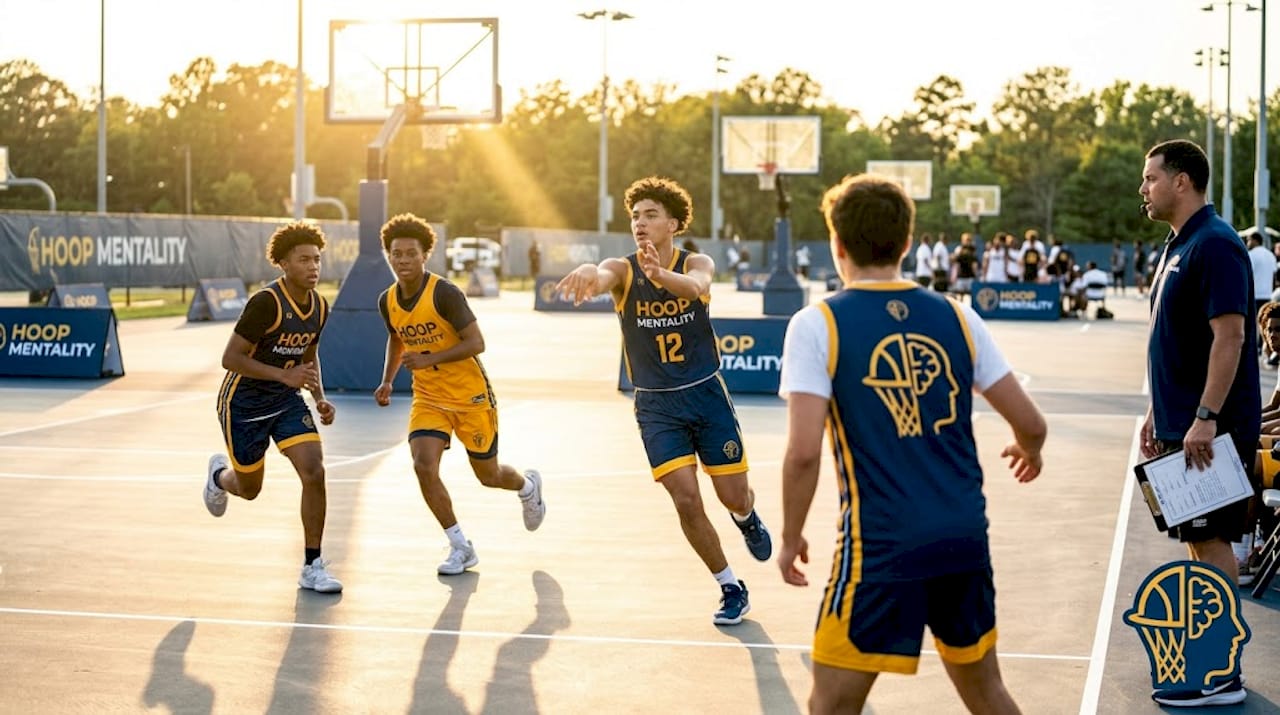
Run and Gun Warmup Drill. This 4-minute drill targets 100 points scored through continuous running, passing, and shooting. It serves two purposes simultaneously: it warms players up physically and reinforces the communication and movement patterns the offense requires. Run it every practice before anything else.
-
3-on-2 to 2-on-1. Three offensive players attack two defenders. The moment the defense secures the ball or forces a stop, two of those defenders immediately become offensive players going the other direction against one of the original three. This drill is relentless. It trains decision-making under fatigue and teaches players to sprint back on defense after they attack.
-
Outlet and Run. Start with a coach or manager under the basket simulating a made shot. The center catches the ball, pivots, and fires an outlet pass to the guard breaking to the sideline. All five players sprint designated lanes to the other end. Repeat without stopping for five reps, then rotate groups.
-
Full Court Weave. Three players weave from baseline to baseline, passing without dribbling. Require a layup to finish. Add a fourth and fifth player and force them to make decisions about when to pull up for the mid-range shot versus attacking the rim.
The common thread through all of these is that fast breaks depend on rebound security, outlet accuracy, and proper lane running. Speed alone does not create good looks. Structure does.
For shooting-specific work within fast-paced contexts, the types of shooting drills that Hoopmentality covers are worth adding to your rotation.
Pro Tip: Track points scored in the Run and Gun Warmup Drill every session and post the numbers publicly. Players respond to visible benchmarks, and the friendly competition sharpens focus before the real practice work begins.
The conditioning component deserves its own emphasis. Your basketball cardio training must specifically mirror game demands — short, explosive bursts with partial recovery, repeated over 32 or 40 minutes. Distance running builds base fitness but does not replicate the specific cardiovascular stress of running this offense.
In-game decision-making at full speed
The biggest mistake players make in run and gun systems is turning pace into panic. Speed is the goal, but not at the cost of good reads. There is a clear decision hierarchy every player needs to internalize before you see it translate on game nights.
The questions every ball-handler should process in the first three seconds of a transition:
- Is there a clear numerical advantage? If yes, attack it immediately.
- Is the defense retreating or set? Retreating defense means push. Set defense means slow and execute.
- Where is the trailer? The trailer often gets the best shot of the possession when the primary break is contested.
- What is the shot clock situation? Early in the shot clock, you have options. Use them wisely.
Robert Horry made a point worth repeating: modern NBA games have more possessions partly due to poor shot selection, not faster or better play. More possessions do not mean better offense. The distinction matters for coaches because your players will confuse activity with effectiveness if you do not define what a good transition shot looks like.
“The outlet pass is the ignition switch of the fast break. Everything that happens after it depends on how quickly and accurately that first pass gets made.” — Transition offense coaching principle
Transition offense requires outlet passing, lane spacing, and unselfish decisions to exploit numerical advantages. Teach your players to read defense, not just run. A guard who automatically attacks a 3-on-2 without scanning where all five defenders are will make bad choices. Scanning has to become a habit at speed.
Understanding transition offense concepts in depth gives you the vocabulary to coach these reads clearly, especially for younger players who need explicit frameworks before the instincts develop.
Physical and mental demands of this style
No style of basketball is more physically punishing than fast-paced basketball sustained across a full season. The conditioning demands are not comparable to playing a half-court, possession-based game.
| Demand | What it requires | How to train it |
|---|---|---|
| Cardiovascular endurance | Sustaining sprint speed in the fourth quarter | Interval sprints, full-court drills without rest |
| Mental focus | Making accurate reads under fatigue | Competitive drills with live consequences |
| Recovery speed | Getting back on defense after attacking | 3-on-2 to 2-on-1 repetitions |
| Communication | Calling out screens, switches, and outlet targets | Verbal cues required during every drill rep |
Peak cardiovascular conditioning is non-negotiable in this system. There are no possessions off, and every player contributes on both ends of every trip. The mental toll is equally significant. Players in high-tempo systems report that concentration fatigue compounds physical fatigue, making late-game execution especially difficult.
The parallel to 3-on-3 basketball is instructive. 3-on-3 formats demand non-stop defensive and offensive activity without natural breaks, replicating what a run and gun system feels like for every player on the floor. Coaches who want to stress-test their players’ conditioning without full 5-on-5 can run extended 3-on-3 sequences as preparation.
Pro Tip: Rotate substitutions in waves of five to preserve pace and avoid individual fatigue from breaking your system. One tired point guard can slow your entire offense.
Pros and cons: is this style right for your team?
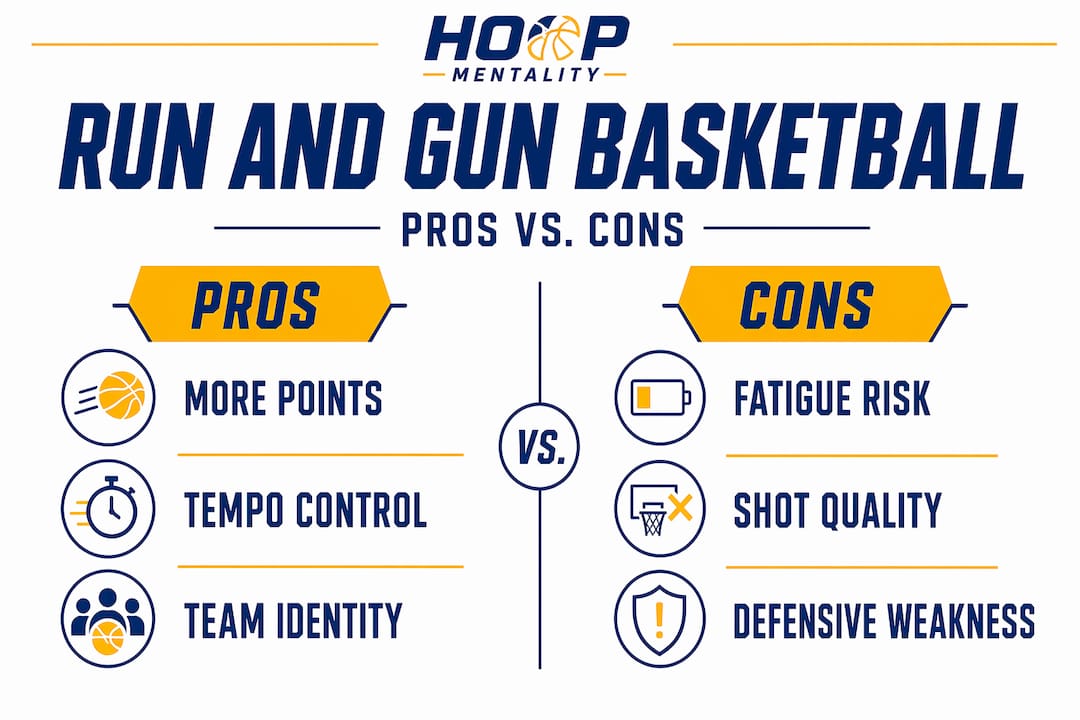
| Factor | Benefit | Risk |
|---|---|---|
| Scoring volume | More attempts generate more points per game | Shot quality drops if pace is forced on bad possessions |
| Momentum | Scoring runs demoralize opponents and energize your team | A defensive breakdown during a run can flip momentum instantly |
| Depth usage | Deep rosters stay engaged and fresh with rotation-heavy play | Thin rosters fatigue faster and make defensive lapses more frequent |
| Opponent conditioning | Faster pace tires less conditioned opponents | Against conditioned teams, the advantage disappears |
| Skill requirements | Skilled players thrive with more touches and freedom | Less skilled rosters risk fatigue and defensive collapse |
The honest assessment: run and gun basketball teams succeed when their roster has athletes who can sustain the pace, a point guard who makes fast decisions without forcing, and forwards comfortable running wide in transition. Rosters lacking depth or skill level undermine sustained fast pace through fatigue and defensive lapses that compound over time.
If your team fits that profile, the benefits of run and gun style are real: high-scoring games, tempo control, and an identity that opponents genuinely struggle to prepare for. If it does not fit, forcing the style creates more problems than it solves.
My honest take on coaching run and gun
I have worked with coaches at multiple levels who came to me convinced that run and gun basketball meant giving players freedom to freelance in transition. That misconception almost always produces the same result: exciting first quarters, collapsing second halves, and a defensive record that gets a coach fired.
What I have learned is that this style is the most disciplined offense in basketball when it is done correctly. Every player has a lane. Every decision has a hierarchy. The outlet pass is choreographed, not improvised. The speed is real, but the structure underneath it is tighter than most half-court sets because there is less margin for error at that pace.
The coaches who implement this well spend more time on decision-making drills than on plays. They watch film of bad transition reads the same way a half-court coach watches film of set-play breakdowns. They condition relentlessly and build depth because they know one tired player changes everything.
My advice: do not try to install this offense in full during preseason. Build it in layers. Run the outlet and warmup drills first. Add the 3-on-2 reads after two weeks. Add the full system in practice games once the habits are automatic. Patience at the start creates speed that holds up in March.
— Dejan
Get your team ready to run

If you are ready to build a true up-tempo system, Hoopmentality has the tools to get there faster. The Big Man Dual Action Drill addresses one of the most overlooked parts of the run and gun offense: keeping your post players active and decisive in fast play, not lagging behind the break. For full practice organization, the Game Preparation Guide with Weekly Practice Plan gives you a structured weekly framework to install your system with clarity. Explore the full Hoopmentality resource library for shooting, conditioning, and transition drills built around real coaching experience.
FAQ
What is run and gun offense in basketball?
Run and gun offense is a fast-paced basketball strategy that prioritizes pushing the ball up the floor quickly after a change of possession, with teams targeting a shot within 7 seconds to attack before defenses can set.
What are the main benefits of run and gun style?
The primary benefits include higher scoring volume, opponent conditioning stress, and momentum-building scoring runs. The style also creates more possessions per game, giving skilled offensive teams more opportunities to score.
Which NBA teams used run and gun basketball successfully?
The Showtime Los Angeles Lakers and Steve Nash’s Phoenix Suns are the most successful examples. Doug Moe’s Denver Nuggets demonstrated both the scoring potential and the defensive trade-offs of the style at an extreme level.
How do you defend against a run and gun team?
Slow the game down by controlling rebounds, avoiding turnovers, and taking time off the shot clock on offense. Denying the outlet pass and setting early transition defense are the most direct ways to neutralize pace.
What drills best prepare players for run and gun basketball?
The Run and Gun Warmup Drill, 3-on-2 to 2-on-1 sequences, and Full Court Weave drills are the most effective. These train the outlet passing, lane spacing, and quick decision-making that the style requires at game speed.