

Remote team building for basketball works best as three things done together: short, basketball-specific virtual drills, a copyable virtual practice plan, and an anonymous feedback loop. Run two remote drills this week, send a short anonymous evaluation to your roster, and loop in your captains and assistants to keep it moving. Hoop Mentality builds the templates so you don’t have to start from a blank page.
TL;DR:
- Running two live drills focused on communication and problem-solving, along with asynchronous video challenges and check-ins, keeps remote players engaged and accountable.
- A 60-minute remote practice plan should include a check-in, skill work, tactical breakout, and feedback, with adjustments for youth, high school, or pro levels.
- Anonymous written feedback uncovers team issues better than live discussions, especially when limited to short surveys with specific questions.
- Tracking simple metrics like completion rates, attempts, tactical success, and attendance provides enough insight to measure progress without overcomplication.
- Using structured templates for drills and evaluations cuts preparation time and ensures consistency across weekly remote sessions.
Table of Contents
- Five Remote Team Building Drills You Can Run This Week
- A Virtual Practice Plan Template You Can Copy Today
- Getting Honest Feedback Without a Locker Room
- Tracking Progress With Remote Challenges
- Your One-Week Implementation Checklist
- Strategies for Fostering Trust and Rapport in Remote Teams
- Techniques to Encourage Active Participation and Engagement
- Handling Time Zones, Communication Gaps, and Other Remote Headaches
- Icebreakers and Energizers Built for Video Calls
- Why Hoop Mentality Builds Remote Templates This Way
- Get the Templates That Match This Guide
- Sources
- FAQ
Five Remote Team Building Drills You Can Run This Week
Remote team building drills work when they mirror what already happens in the gym: communication under pressure, film study, and accountability between teammates. These five fit inside a single video call or run asynchronously, which matters when players are scattered across time zones or juggling school schedules.
- Read-and-react communication drill. Split the roster into breakout rooms of three or four. Give each group a scenario (ball reversal, closeout, help defense) and have them talk through the correct read out loud, no diagrams. Objective: verbal communication under simulated pressure. Time: 10 minutes, two rounds.
- Video skill challenge. Assign a shooting form or ball-handling series and have players submit a 30 to 60 second clip. Score against a simple three-point rubric (footwork, balance, follow-through) so grading stays consistent across the roster.
- Small-group tactical problem-solving. Present a game situation (down two, 14 seconds left) and let breakout groups sketch a solution on a shared whiteboard. This is where breakout-room small groups with assigned roles earn their keep. A recorder and a presenter in each group keeps everyone talking instead of one player dominating.
- Pair accountability check-ins. Partner players up for daily micro-goals (ball-handling reps, free throws made) and a two-minute text or voice check-in. Low effort, high consistency.
- Team film micro-sessions. Players tag one clip of their own play each week and submit it to a shared folder. Cap discussion at 15 minutes so it stays a conversation, not a lecture.
Pro Tip: Run drills 1 and 3 live, and let drills 2 and 4 run asynchronously. Splitting synchronous coaching moments from async submissions means players in different time zones still get full credit for participation.
For more drill variations, Hoop Mentality’s team building activities ideas for basketball coaches offers additional swaps if your roster needs fresh material after a few weeks.
A Virtual Practice Plan Template You Can Copy Today
A remote practice session needs the same bones as a gym session, just compressed. Here’s a 60 minute skeleton you can paste directly into your scheduling doc and adjust by age group.
- Check-in (5 minutes): Quick roll call, one word on how everyone’s feeling.
- Warm-up talk (5 minutes): Coach reviews the day’s focus and expected outcome.
- Skill block (15 minutes): Assign the video skill challenge from the drills above; players work independently on camera.
- Tactical small groups (15 minutes): Breakout rooms tackle a scenario using the read-and-react or problem-solving drill.
- Film feedback (10 minutes): Review one or two tagged clips as a group.
- Challenge assignment (5 minutes): Set the week’s async video challenge and deadline.
- Close (5 minutes): Captain recap, next session reminder.
Level adjustments matter here. Youth teams should shorten the tactical block and lean harder on the skill portion. High school and college teams can stretch film feedback to 15 minutes since players are more used to breaking down tape. Pro-level remote sessions often skip the warm-up talk entirely and move straight into film, since players already know the terminology.
Use a shared doc to assign captains as breakout-room leads and to log scores from the skill challenges. That single doc becomes your running record of who showed up and who’s improving, which saves you from digging through texts later. Hoop Mentality’s Basketball Practice Plan Template is built around this exact structure, already formatted so you just fill in the day’s focus.
Getting Honest Feedback Without a Locker Room
Anonymous written evaluations reveal team dynamics that a group video call never will. Players who won’t say something critical out loud in front of ten teammates will write it down if the form is genuinely anonymous. Coaching practices around post-season reflection consistently point to written evaluations as the way to surface real issues before they fester.
A short survey works better than a long one. Try this format:
- Three Likert-scale items (1 to 5): “I feel comfortable speaking up in team settings,” “I understand my role on this team,” “Practices feel productive to me.”
- One open-ended question: “What’s one thing that would make this team better?”
- One optional line: “Check this box if you’d like a private follow-up conversation.”
Facilitation matters as much as the form itself. Coaching guidance on protecting mental health recommends keeping the bulk of your session focused on teaching rather than praise or correction, an 85/15 split that keeps the tone constructive instead of evaluative. Set a hard time limit on team meetings, ask trigger questions instead of yes/no ones, and enforce a no instant reaction rule when someone shares something critical.
Pro Tip: Send the survey before the meeting, not during it. Reading responses ahead of time lets you address patterns instead of getting blindsided live.
Hoop Mentality’s player feedback methods guide has ready-made evaluation templates if you want a starting point beyond the four questions above.
Tracking Progress With Remote Challenges
Weekly video challenges only work if you’re actually measuring something. Pick a skill (free throws, ball-handling combo, defensive slide footwork), set a submission deadline, and judge against a rubric with three criteria maximum, otherwise scoring becomes a bottleneck.
Track a handful of simple metrics instead of overbuilding a dashboard:
- Completion rate: percentage of the roster that submitted by deadline.
- Attempts logged: how many reps a player put in during the week.
- Decision-making success: ranked outcomes from the tactical breakout drills.
- Session attendance: who showed up live versus who caught the recording.
Virtual challenges and weekly check-ins are proven levers for building trust and cohesion when a team can’t get in the same gym. Display results as a simple leaderboard for effort metrics like attempts and completion, but keep tactical scoring in private notes. Public leaderboards motivate reps; public tactical grades tend to embarrass the players who need the most help.
Reward effort, not just talent. A player who submits every single week and improves incrementally deserves recognition even if their raw numbers trail a more gifted teammate.
Your One-Week Implementation Checklist
Before you launch anything, lock down the basics so players aren’t confused about where to submit or when to show up.
- Platform: pick one video tool and stick with it for the season.
- Upload folder: one shared folder, organized by week, with a consistent file-naming convention (player name, drill, date) so review doesn’t turn into a scavenger hunt.
- Roles: name a captain to lead breakout rooms and a tech-savvy assistant or player to handle upload troubleshooting.
- Cadence: two live sessions, one async challenge, one film micro-session per week.
A sample week: Monday live session (skill block plus tactical breakout), Wednesday async video challenge due, Friday live session (film feedback plus challenge assignment), Sunday film micro-session with tagged clips. Youth teams can drop to one live session and one challenge per week; college and pro programs often add a second film session since players already have more tape to review.
Strategies for Fostering Trust and Rapport in Remote Teams
Trust erodes fastest when players go quiet, and remote settings make quiet the default unless a coach actively fights it. The single most reliable lever is consistency: a weekly check-in where players share a high and a low from their week, run at the same time every week, does more for trust than any elaborate one-off activity. Predictability signals that the coach still cares even when the team isn’t physically together.
Intentional relationship-building, not just skill instruction, is what separates programs that hold cohesion together remotely from ones that drift. Program evaluations of club-level coaching consistently find that coaches who deliberately design relationship-building moments see stronger engagement and better social outcomes among players than coaches who treat team bonding as an afterthought.
Small gestures carry more weight remotely than they would in person. A coach who remembers to ask about a player’s game the night before, or who calls out a specific improvement from a submitted clip by name, builds more rapport than a generic “great work, team” message. Pair up players who don’t already know each other well for the accountability check-ins mentioned earlier. Rotating those pairs every few weeks widens the web of relationships across the roster instead of letting the same cliques reinforce themselves.
Trust also comes from transparency about expectations. Tell players exactly how remote participation factors into their standing on the team, so nobody is guessing whether showing up to a video call actually matters.
Techniques to Encourage Active Participation and Engagement
Getting players to actually show up with cameras on and mouths open takes more than a calendar invite. Breakout rooms with assigned roles, recorder and presenter, solve the single biggest engagement killer in virtual sessions: one player talking while everyone else stares at a muted screen. When every player has a job in the room, silence isn’t an option.
Keep segments short. Attention spans on video drop fast, and a 15 minute tactical breakout beats a 40 minute lecture every time. If you need to cover more ground, split it across two sessions rather than stretching one.
Give players ownership over part of the content. Letting a player pick the clip for film review, or letting captains run the warm-up talk, shifts the session from something that happens to them into something they’re building. Rotate this responsibility so it doesn’t fall on the same two or three players every week.
Recognition matters more in a remote setting than people expect. A player who submits a strong video challenge and gets specific, public praise from the coach is far more likely to submit again the following week. Silence after a submission reads as indifference, even when the coach genuinely liked what they saw.

Finally, make the asynchronous option genuinely equal to the live one. A player who can’t make the live session because of a time zone conflict or a family obligation shouldn’t feel like a second-class participant. Score their submission the same way, name them in the same recap.
Handling Time Zones, Communication Gaps, and Other Remote Headaches
Time zones are the most common practical obstacle, and the fix is structural, not motivational. Designing every drill with both a synchronous coaching moment and an asynchronous submission option means no player is locked out just because practice falls at 7 p.m. on the coast where they don’t live. Set challenge deadlines in a rolling 48 hour window rather than a fixed clock time whenever possible.
Communication gaps usually come from too many channels, not too few. If players are getting instructions through a group text, a team app, and email at the same time, something gets missed. Pick one primary channel for logistics and stick to it for the entire season. A platform like Athlo can centralize schedules, video submissions, and team messaging in one place, which cuts down on the “I didn’t see that” excuse considerably.
Uneven tech access is a real barrier, especially for youth programs. Not every player has a stable connection or a quiet space for a video call. Build in a low-bandwidth option, a text-based check-in or a voice-only call, for players who can’t reliably join video sessions.
Motivation dips are common by week four or five of any remote stretch. This is where the weekly challenge format and visible leaderboard from earlier really justify themselves; players who see incremental progress logged over time stay more engaged than players getting generic encouragement with no data behind it. When a player disengages entirely, a private one-on-one message from the coach, not a public callout, is almost always the right first move.
Icebreakers and Energizers Built for Video Calls
A good remote icebreaker gets players talking within the first two minutes, before the session ever gets to basketball. “High and low of the week” works as a standing opener because it’s fast, personal, and doesn’t require any prep from the coach. Give each player 20 seconds so the whole roster gets through it without eating into practice time.
“Two truths and a lie, basketball edition” is a solid warm-up for a first remote session with a new roster. Each player states two true facts and one false one about their game (favorite move, best game memory, worst shooting slump) and teammates guess the lie. It works especially well early in a season when players don’t know each other yet.
For a quick energizer mid-session, try a rapid-fire “name that play” using clips pulled from film. Show a five-second clip, mute it, and have players shout out what defense or set they’re watching. It resets attention after a long tactical breakout without requiring anyone to stand up.
A “captain’s challenge” energizer works well right before the film feedback block. The captain picks a quick, low-stakes question, best current NBA matchup, favorite pregame ritual, and everyone answers in the chat while the coach pulls up the next clip. It costs zero prep time and keeps the room loose heading into a more serious part of the session.
Why Hoop Mentality Builds Remote Templates This Way
Hoop Mentality’s goal with every remote resource is simple: cut prep time, sharpen communication with players, and give coaches a structure they can trust without reinventing it every week. Editable practice-plan templates exist because coaches told us the biggest barrier to running consistent virtual sessions wasn’t ideas, it was the hours spent formatting a plan from scratch every Sunday night. A template that’s already built means that time goes back into actually coaching.
— Dejan
Get the Templates That Match This Guide
Every drill and template in this guide has a matching download built for exactly that job. Need a virtual session structure without building one from scratch? The Basketball Practice Plan Template mirrors the skeleton above, already formatted and editable. Running film review remotely? The Editable Scouting Report Template and Basketball Scouting Report Template turn tagged clips into structured breakdowns your players can actually use. Assigning video skill challenges every week? Skill Improving Infinite Loop Drills gives you a ready-made drill pack for exactly that.
Each resource is an instant-download PDF, no waiting on shipping, no rebuilding a document you’ve already seen a hundred versions of online.
- Editable PDF format, adjustable for any age group or level.
- Immediate download after checkout, ready for tonight’s practice.
- Built to cut planning time down to minutes, not hours.
If you’re setting up a remote program from the ground up, the Basketball Starter Pack For Coaches bundles the essentials into one purchase, or check the Basketball Template Bundle For Coaches for the full set of editable planning and evaluation documents. Preview the practice plan template now and have your first virtual session mapped out before your next scheduled call.
Sources
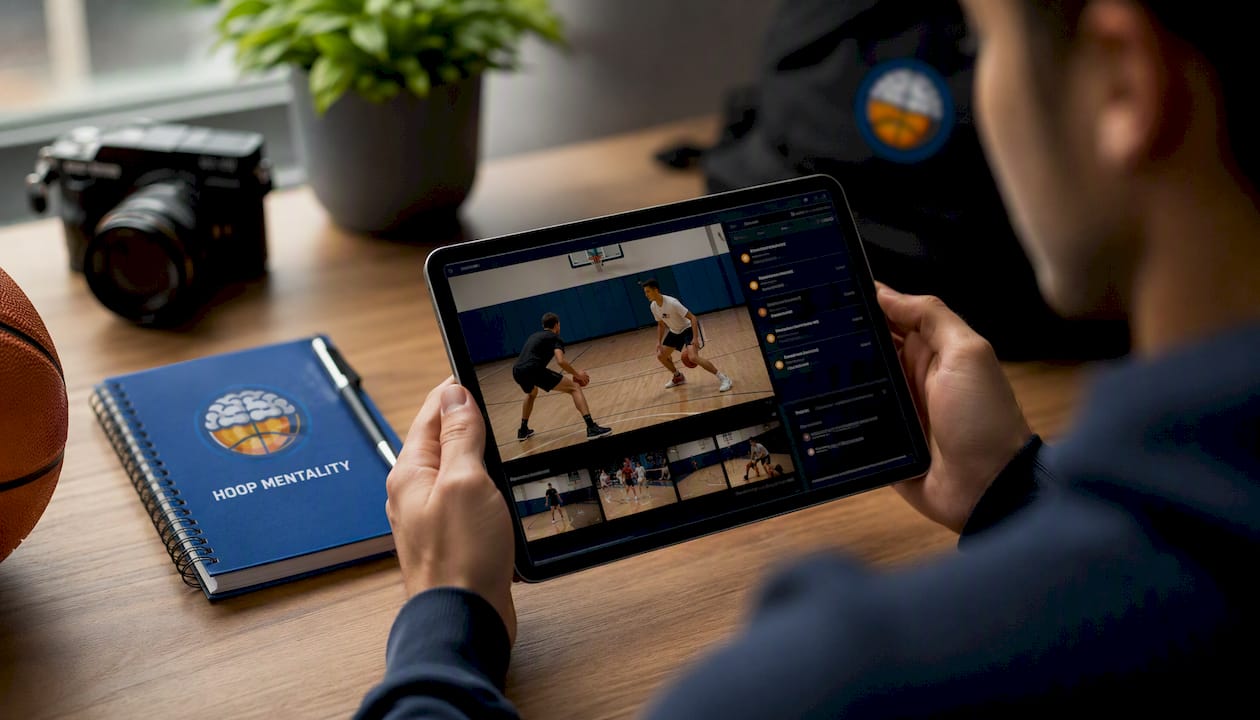
These are the resources referenced throughout this guide, plus a few more worth bookmarking.
- Tips and Guidelines for Communication and Teaching Methodology to Protect Mental Health – Coaches Insider
- Pre-Season Basketball Trust Building Exercises and Fun – BasketballTrainer
- Coaching for development (Walker / Blaze case study)
FAQ
What Is Remote Team Building for Basketball?
It’s the combination of short virtual drills, a structured virtual practice plan, and anonymous player feedback used to maintain cohesion and communication when a team can’t practice together in person.
How Long Should a Virtual Practice Session Run?
Sixty minutes works for most levels, broken into a check-in, skill block, tactical breakout, film feedback, and challenge assignment as outlined in the practice plan template above.
How Often Should Coaches Collect Player Feedback Remotely?
A short anonymous survey every one to two weeks, paired with a weekly check-in, catches problems early without overwhelming players with forms.
What Metrics Actually Matter for Remote Challenges?
Completion rate, attempts logged, ranked decision-making success from tactical drills, and session attendance give a coach enough signal without building an overcomplicated tracking system.
Can Youth Teams Use the Same Remote Drills as High School or College Teams?
Yes, with shorter tactical blocks and a heavier focus on the skill portion. Hoop Mentality’s templates are built to be adjusted by age group without a full rebuild.