

TL;DR:
- Off-ball movement involves purposeful movement by players without the ball to create scoring chances and disrupt defenses. It is the main factor behind offensive efficiency, with cutting actions producing more points per possession than isolation plays. Coaches should emphasize habits like quick cuts, screens, and spacing to improve team performance and generate higher-quality shots.
Off-ball movement is defined as the intentional, purposeful movement of players who do not have the basketball, designed to create scoring opportunities and disrupt defensive structure. With NBA players possessing the ball on only 30–40% of possessions, what you do without the ball determines your value on offense far more than what you do with it. Off-ball movement explained properly covers cutting, screening, relocating, and spacing. Together, these techniques force defenders into constant decisions and open lanes that static players never see.
What is off-ball movement and why does it matter?
Off-ball movement is the foundation of every effective basketball offense. The term refers to any deliberate action taken by a player who does not control the ball: a cut toward the basket, a curl off a screen, a relocation to a new spot after passing. The industry standard term for this concept is “off-ball action,” and coaches at every level use it to describe the full range of movements that keep a defense working.
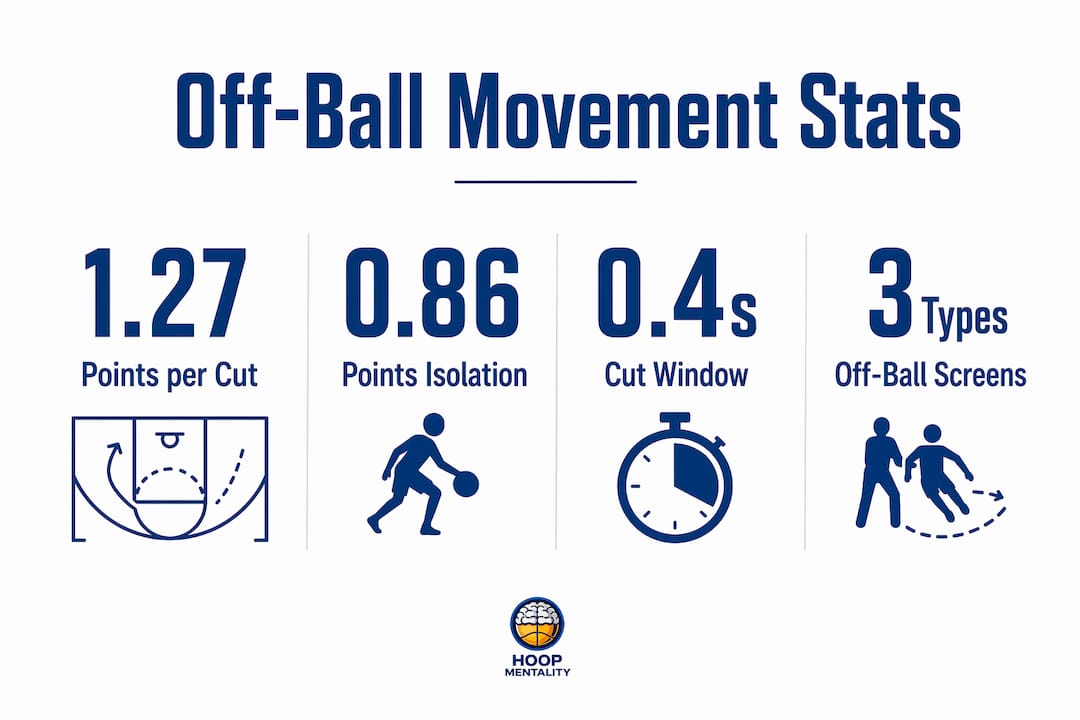
The numbers make the case clearly. Cutting actions yield 1.27 points per possession compared to just 0.86 for isolation plays. That gap means a team that moves well without the ball scores more efficiently than a team that relies on one-on-one creation. Off-ball movement is not a secondary skill. It is the primary driver of offensive efficiency for most teams.
Understanding off-ball play also changes how coaches evaluate players. A player who relocates after every pass, sets a hard screen, and reads the defense without the ball is far more valuable than a player who only performs when holding it. Coaches who teach ball movement alongside off-ball habits build offenses that are genuinely hard to guard.
How does off-ball cutting create scoring opportunities?
Cutting is the most direct form of off-ball movement. A cut is a sharp, decisive change of direction toward the basket or an open area, timed to exploit a moment when the defender’s attention shifts. The six core cut types are the baseline cut, the 45-degree cut, the backdoor cut, the V-cut, the L-cut, and the flash cut. Each serves a specific purpose depending on where the ball is and how the defender is positioned.
The timing of a cut is everything. The window for a successful cut is approximately 0.4 seconds. That is the brief moment when a defender’s eyes move to the ball or a screen, leaving the cutter temporarily open. Miss that window and the defender recovers. Hit it and you get a layup or a short catch-and-finish.
Elite players do not simply run their cuts. Setup moves are essential for effective cuts and screens. Walking a defender to a specific spot, changing pace, or faking in one direction before cutting in another creates the separation needed to receive the pass. A cut without a setup is easy to defend.
Here are the six primary cut types and when to use each:
- Baseline cut: Used when the defender overplays the high side; the cutter dips below and attacks the basket from the baseline.
- 45-degree cut: A direct cut from the wing toward the elbow or mid-post area to receive a pass in a scoring position.
- Backdoor cut: Used when the defender denies aggressively; the cutter reverses direction toward the basket behind the defender.
- V-cut: A two-step move where the player drives toward the basket, then plants and cuts back to the ball to receive a pass at the wing or elbow.
- L-cut: A cut that changes direction at a 90-degree angle, typically used by post players to get open on the block.
- Flash cut: A cut from the weak side to the high post or elbow, used to receive a pass and create a new ball-side action.
Pro Tip: Watch the defender’s eyes, not their feet. When their eyes go to the ball handler, that is your 0.4-second window. Go immediately.
How do screens and spacing work in off-ball strategy?
Screens and spacing are the structural backbone of off-ball positioning in basketball. A screen is a legal block set by an offensive player to free a teammate from their defender. Spacing refers to how players distribute themselves across the floor to stretch the defense and create passing lanes.
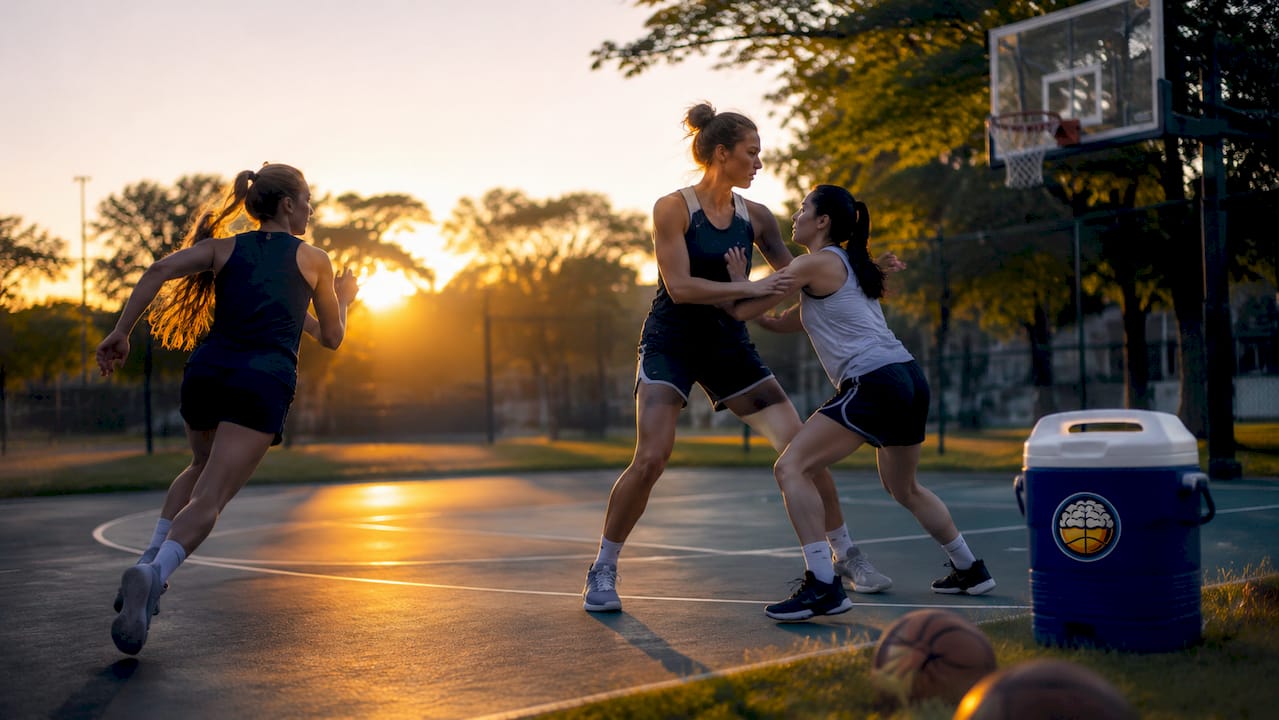
Pin-down, flare, and zipper screens are the most common and effective off-ball screens in NBA offenses. Each type targets a different defensive reaction. A pin-down screen is set below the ball to free a shooter coming up toward the perimeter. A flare screen pushes the cutter away from the ball toward the corner, used when the defender cheats toward the expected curl. A zipper screen is set near the lane line and sends the cutter straight up the floor to the wing or top of the key.
The ball screen and back screen complete the core screen vocabulary. A ball screen is set directly on the ball handler’s defender. A back screen is set on a player’s back, sending them toward the basket for a lob or layup. Each screen type demands a different read from the cutter and a different response from the defense.
Spacing is what makes screens work. When off-ball players spread the floor correctly, one defender cannot help on a screen without leaving an open shooter. Relocating after a pass is the most underused spacing habit. Players who stand still after passing allow their defenders to sag and help. Players who relocate immediately force their defenders to follow, which opens new passing angles.
Pro Tip: After setting a screen, do not stand and watch. Roll to the basket, pop to the perimeter, or relocate to the corner. The screener is often the most open player on the floor.
How do you build off-ball movement into a team habit?
Off-ball movement is primarily a habit, not a physical skill. Conditioning helps, but the real barrier is mental. Players default to standing still after passing because it requires no effort. Breaking that default requires deliberate repetition in every practice until movement becomes automatic.
The core habit rule is simple: never stand still after a pass. Every pass must trigger an immediate action. That action can be a cut, a screen, a relocation, or a spacing adjustment. The specific action matters less than the commitment to moving. Active off-ball movement forces the defense to continually adjust, which creates passing lanes and open shots that a static offense never generates.
Coaches who want to build this habit should structure practice around these four progressions:
- Pass and cut: Every player who passes must immediately cut to the basket or relocate. Run this rule in every drill, not just dedicated cutting drills.
- Spacing and rotation: After each pass, all off-ball players shift one position to maintain floor balance. This teaches players to read the ball and move in response.
- Screen and read: Players set a screen, then read the defender’s reaction to decide whether to roll, pop, or relocate. This builds decision-making alongside movement.
- Continuous motion: Run five-on-zero motion offense for five minutes at the start of practice. No defense means players focus entirely on movement patterns and spacing.
Pro Tip: Use a simple verbal cue during drills: “Pass, move.” Say it every time a player holds the ball after passing. Within two weeks, players will self-correct before you say it.
Habit-building through basketball habits coaching produces a compounding effect. Players who move well without the ball force defenders into constant decisions. Those decisions create mistakes. Those mistakes become open shots and layups.
Practical off-ball movement drills for coaches and players
Drills are where habits get built. Pass-and-cut and spacing drills are the most effective methods for embedding off-ball movement into a team’s muscle memory. The key is repetition with purpose: every drill rep should reinforce the habit of moving immediately after the ball leaves your hands.
Here are five drills that directly develop off-ball skills:
- 3-man weave with cut: After the final pass for a layup, the passer cuts hard to the basket instead of stopping. The receiver must read the cut and decide to pass or finish. This trains timing and decision-making simultaneously.
- V-cut shooting drill: A player starts at the block, drives toward the basket, plants, and cuts back to the wing to receive a pass for a catch-and-shoot. Repeat from both sides. Focus on sharp footwork and hands ready in the shot pocket.
- Pin-down screen drill: A screener sets a pin-down for a shooter coming off the screen to the wing. The shooter reads the defender and either curls, fades, or pops. The screener rolls or pops after contact.
- Relocation shooting: After every made or missed shot in a shooting drill, the shooter relocates to a new spot before the next rep. This builds the habit of moving after every action, not just after passes.
- 5-on-0 motion offense: Run your base motion offense with no defense for five minutes. Players focus entirely on spacing, cutting, and screening without the pressure of a defender. Add defense progressively as habits solidify.
Shot preparation is a detail most players overlook. Keeping hands in the shot pocket during off-ball movement reduces shot release time by 0.1–0.2 seconds. That fraction of a second is the difference between a clean catch-and-shoot and a contested one. Teach players to carry their hands high and ready throughout every cut and relocation.
To measure off-ball effectiveness in practice, track two simple metrics: how often players stand still after passing, and how many cuts result in a catch within the paint. Both numbers improve quickly when drills are run with consistent cues and accountability.
Key Takeaways
Off-ball movement is the single most undercoached skill in basketball offense, and teams that master it consistently generate higher-percentage shots than teams that rely on isolation play.
| Point | Details |
|---|---|
| Cutting efficiency | Cuts yield 1.27 points per possession versus 0.86 for isolation plays. |
| Timing is critical | The window for a successful cut is approximately 0.4 seconds after a defender’s attention shifts. |
| Screens need setups | Walking a defender before cutting or screening is what creates the separation to get open. |
| Habit over conditioning | Off-ball movement improves through deliberate repetition, not physical training alone. |
| Shot pocket readiness | Keeping hands ready during movement cuts shot release time by up to 0.2 seconds. |
Why off-ball movement is the skill most coaches underteach
I have watched hundreds of practice sessions where coaches spend 80% of their time on ball-handling, shooting, and one-on-one defense. The players who do not have the ball during those drills are standing around, waiting. That is where most offenses fall apart.
The mistake I see most often is treating off-ball movement as a system problem. Coaches think they need a new play or a new offense. What they actually need is to fix what players do between plays. A player who stands still after passing is not a system problem. It is a habit problem. And habit problems are solved in practice, not on a whiteboard.
The mindset shift that changes everything is this: the pass is not the end of your action. It is the beginning of your next one. Once players internalize that idea, the offense becomes fluid without any new plays being drawn up. Defenders cannot rest. Help rotations break down. Open shots appear.
I also think coaches underestimate how much off-ball movement affects team chemistry. When every player moves with purpose, the ball moves faster, trust builds, and players stop hunting their own shot. The motion offense becomes a shared language rather than a set of rules. That is when a team starts playing together instead of alongside each other.
— Dejan
Hoop Mentality resources for off-ball movement training
Coaches who want to build off-ball movement into their practice structure need more than drills. They need organized systems that save time and keep players progressing.
Hoop Mentality’s Basketball Template Bundle for Coaches includes practice plan templates, drill progressions, and strategy guides built around real coaching experience. The bundle covers off-ball movement habits, cutting sequences, screening actions, and spacing principles in formats you can use immediately. For coaches focused on shooting off screens and catch-and-shoot situations, the Basketball Shooting Bundle adds shot preparation drills that pair directly with off-ball movement training. Both resources are ready to use and built for coaches at every level.
FAQ
What is off-ball movement in basketball?
Off-ball movement is any deliberate action taken by a player who does not have the ball, including cuts, screens, relocations, and spacing adjustments. Its purpose is to create open shots and disrupt defensive structure.
Why do cuts score more efficiently than isolation plays?
Cutting actions yield 1.27 points per possession compared to 0.86 for isolation plays because cuts attack the basket before the defense can set. The advantage comes from timing and positioning, not individual skill.
How long is the window to make a successful cut?
The window for a successful cut is approximately 0.4 seconds. That is the brief moment when a defender’s attention shifts to the ball or a screen, leaving the cutter temporarily open.
What are the most effective off-ball movement drills?
Pass-and-cut drills, V-cut shooting drills, and pin-down screen drills are the most effective for building off-ball habits. Running five-on-zero motion offense at the start of practice reinforces spacing and cutting patterns without defensive pressure.
How does shot pocket positioning improve off-ball play?
Keeping hands in the shot pocket during off-ball movement reduces shot release time by 0.1–0.2 seconds. That reduction makes catch-and-shoot attempts faster and harder for defenders to contest.