

TL;DR:
- Off-ball screens are strategic tools that manipulate defensive positioning, creating open shots and forcing rotations. Proper spacing, timing, and immediate after-contact actions are essential for effective execution and offensive flow. Coaches should focus on teaching the purpose, reads, and second actions to maximize their tactical benefit.
Most coaches treat off-ball screens as secondary actions, something to keep players moving while the ball handler works. That framing undersells one of the most tactically rich tools in basketball offense. The role of off-ball screens goes well beyond setting a pick. Done correctly, these actions manipulate defensive positioning, create high-percentage looks for shooters and cutters, and force defenses into decisions they cannot win. This guide breaks down the mechanics, timing, spacing principles, and real-game applications that separate a good screen from a great one.
Table of Contents
- Key takeaways
- The role of off-ball screens: types and core functions
- Spacing and strategic impact
- Executing off-ball screens correctly
- Off-ball screen examples in game situations
- My take on what coaches consistently miss
- Build your off-ball screen system with Hoopmentality
- FAQ
Key takeaways
| Point | Details |
|---|---|
| Off-ball screens are strategic tools | They manipulate defensive positioning and force help rotations, not just clear a path for one player. |
| Spacing is a measurable variable | Optimal spacing of 12 to 15 feet between players makes off-ball screens significantly harder to guard. |
| Timing beats screen type | Synchronization between screener and receiver matters more than which specific screen action you run. |
| Screeners must stay active | Rolling, popping, or relocating after setting a screen keeps the offense flowing and creates second-side threats. |
| Film study accelerates improvement | Labeling foot placement and timing in video review helps coaches identify and fix synchronization failures faster. |
The role of off-ball screens: types and core functions
An off-ball screen happens away from the ball. The screener sets a legal body barrier against a defender to free a teammate who does not have possession. That teammate, often called the cutter or receiver, uses the screen to gain separation for a catch, a shot, or a drive.
This is different from an on-ball screen, where the screener targets the ball handler’s defender directly. Off-ball screens work on the weakside or in the mid-post area, often while the primary action unfolds elsewhere on the floor. Defense must divide attention, and that division is the whole point.
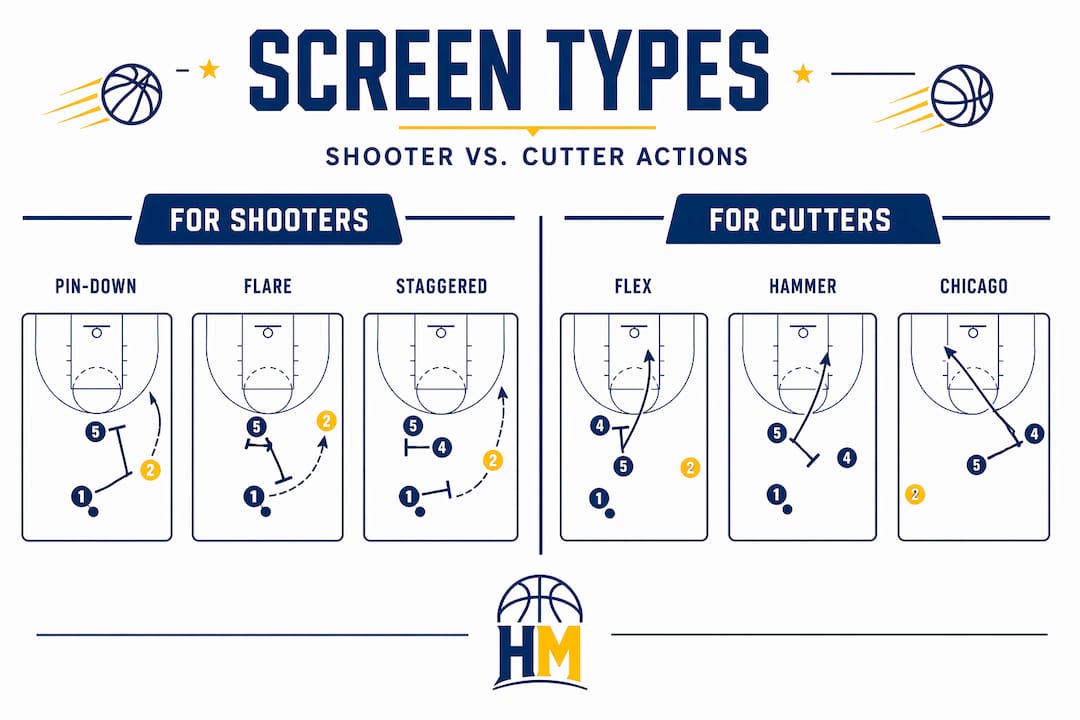
The common types of off-ball screens your team needs to know:
- Pin-down screen: Set below the three-point line, freeing a wing shooter to curl or fade to the arc. This is one of the most common setups for creating catch-and-shoot threes.
- Flare screen: The receiver cuts away from the basket toward the corner or wing. Useful against aggressive defenders who trail receivers through cuts.
- Hammer action: A back-screen variation where a player cuts to the weakside corner off a screen, often right as the ball swings. Timing with ball movement is critical here.
- Chicago action: A layered action combining an off-ball screen with a ball screen to create multiple reads and overload the defense.
Off-ball screens create separation for shooters and cutters in every one of these scenarios. The goal is always a quality shot or an advantageous catch position.
Pro Tip: Teach your receivers to read their defender before the screen arrives. A defender leaning to the top side is begging for a backdoor cut. A defender sagging invites the receiver to curl hard off the screen into a mid-range or at-rim finish.
Spacing and strategic impact
Off-ball screening does not work in a crowded halfcourt. The floor must be spaced correctly for screens to generate real advantages. Spacing of 12 to 15 feet between players prevents easy defensive help and gives receivers room to operate after they clear the screen.
Think of spacing as geometry. When players are too close together, the defense can cover two threats with one body. When spacing is correct, a single defensive rotation leaves someone open. Off-ball screens function as the trigger that forces that rotation.
Here is how screens manipulate defensive positioning at a tactical level:
| Screen action | Defensive problem created | Offensive read |
|---|---|---|
| Pin-down for a shooter | Defender must fight over or go under | Catch-and-shoot three or curl to mid-range |
| Flare screen in corner | Defender trailing gets sealed on wrong side | Open corner three or skip pass opportunity |
| Hammer action | Help defense must rotate to cover cutter | Dump-off to rolling big or kick to opposite wing |
| Chicago action | Ball handler and cutter both threaten | Ball handler attacks downhill or fires to cutter |
The table above captures why off-ball screening is strategic manipulation, not just physical disruption. Every screen puts a question to the defense, and the offense reads the answer.
After a screen is set, the play does not stop. Screeners must roll, pop, or relocate immediately. A screener who stands still after contact becomes a liability, giving the defense a stationary landmark to organize around. A screener who pops to the three-point line or rolls to the rim becomes a second read, often the better one.
Pro Tip: Build “screen and second action” into your practice reps from day one. The screener’s move after contact is just as important to drill as the initial foot placement.
Executing off-ball screens correctly
Most off-ball screens fail not because players lack effort but because they lack precision. The details are small and punishing when ignored.
Here is the execution sequence your players need to internalize:
- Set your feet before contact. The screener must be stationary before the defender makes contact. Moving into a defender at contact is a foul. Great screeners live on that legal boundary, maximizing contact without crossing it.
- Use a wide base. Feet wider than shoulder-width give the screener more surface area. A narrow base gets blown through by a physical defender, and the screen disappears.
- Arrive before the cutter moves. If the receiver cuts before the screener is set, the defender walks right through the gap. Timing between screener and receiver is the single biggest predictor of whether a screen works.
- Read the coverage. Defenders can drop, hedge, switch, or blitz. Adapting screen technique to defensive coverage separates a good screener from an elite one. Against a switch, the screener seals the new defender immediately. Against a drop, the receiver curls aggressively.
- Communicate before the action. Screener and receiver should have a quick signal. A raised fist, a verbal call, a specific cut angle. Anything that confirms both players are reading the same cue from the defense.
- Protect your hands and face. Arms crossed over the chest, hands on shoulders or forearms. This keeps the action legal and protects the screener from a defender’s elbow.
Coaches can use video labeling to find the exact frame where synchronization breaks down. Mark the screener’s foot plant and the cutter’s departure separately. If the cutter leaves before the plant, you have found the problem without guessing.
Off-ball screen examples in game situations
Watching how elite teams apply off-ball screens at scale shows you what’s actually worth teaching. The concepts are not abstract once you attach them to real game footage.
The Toronto Raptors run a flex-to-pin-down combination that consistently generates open above-the-break threes against overloaded defenses. The action works because the flex screen forces the first defender into a chase, and the subsequent pin-down catches that defender out of position as the ball swings. The receiver gets a clean catch at the arc before the defense can recover.
At the high school level, the benefits of off-ball screens show up just as clearly. Wooster’s girls basketball team used repeated pin-down actions in the fourth quarter of an OHSAA tournament game to generate quick catch-and-shoot opportunities that fueled a decisive scoring run. The execution was not flashy, but it was precise and purposeful.
Here are practical ways to integrate these actions into your own program:
- Run pin-downs out of a set play after timeouts. Your best shooter gets a clean look in the first few seconds after inbounds, before the defense can set up its preferred coverage.
- Use flare screens on the weakside when your point guard attacks. The corner player’s defender will be tempted to help on the drive. A flare screen seals that defender and creates an open corner three on the kick-out.
- Stack Chicago actions into transition. As your team pushes the pace, a quick off-ball screen in the frontcourt can turn a disrupted half-court set into an open mid-range shot before the defense organizes.
- Practice the catch, not just the screen. Receivers need reps reading the screen, catching cleanly in balance, and shooting or driving immediately. The screen only matters if the receiver finishes the action.
Understanding ball screen offense for youth teams alongside these off-ball actions gives you a complete picture of how screens work together across the whole offense. The two systems reinforce each other and create problems a defense cannot solve with one adjustment.
Off-ball movement as spacing geometry is the framework that ties all of this together. Screens are not isolated events. They are timed, coordinated actions that move defenders and open receivers as part of a continuous offensive structure.
My take on what coaches consistently miss
I’ve spent years watching coaches drill screens and still lose the benefit of them in games. The problem is almost never physical. It’s conceptual.
Most players understand that they are supposed to set a screen. What they don’t understand is why the action works and what their job is the moment after contact. I’ve seen teams run perfect pin-down geometry in practice and then watch the screener stand flat-footed in a game because no one ever drilled the second action. The screen created a look, but the offense stalled because the screener stopped being a threat.
The other thing I’ve noticed is that coaches often teach screen types without teaching defensive coverage reads. You cannot run a flare screen effectively if your receiver does not know the difference between a trailing defender and a switching one. Teaching the action without teaching the read is half a lesson.
My advice: build your off-ball movement principles around the concept of spacing geometry first. Show players the floor from a bird’s-eye view. Show them where the open space is before the screen happens and after the defender reacts. When players see the geometry, the timing clicks faster than when you just tell them where to stand.
Finally, discard the myth that screens are a big man’s job. Your best screener might be a guard who sets a back-screen at the elbow and then pops to the three-point line. Versatility in who screens and from where is what makes a defense truly uncomfortable.
— Dejan
Build your off-ball screen system with Hoopmentality
Ready to put these concepts into practice with your team? Hoopmentality has the tools you need.

The Big Man Dual Action Drill is built specifically to develop timing, foot placement, and roll-or-pop decision-making for your big men on off-ball screens. It targets exactly the execution details covered in this article. For coaches who want a full structure, the Basketball Practice Plan Template includes off-ball screen sets built directly into practice blocks, so your team gets consistent, organized reps without you rebuilding the plan from scratch each week. Both resources come from real coaching experience and are ready to use immediately.
FAQ
What is the role of off-ball screens in basketball?
Off-ball screens free shooters and cutters from defenders away from the ball, creating high-percentage scoring opportunities and forcing defenses into difficult rotations. They are a core tool in modern spacing-based offenses at every level.
What are the most common types of off-ball screens?
The most common types are pin-downs, flare screens, hammer actions, and Chicago actions. Each targets a different defensive positioning and creates a different scoring read for the receiver.
How does spacing affect off-ball screen effectiveness?
Spacing of 12 to 15 feet between players prevents defenders from helping off their assignments, making screens significantly harder to guard and giving receivers more room to operate after the screen.
Why do off-ball screens fail?
Most failures come from poor synchronization between the screener and the receiver. If the receiver cuts before the screener is legally set, the defender walks through the gap and the screen provides no advantage.
What should a screener do after setting an off-ball screen?
The screener should immediately roll toward the basket, pop to the three-point line, or relocate to an open spot. Staying stationary after the screen removes the screener as an offensive threat and lets the defense ignore them.