

TL;DR:
- Effective basketball ball movement involves quick passes and purposeful off-ball movement to create scoring chances. Coaches should focus on layered drills at game speed, including full-speed passing and off-ball actions, to develop decision-making and timing. Consistent, competitive practice helps teams become more skilled and difficult to guard.
Ball movement in basketball is defined as the practice of passing quickly and moving purposefully off the ball to create open scoring opportunities and force defenses to constantly adjust. Coaches who teach ball movement effectively see direct results: higher shooting percentages, more assists, and an offense that is genuinely difficult to guard. The key is building this skill through layered drills that progress from stationary fundamentals to full-speed, game-like scenarios. This guide covers the foundational skills, the most effective drills, off-ball movement principles, and the common mistakes that slow player development.
How to teach ball movement: foundational skills first
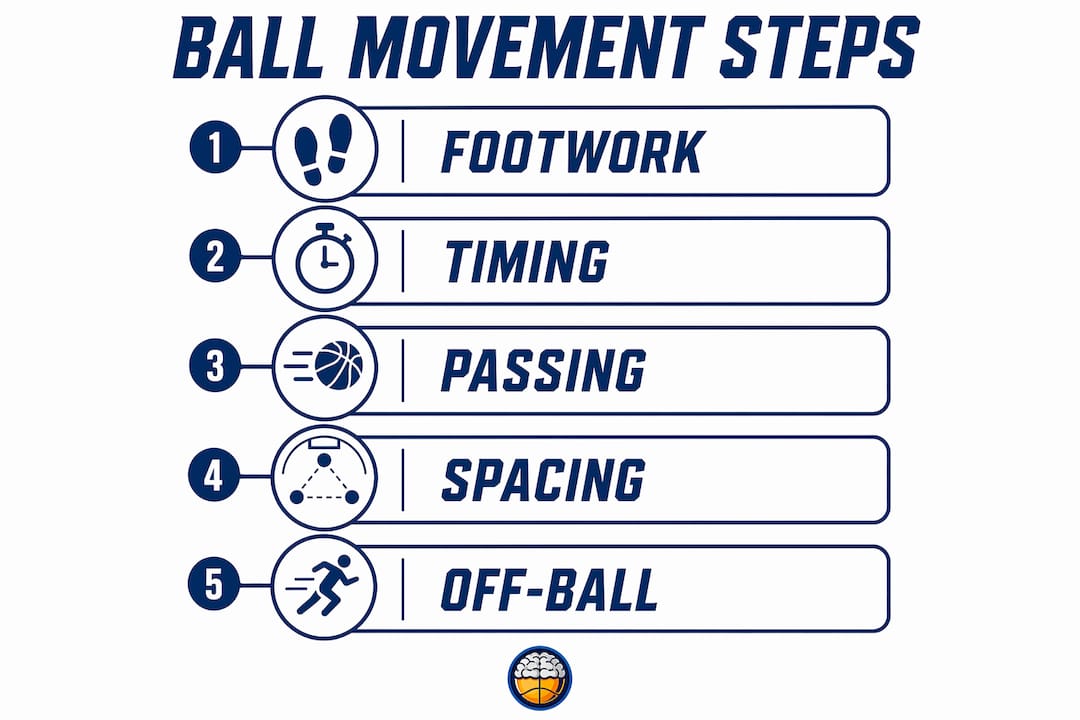
Teaching ball movement starts with breaking it into discrete, teachable elements. Experts recommend separating the concept into footwork, timing, pass selection, and spatial awareness. Oversimplifying these elements into one vague concept leads to weaker coaching and slower player development.
Footwork
Footwork is the foundation of every effective pass. A player who cannot establish a pivot foot quickly cannot create a clean passing angle. Proper footwork supports passing accuracy and allows players to cut sharply without losing balance. Coaches should drill the jump stop, the stride stop, and the reverse pivot before introducing any passing pattern.
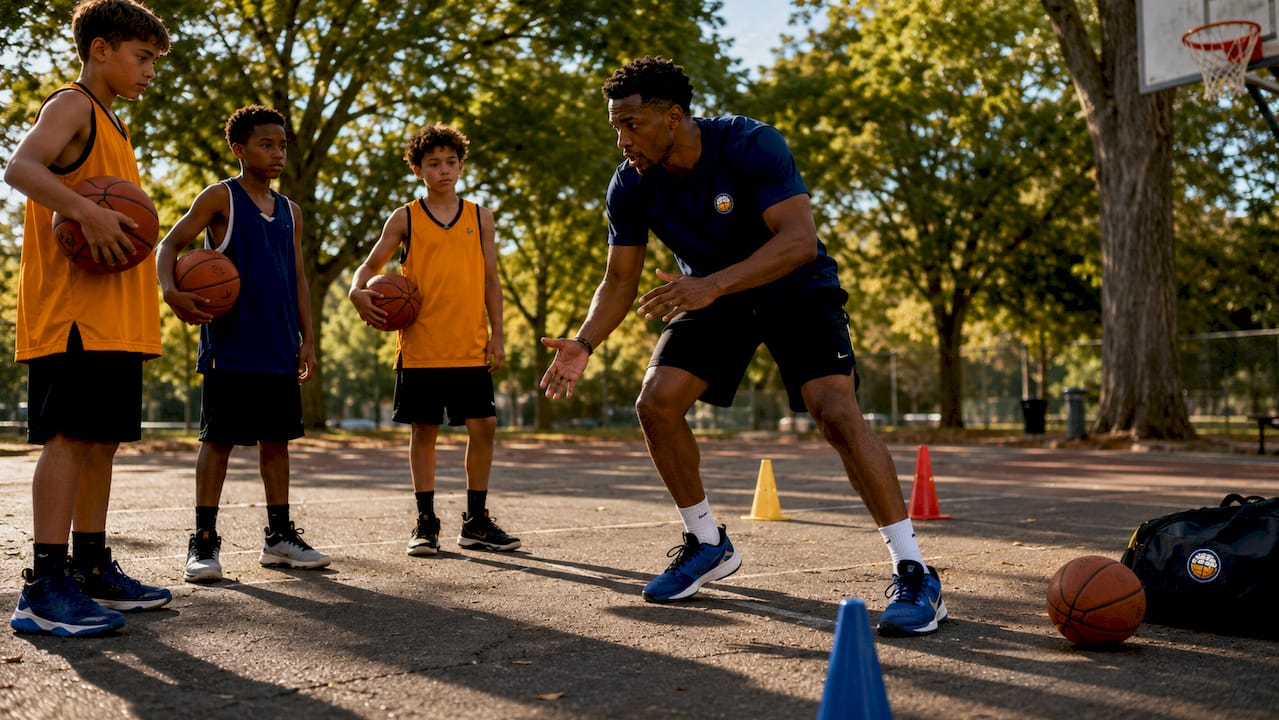
Timing and rhythm
Timing determines whether a pass creates an advantage or gives the defense time to recover. Players must learn to pass the ball before the defense closes out, not after. Rhythm drills, where players count beats between catches and releases, train this instinct effectively. A one-count catch-and-release rule is a practical standard for youth and high school players.
Spatial awareness and passing lanes
Players need to read the floor before they receive the ball, not after. Spacing exercises where players must identify and fill gaps in the defense build this habit. Teaching the difference between an inside-hand pass and an outside-hand pass gives players the vocabulary to attack specific defensive positions. Shuttle passes, where the ball moves from wing to elbow to opposite wing without a dribble, train players to see the full court.
- Footwork: Jump stop, stride stop, and reverse pivot before any passing pattern
- Timing: One-count catch-and-release rule to prevent defensive recovery
- Pass selection: Inside-hand, outside-hand, and shuttle passes for specific defensive situations
- Spatial awareness: Pre-catch floor reading and gap identification
- Decision speed: Reading the defense before the ball arrives, not after
Pro Tip: Run footwork drills without a ball for the first five minutes of every practice. Players who cannot move correctly without the ball will not pass correctly with it.
Which drills effectively teach full-speed ball movement?
The most common coaching error is running passing drills at half speed. Stationary passing drills produce players who cannot adapt in real games. Movement-based practice at game speed is the only way to develop real-world passing skills.
The Serbian Passing Drill
The Serbian Passing Drill is the most direct tool for building game-speed passing mechanics. Players line up near the lane and the three-point line, then sprint side by side while executing various passes without slowing down. The drill forces players to maintain balance and accuracy under physical stress, which is exactly what happens in transition offense. Coaches should introduce chest passes first, then add bounce passes and overhead passes as players gain confidence.
Training at full stride improves passing mechanics and balance under pressure, leading directly to better in-game performance. The drill also builds communication habits because players must call for the ball while sprinting.
Ball reversal and paint-attack drills
Ball reversal drills teach players to stretch defenses and find dynamic passing options on the weak side. Set up a five-player shell with the rule that the ball must touch all five positions before a shot attempt. Players quickly learn that quick reversal collapses help defenders and opens driving lanes. Paint-attack passing drills add a second layer: once the ball enters the paint, players must make a read and kick out to an open shooter within two seconds.
Competitive passing drills
Competitive drills boost decision speed by 50%, improving execution under pressure and reducing turnovers. That number reflects a real shift in how players process information when the stakes feel real. Add a scoring system to any passing drill: one point for a completed sequence, minus one for a turnover. Players communicate more, focus harder, and make faster reads when the drill has a winner.
| Drill | Key skill developed | Recommended level |
|---|---|---|
| Serbian Passing Drill | Full-speed passing, balance, communication | Intermediate to advanced |
| Ball reversal shell drill | Weak-side awareness, spacing, shot creation | All levels |
| Paint-attack kick-out drill | Quick reads, passing under pressure | Intermediate to advanced |
| Competitive passing circuit | Decision speed, turnover reduction | All levels |
| Shuttle passing drill | Court vision, catch-and-release timing | Beginner to intermediate |
Pro Tip: Record your players during full-speed drills and review the footage together. Players who see their own hesitation on video correct it faster than players who only hear verbal feedback.
How can coaches teach off-ball movement to complement ball movement?
Off-ball movement is what makes ball movement possible. A team that passes well but stands still gives the defense an easy job. Screen-and-cut drills and spacing exercises are the most effective tools for teaching players to move without the ball and support passing lanes.
The relationship between ball movement and off-ball movement is direct. Every time the ball moves, at least one off-ball player should also move. Coaches should teach this as a rule, not a suggestion. Use the phrase “ball moves, you move” as a practice cue until it becomes automatic.
Key off-ball principles to drill:
- Basket cuts: When a player passes and the defender turns to watch the ball, the passer cuts hard to the basket.
- Flare screens: A player sets a screen away from the ball to free a shooter on the perimeter.
- Fill cuts: When a player drives or cuts, teammates fill the vacated spot to maintain spacing.
- V-cuts: Players use a sharp change of direction to separate from their defender and get open for a pass.
Spacing exercises reinforce these habits. Place cones at the five standard offensive positions and require players to always occupy those spots. When one player drives, the others rotate to fill. This teaches players to read the ball and move simultaneously. For a deeper breakdown of these techniques, the off-ball movement guide from Hoop Mentality covers each principle with specific drill progressions.
What common mistakes hinder ball movement teaching?
The biggest mistake coaches make is running drills that do not match game conditions. Focusing only on stationary passing produces players who look polished in warmups and hesitate in games. Every drill should include movement, and at least half of every practice’s passing work should happen at game speed.
Common mistakes to eliminate from your practice plan:
- Stationary-only passing: Players never face a stationary defender in a game. Neither should they in practice.
- Skipping footwork fundamentals: Coaches who rush to passing patterns before footwork is solid build bad habits that are hard to correct later.
- Ignoring off-ball spacing: A passing drill with five players standing still teaches passing mechanics but not basketball.
- No competitive pressure: Drills without stakes produce slow decision-making. Add scoring, time limits, or consequences for turnovers.
- Poor drill sequencing: Starting with complex patterns before players have mastered simple ones creates confusion and frustration.
Drill sequencing matters as much as drill selection. Coaches should layer skill-building drills from stationary basics to full-speed movement. A session that starts with footwork, moves to two-player passing in motion, and finishes with a five-on-zero shell drill builds competence at each stage before adding complexity.
Pro Tip: Limit each drill to eight minutes maximum. Players lose focus and intensity after that window. Shorter, sharper drills with clear objectives outperform long, unfocused sessions every time.
Key Takeaways
Effective ball movement teaching requires layered drills, solid footwork fundamentals, and competitive practice conditions that match game speed.
| Point | Details |
|---|---|
| Start with footwork | Establish pivot stops and passing angles before introducing any passing pattern. |
| Use full-speed drills | The Serbian Passing Drill and ball reversal drills build real-game passing mechanics. |
| Add competitive pressure | Competitive drills boost decision speed by 50%, reducing turnovers and improving communication. |
| Teach off-ball movement | Screen-and-cut drills and fill cuts make ball movement possible by keeping defenses moving. |
| Sequence drills correctly | Progress from stationary basics to full-speed patterns to build confidence at each stage. |
What I’ve learned from coaching ball movement over the years
The coaches who struggle most with ball movement are the ones who treat it as a passing skill. It is not. It is a decision-making skill that happens to involve passing. Once I shifted my practice design around that idea, everything changed. Players stopped waiting for the perfect pass and started moving to create it.
The Serbian Passing Drill was the single biggest shift in how my players performed in transition. The first time we ran it at full speed, the turnovers were embarrassing. Two weeks later, the same players were making accurate passes at a dead sprint without thinking about it. That is what game-speed repetition does. It moves the decision from the conscious mind to instinct.
The other thing I have seen consistently is that off-ball movement is where most teams leave points on the floor. You can have five players who pass well and still score nothing if nobody moves. The “ball moves, you move” rule sounds simple. Getting players to actually do it every possession takes months of deliberate practice. But when it clicks, the offense becomes genuinely hard to guard because the defense cannot cheat toward the ball without giving up something else.
If you want to see real improvement, record your practices. Watch where players stand when they do not have the ball. That footage will tell you more about your team’s ball movement problems than any drill result.
— Dejan
Hoop Mentality resources for structured practice planning
Building a practice plan that teaches ball movement from the ground up takes time. Hoop Mentality’s Basketball Template Bundle gives coaches a ready-to-use system with progressive drills, structured practice plans, and clear session frameworks built from real coaching experience.

Each template is designed to save preparation time and keep practice sessions focused. Coaches get drill progressions that move from fundamentals to full-speed scenarios, so players build skills in the right order. The bundle also includes a weekly practice plan that helps coaches structure the entire week around specific skill development goals. Less time planning means more time coaching.
FAQ
What is ball movement in basketball?
Ball movement is the practice of passing quickly and moving purposefully off the ball to create open scoring opportunities. Quick passes raise shooting percentages and force defenses to constantly adjust their positioning.
What is the best drill for teaching ball movement?
The Serbian Passing Drill is the most effective tool for building game-speed passing habits. Players sprint side by side and execute various passes without slowing down, which directly simulates transition offense conditions.
How do I get players to move without the ball?
Use the “ball moves, you move” rule as a consistent practice cue and drill basket cuts, fill cuts, and V-cuts in every session. Screen-and-cut drills develop the instinct to move to open spaces and support passing lanes.
Why do players hesitate when passing in games?
Hesitation comes from practicing at speeds slower than game pace. Players who only train in stationary or slow drills have not built the instinct to make fast reads under pressure. Full-speed, competitive drills correct this directly.
How long does it take to improve team ball movement?
Consistent improvement shows up within two to four weeks of daily full-speed drill work. The “ball moves, you move” habit takes longer, often two to three months of deliberate practice, before it becomes automatic across all five positions.