


Most coaches think situational basketball is just running a few set plays in the final minutes. That’s a costly misconception. True situational basketball involves adapting your tactics dynamically to specific game moments, from two-for-one possessions to matchup exploitation. Mastering these nuanced strategies can dramatically improve your team’s performance in critical moments. Research shows that end-game strategies like fouling up three increase win probability four times compared to overtime scenarios. This guide breaks down the core situational strategies, practice methods, and advanced nuances every coach needs to win more games.
Table of Contents
- Key takeaways
- What is situational basketball and why it matters
- Core situational strategies coaches must master
- Building situational awareness through coaching practices
- Advanced nuances and balancing strategy with entertainment
- Improve your coaching with specialized drills and plans
- Frequently asked questions
Key Takeaways
| Point | Details |
|---|---|
| End game mastery | Mastering end game strategies dramatically increases win probability in critical moments. |
| Two for one clock | Take a quality shot earlier to ensure your team gets the ball back for a final possession. |
| Fouling up three | When ahead by three with seconds left, fouling forces free throws and multiple possessions to tie or win, with a 92 to 94 percent win rate when executed properly. |
| Matchup recognition | Analyze habits footwork tendencies and defensive vulnerabilities to inform tactical calls and substitutions. |
| Peel switching | Peel switching neutralizes penetration while keeping shooters covered through strategic help rotations. |
What is situational basketball and why it matters
Situational basketball means adjusting your tactics dynamically based on game context and specific moments. It goes far beyond memorizing set plays. You’re reading the score, clock, fouls, matchups, and momentum to make split-second strategic decisions that maximize your team’s winning chances.
Simple set plays don’t suffice because basketball is fluid. Your opponent adjusts, the clock changes everything, and matchups shift possession by possession. Effective situational play requires understanding key performance indicators like effective field goal percentage (eFG%), three-point percentage (3P%), and turnover percentage (TOV%). These metrics predict outcomes and guide your in-game adjustments with precision.
Situational basketball impacts overall team performance significantly, especially in close games. Studies analyzing professional leagues show that teams mastering end-game strategies increase their win probability substantially. The difference between winning and losing often comes down to executing the right tactic at the right moment.
Typical situations where strategic adjustments matter most include:
- End-game management with specific score differentials
- Late shot clock decisions requiring quick reads
- Matchup-based adjustments exploiting opponent weaknesses
- Foul trouble scenarios affecting rotation decisions
- Momentum shifts demanding tactical responses
Understanding special situations basketball gives you a framework for preparing your team. You’ll know exactly which drills to run, which scenarios to simulate, and how to build the mental readiness your players need when pressure peaks.
Core situational strategies coaches must master
Successful coaches rely on specific situational tactics that statistics validate. These strategies separate winning programs from those that struggle in critical moments.
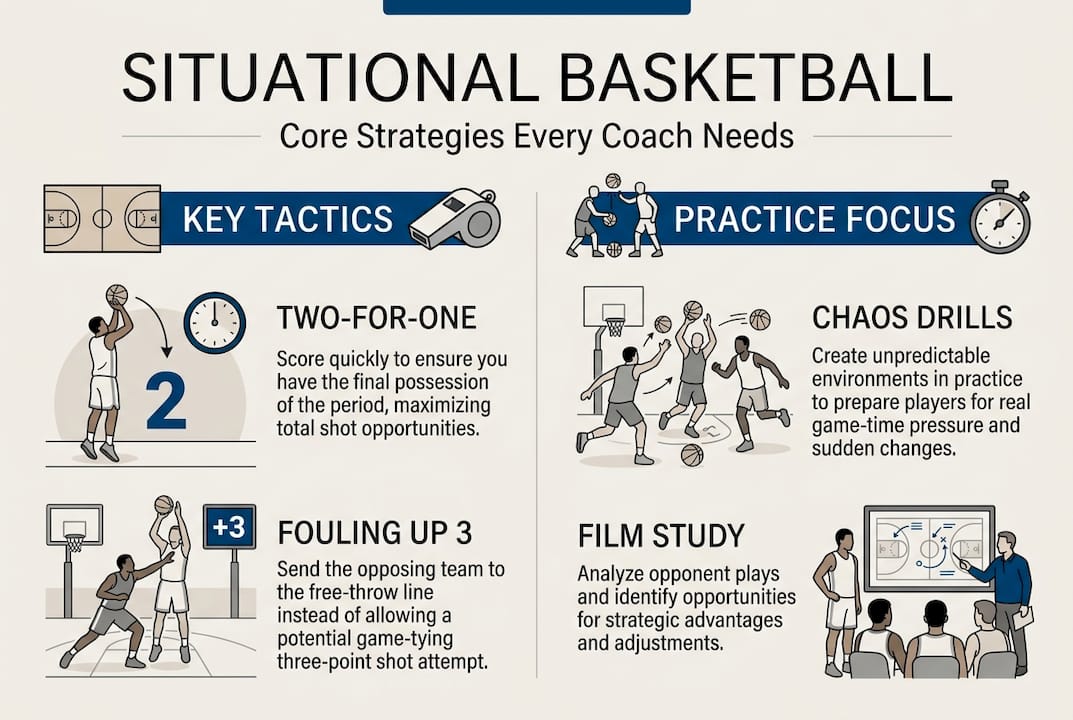
The two-for-one possession strategy maximizes scoring opportunities late in quarters. When the shot clock shows between 30 and 40 seconds remaining in a period, you take a quality shot earlier to ensure your team gets the ball back for a final possession. This tactic gains an extra scoring chance your opponent won’t have, directly impacting your points per game.
Fouling up three prevents opponents from tying the game with a three-pointer. When you’re ahead by three points with seconds remaining, intentionally fouling forces your opponent to make free throws and get the ball back, requiring multiple possessions to tie or win. Research shows this approach wins 92-94% of games when executed properly.
Matchup recognition goes beyond comparing player size. You’re analyzing habits, footwork tendencies, and defensive vulnerabilities. Does their point guard drift left on drives? Does their center struggle with face-up moves? These nuances inform your tactical calls and substitution patterns. Peel switching on penetration disrupts their offensive rhythm by rotating help defenders strategically.
Key situational tactics every coach should master:
- Two-for-one clock management in final minute of quarters
- Fouling up three under 12 seconds to prevent game-tying attempts
- Matchup recognition based on habits and footwork patterns
- Peel switching to neutralize penetration without leaving shooters
- Late clock isolation plays exploiting favorable one-on-one situations
Pro Tip: Time your foul-up-three strategy for under 12 seconds remaining. This timing doubles your win chances compared to fouling earlier, giving opponents less time to execute multiple possessions.
Teams using the foul-up-three strategy win 92-94% of games compared to defending straight, according to game theory analysis.
Mastering these core strategies requires understanding the basketball endgame strategy framework. You’ll develop the confidence to make bold calls that analytics support, even when conventional wisdom suggests otherwise.
Building situational awareness through coaching practices
Developing team situational understanding requires deliberate practice design. Random scrimmages won’t build the specific awareness your players need in pressure moments.
Repeated situational simulation in practice drives skill retention and mental readiness. Your players need to experience game-ending scenarios dozens of times before facing them in competition. Run the same situation from multiple angles: down two with 15 seconds, up one with opponent ball, tied game with 8 seconds. This repetition creates automatic responses when stress peaks during actual games.
Specialized drills tailored by position accelerate learning:
- Guards focus on closeout recognition and decision speed
- Wings practice reading help defense and making quick passes
- Bigs work on spacing awareness and seal positioning
- All positions rehearse communication protocols for switches
Chaos and pressure drills simulate game stress better than controlled exercises. Add crowd noise, fatigue, and unpredictable variables. Make players execute situational plays after running sprints. Create scenarios where they must problem-solve under genuine pressure. This approach transfers directly to game performance because you’ve replicated the environment they’ll face.
Film study integration enhances matchup IQ dramatically. Show your team specific opponent tendencies before practicing counters. If their center always hedges high on ball screens, practice the slip pass until it becomes instinctive. Small-sided games (three-on-three, four-on-four) force players to recognize and exploit matchups in real time without the complexity of full-court action.
Pro Tip: Use daily reinforcement exercises focusing on situational awareness rather than isolated skills alone. Spend the final 10 minutes of every practice on game-specific scenarios, rotating through different situations each day.
Integrating defensive adjustment tips with your situational practice creates well-rounded preparation. Your team learns to recognize what opponents are trying to accomplish and counter it immediately. This dual awareness, offense and defense, separates elite programs from average ones.
Structured basketball skills development workflows ensure your situational training builds progressively. Start with basic recognition, add decision-making layers, then introduce pressure and fatigue. This systematic approach prevents overwhelming players while steadily increasing their capability.
Advanced nuances and balancing strategy with entertainment
Expert-level situational basketball involves understanding when analytics conflict with other considerations. Not every statistically optimal decision fits every context.
The fouling-up-three debate illustrates this tension perfectly. Analytically, fouling up three wins 92-94% of games according to decision theory models. Yet critics argue it reduces game excitement and some studies show minimal difference compared to straight defense. You’re weighing pure win probability against fan experience and program perception.
| Strategy aspect | Fouling up 3 | Defending straight |
|---|---|---|
| Win percentage | 92-94% | 85-88% |
| Entertainment value | Lower (stops action) | Higher (dramatic finish) |
| Effectiveness factors | Timing under 12 seconds critical | Requires elite perimeter defense |
| Risk level | Controlled outcome | High variance |
Time-dependent variables change everything. Fouling under 12 seconds remaining doubles your win chances compared to fouling at 20 seconds. The opponent has less time to execute the complex sequence needed to tie or win. Every second matters in these calculations.
Factors coaches should weigh when choosing situational tactics:
- Team defensive strength and perimeter closeout ability
- Opponent three-point shooting percentage and clutch performance
- Game importance and championship implications
- Fan experience and program entertainment reputation
- Player confidence and psychological readiness for pressure
Balancing advanced strategic decisions with entertaining game flow requires judgment. In a regular season game with young players, you might prioritize the learning experience of defending straight. In a championship game, you deploy every analytical advantage available. Neither choice is wrong; context determines appropriateness.
Some coaches refuse fouling-up-three on principle, believing it teaches players to avoid competition. Others use it religiously because winning matters most. Your basketball game management philosophy determines which camp you join. The key is making an informed choice based on data, not just tradition or gut feeling.
Understanding these nuances makes you a more complete coach. You know the optimal statistical play, you understand the counterarguments, and you can explain your decision to players and parents with confidence. That credibility matters as much as the tactical choice itself.
Improve your coaching with specialized drills and plans
Transforming situational basketball theory into practice requires the right tools and structured resources.
Hoop Mentality offers specialized drills tailored for key basketball positions, helping you build the specific skills this article discusses. The big man dual action drill develops the spacing awareness and seal positioning critical for situational success in the paint.

Organizing effective practice sessions becomes simple with our basketball practice plan template. This resource helps you structure your time to emphasize situational awareness, ensuring every practice builds the game-specific skills your team needs. You’ll optimize session focus, track progression, and implement the chaos drills and simulations that transfer to actual competition.
These practical tools bring the strategies covered here into your daily coaching routine, helping you develop teams that execute confidently in pressure moments.
Frequently asked questions
What is situational basketball?
Situational basketball is the practice of adjusting your team’s tactics dynamically based on specific game contexts like score, time remaining, fouls, and matchups. It goes beyond running set plays to making strategic decisions that maximize win probability in each unique moment. Coaches use situational basketball to exploit opponent weaknesses and optimize possession value throughout the game.
When is situational basketball most critical?
Situational basketball becomes most critical during late-game scenarios, pressure moments with tight scores, and when exploiting specific matchup advantages. The final two minutes of close games require precise execution of strategies like two-for-one possessions and foul management. Any moment where the score differential is within one possession demands heightened situational awareness and tactical precision.
How can I practice situational basketball with my team?
Use repeated situational simulations and chaos drills that replicate game pressure and fatigue. Tailor drills by position, with guards focusing on closeout speed and bigs working on spacing awareness. Integrate film study to highlight opponent tendencies, then practice specific counters in small-sided games. Daily reinforcement of situational scenarios in the final 10 minutes of practice builds automatic responses your players can execute under stress.
Is fouling up three a good strategy?
Fouling up three statistically improves win chances to 92-94% effectiveness when executed under 12 seconds remaining. However, it’s criticized for reducing game excitement, and some studies show similar results for straight defense depending on your team’s perimeter closeout ability. The strategy works best when timed precisely and your opponent has strong three-point shooters who could tie the game.
What are common misconceptions about situational basketball?
Many coaches mistakenly believe situational basketball only involves end-game fouling decisions or running a few set plays in the final minute. In reality, situational adjustments matter throughout the game, from quarter-ending two-for-one possessions to matchup exploitation in the second quarter. Another misconception is that situational play is purely instinctive rather than something you can systematically teach and practice.
What drills help improve matchup recognition?
Use position-specific drills focusing on guard speed advantages and big man spacing requirements. Incorporate film analysis sessions that highlight opponent tendencies and habits before practicing counters. Small-sided games simulate real matchup adjustments without full-court complexity, forcing players to read and react to defensive positioning. These methods combined build the matchup IQ necessary for effective situational basketball execution.