

Every american basketball fan knows that the final moments of a close game can feel like pure chaos, yet these high-pressure minutes are where true strategy shines. With over 60 percent of NBA games decided by ten points or less, understanding endgame tactics separates average teams from real contenders. This guide breaks down how calculated decisions, sharp time management, and mental toughness can flip a narrow lead into lasting victory.
Table of Contents
- Defining Basketball Endgame Strategy
- Key Concepts And Core Principles
- Types Of Endgame Situations And Tactics
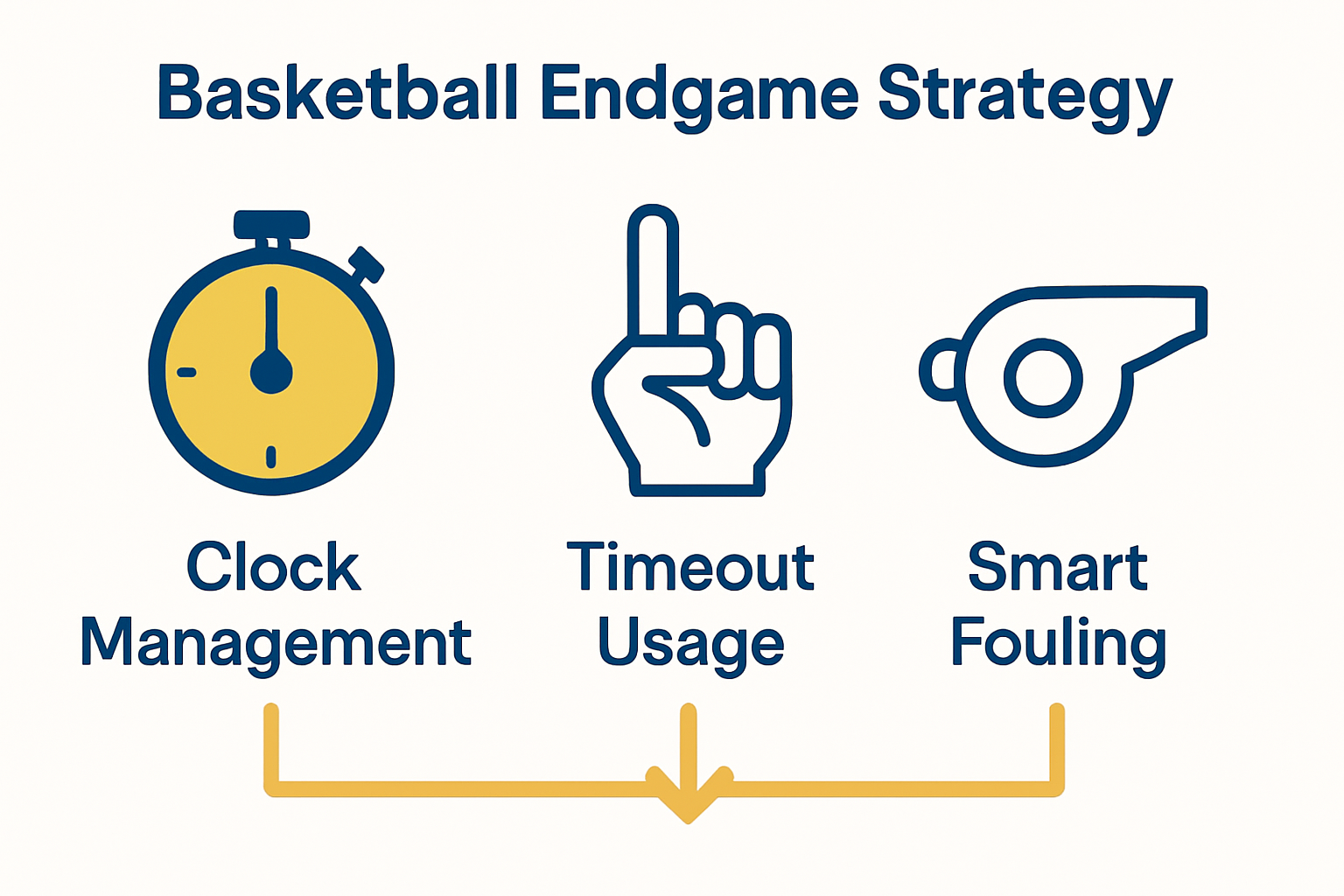
- Timeouts, Fouls, And Clock Management
- Adjusting Lineups And Plays In Crunch Time
- Common Endgame Mistakes To Avoid
Key Takeaways
| Point | Details |
|---|---|
| Endgame Strategy is Multifaceted | Successful endgame strategies incorporate psychological, tactical, and time management elements that can turn a potential loss into a win. |
| Critical Decision-Making in Crunch Time | Coaches must swiftly evaluate player conditions and performance to make effective lineup adjustments and play calls during high-pressure moments. |
| Mastering Time Management | Effective clock management and strategic timeout usage are essential for controlling game tempo and maximizing scoring opportunities. |
| Avoiding Common Mistakes | Teams should practice discipline and resist unnecessary aggressive plays to maintain strategic control, minimizing the risk of crucial errors. |
Defining Basketball Endgame Strategy
Basketball endgame strategy represents the critical set of tactical decisions and execution methods teams employ in the final minutes of a close game to secure victory. These strategies go far beyond simple point-scoring - they involve complex psychological, tactical, and time management considerations that can transform a potential loss into a triumphant win.
At its core, endgame strategy involves carefully managing game tempo, possession, and scoring opportunities while minimizing opponent chances. Tactical basketball systems play a crucial role in determining how teams approach these high-pressure situations. Coaches must make rapid decisions about player positioning, shot selection, defensive alignments, and clock management - each choice carrying significant potential consequences.
One fundamental endgame technique involves strategically running out the clock, a method designed to maintain a lead by deliberately controlling game tempo. When a team holds a narrow advantage, they may use specific basketball tactical approaches like the classic four corners offense, where players deliberately spread across the court to limit opponent scoring opportunities while consuming valuable game time. This strategy requires exceptional ball handling, precise passing, and disciplined player movement to effectively neutralize aggressive defensive pressure.
Successful endgame strategies demand more than technical skill - they require mental fortitude, strategic intelligence, and the ability to perform under extreme competitive stress. Coaches must prepare players not just with technical drills, but with mental conditioning that allows them to make split-second decisions when game outcomes hang in the balance. Understanding these nuanced approaches separates championship teams from ordinary competitors, transforming potential defeats into memorable victories.
Key Concepts and Core Principles
Basketball endgame strategy rests on several foundational principles that transform theoretical knowledge into practical, high-pressure execution. These core concepts represent the strategic toolkit coaches and players use to navigate critical moments where games are won or lost within seconds of intense competition.
One fundamental principle involves adaptive defensive positioning. Defensive strategies become paramount in endgame scenarios, where teams must rapidly shift between different defensive configurations. The match-up zone defense emerges as a particularly sophisticated approach, blending man-to-man and zone defensive techniques to create maximum tactical flexibility. This hybrid strategy allows teams to dynamically respond to offensive threats while maintaining defensive integrity.
Another critical concept centers on probabilistic shot selection, which involves making mathematically informed decisions about scoring opportunities. Advanced game-theoretic research suggests teams should optimize shot percentage distribution among players, calculating the most efficient scoring pathways under time and score constraints. This analytical approach transforms endgame strategy from an intuitive art into a data-driven science, where each possession becomes a carefully calculated risk-reward equation.
Ultimately, successful endgame strategy transcends technical skills. Mental resilience, communication, and collective team composure form the psychological foundation that enables players to execute complex tactical plans under extreme pressure. Championship teams distinguish themselves not just through superior technical abilities, but through their capacity to maintain strategic clarity and emotional control when milliseconds and inches separate victory from defeat.
Types of Endgame Situations and Tactics
Basketball endgame situations demand nuanced tactical approaches that go far beyond standard gameplay strategies. Coaches and players must rapidly assess multiple variables, including score differential, remaining time, player fatigue, foul counts, and psychological momentum to select the most effective tactical response.
One controversial yet strategic approach involves the intentional fouling tactic, most famously exemplified by the Hack-a-Shaq strategy. This high-risk maneuver targets poor free-throw shooters, deliberately sending them to the free-throw line to limit potential scoring opportunities. While mathematically sound in certain scenarios, this approach requires precise calculation and carries significant psychological and tactical risks that can backfire if not executed with extreme precision.
Alternative endgame formats like the Elam Ending represent innovative approaches to managing final game moments. Basketball leadership strategies become crucial in implementing these dynamic scoring formats, where traditional time-based constraints are replaced by target score objectives. This approach fundamentally transforms endgame dynamics, eliminating intentional fouling and creating more exciting, skill-driven conclusions to competitive matches.
Successful endgame tactics ultimately require a holistic understanding of team dynamics, individual player capabilities, and split-second decision making. Coaches must develop comprehensive tactical playbooks that provide flexible responses to diverse scenarios, empowering players to make intelligent choices under extreme competitive pressure. The most effective teams treat these critical moments not as isolated incidents, but as culminating expressions of their collective strategic intelligence and mental preparation.
Timeouts, Fouls, and Clock Management
Mastering the intricate dance of timeouts, fouls, and clock management represents the ultimate strategic challenge in basketball’s most pressure-packed moments. Coaches must transform these technical elements into a sophisticated chess match, where every second and every decision carries potentially game-changing consequences.
The art of running out the clock involves precise manipulation of game tempo and strategic decision making. Time management techniques become critical as teams employ tactical approaches like intentional fouling to disrupt opponent momentum. Strategic clock management can involve complex scenarios such as the Hack-a-Shaq approach, where teams deliberately foul poor free-throw shooters to limit scoring opportunities and control game rhythm.

Timeout management emerges as another crucial strategic weapon. Coaches must decide not just when to call timeouts, but how to use them most effectively. A well-timed timeout can reset team psychology, design a critical play, or interrupt the opponent’s momentum. Successful teams treat timeouts as strategic pauses that allow for rapid tactical recalibration, transforming these brief moments into potential turning points that can decide entire games.
Ultimately, clock management transcends mere technical skill. It represents a complex psychological battle where mental composure, strategic intelligence, and split-second decision making converge. The most effective coaches and players understand that managing time is not just about mathematical calculations, but about maintaining emotional control and strategic clarity when the pressure reaches its absolute peak.
Adjusting Lineups and Plays in Crunch Time
Crunch time represents the most critical moment in basketball, where strategic lineup adjustments and play selection can transform potential defeat into unexpected victory. Coaches must rapidly synthesize complex information, assessing player performance, physical condition, and psychological readiness to make split-second decisions that can define an entire season.
Advanced analytical approaches are revolutionizing how teams approach these high-pressure moments. Basketball playbook strategies now incorporate sophisticated models that examine temporal passing networks, analyzing how player interactions dynamically shift under extreme time pressure. The emerging PlayBest model demonstrates how data-driven planning can help coaches optimize player combinations and predict optimal strategic responses during critical game moments.
Successful lineup adjustments require more than statistical analysis. Coaches must read the psychological landscape of the game, understanding which player combinations generate maximum synergy, which matchups can be exploited, and how individual player strengths can neutralize opponent advantages. This involves a nuanced understanding of player chemistry, individual confidence levels, and the subtle communication patterns that emerge during high-stress competitive scenarios.
Ultimately, crunch time strategy transcends technical skills and mathematical models. It represents a profound test of coaching intuition, player trust, and collective team resilience. The most effective teams view these moments not as isolated incidents, but as culminating expressions of their collective preparation, mental conditioning, and shared competitive spirit.
Common Endgame Mistakes to Avoid
Endgame strategy represents a delicate balance between aggressive competitiveness and strategic restraint. Coaches and players must navigate complex psychological and tactical landscapes where a single miscalculation can transform a potential victory into a devastating defeat.
One critical error involves unnecessary aggressive play, particularly the temptation to continue scoring despite holding a substantial lead. Basketball coaching strategies emphasize that such approaches not only risk potential backlash but can also expose teams to unexpected counterattacks. Coaches must instill a disciplined mindset that prioritizes game management over individual point totals, understanding that strategic control matters more than statistical padding.
Another frequent mistake involves poor timeout management and ineffective communication during high-pressure moments. Teams often squander critical possessions by failing to design clear, executable plays or by making impulsive substitutions that disrupt team rhythm. Successful endgame execution requires precise choreography, where each player understands their specific role and maintains collective composure under extreme competitive stress.
Ultimately, avoiding endgame mistakes demands more than technical basketball knowledge. It requires emotional intelligence, strategic discipline, and the ability to maintain collective focus when individual impulses threaten to derail carefully constructed game plans. Championship teams distinguish themselves not by never making mistakes, but by minimizing errors and maintaining strategic clarity when the stakes are highest.
Master Your Basketball Endgame Strategy Today
Closing out tight basketball games takes more than just skill. It demands clear strategies for clock management, lineup adjustments, and decision making under pressure. If you want to build that winning edge and execute like a pro in crunch time, our Basketball Playbooks offer detailed, proven plans designed to help you control those final moments and avoid costly mistakes.

Start transforming your team’s endgame performance now by exploring our collection at Hoop Mentality. Equip yourself with structured plays, focused practice drills from our Basketball Drills, and effective training tools to save time and boost communication. Don’t leave close wins to chance. Take action today and develop your team’s confidence and clarity when the game is on the line.
Frequently Asked Questions
What is basketball endgame strategy?
Basketball endgame strategy refers to the tactical decisions and execution methods teams use in the final minutes of a close game to secure victory, including managing game tempo, possession, and scoring opportunities.
How can teams effectively run out the clock in a close game?
Teams can run out the clock by employing strategies like the four corners offense, which involves spreading players across the court to limit the opponent’s scoring opportunities while consuming valuable game time.
What are some common mistakes teams make during the endgame?
Common mistakes include unnecessary aggressive play and poor timeout management, which can lead to missed opportunities and disrupted team rhythm during crucial moments of the game.
How important is mental preparation in executing endgame strategies?
Mental preparation is crucial for executing endgame strategies, as it enables players to make split-second decisions under pressure and maintain composure, which can significantly impact the outcome of the game.