


TL;DR:
- The defensive stance is the foundational element of effective basketball defense, not athleticism.
- Proper stance improves agility, reduces injuries, and enhances team defensive performance across all levels.
- Regular stance drills and consistency in practice reinforce habits that lead to better rotations and team success.
Most coaches assume defense starts with athleticism. It doesn’t. The real foundation is the defensive stance, and when it breaks down, everything else breaks down with it. Missed rotations, unnecessary fouls, blown coverages — these problems trace back to poor stance mechanics more often than poor effort. Defensive stance in basketball is the foundational body position for effective individual defense, and it shapes every outcome from the opening tip to the final buzzer. This article breaks down exactly what defensive stance is, why it matters at every level, how to teach it, and how it connects to your team’s broader defensive system.
Table of Contents
- Understanding the defensive stance: Fundamentals and biomechanics
- Defensive stance across levels: Adaptations from youth to pro
- Integrating stance into team defense: Rotations, help, and schemes
- Practical drills and coaching methods for stance mastery
- Our perspective: Why stance dictates defensive outcomes and how coaches should approach it
- Enhance your team’s defense with Hoop Mentality training tools
- Frequently asked questions
Key Takeaways
| Point | Details |
|---|---|
| Stance drives defensive results | Defensive stance is the foundation for player agility, balance, and contesting shots, impacting every defensive metric. |
| Level-specific adaptations matter | NBA, college, and youth teams each require stance adjustments based on rules and schemes for optimal performance. |
| Data links stance to team success | Teams with strong stance fundamentals allow fewer points and secure more rebounds, especially for guards. |
| Drills must be integrated | Daily stance drills and feedback are essential for lasting improvement and avoiding bad habits at all levels. |
Understanding the defensive stance: Fundamentals and biomechanics
Every coach talks about defense. Fewer coaches actually teach the stance that makes defense possible. Understanding the mechanics is the first step toward fixing what your players are doing wrong.
A proper defensive stance starts with the feet. They should be shoulder-width apart, toes pointed slightly outward, with the weight distributed forward on the balls of the feet — not the heels. Knees are bent, hips are low, and the back stays flat. This isn’t just about looking right. It’s about being ready to move in any direction without a wasted step.
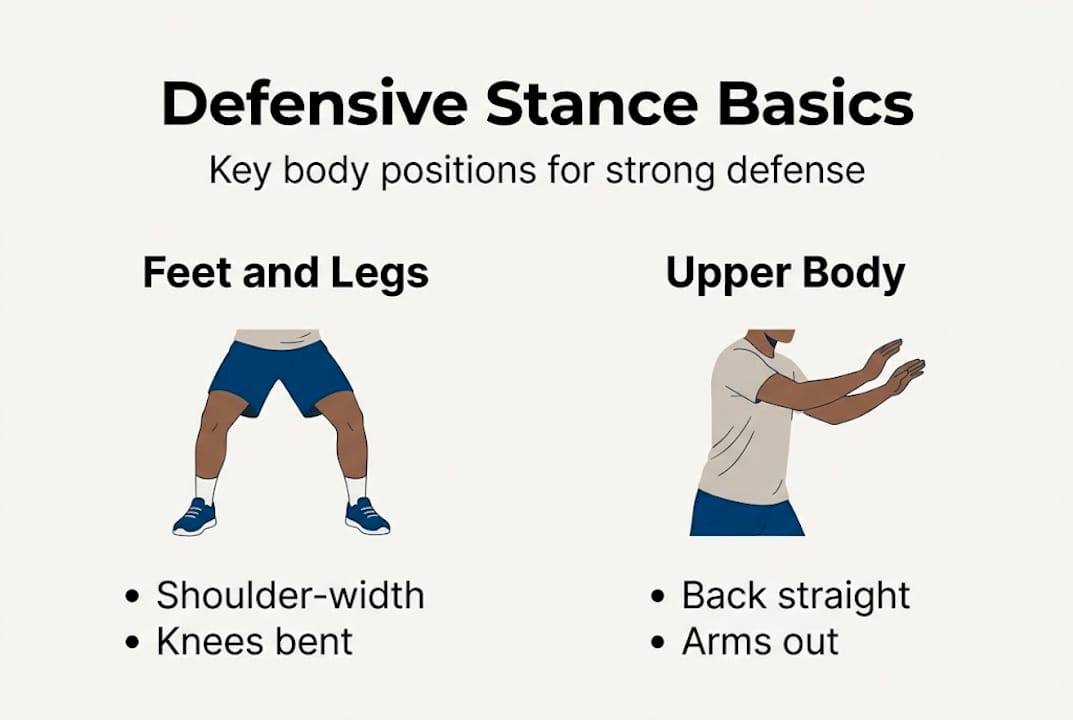
The biomechanical advantages are real. Proper stance enhances agility and reduces injury risk, which means players who practice good stance don’t just defend better — they stay healthier throughout a long season. A low center of gravity creates stability. Bent knees act like springs, allowing explosive lateral movement without telegraphing direction.
Arms and hands matter too. The lead hand should be active, positioned to contest passes and disrupt dribbles. The trail hand stays low to cut off drives. Both hands should be moving, not hanging at the sides.
Here’s a quick breakdown of stance essentials:
- Feet shoulder-width apart, weight on balls of feet
- Knees bent, hips below shoulder level
- Flat back, chest up, eyes on the ball
- Lead hand active and high, trail hand low
- Short, choppy steps to maintain balance while moving
For coaches building a basketball fundamentals checklist, stance should be item one. It connects directly to every defense tip for coaches that follows. When players understand why the stance works, not just how to do it, they maintain it under pressure.
Pro Tip: Add two minutes of stance holds and lateral slides to every warm-up. Short, consistent repetitions build muscle memory faster than long, infrequent drills — and they prevent bad habits from forming during live play.
The defensive concepts guide reinforces this point: stance is not a drill you do once and move on from. It’s a daily habit.
Defensive stance across levels: Adaptations from youth to pro
The fundamentals don’t change. But the context does. How you teach and apply defensive stance depends heavily on the level you’re coaching, the rules in play, and the defensive schemes you run.
Core stance is similar across levels, but NBA rules and zone packing affect positioning. The NBA’s defensive 3-second rule, for example, prevents defenders from camping in the paint. That forces big men to stay active and maintain stance while moving, not just planting and waiting. In college and high school, zone schemes allow more static positioning, but stance quality still determines how quickly a player can close out or rotate.
Here’s how stance nuances break down by level:
| Level | Key stance focus | Primary challenge |
|---|---|---|
| NBA | Constant movement, active hands | Defensive 3-second rule |
| College | Zone positioning, closeout speed | Transition defense |
| High school | Footwork discipline, hip depth | Maintaining stance under fatigue |
| Youth | Basic posture, balance, awareness | Short attention spans, bad habits |
At the youth level, coaches should prioritize posture and balance above all else. Kids naturally want to stand upright and reach with their hands. Correcting that early pays dividends for years. At the high school level, the challenge shifts to maintaining stance when players are tired. Fatigue is where stance breaks down first.
“Coaches should prioritize stance drills early in practice for all levels — building the habit before fatigue sets in is what separates disciplined defenders from reactive ones.”
Advanced stance tactics become relevant as players develop. These include:
- Switching: Requires both defenders to maintain stance through contact and communication
- Trapping: Stance depth and hand activity determine trap effectiveness
- Top-locking: Overplaying the passing lane demands precise foot positioning
For zone defense tactics, stance is what keeps gaps tight. A player who stands straight up in a 2-3 zone creates passing lanes that shouldn’t exist. And for defensive adjustment tips mid-game, stance is often the first thing to check when your defense is leaking points.
Integrating stance into team defense: Rotations, help, and schemes
Individual stance is where it starts. Team defense is where it pays off. When five players maintain proper stance simultaneously, rotations become faster, help-side coverage improves, and opponents run out of easy options.
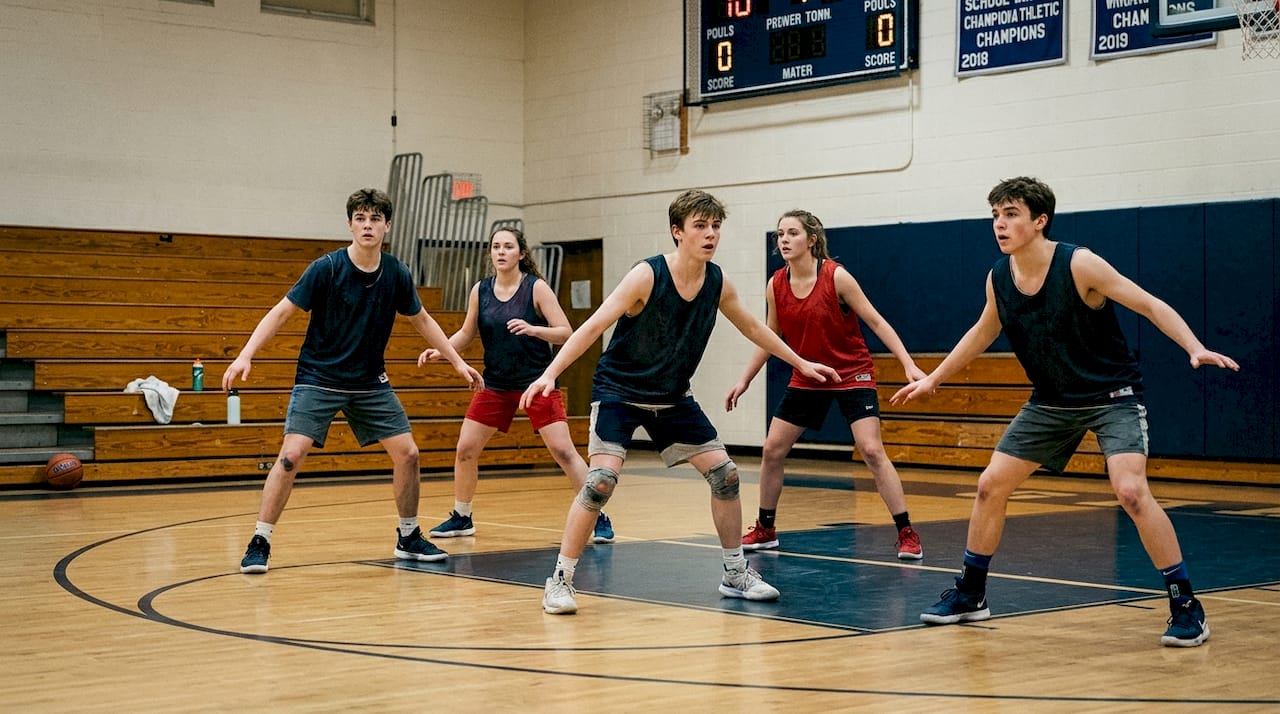
ML models detect stance-related strategies like switches and traps with 91.4% accuracy on NBA data, which tells you something important: stance patterns are so consistent and readable that even algorithms can identify them. That means your players’ stance habits are visible to opponents too. Good stance habits create defensive structure. Poor ones create exploitable patterns.
Stance fundamentals correlate with points allowed and rebounds, with teams showing stronger stance discipline consistently outperforming in both categories. Here’s a simplified breakdown:
| Position | Stance impact on points allowed | Stance impact on rebounding |
|---|---|---|
| Guards | Reduces perimeter shooting efficiency | Improves box-out positioning |
| Forwards | Limits mid-range and drive opportunities | Increases defensive rebound rate |
| Centers/Bigs | Deters paint scoring | Directly improves rebounding angle |
To integrate stance into team defense, use this sequence:
- Start with shell drill: Four defenders, no offense. Focus on stance, spacing, and communication before adding any ball movement.
- Add ball movement: Introduce a passer. Defenders rotate while maintaining stance. No reaching, no standing up.
- Introduce live dribble penetration: Now stance is tested under pressure. Reward players who hold their form.
- Run full help-side rotations: Connect stance to defensive rotations so players understand how individual form affects team coverage.
- Add fatigue: Run conditioning, then immediately run defensive sets. Stance under fatigue is the real test.
Advanced schemes like scram switches and box-and-one only work when every player on the floor maintains stance through the action. One player standing upright breaks the entire scheme.
Pro Tip: Film your defensive sets and review stance specifically. Players are often surprised by how much their form drops in live play compared to isolated drills. Video feedback accelerates improvement faster than verbal correction alone. Check out how defensive drills can boost defense when applied consistently.
Practical drills and coaching methods for stance mastery
Knowing what good stance looks like is one thing. Building it in your players, day after day, is another. These drills are practical, level-appropriate, and designed to create lasting habits.
Core stance drills for all levels:
- Wall sits: Players hold a seated position against the wall for 30 to 60 seconds. This builds the quad and hip strength needed to maintain low stance for extended possessions.
- Mirror stance: Two players face each other. One leads, one mirrors. Develops lateral quickness and teaches players to stay in front without reaching.
- Lateral slides: Players slide across the lane, touching each line with the outside foot. Focus on staying low and not crossing feet.
- Closeout drill: Players sprint from help position to contest a shot, stopping in proper stance without fouling. Connects stance to real defensive situations.
- Stance and recover: Player holds stance, coach points left or right, player sprints and recovers back to stance. Builds reactive movement from a set position.
Coaches should integrate stance drills early for endurance and foul prevention, ideally in the first 10 minutes of practice before fatigue affects form.
Common mistakes to correct:
- Weight on heels instead of the balls of the feet
- Locked or straight knees
- Inactive hands hanging at the sides
- Standing upright when the ball moves away
- Crossing feet during lateral movement
For on-ball defense, stance mistakes are immediately punished. A player with weight on their heels gets blown by on the first drive. For box-and-one defense, stance consistency from all five players is non-negotiable.
Pro Tip: Use video review at least once a week focused entirely on stance. Pull clips from practice and games. Show players what they look like when they’re doing it right and when they’re not. Self-awareness is one of the fastest paths to correction.
Finally, connect stance to live play as early as possible. Isolated drills build the foundation, but players need to feel how stance translates to real stops, real rotations, and real defensive wins.
Our perspective: Why stance dictates defensive outcomes and how coaches should approach it
Here’s what years of coaching have shown us: most coaches know stance matters, but very few treat it like the priority it actually is. It gets a few minutes in pre-season and then disappears into the background while schemes and plays take over.
That’s a mistake. Stance is not a checklist item. It’s the glue that holds your entire defensive system together. When your team’s stance breaks down, your rotations break down. Your help-side breaks down. Your identity as a defensive team breaks down.
The best results come from connecting stance to real-game scenarios every single day, not just running lateral slides in isolation. When players understand that their stance directly affects whether they give up a layup or force a tough shot, they buy in faster.
Expect early resistance. Players don’t naturally want to stay low for 30 seconds at a time. But stay consistent. Within two to three weeks of daily stance work, you’ll see measurable improvement in your team’s defensive performance. Explore how defensive drills boost defense when applied with this kind of consistency and intention.
Stance is where your defense starts. Treat it that way.
Enhance your team’s defense with Hoop Mentality training tools
If you’re ready to build stance mastery into your daily practice, Hoop Mentality has the tools to make it structured and repeatable.

Our game preparation guide with weekly practice plan gives you a complete framework for organizing practices around defensive priorities, including stance work. The big man dual action drill targets the specific footwork and positioning that big men need for stance-based defense. Every resource at Hoop Mentality is built from real coaching experience, designed to save you time and give your team a clear defensive structure to execute with confidence.
Frequently asked questions
What is the purpose of the defensive stance in basketball?
Defensive stance is foundational for effective individual defense, allowing players to react quickly, contest shots, and stay balanced against any offensive action.
How does the defensive stance change between NBA, college, and high school basketball?
Stance fundamentals stay consistent across all levels, but NBA rules and zone packing affect positioning — NBA players must stay in constant motion due to the defensive 3-second rule, while college and high school players can adjust stance for zone schemes.
Which drills are best for improving defensive stance?
Wall sits, lateral slides, mirror stance, and fatigue training are proven methods, and stance drills early in practice build endurance and prevent fouling habits before players get tired.
Can defensive stance directly impact team defensive performance?
Yes. Stance fundamentals correlate with team success metrics like points allowed and rebounds, with teams that maintain better stance discipline consistently outperforming in both categories.