

TL;DR:
- The box-and-one is a hybrid defense combining zone and man-to-man, targeting dominant scorers.
- Proper execution requires communication, rotations, and specific drills to reinforce positioning.
- It is most effective against teams relying on a single star scorer and should be used situationally.
Most coaches have a go-to defense. They run their man or zone system, make small adjustments, and hope it holds. But when you face a team built around one dominant scorer, those standard approaches often fall apart. The box-and-one defense is a hybrid basketball defense where four players form a box-shaped zone while one defender plays man-to-man on the opponent’s best scorer. It is a targeted solution most coaches underuse. This guide covers what it is, how it works, when to deploy it, and how to coach it effectively.
Table of Contents
- Understanding the box-and-one defense
- Box-and-one mechanics: How it works in practice
- When (and when not) to use the box-and-one
- Coaching tips: Teaching and troubleshooting the box-and-one
- Our perspective: Why the box-and-one is underutilized and how coaches can unlock its real value
- Advance your defense with Hoop Mentality resources
- Frequently asked questions
Key Takeaways
| Point | Details |
|---|---|
| Hybrid defensive strategy | The box-and-one defense blends zone and man-to-man to target elite scorers. |
| Effective against one-star teams | Use this defense to disrupt teams overly reliant on a single high scorer. |
| Communication is critical | Success depends on all defenders coordinating rotations and covering gaps. |
| Drill progression matters | Teach the system in steps, from walk-throughs to live drills for greatest impact. |
Understanding the box-and-one defense
The box-and-one sits in a category coaches sometimes call “junk” defenses. That label is misleading. It is not a desperate trick. It is a calculated structure that combines two defensive systems into one.
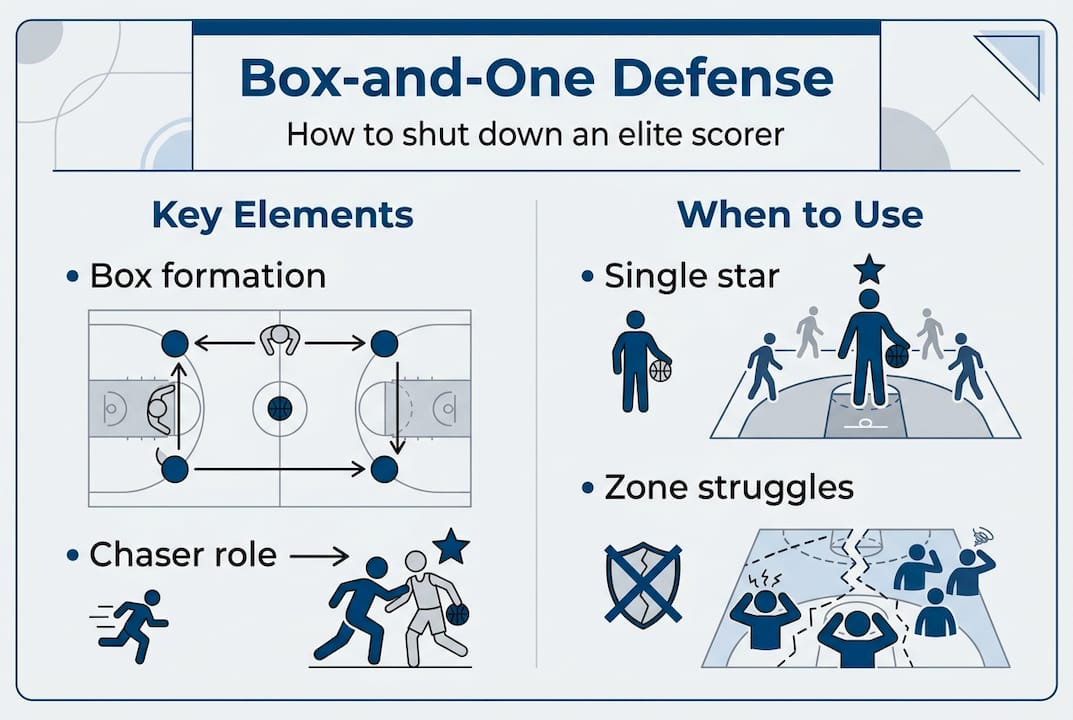
Four players hold a zone in a box shape, covering the paint and key scoring areas. The fifth player, called the “chaser,” locks onto the opponent’s primary scorer man-to-man. As explained in Box-and-1 Defense: A Complete Guide, the box-and-one features four players in a box zone and a fifth chaser assigned to the opposition’s main threat. That combination is what makes it so disruptive.
Here is how the box alignment breaks down:
- Two high players position near the elbows of the free-throw line
- Two low players anchor near the low blocks on each side of the paint
- The chaser follows the star scorer everywhere, through screens and off the ball
Compare this to other common defensive systems:
| Defense type | Structure | Best used against |
|---|---|---|
| Man-to-man | Each player guards one opponent | Balanced offensive teams |
| 2-3 zone | Two high, three low | Teams relying on perimeter shots |
| Box-and-one | Four in box zone, one chaser | Teams with one dominant scorer |
| 1-3-1 zone | Spread across three levels | Teams with weak ball handlers |
Understanding zone defense fundamentals helps you see why the box-and-one works. Zone principles protect the paint. Man principles neutralize individual threats. The box-and-one does both at once.
If you already run a 1-3-1 zone, you will find the box-and-one shares similar communication demands. Both require constant awareness of ball position and quick rotations. The difference is the chaser role, which adds a layer of individual pressure that pure zone defenses lack.
The box-and-one excels in specific circumstances:
- The opponent has one scorer averaging significantly more points than teammates
- Your team struggles to guard that scorer one-on-one in a full man defense
- You want to force role players to beat you from uncomfortable spots
- Late-game situations where limiting one player changes the outcome
This defense does not work by accident. It works because it forces the offense to solve a problem they did not prepare for.
Box-and-one mechanics: How it works in practice
Knowing the structure is step one. Getting your players to execute it under pressure is the real challenge. Here is the step-by-step flow your team needs to internalize.
- Set the box. Before the ball crosses half court, your four zone players lock into the box. High players at the elbows, low players at the blocks.
- Position the chaser. The chaser identifies the star scorer immediately and attaches to them, regardless of where they move.
- Shift as a unit. When the ball moves, the box shifts together. The box players shift as a unit based on the ball’s location, with the strong-side high player closing out on the wing and the weak-side player protecting the high post.
- Communicate constantly. Every player must call out screens, ball location, and rotation switches.
- Crash the boards. After a shot, all five players have rebounding assignments. This is where box-and-one teams often give up second-chance points.
Here is how player rotation looks across three common ball positions:
| Ball location | High-left player | High-right player | Low-left player | Low-right player |
|---|---|---|---|---|
| Top of key | Stays at elbow | Stays at elbow | Holds block | Holds block |
| Left wing | Closes to wing | Drops to high post | Stays at block | Shifts to paint |
| Right corner | Drops to high post | Closes to corner | Shifts to paint | Holds block |
Using defensive rotation drills in practice locks in these movements before they need to happen in a game. Repetition builds the instinct to shift together without thinking.
Team defense communication is the engine of this defense. Without it, gaps open and the offense finds easy looks. Every player must be vocal, not just the point guard.
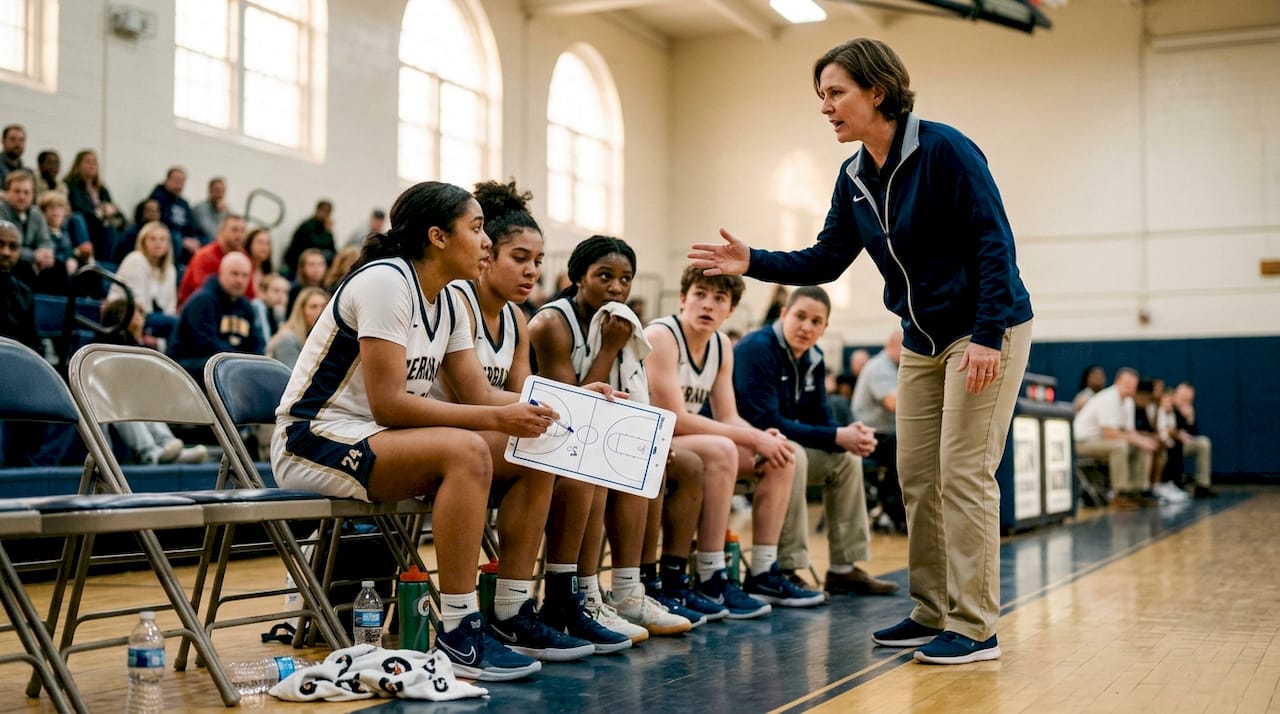
Pro Tip: Designate one player as the “box anchor” during practice. Their job is to call ball location on every pass. This one habit reduces breakdowns by keeping everyone oriented.
The most common live-game breakdown happens on skip passes. When the offense swings the ball quickly from one side to the other, the box must rotate fast. Drilling skip-pass rotations separately before combining them with the chaser element saves you from giving up open corner threes.
When (and when not) to use the box-and-one
Deployment timing is everything. Use this defense in the wrong situation and it becomes a liability.
Use the box-and-one when:
- The opponent has one scorer carrying the offensive load, often averaging 25 or more points per game
- Your team has a strong perimeter defender with the stamina to chase for extended stretches
- You want to disrupt the opponent’s offensive rhythm in a key moment
- The game situation calls for forcing role players to make decisions
As noted in Box-and-1 Defense: A Complete Guide, the defense is best used against teams relying on a single dominant scorer, not teams with multiple threats or poor communication. That boundary matters.
Avoid the box-and-one when:
- The opponent has two or more consistent scorers above 18 points per game
- Your team’s zone players are weak rebounders
- Your best defender is in foul trouble and cannot handle the chaser role
- The opponent has excellent spacing and ball movement that exposes zone gaps
A statistic worth noting: teams that hold a star scorer to 40% or less of their season average using targeted defenses often win games where they were considered underdogs. The psychological effect on the scorer and their team is real. When the star is neutralized, role players feel pressure they are not built for.
Pro Tip: Watch two or three film clips of the opponent’s star scorer before deciding on the chaser. Look for their go-to moves, preferred spots, and how they react when denied the ball early. That information shapes how aggressive your chaser should be.
Common errors coaches make:
- Over-helping: Zone players leaving their spots to double the star, which opens easy passes
- Poor communication: Box players not calling out screens, leading to the chaser getting lost
- Misreading matchups: Assigning a slow or foul-prone defender as the chaser
For more on reading the game and making real-time changes, check out these defensive adjustment tips. And if you want alternatives when the box-and-one is not the right fit, explore hybrid defense options that give you similar disruption with different structures.
Coaching tips: Teaching and troubleshooting the box-and-one
Your players cannot execute what they do not understand. Teaching this defense requires a clear progression from concept to live application.
Practice progression:
- Explain the concept. Walk players through the box alignment and chaser role using a whiteboard. Keep it simple. Show the four positions and the chaser’s path.
- Walk-through without defense. Have players move through the box rotation slowly, calling out positions as they shift. No offense yet.
- Static drill. Set up five offensive players in fixed spots. Defense holds positions and shifts only when you call a new ball location.
- Shell drill progression. Move to a shell drill format where the offense passes but does not drive. Defense rotates live.
- Live play. Full five-on-five with the chaser assigned to your best offensive practice player. This is where real reads develop.
As outlined in Box-and-1 Defense: A Complete Guide, the box-and-one requires drilling from static setups to live reads, with focus on communication, rotations, and rebounding. That sequence is not optional. Skipping steps creates confusion in games.
Key coaching reminders during each practice:
- Commitment: Every player must buy into their role. One distracted zone player breaks the whole structure.
- Communication: Constant verbal cues. Screen calls, ball location, rotation switches.
- Rebound positioning: After every shot attempt, all five players must know their box-out assignment. This is the most overlooked part.
Pro Tip: Assign a vocal leader, often your point guard or center, to organize the defense during breakdowns. Give them the authority to call resets mid-play. One voice in chaos prevents five players from guessing.
Using defensive drills for teams that isolate rotation and communication separately before combining them speeds up the learning curve. You can also pull specific cues from these defense coaching tips to reinforce what you are building in practice.
Troubleshooting common breakdowns:
- Chaser getting screened: Drill the chaser going over screens, not under. Under gives the scorer space.
- Box collapsing too early: Remind zone players their job is to protect the paint, not help the chaser.
- Rebounding lapses: End every defensive possession drill with a required box-out before the drill ends.
Our perspective: Why the box-and-one is underutilized and how coaches can unlock its real value
Most coaches treat the box-and-one as a last resort. They pull it out when nothing else is working, usually too late in the game. That is the wrong approach.
The real value of this defense is the disruption it creates before the opponent adapts. Offenses prepare for man and zone. They rarely prepare for both at once. When you run the box-and-one early, you force the opponent’s coaching staff to adjust on the fly. That costs them timeouts, momentum, and confidence.
As noted in Box-and-1 Defense: A Complete Guide, junk defenses like the box-and-one are situational tools that create chaos and force teams out of their comfort zone when coached well. The word “situational” is key. This is not a defense you run all game. It is a weapon you deploy with purpose.
Coaches who fear hybrid defenses often do so because they lack practice reps with them. That is a solvable problem. Build it into your weekly practice rotation, even if you only use it a handful of times per season. When the moment comes, your team is ready.
If you want to understand how opponents try to break out of these structures, studying beating zone defenses from the offensive side gives you a sharper defensive eye.
Advance your defense with Hoop Mentality resources
Implementing the box-and-one takes more than reading about it. You need structured practice time, clear player assignments, and the right drills in the right order.

Hoop Mentality has the tools to make that process faster. Use our practice plan template to build a session around introducing the box-and-one, from walk-throughs to live reps. For big men who anchor the low box positions, the big man dual action drill builds the footwork and positioning they need to hold their spots under pressure. Every resource is built from real coaching experience. Explore what fits your team.
Frequently asked questions
What is the main objective of the box-and-one defense?
Its primary goal is to neutralize a dominant scorer by dedicating one defender to them while the rest protect key scoring areas. The box-and-one’s chaser is assigned specifically to the opposition’s main threat, leaving the four zone players to cover the paint and perimeter.
When should coaches avoid using the box-and-one defense?
Avoid it against teams with multiple scoring threats or if your team lacks communication skills. The defense is best used against single-scorer-dependent teams, not balanced offenses.
Who should play the ‘chaser’ role in the box-and-one?
Assign your best perimeter defender with stamina, discipline, and the ability to avoid foul trouble. The chaser must guard the top scorer through screens and continuous off-ball movement, so fitness and focus are non-negotiable.
How do you beat a box-and-one defense?
Try ball reversals, spacing, and using multiple scoring threats to overload the defenders. Quick skip passes and off-ball movement force the box to rotate faster than it can recover.