

Being a good team leader is primarily about creating trust and developing your people while delivering results. Leadership IQ found teams run by excellent leaders show roughly 35% higher engagement than teams led by poor ones. Start today: schedule weekly one-on-ones and write down three clear expectations for each person on your team, using a simple SMART goal for at least one of them.
TL;DR:
- Effective leaders schedule weekly one-on-ones and set one measurable SMART goal per team member each quarter to foster growth and accountability.
- Good daily leadership behavior includes repeating goals during meetings, logging mood observations, admitting mistakes publicly, and delegating tasks that stretch skills.
- Consistent habits such as removing blockers early, providing specific feedback using the FIRE framework, and creating explicit team norms improve team performance over time.
- Leaders should tailor motivation to individual preferences, adapt their style based on team experience, and handle conflicts within days using structured problem-solving.
- Remote teams require deliberate check-ins, clear response norms, and asynchronous rituals to build trust and maintain effective communication.
Table of Contents
- Core Leadership Qualities and What They Actually Produce
- What Do These Qualities Look Like Day to Day?
- The 10 Things Good Team Leaders Do Every Week
- How to Run One-on-Ones and Delegation That Actually Develop People
- Feedback and Communication Rhythms That Build Trust
- What Builds Psychological Safety on a Team?
- Setting One SMART Goal and Measuring Your Impact as a Leader
- A Daily and Weekly Routine That Protects Your Leadership Time
- Conflict Resolution Strategies for Leaders
- Motivation Techniques Tailored to Different Team Members
- Adapting Leadership Style to Team Dynamics and Individual Needs
- Handling Difficult Conversations Effectively
- Strategies for Remote or Hybrid Team Leadership
- The Hoop Mentality Take: Leadership Lessons From the Sideline
- Coach-Ready Tools to Put This Into Practice
- Sources
- FAQ
Core Leadership Qualities and What They Actually Produce
Good leadership is not a personality trait. It is a set of behaviors that predictably move a team from confusion to output. Each quality below ties to something measurable, not just a warm feeling in a meeting room.
- Communication. Clear, frequent updates cut rework and reduce the “wait, what did you mean” emails that eat a Tuesday afternoon.
- Emotional intelligence. Reading tension before it becomes a resignation letter keeps turnover down and morale steady.
- Integrity. Following through on small promises (the meeting you said you’d move, the raise you said you’d fight for) is what makes people trust the big promises.
- Decisiveness. A leader who makes a timely call, even an imperfect one, keeps projects moving; indecision is its own kind of failure.
- Delegation. Handing off real authority, not just tasks, builds a bench of people who can eventually replace you.
- Coaching. Asking questions instead of handing out answers grows judgment in your team, not just task completion.
Leadership IQ’s survey of 3,018 leaders found only 19% felt adept at reducing burnout and just 43% could deliver feedback that actually changed behavior. Those gaps are exactly where new leaders should focus first.
What Do These Qualities Look Like Day to Day?
Reading about emotional intelligence and practicing it are two different skills. Here is what each core quality looks like when it shows up in a real Tuesday standup, not a leadership seminar.
- Communication looks like repeating the goal out loud at the start of every meeting so nobody is guessing. Thirty-day practice: end every one-on-one by asking, “What did you hear me say the priority is?”
- Emotional intelligence looks like noticing a normally talkative teammate go quiet and asking about it privately, not in the group chat. Thirty-day practice: log one observation about someone’s mood each day.
- Integrity looks like admitting in front of the team when your own call was wrong. Thirty-day practice: name one mistake out loud in every retrospective.
- Decisiveness looks like setting a deadline for your own decision, not just the team’s deliverables. Thirty-day practice: give yourself 24 hours max on any decision that doesn’t need more data.
- Delegation looks like handing a stretch task to someone with the authority to make it their own, not just a checklist. Thirty-day practice: delegate one task weekly that scares you a little.
Pro Tip: Keep a one-line leadership journal each night: what decision did I make, and what did it cost or earn me? Patterns show up in about two weeks.
The 10 Things Good Team Leaders Do Every Week
Good leadership rarely comes from one dramatic gesture. It comes from a short list of habits repeated on a schedule, in the same order the best coaching staffs run their weeks.
- Hold weekly one-on-ones. Fifteen minutes, no exceptions. Skipping this is the fastest way to lose touch with a struggling teammate.
- Set one SMART goal per person, per quarter. “Improve communication” is not a goal; “reduce handoff errors from five to one per sprint by March” is.
- Delegate for growth, not convenience. Give away tasks that stretch someone’s skill, not just the ones you don’t want to do.
- Give feedback using the FIRE framework. Facts, Interpretation, Reaction, End result. More on this below.
- Remove blockers before they escalate. Ask “what’s in your way?” before someone has to ask you for help.
- Celebrate specific wins, publicly. “Great job” is forgettable; “your fix on the client escalation saved the account” sticks.
- Coach for solutions instead of handing out answers. Ask, “What have you tried?” before you jump in.
- Create explicit team norms. Write down how you handle disagreements, deadlines, and communication so nobody has to guess.
- Measure outcomes, not just activity. Track delivery quality and engagement, not hours logged.
- Protect focus time, yours and theirs. Block two hours a day with no meetings and defend it like a deadline.
Each of these takes minutes, not hours, but the compounding effect over a quarter is what separates a team that drifts from one that improves. Harvard Business Publishing’s research on core leadership capabilities backs the same pattern: consistency in small behaviors outperforms occasional big gestures.
How to Run One-on-Ones and Delegation That Actually Develop People
A one-on-one that turns into a status update is a wasted fifteen minutes. Structure it so half the time is coaching questions (“What’s the hardest part of your week?”) and half is documented next steps. Write down what you agreed to, even in a shared note. That record becomes your own accountability tool.
Delegation follows a similar discipline. Leadership IQ’s guidance on delegating leadership points to picking tasks that force a new skill, giving real temporary authority, checking in at agreed points, and debriefing on what was learned rather than just whether the task got done.
- Pick a task that stretches, not one that’s simply annoying to you.
- Give the authority to make real decisions on it, not just execute yours.
- Check in twice, not daily; hovering defeats the point.
- Debrief on the learning, not just the outcome.
A simple 30-day plan: pick one skill to coach in someone, apply weekly check-ins to it, and measure whether it changed by day 30.
Pro Tip: Ask “what did you learn, not just what did you finish” at every debrief. That single question shift is what turns delegation into development.
Feedback and Communication Rhythms That Build Trust
Feedback fails most often because it’s vague or it arrives too late to matter. The FIRE framework fixes both: state the Facts (“you missed the Thursday deadline”), share your Interpretation (“it looked like priorities weren’t clear”), name the Reaction (“it put pressure on the release”), and agree on the End result (“let’s confirm deadlines every Monday going forward”).
- Use synchronous conversation (in person or video) for anything emotionally loaded.
- Use async messages for routine updates and confirmations.
- Give feedback within 48 hours of the event, not at the next scheduled review.
Teams led by leaders who develop strong goal-setting and feedback skills show measurably higher engagement, according to Leadership IQ, which found the average leader skill gap in this area is one of the largest in their survey.
What Builds Psychological Safety on a Team?
Trust is built in small, repeatable moments, not a single team-building retreat. The Center for Creative Leadership ties authenticity and coaching capability directly to higher engagement and performance.
- Follow through on commitments, even small ones like moving a meeting time.
- Be transparent about decisions you can’t change, and why.
- Admit your own mistakes before someone else points them out.
- Shield your team from unnecessary organizational noise.
Pair those behaviors with rituals: a regular retrospective, low-stakes “safe fail” experiments where mistakes are expected, negotiated team norms everyone helped write, and public recognition of good work. These rituals turn abstract trust into something people can actually see happening every week.
Setting One SMART Goal and Measuring Your Impact as a Leader
Pick one goal your whole team can see themselves in. Example: “Reduce client response time from 48 hours to 24 hours by the end of the quarter, measured weekly.” That’s specific, measurable, achievable, relevant, and time bound, the five letters of SMART.
- Track delivery quality (errors, revisions, client complaints).
- Track feedback cadence (are one-on-ones actually happening weekly?).
- Track an engagement indicator (a simple 1 to 5 pulse check monthly).
- Track development progress (did the delegated skill actually improve?).
Run a 30-day measurement experiment: pick the metric, check it weekly, and adjust your approach based on what moved. Leadership IQ’s framework recommends this micro-practice approach specifically because it avoids the overwhelm of trying to fix everything at once.
A Daily and Weekly Routine That Protects Your Leadership Time
Start each morning by picking the one conversation or decision that matters most, and do it before checking email. Reactive firefighting is the biggest thief of leadership energy.
- Weekly: one-on-ones, a short team review, and a goal check-in.
- Daily: a two-line journal entry on one decision and its outcome.
- Protected: at least one no-meeting block for deep problem-solving.
- Friday close: one sentence on what you learned that week.
Pro Tip: End every Friday with the question “what would I do differently?” It takes ninety seconds and prevents the same mistake from repeating in week three.
Conflict Resolution Strategies for Leaders
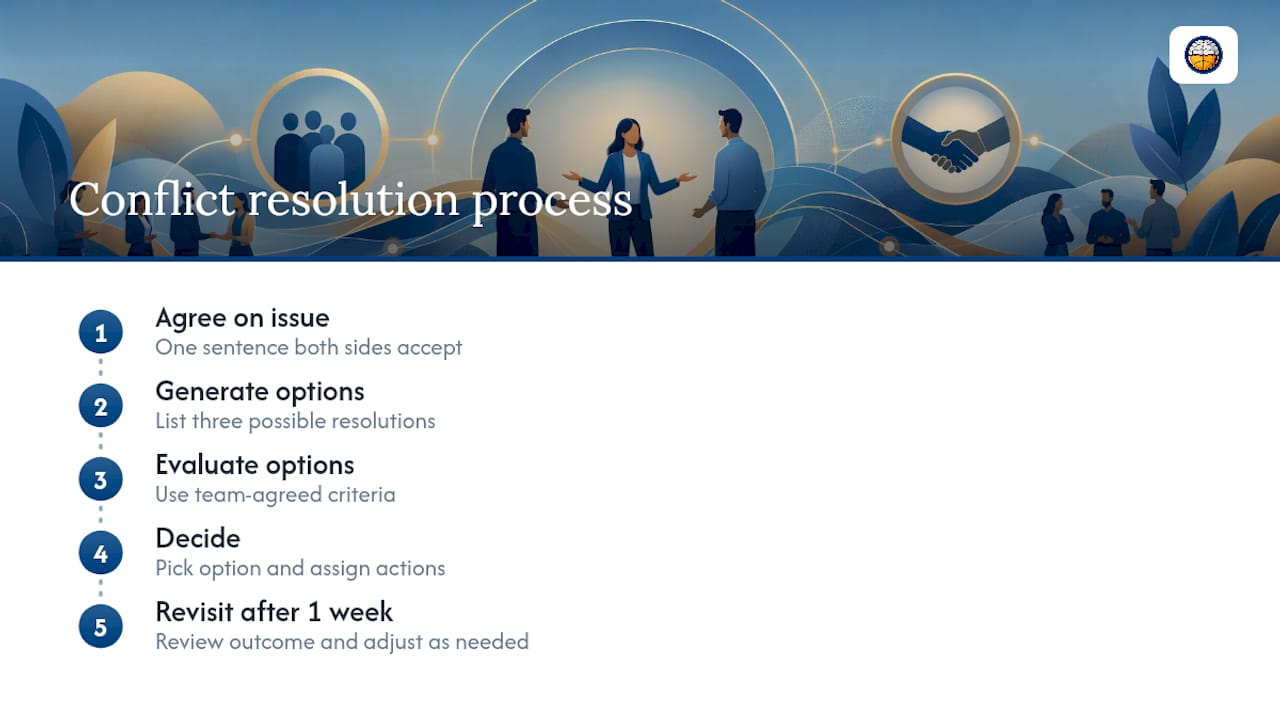
Conflict avoided doesn’t disappear, it just moves underground and shows up as passive resistance three weeks later. The better move is a structured problem-solving session: define the disagreement in one sentence both sides agree on, generate three possible resolutions, evaluate them against criteria the team agreed to in advance, decide, and revisit the outcome a week later.
Separate the person from the position. “You’re being difficult” derails a conversation; “we disagree on the deadline, let’s look at the workload” keeps it productive. Address conflict within days, not weeks. The longer a disagreement sits, the more it hardens into a grudge instead of a solvable problem.
Some conflict is actually useful. Disagreement over how to approach a project, surfaced early and handled respectfully, produces better decisions than forced harmony. Your job is not to eliminate all friction. It’s to keep friction productive instead of personal.
Motivation Techniques Tailored to Different Team Members
Generic motivation (“great job, team!”) lands flat because people are not motivated by the same things. Some teammates want public recognition; others find it uncomfortable and prefer a private note. Some are driven by mastery and want harder problems; others are driven by stability and want predictable schedules.
Ask directly: “What makes a project feel worth doing to you?” Most leaders never ask this simple question and instead guess based on their own preferences. Match the reward to the person: autonomy for the self-directed teammate, structure for the one who thrives on clarity, visibility for the one chasing growth into a bigger role.
Tie motivation to real development, not just praise. Leadership IQ’s coaching guidance notes that great leaders create conditions for exceptional performance by developing people, not simply managing their tasks.
Adapting Leadership Style to Team Dynamics and Individual Needs
The leadership style that works with a seasoned, self-sufficient team will frustrate a group of newer hires who need more direction. A new employee usually needs clear instructions and frequent check-ins; an experienced teammate usually needs autonomy and just enough context to run with it.
Read the room before choosing your approach. A team under deadline pressure needs a more directive style temporarily; a stable team doing familiar work benefits from a collaborative, hands-off approach that builds ownership.
The CCL’s framing of leadership as a social process producing direction, alignment, and commitment (the DAC framework) is useful here: your style should flex to whatever the team currently lacks most. A team with clear direction but low alignment needs more collaborative conversation; a team with alignment but no commitment needs clearer stakes and follow-through.
Handling Difficult Conversations Effectively
Most difficult conversations get harder because leaders delay them, hoping the problem resolves itself. It usually doesn’t. Schedule the conversation within 48 hours of noticing the issue, in private, and prepare three specific facts before you walk in.
Open with the fact, not the judgment: “You’ve missed the last three deadlines” lands better than “you don’t seem committed.” State the impact clearly, then ask an open question: “What’s going on?” Give real space for the answer before offering your own read.
End every difficult conversation with a concrete next step both people agree to, and a date to revisit it. Vague conversations that end on “let’s just be better about this” rarely change anything.
Strategies for Remote or Hybrid Team Leadership
Leading a remote or hybrid team removes the hallway conversations that used to catch small problems early. That means you need to build those check-ins deliberately instead of relying on chance encounters.
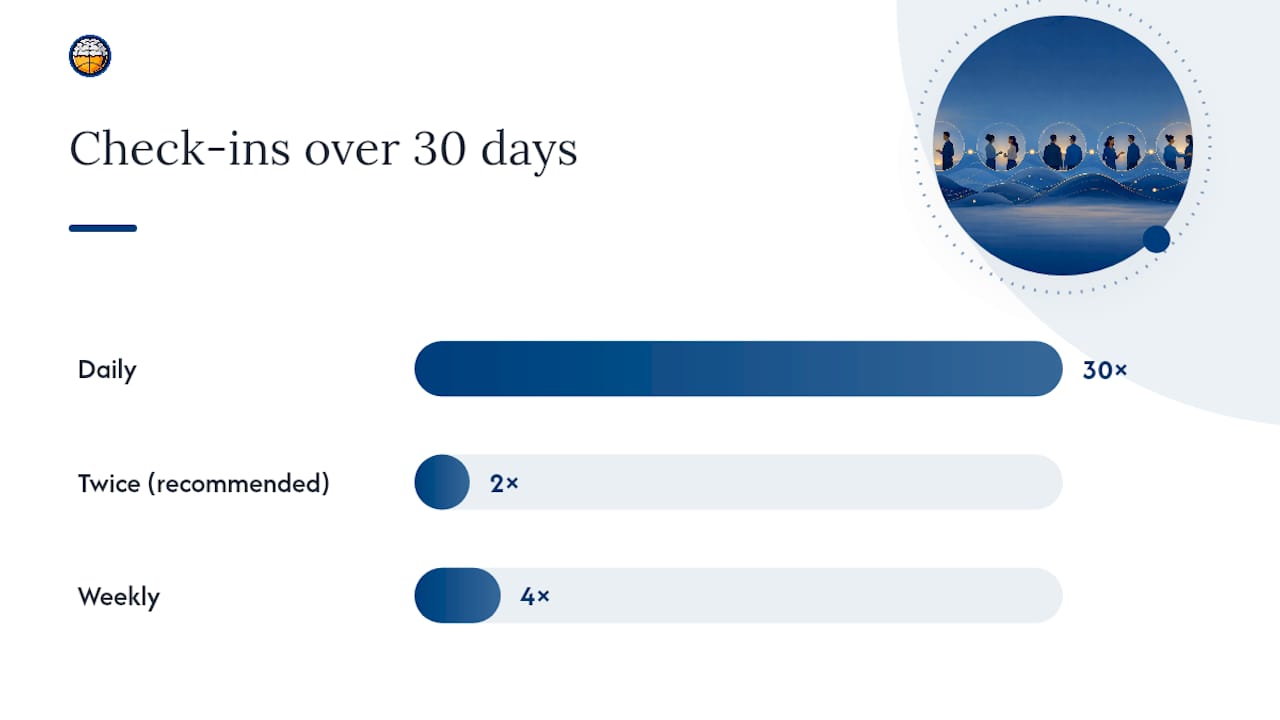
Keep one-on-ones on video, not just chat, at least twice a month; tone and hesitation are easy to miss in text. Set explicit norms for response times so nobody is anxiously waiting on a reply that was never urgent. Overcommunicate context on decisions since remote teammates miss the informal explanations that happen in an office.
Create asynchronous rituals that replace in-person ones: a weekly written update, a shared goals document, a recorded standup for people in different time zones. The core leadership qualities don’t change remotely. The delivery mechanism does.
The Hoop Mentality Take: Leadership Lessons From the Sideline
Coaching a basketball team is leadership under a stopwatch. Weekly player one-on-ones surface the same issues a corporate manager finds: confusion about role, quiet frustration, a skill nobody flagged. A scouting report template works the same way a SMART goal does in an office. It turns “get better” into a specific, trackable target for one player at a time. The core leadership roles we outline for coaches map almost exactly onto what new managers need: clarity, consistency, and a plan for developing people, not just running plays.
— Dejan
Coach-Ready Tools to Put This Into Practice
If you’re leading a basketball team instead of an office, the same trust-and-development principles need a practical structure behind them, not just good intentions. A player code of conduct template gives you the written norms this article recommends creating with your team, already built for a sports setting instead of a generic corporate one. Pair it with a scouting report template to track individual development goals the way a SMART goal does for an office team member.
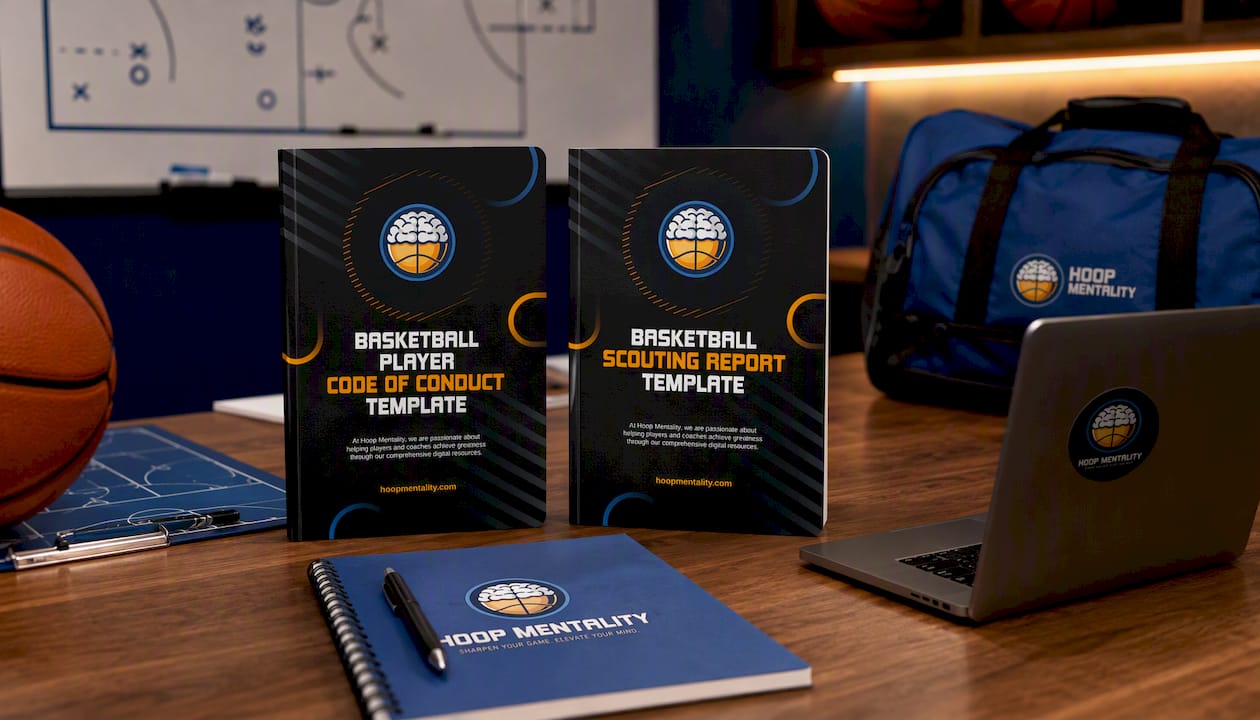
These resources are designed to support weekly habits like setting clear expectations, delegating responsibility, and measuring progress instead of relying on hope alone. Browse the full basketball playbooks collection to structure your practices around the goals you set with your team, check the basketball drills library for skill-specific development work, or look through the basketball guides and basketball templates for ready-made tools. If conditioning is part of your team’s development plan, the basketball workouts collection rounds it out. Pick one template this week and put it in front of your team at your next practice.
Sources
- How to develop leaders in your organization: a practical framework — Leadership IQ
- Leadership Reframed for the Workplace of the Future — Harvard Business Publishing
FAQ
What Is the Most Important Quality of a Good Team Leader?
Trust, built through consistent follow-through and clear communication, underpins every other leadership quality. Teams with excellent leaders show about 35% higher engagement than teams with poor ones, and that gap traces back to trust more than any single skill.
How Often Should a Team Leader Hold One-on-Ones?
Weekly one-on-ones, even just fifteen minutes, catch small problems before they become resignations or missed deadlines. Skipping them is one of the fastest ways new leaders lose touch with their team.
What Is the FIRE Feedback Framework?
FIRE stands for Facts, Interpretation, Reaction, and End result, a structure for giving feedback that changes behavior instead of just venting frustration. Leadership IQ’s research found only 43% of leaders feel confident giving feedback that actually shifts behavior.
How Do I Delegate Without Losing Control of the Outcome?
Give real temporary authority over the task, not just the labor, and schedule two check-ins instead of hovering daily. End with a debrief focused on what was learned, which is the approach Leadership IQ’s delegation guidance recommends for developing people rather than just getting tasks done.
Does Hoop Mentality Offer Tools for Team Leadership, Not Just Basketball Strategy?
Yes. Templates like the player code of conduct and scouting report are built for setting team norms and tracking individual development, the same leadership work covered in this guide. Pricing details for these resources are available on the Hoop Mentality website.