



TL;DR:
- Assistant basketball coaches handle a wide range of responsibilities, including practice planning, recruiting, academic support, and in-game adjustments. Their specialized roles in scouting, player development, and game management directly impact team strategies and fostering player growth. They also serve as vital continuity agents, maintaining culture through coaching transitions and reinforcing clarity in leadership dynamics.
Most coaches assume the assistant’s job is simple: run drills, track time, hand out water bottles. That picture misses almost everything. Assistant basketball coach duties span practice design, opponent scouting, recruiting coordination, academic monitoring, and in-game tactical adjustments. Get these roles right and your program runs with clarity. Get them wrong and practices feel disorganized, recruiting falls apart, and players slip through academic cracks. This guide breaks down every major responsibility so you know exactly what to expect, assign, and execute at any level.
Table of Contents
- Core responsibilities of assistant basketball coaches
- Specialized tasks: Scouting, player development, and game support
- Compliance, recruiting challenges, and academic support
- Assistant coach roles in youth basketball: Game management and player readiness
- Organizational and leadership dynamics of assistant coaching
- The role most programs underestimate
- Ready to build a more organized coaching staff?
- Frequently asked questions
Key Takeaways
| Point | Details |
|---|---|
| Assistant coach’s diverse role | Assistant basketball coaches manage practices, recruiting, player development, compliance, and game support. |
| Recruiting requires balance | Effective recruiting includes athletic skill assessment and academic vetting to reduce attrition. |
| Tactical specialization | Assistants lead position drills and scouting, enhancing team preparation and player skills. |
| Youth game management | At youth levels, assistants handle substitutions and timeout logistics to support head coaches. |
| Leadership structure | Assistants execute tactical plans within the strategic framework set by head coaches, fostering strong communication and culture. |
Core responsibilities of assistant basketball coaches
The range of assistant basketball coach duties is wider than most people realize, and it changes based on your level. At the college level, assistant coaches assist in planning and directing all activities for a Division I program, including recruitment, practice coordination, skill instruction, academic advising, and NCAA compliance. That is a full job description in one sentence.
Let’s break down what that looks like in practice:
- Practice coordination. At the college level, preparing practice sessions takes several hours each day. Assistants build drill sequences, coordinate equipment, manage time blocks, and adjust plans based on player availability.
- Recruiting. Assistants vet prospects both athletically and academically. They track communication timelines, maintain contact records, and often make the first calls to recruits.
- Academic advising. Assistants monitor grades, coordinate with tutors, and work directly with academic advisors to keep athletes eligible and on track toward graduation.
- NCAA compliance. This means ongoing education, regular record keeping, and knowing exactly which rules apply to every recruiting contact or activity.
- Youth level logistics. At the youth level, basketball coaching responsibilities shift toward game-day operations. Assistants manage substitutions, track timeouts, and prepare players mentally before they step onto the floor.
Understanding the full scope helps you build a basketball coach responsibilities framework that assigns tasks clearly before the season begins. Ambiguity in a coaching staff creates confusion on game day.
Specialized tasks: Scouting, player development, and game support
Once the general duties are clear, the specialized roles of an assistant coach become even more impactful. These are the tasks that directly shape your team’s tactical identity and your players’ individual growth.
Scouting is one of the most time-intensive responsibilities in the role. A thorough opponent breakdown requires 10 to 20 hours per game. That includes video analysis and tendencies review, identifying patterns in offense sets, defensive rotations, and individual player habits. Assistants condense that research into a usable scouting report the head coach and players can act on.
Player development is the second major pillar. Assistants lead position-specific drills rather than running generic group activities. A guard might spend 45 minutes working on ball-handling under pressure while bigs work on post footwork. This specificity accelerates individual growth far faster than generalized sessions.
Here is what effective specialized support looks like:
- Run targeted position drills tied to the week’s scouting report
- Rotate scouting assignments across staff to build versatility and prevent burnout
- Provide individual feedback after every practice rep, not just game film sessions
- Monitor player fatigue and flag it to the head coach before it affects performance
- Assist with tactical adjustments during games by tracking opponent tendencies in real time
The assistant coach training process should teach each staff member to own at least two of these specialized areas. Check out this skills development workflow for a structured approach to player improvement. For the scouting side, this basketball scouting workflow gives you a repeatable system from film room to game-day report.
Pro Tip: Build a weekly rotation where each assistant owns one scouting assignment and one position group. It creates accountability, grows your staff’s versatility, and removes the bottleneck of having a single person carry the entire analytical load.
Compliance, recruiting challenges, and academic support
Moving from the court to the office, this is where many assistant coaches feel the most pressure. Compliance and academic support are not glamorous, but they are the backbone of a sustainable program.
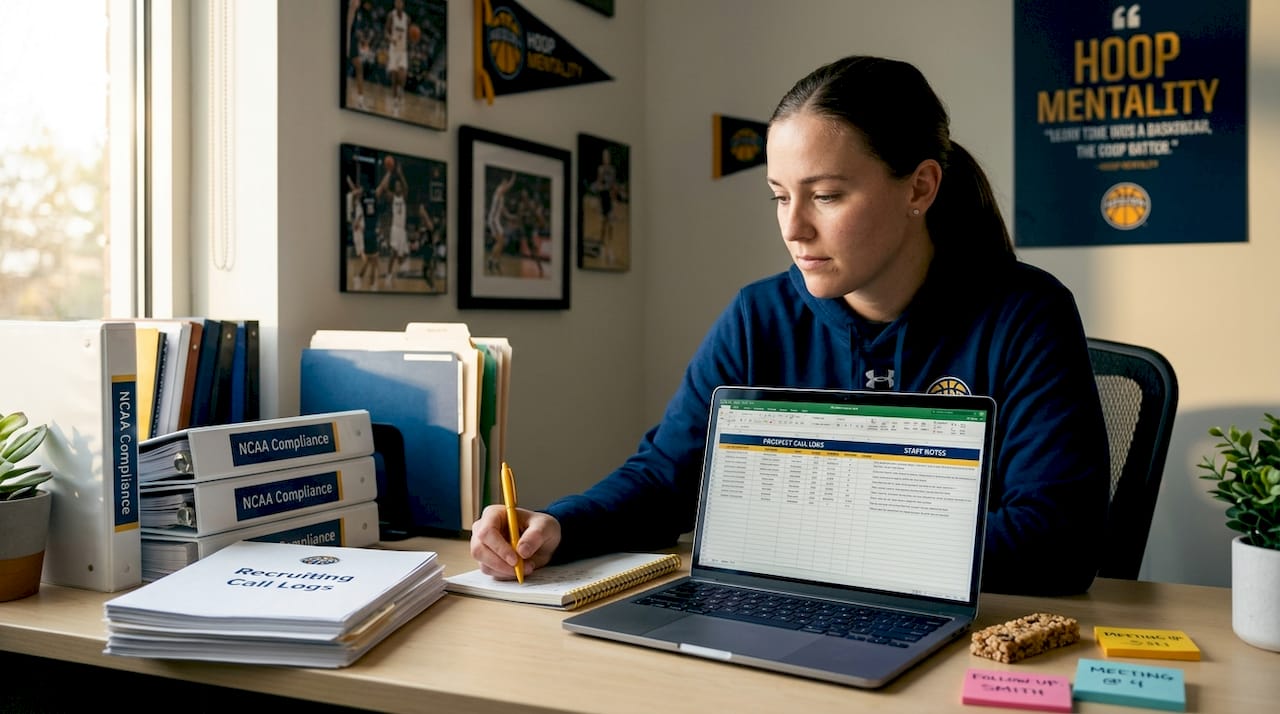
Compliance duties involve daily recruiting call record-keeping, eligibility monitoring, and mandatory NCAA certification tests. Miss a deadline and your program faces sanctions. It is that direct.
The recruiting challenge is just as serious. Over-recruiting without academic vetting causes 30 to 40 percent attrition rates. That means players leave before they can contribute, and your roster stability collapses. Early coordination with admissions offices and consistent tutoring assignments are what prevent that pattern.
Here is a practical compliance and academic process to follow each season:
- Build a recruiting contact log updated after every call, visit, or email
- Schedule NCAA certification completion at the start of the calendar year
- Assign an academic liaison role to one assistant per class year of players
- Meet with each player’s academic advisor at least once per semester
- Flag eligibility risks six weeks before they become disqualifying
“The assistant who owns academic relationships owns team continuity. Players stay enrolled when they feel supported, not just recruited.”
This is also where the coach responsibilities for recruiting and academics become a long-term competitive advantage. Programs that graduate players attract better recruits. The cycle reinforces itself.
Assistant coach roles in youth basketball: Game management and player readiness
At the youth level, the roles of an assistant coach shift from analysis to real-time operations. The game moves fast and the head coach cannot track everything simultaneously. That gap is where assistants provide direct value.
Assistants manage the bench during youth games by tracking player rotations, ensuring substitutes are mentally ready, handling timeout logistics, and staying clear of the head coach’s decision-making authority. That last part matters more than most assistants expect. Stepping on the head coach’s communication with players during a timeout creates confusion, not clarity.
Practical bench duties at the youth level include:
- Rotation tracking. Monitor who has played and for how long. Checking every two to four minutes prevents both overplaying starters and losing track of players who have not entered the game.
- Sub readiness. Before a player enters, give them a quick mental cue. One specific task, not a speech. “Box out on every miss” is more useful than “go play hard.”
- Timeout management. Have water, note pads, and position cards ready before the timeout is called. Your job is to clear the operational space so the head coach can coach.
- Minutes tracking. Monitoring total minutes per player reduces fatigue and keeps younger players engaged throughout the game.
- Trust boundaries. Know when to speak and when to observe. A good assistant does not compete with the head coach for a player’s attention.
Pro Tip: Keep a simple rotation chart on a clipboard with player names and minute counts. Update it every possession change. At the end of a close game, you will always know who is fresh without having to guess.
These youth basketball coaching duties are where trust between you and the head coach is built or broken. Do the operational work completely and the relationship runs smoothly.
Organizational and leadership dynamics of assistant coaching
Beyond the task list, understanding how assistants fit into the coaching hierarchy is what separates good staff from great ones. The structure is not about rank. It is about clarity.
Head coaches set strategy while assistants specialize in task execution and player development, and well-structured staff roles improve team performance by up to 30 percent. That figure reflects what happens when communication is clear and no one is stepping outside their lane.
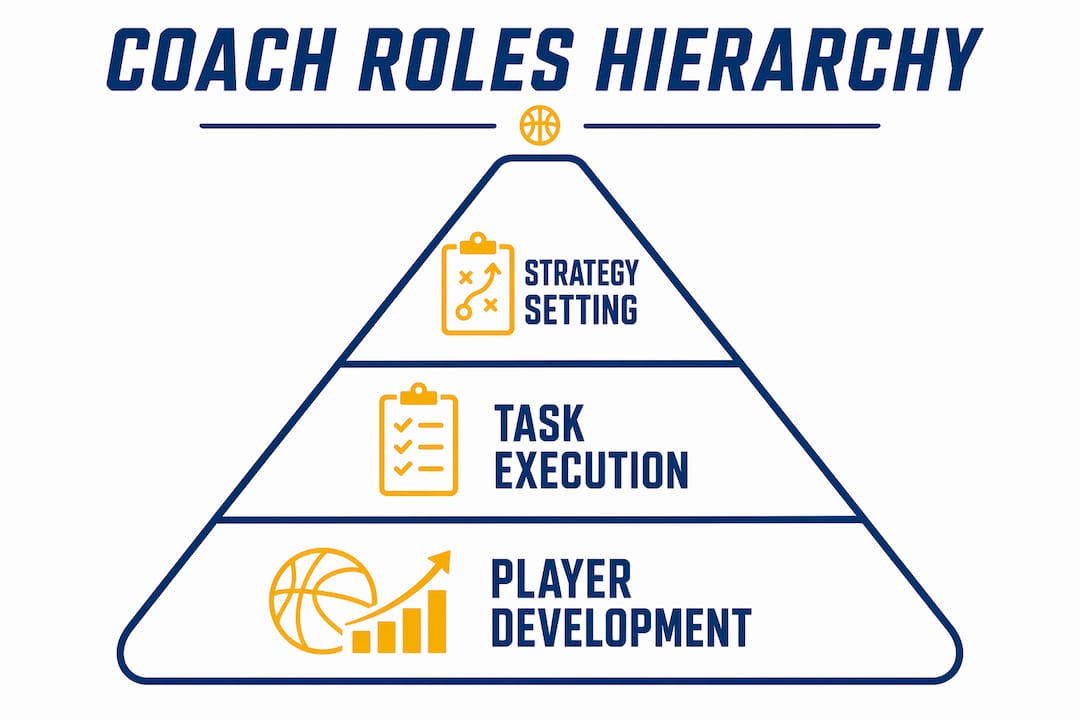
Here is how the leadership structure breaks down in practice:
| Area | Head coach responsibility | Assistant coach responsibility |
|---|---|---|
| Game strategy | Sets offensive and defensive systems | Executes drills to install the system |
| Recruiting | Final decisions on offers | Initial contact and prospect vetting |
| Player development | Sets development priorities | Leads individual skill sessions |
| Compliance | Program-level accountability | Daily record keeping and certification |
| Academic support | Program standards | Individual player monitoring |
| Game-day adjustments | Strategic timeouts and matchups | Real-time tracking and data relay |
The assistant’s role in communication is especially important. Players will share things with an assistant they would not say directly to the head coach. That information, relayed appropriately, helps the head coach address issues before they affect performance. Assistants serve as a genuine bridge, not just a relay point.
Here is how to build clear leadership dynamics on your staff:
- Define each assistant’s primary ownership area before preseason
- Set a weekly staff meeting to align on player status and practice priorities
- Establish a communication protocol for player concerns that protects confidentiality
- Review task assignments mid-season and redistribute if workload is uneven
Strong leadership skills in basketball start with the coaching staff modeling clarity and accountability. When assistants lead with confidence in their defined areas, players follow that example. Use these player development tips for coaches to connect your staff structure directly to player growth outcomes.
The role most programs underestimate
Here is something most coaching articles will not tell you. The assistant coach is often the real continuity of a program. Head coaches get hired, fired, and moved. Assistants, especially those at the associate level, carry the culture, the relationships, and the systems through those transitions.
Programs that treat the assistant role as a temporary stepping stone end up rebuilding from scratch every coaching change. Programs that invest in assistant coach training and give assistants genuine ownership build something that lasts. The players see it too. When an assistant is clearly in charge of a skill area and holds players accountable within it, the respect is immediate.
Team strategy development is not a solo act. The best head coaches we have seen at Hoop Mentality are the ones who rely on assistants to challenge their assumptions in staff meetings, not just confirm them. That dynamic is what keeps game planning honest and adaptive.
Define the duties clearly. Assign them with intention. Then let your assistants lead.
Ready to build a more organized coaching staff?
At Hoop Mentality, every resource we offer is built around the real work coaches do every day.

Our practice plans, scouting templates, and playbooks give your staff the structure to execute assistant basketball coach duties with confidence. No more spending hours building materials from scratch. Whether you are coordinating a youth bench or running a college program’s recruiting pipeline, our tools cover every layer of basketball coaching responsibilities. Explore our full collection at Hoop Mentality and give your staff what they need to prepare, plan, and perform at their best. Ready to get organized? Start browsing today.
Frequently asked questions
What are the primary duties of an assistant basketball coach?
Assistant basketball coaches assist in planning, organizing, recruiting, practice coordination, and compliance. They also handle player development, academic advising, and game-day support to keep the program running effectively.
How much time do assistant coaches spend on recruiting?
Recruiting via mail, phone, and in-person visits targets 50 to 100 prospects annually. Assistants carry much of this workload, including initial outreach and eligibility screening.
What role do assistant coaches have in NCAA compliance?
Assistants complete annual NCAA certification and maintain recruiting records and eligibility documentation to keep the program in good standing and avoid sanctions.
How do assistant coaches support youth basketball teams during games?
Youth assistants manage the bench, rotate players, handle timeout logistics, and support the head coach without overruling decisions or disrupting player communication during play stoppages.
What is the leadership dynamic between head and assistant coaches?
Head coach sets strategy; assistants handle tactical execution and communication. Assistants bridge the gap between players and the head coach, surfacing insights the head coach cannot always see directly.