

Use this ready-to-run 60-minute youth basketball practice plan template and paste it into your practice board before your next session. The structure is simple: warm-up, fundamentals, team concepts, scrimmage, and cool-down. Each block has a set time window, so you’re not guessing what to run next mid-practice.
Here’s the fastest path to running it:
- Copy the block names and timings below onto a clipboard or whiteboard.
- Swap in drills your team already knows for the first run.
- Download Hoop Mentality’s Basketball Practice Plan Template if you want it pre-formatted and printable.
Key Takeaways
A 60-minute youth basketball practice built on timed warm-up, fundamentals, team concepts, scrimmage, and cool-down blocks develops skills faster than unstructured scrimmage-heavy sessions.
| Point | Details |
|---|---|
| Follow the five-block structure | Warm-up, fundamentals, team concepts, scrimmage, and cool-down each need a set time window, not an open-ended slot. |
| Protect fundamentals time | Give 20 to 30 minutes to skill work before scrimmage eats the clock; skills built early prevent plateaus later. |
| Adjust for age | Ages 6 to 8 run 45 to 60 minutes with short drill cycles; ages 12 to 14 can handle 75 to 90 minutes. |
| Prep before players arrive | Set objectives, station leads, and equipment in advance so warm-up starts on time. |
| Use a ready-made template | Hoop Mentality’s Basketball Practice Plan Template gives coaches an editable, coach-tested 60-minute structure without building one from scratch. |
Table of Contents
- What Goes Into a Youth Basketball Practice Plan Template?
- Exact 60-Minute Practice Plan With Timed Blocks
- How Should Practice Length Change by Age Group?
- Must-Have Drills for Every Practice Segment
- Pre-Practice Checklist Before Players Arrive
- Hoop Mentality’s Practice Plan Tools and Author Background
- Where Most Practice Plans Go Wrong
- Get a Ready-Made Practice Plan Instead of Building One From Scratch
- Sources
- FAQ
What Goes Into a Youth Basketball Practice Plan Template?
A solid youth practice plan template breaks a session into five blocks: warm-up, fundamentals, team concepts, scrimmage, and cool-down. Each one has a job to do, and the time you give it should match that job, not just fill a slot on the schedule.
Here’s how a standard 60-minute session divides up, based on common practice-plan breakdowns:
- Dynamic warm-up (8 to 10 minutes). Basketball-specific movement, not static stretching. Think high knees, defensive slides, and layup lines that raise heart rate while touching the ball.
- Fundamentals (20 to 30 minutes). The bulk of practice. Ball-handling, passing, and shooting progressions live here, moving from controlled reps to light pressure.
- Team concepts (6 to 15 minutes). Simple plays, spacing rules, or defensive rotations. Younger teams get less time here; older teams can absorb more.
- Scrimmage (7 to 15 minutes). Controlled 3v3 or 4v4, or a short 5v5 with coaching stops built in, so mistakes turn into lessons instead of just running the clock.
- Cool-down and reflection (3 to 5 minutes). A stretch, a water break, and one takeaway you want players to remember walking off the court.
Progression matters more than any single drill choice. Coaches get the best results moving from form work to controlled application to live, pressured play rather than jumping straight into scrimmage-style chaos. Start clean, add pressure gradually, and finish with something game-like.
Pro Tip: Post the block timings somewhere players can see, even a piece of tape on the scorer’s table with times written in marker. Kids self-regulate better when they know how much time is left in a drill.
Exact 60-Minute Practice Plan With Timed Blocks
Here’s the plan, minute by minute. Print it, tape it to a clipboard, or load it straight into Hoop Mentality’s practice plan template and adjust drill names to fit your roster.
| Time | Block | What to run |
|---|---|---|
| — | Dynamic warm-up | High knees, lateral slides, layup lines, dynamic stretches |
| — | Fundamentals | Stationary dribbling, cone weave, partner passing, form shooting |
| — | Team concepts | Spacing drills, simple motion offense, or shell defense rotations |
| — | Scrimmage | Controlled 3v3 or 4v4 with coach stops for teaching moments |
| — | Cool-down | Static stretch, one takeaway, quick announcements |
A few notes on running it well:
- Keep fundamentals drills in 3 to 10 minute cycles so players stay engaged instead of drilling the same motion until it gets sloppy, a pattern backed by common youth coaching templates.
- During team concepts, limit your talking to the first 30 seconds, then let players work through it with one-line corrections as reps happen.
- Stop the scrimmage every few minutes for a 15-second teaching point, not a full lecture. Kids remember the moment, not the speech.
- Save your final coaching cue for cool-down. One clear takeaway sticks better than five scattered notes.
This template works as written for a typical 10 to 12 player roster with two coaches. Adjust the fundamentals-to-scrimmage ratio if your team needs more skill repetition or more game reps heading into a tournament week.
How Should Practice Length Change by Age Group?
Session length should track attention span, not just the calendar on your schedule. Younger players lose focus fast; older players can handle longer technical blocks and more live play.
Age-group guidelines commonly map out like this, based on youth development research:
- Ages 6 to 8: 45 to 60 minutes total, with drill cycles kept under 5 minutes. These players learn through short games and repetition, not long explanations.
- Ages 9 to 11: 60 to 75 minutes, with slightly longer fundamentals blocks and simple team concepts introduced gradually.
- Ages 12 to 14: 75 to 90 minutes or more, where scrimmage time and defensive systems can expand since attention and conditioning have caught up.
If you notice energy dropping mid-practice, trim the team-concepts block first and extend fundamentals instead. Skill work with a ball in hand holds attention longer than a chalk-talk on rotations.
Equipment matters too. Ball size, rim height, and even court dimensions should follow standard youth guidelines for the age group you’re coaching. A 10-year-old struggling to shoot on a 10-foot rim with a full-size ball isn’t a skill problem, it’s an equipment mismatch.
Must-Have Drills for Every Practice Segment
Every block in your template needs two or three reliable drills you can rotate through a season without reinventing practice each week. Here’s a starter library organized by segment.
Warm-up: Dynamic movement drills (high knees, defensive slide series) and a layup-line variation get bodies moving and balls in hands at the same time. Hoop Mentality’s warm-up drill collection has several options that take under 10 minutes.
Ball-handling: Start with a stationary dribbling series, move to a cone weave, then finish with a competitive relay once the fundamentals click. This progression from controlled reps to pressure is exactly what effective practice structures recommend, and Hoop Mentality breaks down seven ball-handling drill types if you want more variety.
Passing: Partner progressions build the basics; monkey-in-the-middle adds decision-making under light defensive pressure. Both teach players to read the defense instead of just executing a mechanical pass.
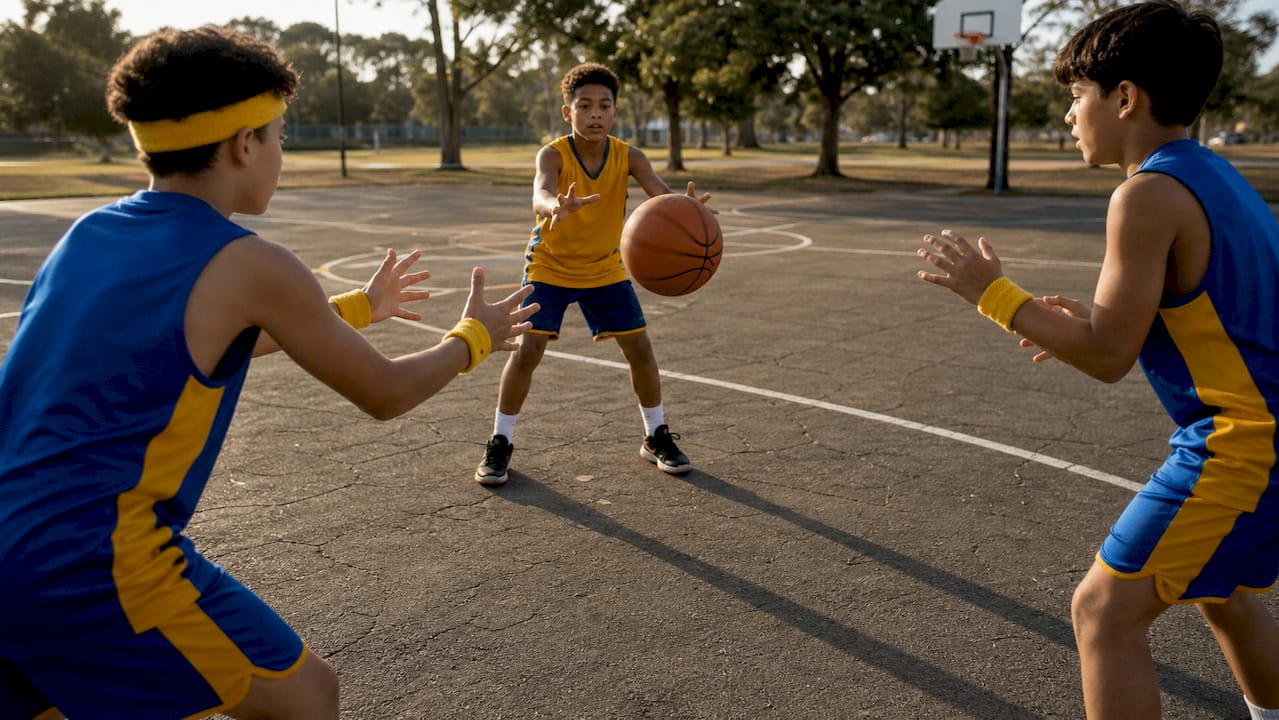
Shooting: Teach BEEF form (balance, eyes, elbow, follow-through) early, then move to spot shooting and Mikan drills for layup mechanics near the rim.
Defense and games: Closeouts, shell drills, and 1-on-1 containment work build habits without a full scrimmage. Mix in a fun mini-game occasionally, engagement-focused games keep energy up on days when technical drills feel repetitive.
Pro Tip: Rotate one new drill into a segment each week instead of replacing your whole library. Kids need repetition to actually improve, and swapping everything constantly resets that progress.
Pre-Practice Checklist Before Players Arrive
Practice runs smoother when the first five minutes are already solved before anyone steps on the court. A short pre-practice routine prevents the scramble that eats into your warm-up window.
- Write one to three session objectives and post them where assistant coaches can see them, not just in your head.
- Set up stations and equipment before players arrive, so warm-up starts on time instead of during setup.
- Assign a warm-up leader and station leads if you have assistant coaches or older players helping out.
- Set a visible timer or use a stoplight system so transitions between blocks happen without you calling out constantly.
- Plan two short coaching cues in advance, phrases you’ll use to pause play for a teaching moment without derailing momentum.
Coaches who identify two or three objectives before practice and communicate them during warm-up tend to run more focused sessions. Players know what they’re working toward instead of just running drills for the sake of running drills.
Hoop Mentality’s Practice Plan Tools and Author Background
This template guidance comes from Dejan, an experienced basketball coach who has built practice structures across youth and competitive levels. The 60-minute breakdown above reflects patterns that hold up across age groups and skill levels, not a one-size-fits-all script.
Hoop Mentality builds resources around exactly this kind of practical need:
- The Basketball Practice Plan Template covers single-session planning, ready to print or edit before tonight’s practice.
- The Game Preparation Guide With Weekly Practice Plan extends this into weekly and season-level planning for coaches managing a full schedule.
- The Basketball Template Bundle For Coaches packages templates, drills, and playbooks together for coaches running multiple teams or seasons.
Each resource is built from real coaching experience, not generic filler, and designed to save prep time so you spend more of it actually coaching.
Where Most Practice Plans Go Wrong
The biggest mistake in youth practice planning isn’t drill selection, it’s time allocation. Coaches consistently give too much time to scrimmage because it’s fun to watch and too little to fundamentals because form work feels slow. That’s backward for development. A team that scrimmages for 25 minutes and drills fundamentals for 15 will look competitive at age 9 and plateau by age 12, because the skill foundation never got built properly.
The conventional advice to “just have fun and let them play” undersells what a printable, timed template actually does for a coaching staff. It’s not about rigidity, it’s about protecting the fundamentals block from getting eaten by scrimmage enthusiasm. A template posted courtside also lets assistant coaches run stations independently, which frees you up to actually watch technique instead of managing logistics.
If you take one thing from this, prioritize the fundamentals-to-scrimmage ratio over drill variety. You can run the same three shooting drills all season and still see progress, but you can’t skip form work and expect scrimmage reps to fix it. Structure first, creativity second.
Get a Ready-Made Practice Plan Instead of Building One From Scratch
Building a 60-minute practice plan from a blank page every week costs you time you could spend actually coaching. Hoop Mentality’s templates are already structured, timed, and coach-tested, so you copy the blocks in and adjust drills instead of designing a session from zero.
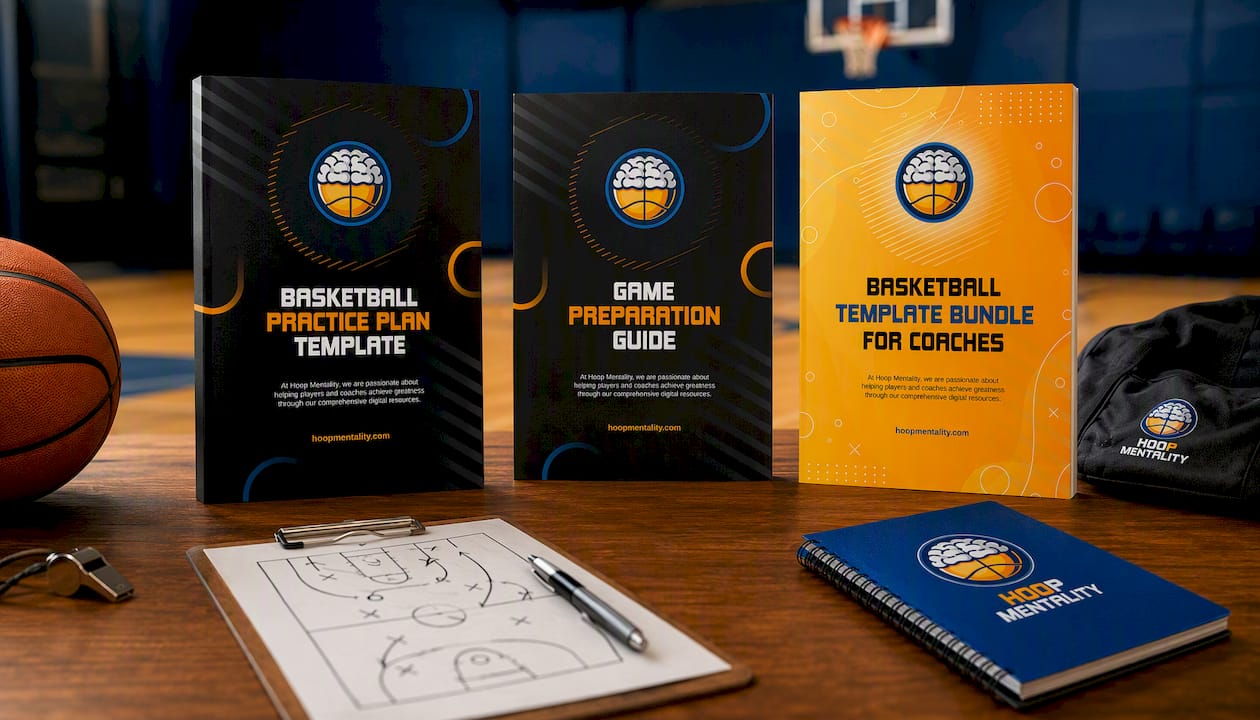
If you’re running single sessions, the Basketball Practice Plan Template gives you an editable PDF with the block structure and timing built in. Coaches planning a full week or preparing for a specific opponent get more out of the Game Preparation Guide With Weekly Practice Plan, which extends the same logic across a full schedule. If you’re managing multiple teams or want playbooks, drills, and scouting tools in one place, the Basketball Template Bundle For Coaches covers all of it in a single download.
Every resource downloads instantly after checkout, ready to print or edit before your next practice. Browse the Hoop Mentality product catalog and pick the template that matches your season.
Sources
- Youth Basketball Practice Plan Template | Practice Plan App
- Basketball Practice Plan (Free Templates & Drills)
- Create an Effective Youth Basketball Practice Plan
FAQ
How Long Should a Youth Basketball Practice Be?
Most youth sessions run 45 to 90 minutes depending on age, with 60 minutes working well for the 9 to 11 age range using the five-block template above.
What Are the Five Blocks in a Basketball Practice Plan?
Warm-up, fundamentals, team concepts, scrimmage, and cool-down, each with its own time window based on age and session length.
How Much Time Should Scrimmage Get in Youth Practice?
Roughly 7 to 15 minutes of a 60-minute session, run as controlled 3v3 or 4v4 with coaching stops rather than an uninterrupted full-court game.
Can I Use the Same Template for Different Age Groups?
Yes, but adjust the timing. Younger players need shorter drill cycles and less team-concept time, while older players can absorb longer fundamentals and scrimmage blocks.
Where Can I Get a Printable Practice Plan Template?
Hoop Mentality’s Basketball Practice Plan Template provides an editable, ready-to-print version of the structure covered here.