

TL;DR:
- Progressive drills are structured exercises that gradually increase in complexity to develop basketball skills. They outperform static repetition by embedding deliberate practice cycles and applying overload principles for better transfer and injury prevention. Effective practice involves moving players through stages from mechanics to live game scenarios, tailored to individual mastery to ensure skill retention and motivation.
Progressive drills are structured training exercises that increase in complexity and challenge over time, making them the most effective method for basketball skill development. Unlike static repetition, progressive drilling techniques build on each stage of learning, moving athletes from foundational mechanics to live, game-speed scenarios. Research on deliberate practice confirms that structured feedback cycles outperform unstructured repetition for skill acquisition. Coaches who understand why use progressive drills gain a clear advantage in designing practices that produce real results on the court.
Why use progressive drills instead of static repetition?
Progressive drills replace shallow repetition with deliberate cycles of attempt, feedback, reflection, and adjustment. That structure is what separates skill development from mere activity. A player who shoots 200 free throws with no feedback is not practicing. A player who shoots 20 with a specific cue, adjusts based on a coach’s correction, and repeats the adjusted movement is learning.
Deliberate practice sessions of 15 minutes with structured feedback outperform hours of unstructured drilling for skill acquisition. That finding matters because most coaches have limited practice time. Spending 90 minutes on static repetition is a poor trade when 20 minutes of structured progression produces deeper retention.
Static drills also fail the motivation test. Without attempt, feedback, and adjustment cycles, repetitive drills lead to poor skill transfer and low motivation. Players disengage when the challenge never changes. Progressive drills keep athletes mentally active because each stage demands more than the last.
Pro Tip: Track which stage of a drill each player is working on. When a player completes a stage consistently, move them forward. Do not wait for the whole group.
| Drill Type | Skill Transfer | Player Engagement | Game Readiness |
|---|---|---|---|
| Static repetition | Low | Decreases over time | Poor |
| Progressive drilling | High | Sustained | Strong |
How does progressive overload apply to basketball drills?
Progressive overload is the principle that the body only improves when the training stimulus increases beyond what it has already adapted to. The nervous system recruits more motor units and improves activation only when the challenge increases. Apply that to basketball and the implication is direct: drills that never get harder stop producing results.
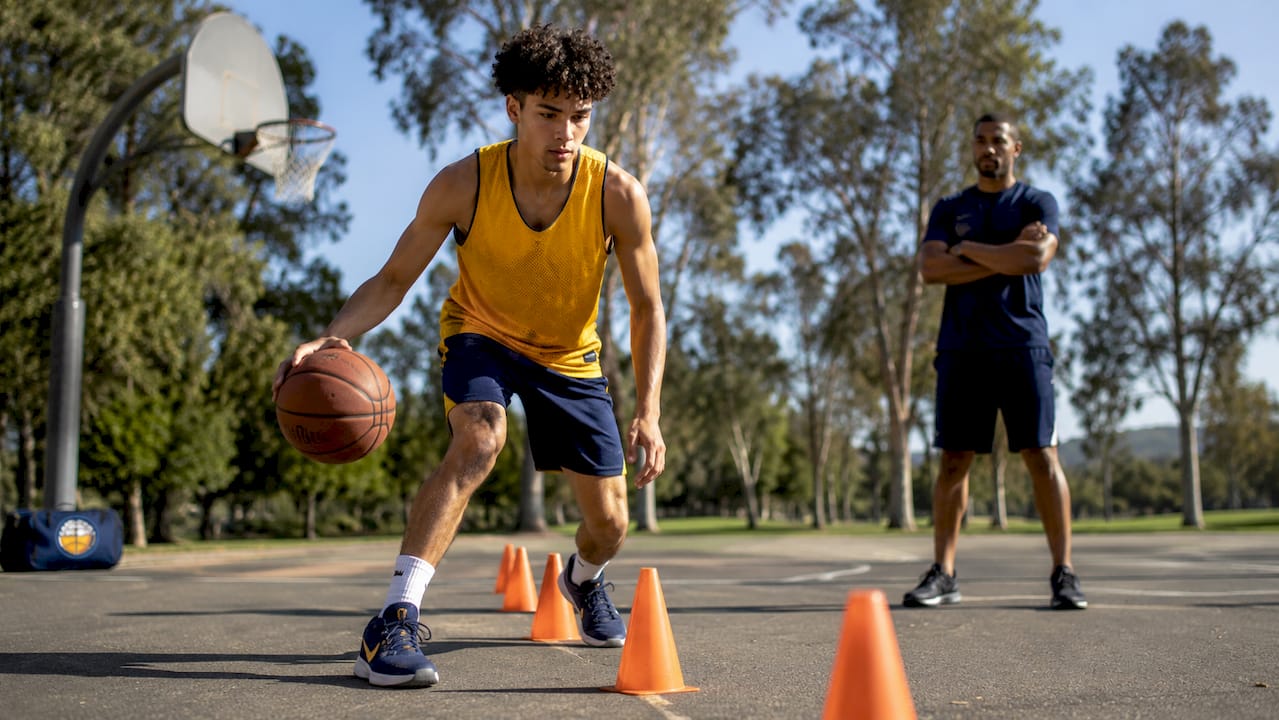
The benefits of progressive drills come directly from this principle. A ball-handling drill that starts with stationary dribbling, then adds movement, then adds a defender, then adds a shot decision at the end is applying progressive overload to a skill. Each layer forces the nervous system to adapt. Each layer builds on the one before it.
Small, consistent increases in training difficulty yield better long-term progress than random or large jumps. That is a critical point for coaches who rush players through progressions. Skipping stages does not accelerate development. It creates gaps in the motor pattern that show up under game pressure.
Here is how to apply progressive overload safely in basketball drills:
- Start with the foundational movement at low speed with no opposition.
- Add a secondary skill once the first movement is consistent (for example, add a pass after a dribble move).
- Introduce a passive defender who adds mild pressure without contesting aggressively.
- Add a live defender with full contest rights.
- Add a time constraint or score consequence to simulate game stakes.
Pro Tip: If a player breaks down technically when you add a new layer, remove one layer and rebuild. Regression is a coaching tool, not a failure.
How do you design progressive drills from basics to game scenarios?
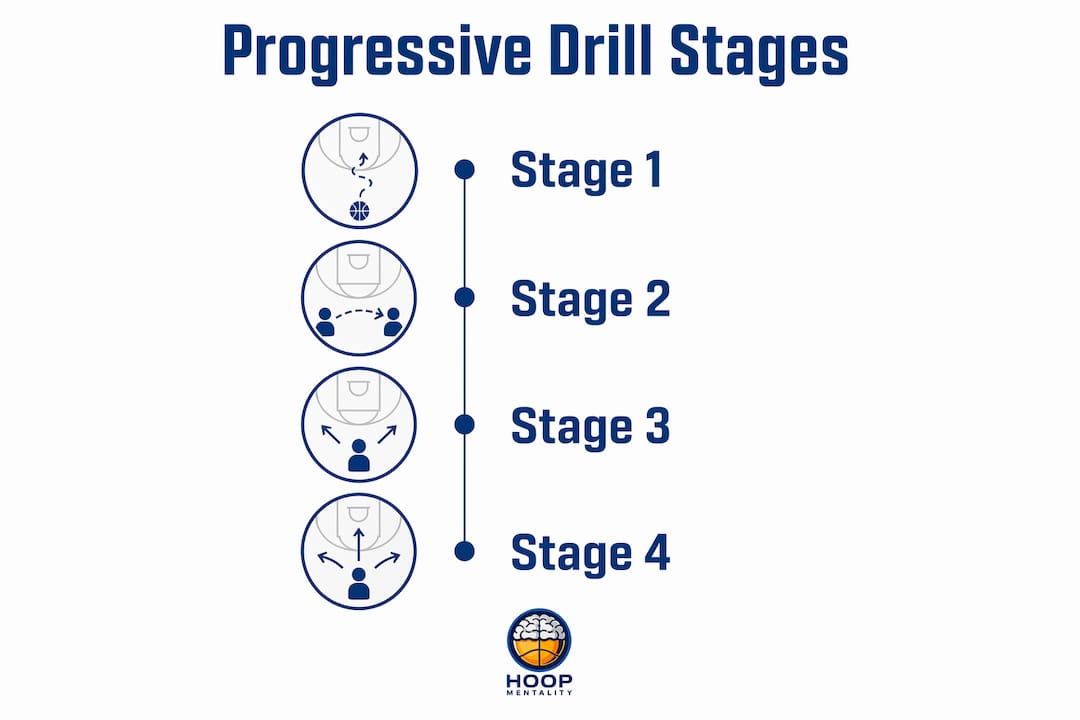
The most effective progressive drill design moves athletes through four clear stages: foundational mechanics, controlled repetition, reactive drills, and live pressure scenarios. Each stage has a specific purpose. Skipping any stage leaves a gap between what a player can do in practice and what they can execute in a game.
Stage 1: Foundational mechanics
Coaches teach the correct movement pattern with no time pressure and no opposition. The goal is to build the motor blueprint. A shooting drill at this stage might involve a player catching, setting their feet, and shooting from a stationary position with a coach providing immediate feedback on form.
Stage 2: Controlled repetition
The player repeats the skill at a moderate pace with consistent, clean feeds. The environment is still controlled, but the volume increases. Logical progressions improve engagement and skill retention compared to random movement patterns. This stage builds the habit without adding chaos.
Stage 3: Reactive drills
The player now responds to a cue rather than a clean feed. A passer varies the timing. A coach calls out a spot. The player reads and reacts. This stage is where skill applicability improves because the athlete must process information before executing. It mirrors the read-and-react demands of actual game play.
Stage 4: Live pressure scenarios
The drill now includes a defender, a score, or a consequence for failure. This is the stage most coaches skip too quickly or avoid entirely. Introducing consequences produces honest feedback. A player who can hit a pull-up jumper in a controlled drill but collapses under live pressure has not yet transferred the skill. Live pressure exposes that gap and closes it.
A common mistake coaches make is spending 80% of practice time in stages 1 and 2. The advantages of using progressive drills only fully materialize when players spend meaningful time in stages 3 and 4. The sports employment sector increasingly values coaches who can demonstrate structured, evidence-based practice design. That starts with knowing how to move players through all four stages.
How do progressive drills reduce injury risk and player stagnation?
Gradual progression protects athletes from overload injuries. Systematic progression bridges motor patterns and competitive demands, preventing stagnation and unsafe overloads. When a coach jumps a player from stationary drills to full-speed live scenarios without intermediate stages, the athlete’s body and decision-making system are not ready. That gap is where injuries and mental errors occur.
The psychological benefits are equally significant. Adaptive challenge prevents drill stagnation and burnout common in static practice. Players who feel challenged but not overwhelmed stay engaged. Players who repeat the same drill at the same difficulty level for weeks lose focus and stop growing.
Progressive drills also close the practice-to-game performance gap. That gap is the most frustrating problem coaches face: a player who looks sharp in practice but disappears in games. The reason is almost always a drilling methodology that never reaches stage 3 or 4. The skill development workflow for closing that gap requires reactive and live elements in every practice session.
Key benefits of progressive drills for player health and engagement:
- Gradual intensity increases reduce soft tissue injury risk compared to sudden spikes in load.
- Structured challenge keeps players mentally present and reduces practice-time disengagement.
- Reactive drill stages prepare athletes for the unpredictability of game situations.
- Coaches can identify skill gaps earlier because each stage reveals specific weaknesses.
- Players build confidence at each stage before facing the next level of difficulty.
The basketball skill progressions used by experienced youth coaches follow this exact pattern. Confidence built at each stage carries forward. A player who masters stage 2 before moving to stage 3 arrives at stage 3 with a foundation that holds under pressure.
Key Takeaways
Progressive drills outperform static repetition because they apply deliberate practice cycles and progressive overload to build skills that transfer directly to game situations.
| Point | Details |
|---|---|
| Deliberate practice beats repetition | Structured feedback cycles produce deeper skill retention than unstructured drilling. |
| Progressive overload drives growth | Increasing drill complexity forces nervous system adaptation and prevents performance plateaus. |
| Four-stage drill design works | Move players from foundational mechanics through reactive and live pressure stages for full skill transfer. |
| Gradual progression reduces injury | Systematic increases in challenge protect athletes from overload and keep motivation high. |
| Live pressure closes the game gap | Drills without consequences fail to prepare players for real game demands. |
What I’ve learned from watching coaches skip the hard stages
Coaches confuse repetition with progression more often than any other mistake I see. A player who does 50 dribble moves in a row with no defense, no decision, and no consequence has not practiced. They have warmed up. The drill looked busy. The gym sounded active. Nothing transferred.
The coaches who get the most out of progressive drilling are the ones who are willing to make practice uncomfortable early. They introduce reactive elements in the second week of a new skill, not the sixth. They add a defender before the player feels “ready.” That discomfort is the signal that learning is happening.
The other pitfall I see consistently is treating all players as if they are at the same stage. A point guard who has run a pick-and-roll drill 200 times does not need stage 1 again. A freshman who just learned the footwork does. Running the same drill at the same stage for the whole team wastes time for the advanced players and overwhelms the beginners. Stage-based tracking is not extra work. It is the job.
Feedback and reflection are not soft additions to a drill. They are the mechanism that makes the drill work. After a reactive drill, ask the player what they saw, not just what they did. That reflection step is what deliberate practice research identifies as the difference between practice that sticks and practice that evaporates.
— Dejan
Hoop Mentality resources for progressive drill planning
Designing progressive drills from scratch takes time. Hoop Mentality builds that structure into ready-to-use coaching resources so you can focus on running the practice, not building it from zero.

The Basketball Template Bundle for Coaches includes practice plan templates, drill progressions, and skill development frameworks built around the four-stage model. Each resource is editable, so you can adapt it to your roster and schedule. Coaches also use the offseason improvement drills collection to run structured progressions when the season is not pushing the pace. Both resources are practical, direct, and ready to use at your next practice.
FAQ
What are progressive drills in basketball?
Progressive drills are training exercises that increase in complexity and challenge across defined stages, moving players from foundational mechanics to live, game-speed scenarios. Each stage builds on the previous one to develop skills that transfer to actual game situations.
Why do progressive drills improve skill retention?
Progressive drills embed deliberate practice cycles of attempt, feedback, reflection, and adjustment, which produce deeper learning than static repetition. Research confirms that structured feedback sessions outperform unstructured drilling for skill acquisition.
How do progressive drills reduce injury risk?
Systematic progression increases training demands gradually, giving the body time to adapt before facing higher loads. Jumping from controlled drills to full-speed live scenarios without intermediate stages is where overload injuries most commonly occur.
When should a coach move a player to the next drill stage?
Move a player forward when they execute the current stage consistently with correct technique, not just once or twice. Consistency under the current challenge level signals readiness for the next layer of difficulty.
How often should progressive drills appear in a practice plan?
Progressive drills should appear in every practice session. At minimum, each skill worked in practice should reach stage 3 (reactive) before the session ends, with stage 4 (live pressure) included at least several times per week.