

Drop coverage is a pick-and-roll defense where the screener’s defender retreats toward the paint or nail while the on-ball defender fights over the top, forcing the ball handler into a mid-range shot instead of a layup or open three. It works best when your big protects the rim and the ball handler isn’t a knockdown pull-up shooter. Skip it against pop shooters or guards who thrive from 15 feet, since that’s exactly the shot drop coverage hands them.
TL;DR:
- Drop coverage works best when your rim protector can stay home and prevent shooters from pulling up or popping behind the arc.
- It is most effective against non-shooting rollers and slow guards, but can be exploited by elite shooters and teams with strong floor spacing.
- Proper execution requires pre-communication, disciplined rotations, and quick adjustments based on the opponent’s shot profile.
- Coaches should tailor drop coverage to the opponent’s threats, switching higher or adjusting when shooters hurt or the scheme breaks down.
- Training drills focused on real-time reads, communication, and pattern recognition improve scheme consistency and reduce blown coverages.
Table of Contents
- What Is Drop Coverage, Exactly?
- Setting Up Roles Before the Screen Even Happens
- Running Drop Coverage Step by Step
- Team Rotations Behind the Drop
- When Drop Coverage Works and When It Backfires
- Drills That Actually Teach Drop Coverage
- What Hoop Mentality Has Learned Coaching Bigs Through This
- A Coach’s Honest Take on Choosing Drop Coverage
- Build Practices That Teach Drop Coverage Correctly
- Sources
- FAQ
What Is Drop Coverage, Exactly?
Drop coverage assigns the screener’s defender, usually your center or power forward, to sink back toward the nail or top of the paint the moment a ball screen is set. That defender’s job is not to chase the screener. It’s to hold ground between the rim and the ball, keeping both the ball handler and the roller in front until help arrives.
Meanwhile, the on-ball defender fights over the screen rather than going under it, chasing the ball handler back into the play. For a beat or two, you effectively have two defenders in front of the ball, a temporary numbers advantage that buys the on-ball defender time to recover.
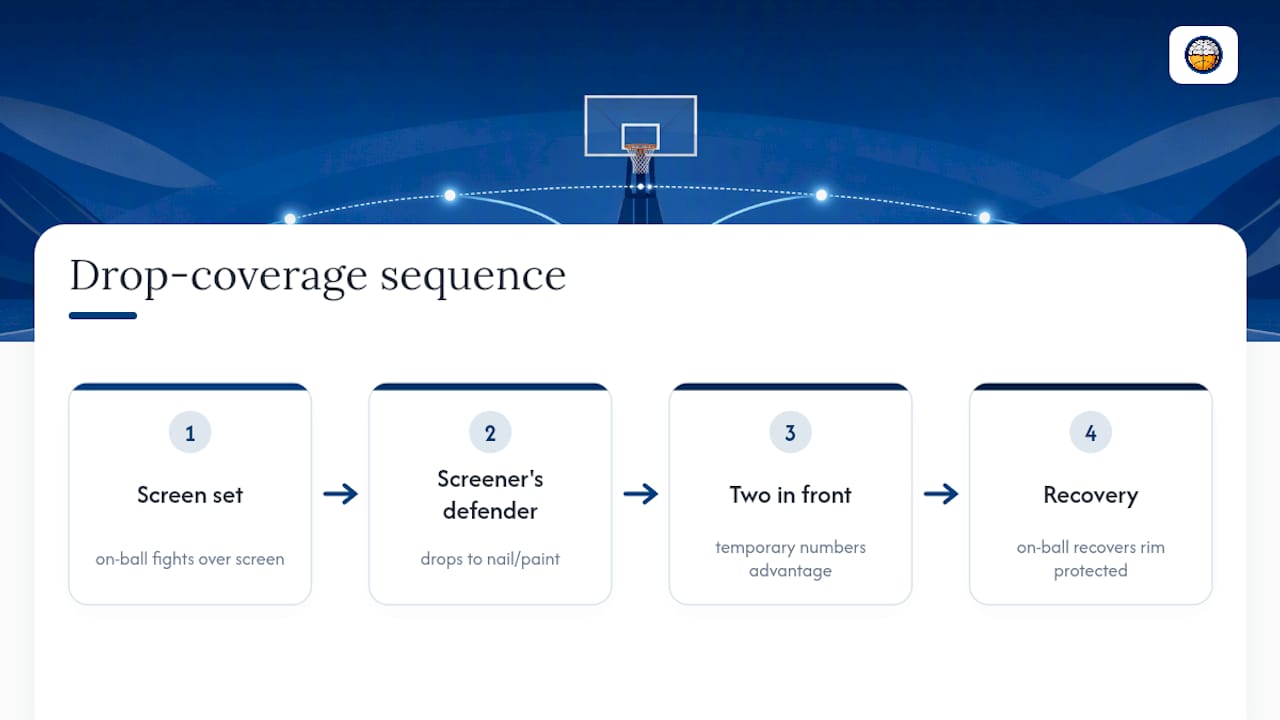
The screener’s defender typically drops to the nail or paint area and stays there until the guard fights back over the top. The whole scheme exists to protect the rim first, then force a contested mid-range look as the fallback.
Setting Up Roles Before the Screen Even Happens
Good drop coverage gets decided before the ball screen is set, not during it. Every player on the floor has a job the instant they see the pick-and-roll developing.
- Screener’s defender: starts at the nail or just above the free-throw line, adjusting a step higher against a screener who likes to pop and a step lower against a pure roller.
- On-ball defender: fights over the screen with a low, quick angle, squeezing the ball handler’s driving lane rather than getting knocked off course.
- Weak-side helper: shades toward the roller’s path to tag him as he cuts, buying an extra half-second for the drop defender.
- Baseline defender: holds position to cut off any dump-off pass and stays alert for a kick to the corner.
Practice teaching short, sharp call phrases like “over,” “drop,” and “tag” so players react on instinct rather than thinking through the assignment mid-possession. That verbal shorthand matters more than most coaches assume because a drop defender’s assignment demands real-time communication and pattern recognition, not just size.
Running Drop Coverage Step by Step
Once the screen is set, the sequence unfolds fast. Here’s the order of operations to drill into your players.
- The screen sets. The drop defender reads the angle and starts sinking toward the paint immediately, before the ball handler even attacks it.
- The guard fights over. The on-ball defender squeezes tight to the screener’s back, refusing to get pinned flat against it.
- The big finds their depth. Against a slower ball handler or tighter gap, the drop defender can hold closer to the free-throw line. Against a quick guard with a wide-open driving lane, the drop needs to sink deeper, closer to the block.
- The read. If the ball handler drives, the drop defender contains without fully committing, staying square to take away the layup while trusting the recovering guard to catch up. If the roller cuts hard to the rim, the drop defender shifts to cut off that passing lane first.
- The recovery. Once the on-ball defender is back in front of the ball, the drop defender releases back to the roller or resets to help position.
The most common breakdown happens when the on-ball defender gets smeared, or pinned flat against the screener, forcing the drop defender to commit early and abandon the paint. Guard technique on the angle and timing of the fight over is often the difference between a scheme that holds and one that collapses.
Pro Tip: If your guard gets smeared, coach the big to bump and delay for one extra step rather than fully committing to the ball. That single beat is often enough for the guard to recover without the rim getting exposed.
Team Rotations Behind the Drop
Drop coverage only holds up when the other three defenders move correctly, because the drop itself creates gaps elsewhere on the floor. This is where possessions get lost even when the primary two defenders execute cleanly.
- Weak-side defenders tag the roller as he cuts, disrupting the pocket pass or lob before it becomes a clean look at the rim.
- Corner and baseline defenders hold their ground rather than crashing early, since a premature rotation opens a kick-out three.
- Coordinated weak-side help protecting the roller and the baseline is what actually prevents kick-outs and lob chances that the drop’s spacing invites.
- Once the ball handler resets or picks up their dribble, every defender sprints back to their original assignment rather than lingering in help position.
Small tags differ from full rotations. A tag is a half-second bump to slow the roller. A full rotation, where a helper fully commits and someone else has to cover for them, should only happen when the drop defender is genuinely beaten.
When Drop Coverage Works and When It Backfires
Drop coverage protects the rim, keeps your defense in simple, teachable positions, and thrives against screeners who can’t shoot. Against a non-shooting roller, dropping deep essentially takes away the highest-value shot on the floor and dares the opponent to settle.
Where it wins:
- Simplifies rotations for young or inexperienced defenders.
- Neutralizes non-shooting screeners by taking away the roll entirely.
- Protects the rim without needing elite guard-on-guard containment.
Where it fails:
- Pop shooters who step behind the arc instead of rolling expose the drop defender’s retreat.
- Elite pull-up shooters punish the space drop coverage concedes in the mid-range, turning the “safe” shot into a good one.
- Spain actions and heavy floor-spacing sets stretch the drop defender thin.
Rudy Gobert built a career on drop coverage precisely because his length lets him protect the rim while conceding the mid-range, a trade coaches accept when their bigs share that profile. Mobile bigs without that rim presence often fare better in a different pick-and-roll defense scheme entirely.
Drills That Actually Teach Drop Coverage
Coaches don’t need a complicated install to teach drop coverage. They need reps that isolate the read before adding pressure.
- Two-man read drill. Ball handler and screener run a live pick-and-roll against just the drop defender and on-ball defender, forcing both to communicate the “over” and “drop” calls out loud.
- Four-on-four shell with tag emphasis. Add weak-side defenders who must tag the roller on every rep, grading them on timing rather than outcome.
- Live closeout progression. Move from walk-through pace to full speed, then to closeouts off a kick-out pass, so players feel the tempo shift.
- Scrimmage with constraints. Play possessions where a made mid-range shot counts less than a made three, reinforcing the shot value the scheme is designed to concede.
Progressing from walk-through to live closeouts and then into constrained scrimmage situations mirrors how the read actually speeds up in games. For structured versions of these reps, Hoop Mentality’s guide on how to teach pick and roll breaks the progression into practice-ready segments.
Pro Tip: Track a simple checkpoint each week: how often the drop defender contains without fouling. That single number tells you more about readiness than watching film alone.
What Hoop Mentality Has Learned Coaching Bigs Through This
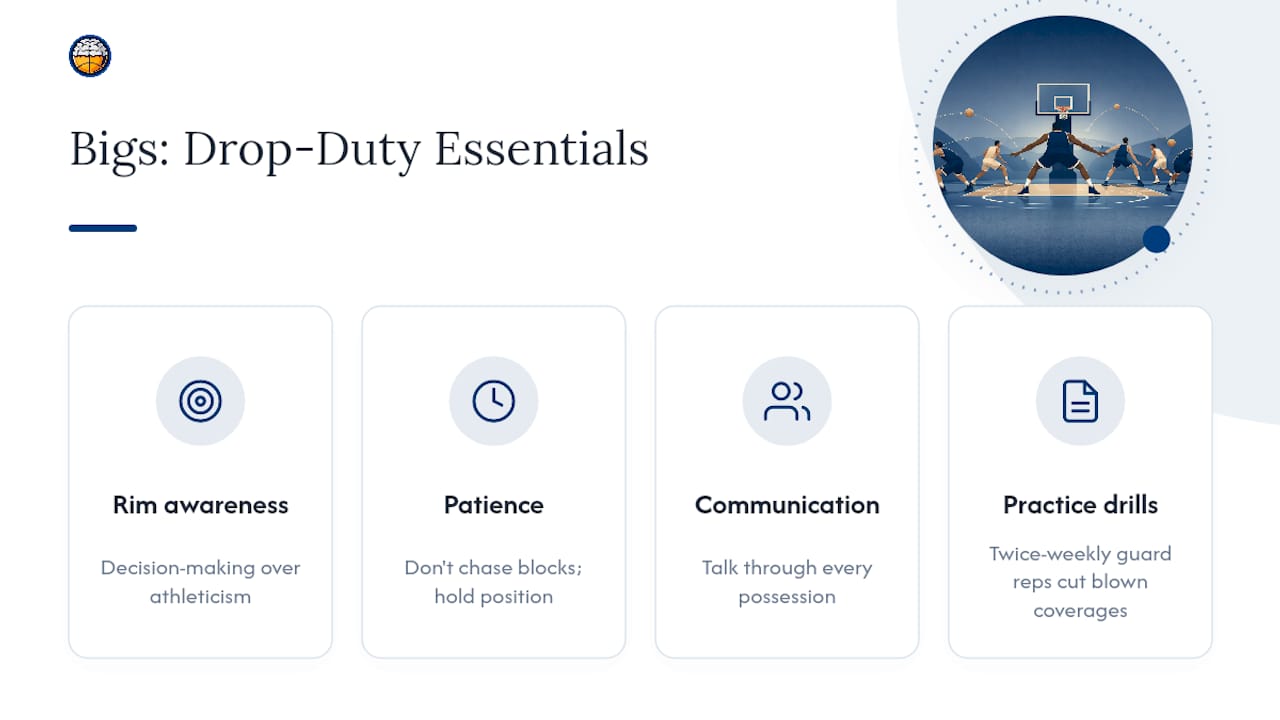
Evaluating a big for drop duty comes down to three traits: rim awareness, patience under pressure, and the willingness to talk through every possession. Bigs who chase blocks instead of holding position usually break the scheme within a few games. Drop coverage asks more of a big’s decision-making than his athleticism, and that surprises coaches who assume size alone solves the assignment.
Drop-coverage installs typically use short walk-through blocks paired with printable diagrams, so players see the spacing before they run it. One youth program that layered in twice-weekly guard-technique reps saw noticeably fewer blown coverages by midseason, mostly from guards learning the fight-over angle rather than the bigs changing anything. Always scout the opponent’s screener first. A drop that works against a non-shooting five can get picked apart against one who pops.
A Coach’s Honest Take on Choosing Drop Coverage
Choose drop coverage when your rim protector is more valuable staying home than chasing shooters, and when the opponent’s ball handler isn’t a proven pull-up threat. Otherwise, you’re conceding a shot they actually want.
At halftime, check three things fast: is the ball handler hurting you from mid-range, is the screener popping instead of rolling, and is your big getting smeared on the screen. Any two of those, and it’s time to bump the coverage higher or switch schemes entirely. Conservative drop against a bad shooting team. Aggressive, higher hedge against one that can really shoot it.
— Dejan
Build Practices That Teach Drop Coverage Correctly
Coaches don’t need to reinvent a defensive install from scratch. Hoop Mentality’s Basketball Starter Pack For Coaches gives you the drills, diagrams, and progression sequence to teach drop coverage without spending hours building slides yourself.

The Basketball Practice Plan Template lets you slot the two-man read drill and shell progressions directly into a weekly schedule, while the Editable Scouting Report Template helps you flag which opponents are pop threats before you ever call the coverage. Pair those with the Skill Improving Infinite Loop Drills to sharpen the conditioning and communication your bigs need to hold position possession after possession. If you want the fuller picture, the Basketball Scouting Bundle For Coaches and Basketball Template Bundle For Coaches round out both sides of your prep. Check out the full collection and build your next practice plan today.
Sources
- What is drop coverage? Explaining defensive scheme used by Rudy Gobert and other NBA shot blockers | Sporting News
- Drop Coverage Explained - by Calvin Wetzel (Her Hoop Stats)
- Drop Coverage in Basketball: Concepts and Examples - Hoop Student
FAQ
What does drop coverage mean in basketball?
It means the screener’s defender retreats toward the paint during a pick-and-roll instead of stepping up, aiming to protect the rim while forcing a contested mid-range shot.
What does it mean to drop coverage in insurance?
That’s an unrelated insurance term referring to canceling or reducing a policy’s coverage terms. It has no connection to the basketball defensive scheme covered in this article.
What is drop-down coverage in insurance?
Drop-down coverage in insurance typically refers to an umbrella policy stepping in when an underlying policy’s limits are exhausted. It’s a separate concept from basketball’s drop coverage and shouldn’t be confused with it.
Is drop coverage good?
Drop coverage is a strong option when your big protects the rim well and the opponent lacks a dangerous pull-up or pop shooter. It becomes a liability against teams built around mid-range scoring or floor-spacing bigs.