

A fast break is a quick offensive push a team runs right after gaining possession, aimed at scoring before the defense can set up. It typically starts from a rebound, steal, blocked shot, or turnover, and its whole point is speed: get the ball ahead of the defense and create a numbers advantage, like 2-on-1 or 3-on-2, before five defenders get back to their spots.
TL;DR:
- True fast breaks require an immediate attack with a numbers advantage, such as 2-on-1 or 3-on-2, before the defense can match up.
- The most effective technical execution focuses on quick outlet passes, precise spacing, and rapid decision-making under pressure to maximize scoring chances.
- Defensive recovery with proper communication and prioritizing rim protection can neutralize fast breaks, prompting teams to reset with organized early offense.
- Drills that simulate fast-break decision points, like continuous 2-on-1 and 3-on-2 plays, are essential for developing routine combat readiness.
- Coaches should measure success by the percentage of successful finishes versus turnovers, emphasizing pace as a habit ingrained through consistent practice.
Table of Contents
- What Counts as a Fast Break, Really?
- The Four Types of Fast Breaks Coaches Actually Use
- How to Run a Fast Break: Roles, Passing, and Finishing
- How Defenses Stop the Fast Break, and How Offenses Should Respond
- Drills That Actually Build Fast-Break Instincts
- A Coaching Perspective on Teaching the Fast Break
- Fast-Break Fundamentals: The Coach’s Quick Checklist
- Building a Fast-Break Identity, Not Just a Set of Plays
- Ready-Made Fast-Break Resources From Hoop Mentality
- Where These Definitions Come From
- Sources
- FAQ
What Counts as a Fast Break, Really?
Not every quick possession is a true fast break. A fast break exists specifically to exploit a numbers gap, whether that’s a breakaway layup with zero defenders back or a 3-on-2 where the offense has one extra body to attack with. The moment the defense matches numbers and gets set, you’ve left fast-break territory and entered early or half-court offense.
The clearest way to picture it: a defensive rebound comes down, the rebounder fires an outlet pass to a guard already sprinting up the sideline, two teammates fill the lanes on either side, and the ball-handler either finishes at the rim or hits an open man before the trailing defenders arrive. That whole sequence, from rebound to finish, might take four seconds.
A few quick distinctions worth knowing:
- True fast break: a numbers advantage exists (1-on-0, 2-on-1, 3-on-2) and the offense attacks it immediately.
- Early offense: the break didn’t produce an advantage, so the team pushes the ball but runs an organized set instead of forcing a bad shot.
- Transition defense breakdown: sometimes mislabeled as a fast break, but it’s really a defensive lapse the offense happened to punish.
The Four Types of Fast Breaks Coaches Actually Use
Coaches generally sort fast breaks into four categories, and knowing the difference changes how you drill each one.
- Primary fast break. This is the break in its purest form: an immediate push right after the change of possession, usually off a defensive rebound or a live-ball turnover. It’s the fastest scoring chance a team gets, and it’s over in seconds.
- Secondary fast break. When the primary push doesn’t produce a clean advantage, the team doesn’t stop. It slows just slightly, spaces the floor, and keeps attacking through ball reversals and quick passing before the defense fully sets. Think of it as the bridge between transition and structured offense.
- Numbered fast breaks. Coaches often teach these by the exact count of players involved. A 1-on-0 is a straight sprint to the rim with no decision required. A 2-on-1 forces the ball-handler to read the single defender and either finish or dump off to the trailing teammate. A 3-on-2 demands spacing discipline, since the two back defenders will try to take away the middle and force a tougher shot from the wing.
- Fly fast break. This one carries the most risk and the most reward. Instead of boxing out on a defensive rebound, one player releases early and sprints downcourt anticipating the outlet pass. If the rebound is secured, that player is already gone for an easy score. If it’s missed, the defense grabs a free offensive rebound.
How to Run a Fast Break: Roles, Passing, and Finishing
Every fast break starts with the same non-negotiable: secure the ball cleanly and get a real outlet pass moving within a second or two. Hesitation at the outlet kills more fast breaks than bad decisions downcourt ever do.
From there, each player has a specific job:
- Ball-handler: pushes the pace up the middle of the floor, reads how many defenders are back, and protects the ball rather than forcing a pass into traffic.
- Wings: sprint wide in the outer lanes, stay behind the ball-handler until the advantage is clear, and present a passing angle the whole way.
- Trailer: trails the play as a safety valve, and if the break stalls, crashes hard for an offensive rebound or resets into early offense.
Passing discipline separates teams that convert fast breaks from teams that turn them over. The first pass, the outlet, should be a firm chest pass or hit-ahead pass, not a lob. Once the ball-handler crosses half-court, a skip pass across the floor can exploit a defender who committed too early. In tighter spaces near the rim, a bounce pass through a passing lane beats a chest pass that a help defender can jump.
Finishing decisions matter as much as the passes that set them up. Take the layup when it’s clean. Kick to the open shooter when a defender rotates to stop the drive. And when the defense has fully recovered and no advantage exists anymore, pull it back out rather than force a contested shot into a set defense.
Pro Tip: Teach players to count defenders out loud during scrimmages (“two back!”) before they touch the ball in transition. That half-second of verbal recognition speeds up decision-making more than almost any drill.
For more on how spacing supports these passing lanes, see how proper floor spacing keeps wings and trailers from colliding on the break.
How Defenses Stop the Fast Break, and How Offenses Should Respond
Good transition defense follows a strict priority order, and every fast break offense should know it cold.
- Protect the rim first. The closest defender sprints back to stop the layup, even if that means leaving a shooter open for a moment.
- Stop the ball second. Whoever is nearest the ball-handler tries to slow the middle of the floor and force a pass rather than a drive.
- Match numbers third. Once the rim and the ball are accounted for, remaining defenders sprint to find the closest offensive player and even out the count.
When defenders win that positioning battle and get numbers matched before the offense can attack, the smart read is to abandon the break entirely. Pushing into a set defense 3-on-3 just to force something usually ends in a turnover or a bad shot. Instead, teams should pull the ball out, call an early offense set, and reset spacing.
Defenses communicate this recovery with cues like “Drop,” meaning sink toward the paint, and “Match,” meaning find a man. Offenses that recognize hesitation in those calls, a defender pointing instead of moving, a late rotation, can exploit that half-second gap before the defense fully organizes.
Drills That Actually Build Fast-Break Instincts
Fast-break skill isn’t taught through scrimmages alone. It’s built through progressions that isolate each decision before stacking them together.
- Outlet and sprint reps. Start with no defense: rebound, outlet pass, sprint the lane, finish. Repeat until the pass and the sprint happen almost simultaneously.
- 2-on-1 continuous play. Add one defender. The offense must decide, every single rep, whether to finish or pass. Rotate players through quickly so decision-making happens under mild fatigue, not fresh legs.
- 3-on-2 continuous play. Add the second layer of defenders and force the offense to read spacing on the wings, not just the middle.
- Constraint drills. Limit dribbles to two per possession, or force a weak-side pass before any shot attempt. Constraints like these push players to make faster reads because the easy option is taken away.
- Conditioning paired with finishing. Short, high-intensity sprint intervals followed immediately by finishing reps train players to make good decisions while breathing hard, which is exactly the state they’ll be in during a real fourth quarter.
Track three numbers across these drills: successful finishes per rep, turnovers per rep, and missed or bobbled outlet passes. A team that’s converting a clear majority of clean outlet passes into finishes is building the reflexes drills are designed to create; a team that’s turning the ball over on the outlet more than once every few reps needs to slow down and rebuild that first link before adding defenders. For a deeper breakdown of rep structures, this guide on transition drills for fast-break success walks through progression sequencing in more detail.
A Coaching Perspective on Teaching the Fast Break
Dejan, who develops coaching systems for Hoop Mentality, built his approach to fast-break teaching around one principle: sequence matters more than talent. Teams with average athletes who drill the outlet pass and lane sprints relentlessly often outrun teams with better athletes who never practiced the sequence at all.
A fast break isn’t one big skill. It’s four or five small skills, chained together, that fall apart if any single link is weak. Coaches who isolate the outlet pass, the sprint, and the finish separately, then stitch them back together under pressure, build teams that actually convert their transition chances instead of just generating them.
Hoop Mentality’s Full-Court Press Break Offense V2.0 and Complete Early Offense Playbook translate these exact progressions into practice-ready sequences, so coaches don’t have to design the drill chain from scratch.
Fast-Break Fundamentals: The Coach’s Quick Checklist
Three rules govern every fast break: secure the outlet, push the pace, and read the numbers before deciding to finish or pass.
- Grade outlet pass accuracy in every scrimmage rep.
- Drill sprint lanes until wings run them without thinking.
- Run 2-on-1 decision reps weekly to sharpen finish-or-pass judgment.
- Slow the break the moment defenders match numbers. Forcing a shot into a set defense costs more possessions than it wins.
Building a Fast-Break Identity, Not Just a Set of Plays
The teams that run fast breaks well aren’t the ones with a single great transition play. They’re the ones that treat pace as a habit, drilled every practice until it becomes the default instead of the exception.
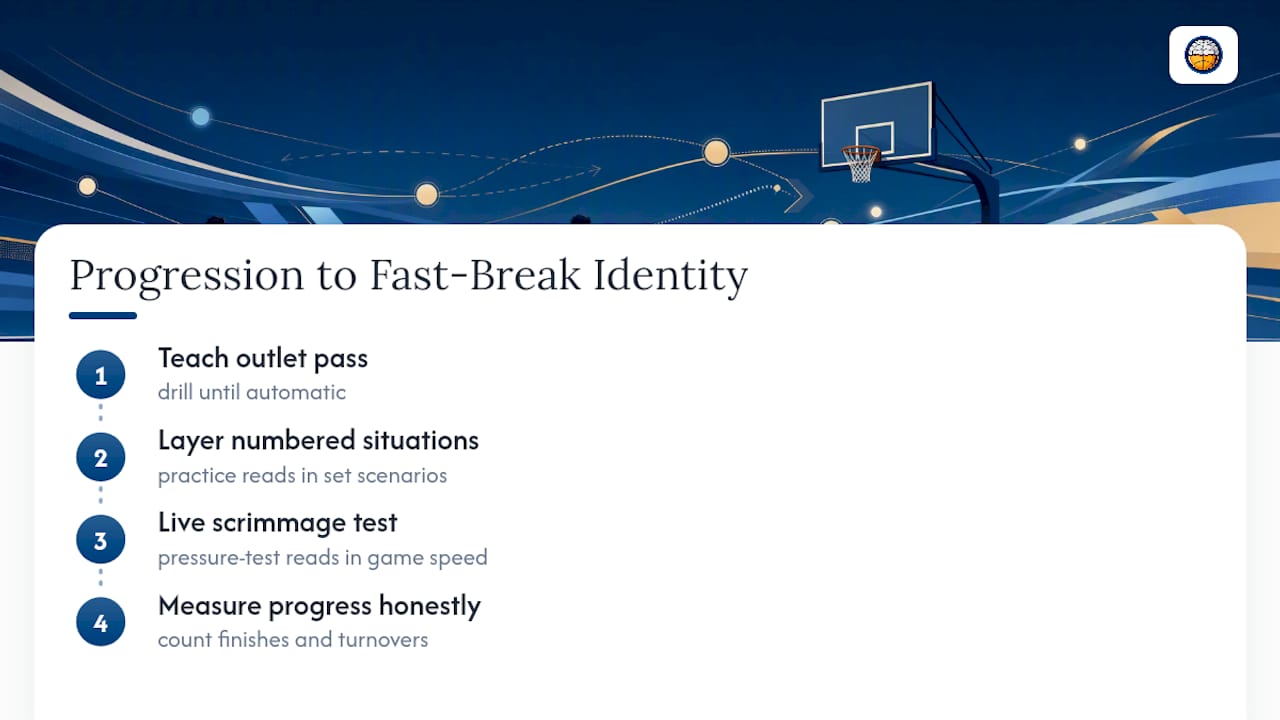
Balance matters here. A team that sprints without discipline turns the ball over constantly, and a team drilled only on half-court sets never develops the instinct to attack an open lane. The fix is progression: teach the outlet pass until it’s automatic, then layer in numbered situations, then let live scrimmage pressure test whether the reads hold up.
Measure progress honestly. Count finishes, count turnovers, and don’t confuse a fast pace with a productive one.
— Dejan
Ready-Made Fast-Break Resources From Hoop Mentality
Coaches don’t need to build fast-break systems from a blank page. Hoop Mentality is the alternative to piecing together drills from scattered video clips and forum threads. Every playbook is a complete, practice-ready system built from real coaching sequences.
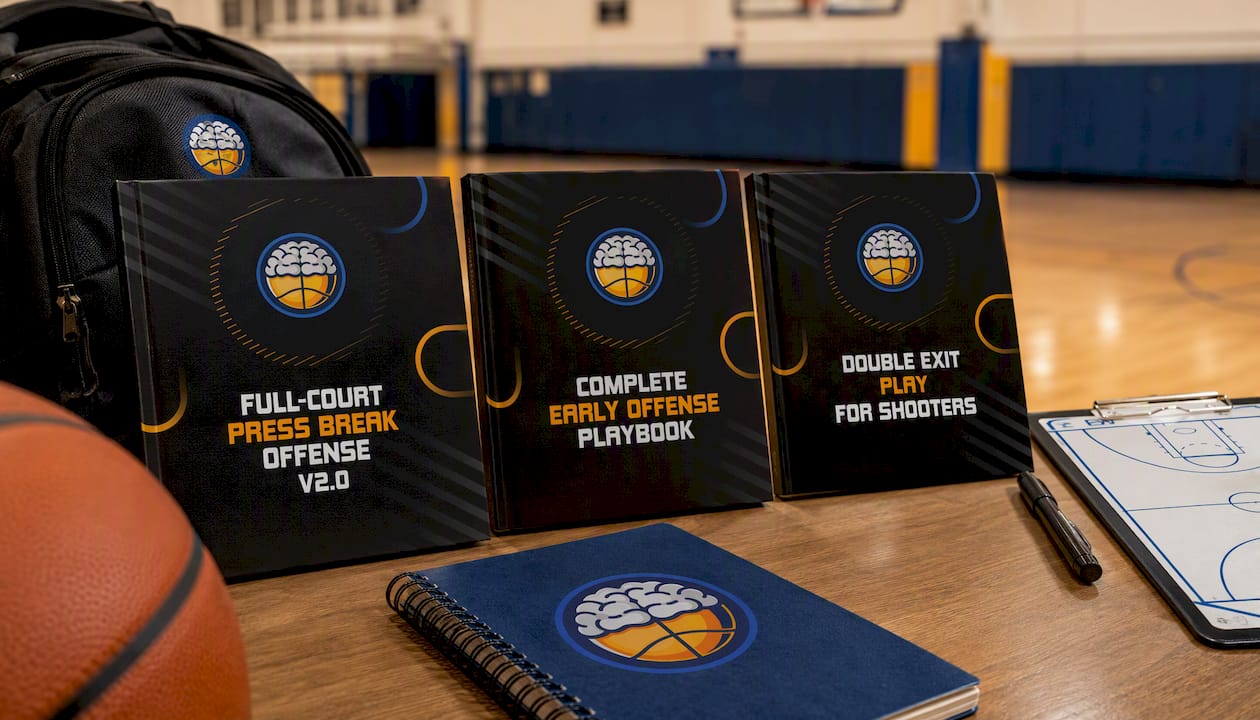
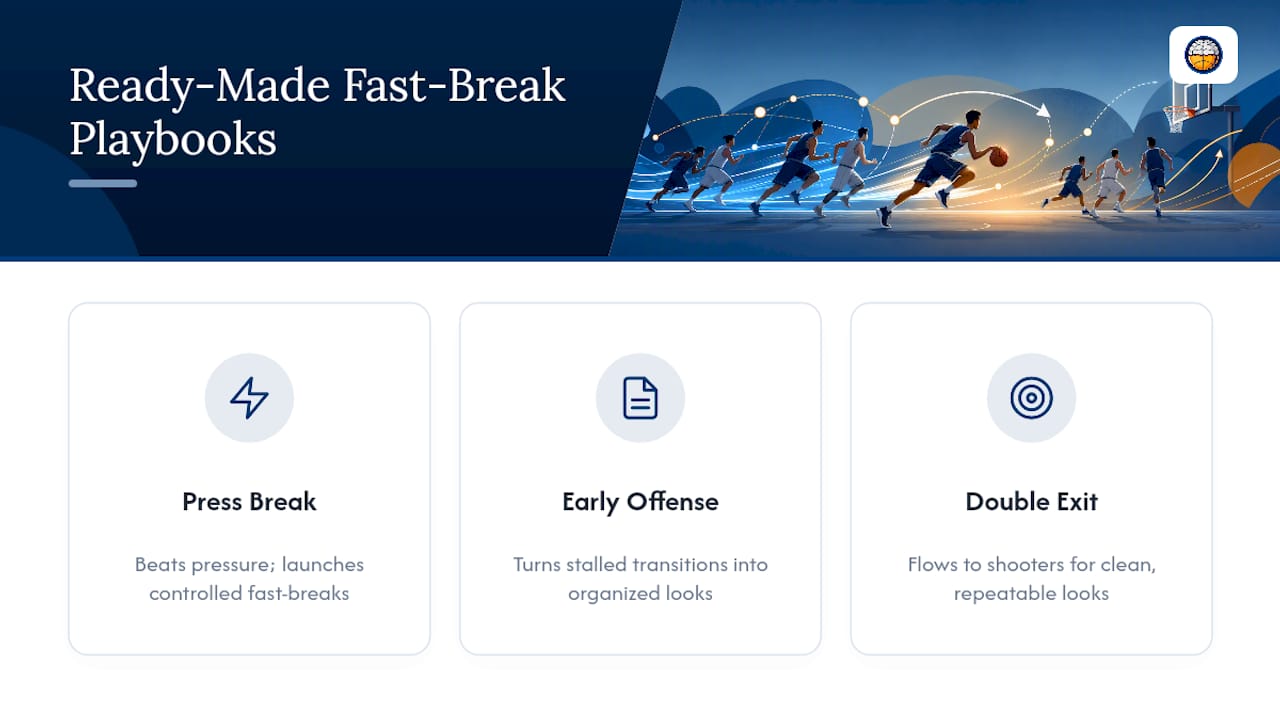
The Full-Court Press Break Offense V2.0 gives you a structured system for beating pressure defenses and launching controlled fast-break chances the moment your team gains possession. The Complete Early Offense Playbook picks up right where the primary break ends, turning stalled transitions into organized, high-percentage looks instead of forced shots. And the Double Exit Play For Shooters gives shooting-heavy lineups a specific action to flow into once the initial break settles, so your best shooters get clean, repeatable looks instead of leftover possessions.
Browse the full library at Hoop Mentality and download the playbook that matches whichever link in your fast-break chain needs the most work this season.
Where These Definitions Come From
The Wikipedia entry on fast breaks covers the strategy’s mechanics and common triggers in detail. Britannica’s sports reference adds historical context, including early innovators who pushed pace before it became standard. Merriam-Webster offers the tightest dictionary definition if you just need the concept in one sentence.
Sources
- Fast break - Wikipedia
- Fast break | sports | Britannica
- FAST BREAK Definition & Meaning - Merriam-Webster
FAQ
What Counts as a Fast Break?
A possession counts as a fast break when the offense has a genuine numbers advantage, like 2-on-1 or 3-on-2, and attacks it immediately after a change of possession, before the defense can get matched up and set.
What Is an Example of a Fast Break?
A classic example: a player grabs a defensive rebound, fires an outlet pass to a guard sprinting up the sideline, two teammates fill the wings, and the ball-handler either finishes at the rim or hits an open wing before defenders recover.
What Skills Is a Fast Break Made Of?
A fast break depends on a chain of specific skills: securing the rebound or steal, throwing an accurate outlet pass, sprinting the lanes with proper spacing, reading the defender count, and finishing under pressure or making the extra pass.
Does the Term “Fast Break” Apply Outside Basketball?
Yes. Dictionary sources note the fast break concept appears in other sports, like handball, where it’s consistently defined as a quick attack launched right after a change of possession.
How Is a Fast Break Different From Early Offense?
A fast break exploits an immediate numbers advantage, while early offense is a more organized, slightly slower push a team runs when that advantage never materialized, using spacing and set plays instead of a straight sprint to the rim.