

TL;DR:
- Proper nutrition boosts basketball performance by fueling energy, supporting recovery, and maintaining hydration. Athletes need tailored intake of carbohydrates, protein, and fats for different training phases and game days. Effective meal timing and hydration management are critical for peak explosive power and decision-making during competition.
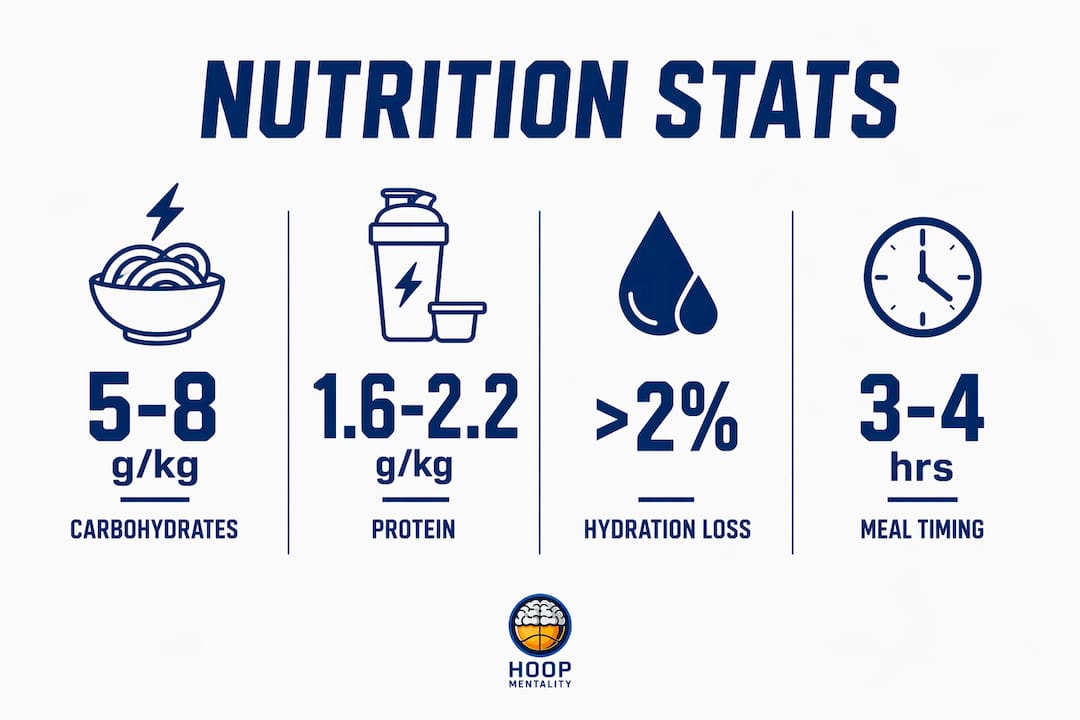
Nutrition is the foundation of basketball performance, directly determining how much energy players generate, how fast they recover, and how clearly they think under pressure. The role of nutrition in basketball extends far beyond eating before a game. It shapes every sprint, every decision, and every training session across a full season. Male collegiate players require 1.6–2.2 g/kg protein and 5–8 g/kg carbohydrates on high-load days to meet the sport’s demands. Get this wrong, and no amount of skill development or tactical preparation will compensate for a body running on empty.

What are the key macronutrients for basketball players?
Carbohydrates are the primary fuel source for basketball’s stop-and-go intensity. The sport relies on both aerobic and anaerobic energy systems, and carbohydrates feed both. Without adequate carbohydrate intake, players hit a wall late in games when execution matters most.
Protein drives muscle repair and growth. Research sets the target at 1.6–2.2 g/kg body weight per day for male players. That means a 90 kg player needs 144–198 grams of protein daily on heavy training days. Female players face an additional challenge: insufficient calorie intake often leads to micronutrient deficiencies that affect bone health and immune function.
Healthy fats support hormone production and provide sustained energy during lower-intensity recovery periods. Sources like salmon, avocado, and olive oil belong in a player’s regular diet. Fats should not be eliminated in pursuit of a leaner body composition.
The key distinction players and coaches often miss is the difference between training days and game days:
- Game days and double sessions: Carbohydrate intake at 5–8 g/kg body weight; protein at the upper end of the 1.6–2.2 g/kg range
- Recovery and rest days: Reduce carbohydrates to match lower energy output; maintain protein to support repair
- Pre-season and high-volume blocks: Increase total calorie intake to prevent under-fueling
- Off-season: Prioritize protein and moderate carbohydrates to preserve muscle while conditioning
Pro Tip: Track your food intake for one week during a heavy game stretch. Most players discover they are eating 20–30% fewer calories than their training load demands.
How should basketball players time their meals?
Meal timing determines whether the body performs or fades. Eating the right foods at the wrong time produces the same result as eating the wrong foods entirely.
Pre-game nutrition sets the foundation. Carbohydrate intake of 1–3 g/kg body weight, consumed 3–4 hours before warm-up, maximizes glycogen stores and sustains energy through the fourth quarter. A 80 kg player should eat 80–240 grams of carbohydrates in that window. Rice, pasta, oats, and bread are reliable choices. For a detailed pre-game fueling approach, the basketball pregame preparation guide from Hoop Mentality covers this in full.
The post-exercise window is where most players fail. Consuming protein and carbohydrates within 30–60 minutes after practice or a game accelerates glycogen resynthesis and muscle repair. Miss this window and the next session starts with a recovery deficit. A chocolate milk, a banana with Greek yogurt, or a protein shake with fruit all work.
On-court fueling matters during long games or back-to-back schedules. Fast-digesting carbohydrates like sports drinks, gels, or fruit during timeouts and halftime maintain blood glucose and delay fatigue.
- 3–4 hours before tip-off: Carbohydrate-rich meal with moderate protein and low fat
- 60–90 minutes before: Light snack if needed, such as a banana or toast with peanut butter
- During the game: 30–60 grams of carbohydrates per hour for games exceeding 60 minutes
- Within 30–60 minutes post-game: Fast-digesting protein plus simple carbohydrates
- 2–3 hours post-game: Full balanced meal with protein, carbohydrates, and vegetables
Pro Tip: Prepare your post-game recovery snack before you leave for the arena. Players who have food ready immediately after the final buzzer recover faster than those who wait until they get home.
What role does hydration play in basketball performance?
Dehydration is one of the fastest ways to destroy performance. Losing more than 2% of body weight through sweat impairs sprint speed, decision-making, and endurance. A 90 kg player becomes impaired after losing just 1.8 kg of fluid. That can happen within the first half of an intense game.
Basketball generates significant sweat losses because of its high-intensity intermittent nature and indoor heat. Sweat carries sodium, potassium, and magnesium out of the body. Replacing fluid alone without replacing electrolytes leads to cramping and continued cognitive decline.
Practical hydration guidelines for players and coaches:
- Morning of a game: Drink 500–600 ml of water upon waking to start the day hydrated
- 2 hours before tip-off: Consume 400–600 ml of water or a low-sugar electrolyte drink
- During the game: Drink 150–250 ml every 15–20 minutes, using sports drinks during intense periods
- Post-game: Drink 1.5 liters of fluid for every kilogram of body weight lost during play
- Urine color check: Pale yellow indicates good hydration; dark yellow signals a deficit
The most common hydration mistake is waiting until thirst signals dehydration. Thirst is a late indicator. By the time a player feels thirsty, performance is already declining. Coaches should build hydration check-ins into warm-up and halftime routines as a non-negotiable team habit.
How does nutrition affect muscle mass and explosive performance?
Muscle mass is the physical engine of basketball. Research shows that muscle mass correlates with peak force (ρ=0.675; p=0.006) and power output (ρ=0.629; p=0.014) more strongly than fat percentage does. That correlation means a player with more lean muscle generates more force on every jump, cut, and sprint.
The common mistake is treating fat loss as the primary body composition goal. Aggressive fat loss undermines explosive power by stripping muscle alongside fat. Players who cut calories too hard lose the very tissue that drives their athletic output.
| Nutrition Goal | Strategy | Basketball Benefit |
|---|---|---|
| Muscle preservation | 1.6–2.2 g/kg protein daily | Maintains jump height and sprint force |
| Glycogen replenishment | 5–8 g/kg carbohydrates on game days | Sustains late-game energy |
| Body composition | Moderate calorie deficit, high protein | Reduces fat without losing muscle |
| Recovery support | Post-exercise protein and carbs within 60 min | Faster readiness for next session |
Protein distribution across the day matters as much as total intake. Spreading protein across 4–5 meals, with 30–40 grams per serving, produces better muscle protein synthesis than loading it all into one or two meals. Eggs, chicken, Greek yogurt, cottage cheese, and lean beef are reliable sources.
Pro Tip: If you are trying to improve body composition during the season, target a calorie deficit of no more than 200–300 calories per day. Larger deficits during a playing schedule cost you muscle and performance.
What supplements have real evidence for basketball players?
Caffeine is the most studied and most effective legal ergogenic aid for basketball players. Doses of 2.3–3 mg/kg improve sprint speed, jump height, and perceived power output. A 80 kg player gets measurable physical benefits from 184–240 mg of caffeine, roughly the amount in two cups of coffee.
The limitation is clear: caffeine does not improve fine technical skills. Shooting accuracy and complex skill execution show minimal response to caffeine supplementation. Players who expect caffeine to sharpen their shooting will be disappointed. It helps the body work harder, not the hands work better.
“Caffeine enhances physical and perceptual game performance, but does not improve isolated technical skills such as shooting. Dosing above 3 mg/kg is usually necessary for game-setting benefits.” — Research on caffeine in basketball performance
The timing risk is real. Caffeine disrupts sleep quality when taken too close to bedtime. For evening games, players should take caffeine no later than 6 hours before sleep. During congested schedules, poor sleep compounds fatigue faster than caffeine can offset it.
Other supplements with supporting evidence include:
- Creatine monohydrate: Supports repeated sprint performance and muscle mass gains during training
- Beta-alanine: May reduce muscular fatigue during high-intensity intervals, though the evidence in basketball-specific contexts is still developing
- Vitamin D and iron: Address deficiencies that directly impair energy and immune function, particularly in female players
Key Takeaways
Proper nutrition is the single most controllable performance variable in basketball, covering fueling, recovery, hydration, and body composition across every phase of the season.
| Point | Details |
|---|---|
| Carbohydrate targets vary by day | Eat 5–8 g/kg on game and heavy training days; reduce on rest days to match output. |
| Post-exercise window is critical | Consume protein and carbohydrates within 30–60 minutes after play to accelerate recovery. |
| Dehydration impairs performance fast | Losing more than 2% body weight in sweat degrades sprint speed and decision-making. |
| Muscle mass drives explosive output | Prioritize muscle preservation over fat loss; aggressive cutting reduces power and jump height. |
| Caffeine helps physically, not technically | Use 2.3–3 mg/kg for physical gains; do not expect improved shooting accuracy from caffeine. |
Nutrition periodization: what most coaches overlook
Coaches talk about periodizing training loads. Few apply the same thinking to nutrition. That gap costs players performance, especially during congested stretches with back-to-back games and travel.
The principle is straightforward. Carbohydrate intake should match daily training demand, rising to 5–8 g/kg on heavy days and dropping on recovery days. I have seen teams go through a four-game week eating the same meals every day, then wonder why players look flat by game three. The body does not run on averages. It responds to what you give it today.
Under-fueling during travel weeks is the most overlooked problem at every level. Players skip meals, eat airport food, and arrive at arenas already in a calorie deficit. That deficit shows up as slow reactions and poor shot selection in the third quarter, not as hunger.
Micronutrients deserve more attention than they get. Iron deficiency reduces oxygen delivery to muscles. Vitamin D deficiency impairs immune function and bone health. These are not edge cases. They are common, especially in female players, and they are fixable with consistent food choices and targeted supplementation.
My advice to coaches: build a basic nutrition framework into your practice planning the same way you build conditioning into it. You do not need a sports dietitian on staff to teach players about recovery nutrition and pre-game fueling. You need to treat it as part of the job.
— Dejan
Coaching resources that support nutrition-aware training
Hoop Mentality builds coaching tools around the full picture of player development, not just Xs and Os.

The Basketball Template Bundle for Coaches includes practice plans, drill progressions, and structure guides that coaches can align with their team’s nutrition and recovery cycles. When your practice load increases, your players’ fueling needs increase with it. Having structured plans makes it easier to communicate that connection clearly. Coaches can also pair these resources with the offseason improvement drills to build the muscle mass and conditioning base that nutrition supports year-round.
FAQ
What is the role of nutrition in basketball?
Nutrition fuels energy production, supports muscle repair, maintains hydration, and sharpens cognitive function during games. It directly determines how well players perform and how fast they recover between sessions.
How many grams of protein do basketball players need per day?
Male collegiate players need 1.6–2.2 g/kg of body weight in protein per day on high-load training and game days. A 90 kg player targets 144–198 grams daily.
When should basketball players eat before a game?
Players should eat a carbohydrate-rich meal of 1–3 g/kg body weight 3–4 hours before warm-up. This maximizes glycogen stores and sustains energy through the full game.
Does hydration really affect basketball performance?
Dehydration above 2% of body weight measurably impairs sprint speed, endurance, and decision-making. Players should drink consistently throughout the day, not just during games.
Does caffeine improve basketball performance?
Caffeine at 2.3–3 mg/kg improves sprint speed and jump height but does not improve shooting accuracy or complex technical skills. Timing matters: avoid caffeine within 6 hours of sleep to protect recovery.