

An NBA playoff system is a compact, matchup-driven coaching framework that trims your set list, tightens rotations, and prioritizes after-timeout (ATO) execution over regular-season volume. The immediate priority this week: finish the opponent scouting dossier and install an 8 to 12 set ATO library before Game 1. Everything else, including rotation decisions, builds off those two pieces.
TL;DR:
- Focusing on a short, 8 to 12 set ATO library that emphasizes spacing, decoy actions, and quick reads is crucial for effective playoff execution.
- Scouting should prioritize actions and weak link defenders rather than outcomes, turning observations into specific, repeatable drill cues.
- The Game 1 week should be heavily front-loaded with personnel, coverage, and install work, reducing physical strain and maximizing retention before tip-off.
- By Game 3, teams typically tighten rotations, introduce countered ATOs, and adjust help-side positioning based on initial series data.
- Using pre-made playbooks tailored for playoff scenarios can save time and provide a proven foundation for install, sequencing, and matchup homework.
Table of Contents
- What Makes a Playoff System Different From a Regular-Season Offense?
- How Do You Build a Playoff Scouting Report That Actually Helps?
- What Does a Game 1 Week Practice Schedule Look Like?
- What Actually Changes by Game 3 of a Playoff Series?
- How Should You Design and Sequence Your ATO Plays?
- What Belongs on Your Printable Game-Week Checklist?
- Overview of the NBA Playoff Format and Seeding Criteria
- How Does the Best-of-Seven Series Structure Actually Work?
- How Has the NBA Playoff System Changed Over the Decades?
- How Are Ties in the Standings Broken for Playoff Seeding?
- How Does Playoff Scheduling Affect Rest and Recovery?
- What Coaching Philosophies Are Unique to Playoff Basketball?
- Why Practice-Ready Systems Beat Theory-Heavy Playbooks
- Playoff Playbooks That Skip the Guesswork
- Sources
- FAQ
What Makes a Playoff System Different From a Regular-Season Offense?
Regular-season basketball rewards variety. Playoff basketball punishes it. When you play the same opponent four to seven times, every extra wrinkle in your offense becomes film for the other coaching staff to solve by Game 2. That’s why the strongest playoff systems shrink rather than expand.
System thinking means teaching principles and reads instead of memorized calls. A player who understands spacing and gap logic can generate the right action against a scramble defense; a player who only knows “the play” gets stuck when the defense takes away the first option. This distinction matters more in a series than in a single regular-season game, since opponents get multiple looks to scout your calls and counter them. System-oriented coaching reduces predictability precisely because it removes the crutch of scripted responses.
Before Game 1, cut your regular-season set list down using three criteria:
- Keep sets your best two or three players can run without a timeout.
- Cut anything that depends on a mismatch you can’t consistently create against this specific opponent.
- Keep any action that has two distinct counters built in, since a single-read set gets scouted out fast.
A shorter menu, run with conviction, beats a long one run tentatively.
How Do You Build a Playoff Scouting Report That Actually Helps?
Scouting for a series looks nothing like scouting for a Tuesday night game. Staffs typically spend a week or more on a single opponent, building personnel dossiers and tagging possessions for every rotation player, according to HoopBrief’s breakdown of playoff prep. The goal isn’t a highlight reel. It’s a decision document.
Here’s a workable four-step process:
- Catalog by action, not by game. Tag every possession by the offensive or defensive action it represents (closeout, pick-and-roll coverage, weak-side tag) rather than by date, so patterns surface across the whole sample.
- Identify the weak link. Find the one or two defenders whose closeouts, hedges, or rotations break down most often, and build your matchup hunting plan around exposing them.
- Design 4 to 8 targeted sets. Each set should force that specific defender into a switch or closeout decision, repeated enough that the read becomes automatic for your players.
- Convert observations into drill cues. Turn film notes into short, physical coaching points, like footwork on a closeout or the exact timing of a weak-side tag, that a player can execute without overthinking it in a live possession.
Small, repeatable behaviors, like a shooter’s fallback footwork or a help defender’s tag timing, decide more playoff possessions than box scores suggest. Standard stats miss them entirely, which is exactly why the film catalog must be built around actions, not outcomes.
Pro Tip: Don’t just log what the weak-link defender does wrong. Log what your own player did in response. That pairing is what actually turns into a practice drill.
What Does a Game 1 Week Practice Schedule Look Like?
Game 1 week deserves your most thorough prep of the series, since it’s the only week where you’re building a complete plan from scratch rather than adjusting one. Think of it as a recon mission: exhaustive up front, then targeted as the series unfolds.
A workable cadence spreads responsibility across your staff so no single assistant becomes a bottleneck.
| Day | Objective | Staff Lead | Practice Focus |
|---|---|---|---|
| Day 1 | Film cataloging and possession tagging | Lead scout | Video review, no court time |
| Day 2 | Personnel pages, individual tendencies | Assistant coach A | Install core coverage |
| Day 3 | Continue personnel pages, matchup sets | Assistant coach A | Live scout-team reps |
| Day 4 | Coverage decision day | Head coach | Full install |
| Day 5 | ATO and sideline out-of-bounds (SLOB) install | Assistant coach B | ATO reps under game clock |
| Day 6 | Final walkthrough | Full staff | Light walkthrough |
| Day 7 | Game 1 | Full staff | Pregame shooting, no new material |
This structure mirrors what several playoff staffs actually run, front-loading personnel work early in the week and saving install for Days 4 and 5, per HoopBrief’s coaching prep coverage. Keep new offensive material capped at around a dozen actions for the week. Beyond that, retention drops and players start hesitating in live possessions instead of reacting.
Practices should shift in composition as the week progresses: heavier walkthrough and teaching early, heavier live and full-speed reps by Day 4, and a deliberately light Day 6 that protects legs for Game 1.
What Actually Changes by Game 3 of a Playoff Series?
Game 3 is the commitment point in almost every playoff series. By that game, staffs typically lock in three structural adjustments: rotation tightening, new ATO packages, and weak-side help geometry changes, and those changes usually hold through Games 4 and 5 unless an injury forces another shift, according to HoopBrief’s analysis of conference finals adjustments.
The logic makes sense once you look at the calendar. Games 1 and 2 give you data. The 48 hours after Game 2 give you a window to actually change something before Game 3 tips off, and that’s typically the last clean adjustment window before fatigue and scouting counters start piling up on both sides.
Three areas to commit on by that point:
- Rotation tightening. Any player logging minimal effective minutes with a negative on/off impact across Games 1 to 2 is a candidate to lose rotation spot entirely, not just have their minutes trimmed.
- ATO repertoire shifts. Whatever you showed publicly in Games 1 and 2 needs a counter-wrinkle by Game 3, since the opponent has now seen it twice on film.
- Weak-side help geometry. If your low-man rotations got exposed early, this is the point to change help-side positioning rather than hoping personnel effort fixes it.
Tracking lineup-state plus-minus across the first three games gives you the clearest signal on which combinations to keep pushing and which to abandon, a method HoopBrief highlights as a habit of top playoff staffs. Reviewing defensive coverage options ahead of time makes this pivot faster when Game 3 arrives.
How Should You Design and Sequence Your ATO Plays?
Your ATO library should run 8 to 12 sets, built around three design principles: clean spacing so the read is obvious in three seconds, at least one decoy action to hold a help defender, and a single primary read rather than multiple options a player has to process under pressure.
Sequencing matters as much as design. A workable approach:
- Games 1 to 2: Run your most reliable, lowest-risk ATOs. Let the opponent see your baseline.
- Game 3: Introduce one or two reserve sets with a genuine wrinkle, timed to land after the opponent has built counters to your early-series calls, a tactic HoopBrief describes as sequencing public sets against reserved curveballs.
- Games 4 to 5: Hold back at least one set entirely unused, reserved for a close-game moment when surprise matters most.
For late-clock situations under 5 seconds, keep it to two or three simple options, like a single exit action for your best shooter, and drill them specifically under shot-clock pressure so players aren’t seeing that fatigue for the first time in a live game.
What Belongs on Your Printable Game-Week Checklist?
A one-page scouting prompt, filled out after every film session, keeps your staff aligned without requiring everyone to sit through the same tape twice. It should force short, direct answers rather than open-ended notes.
Include these fields on the scouting prompt:
- Opponent’s top three offensive actions by frequency
- Weak-link defender and the specific action that exposes them
- Two ATO counters the opponent has shown against similar coverage
- Closing-lineup tendencies in the final five minutes
Pair that with a practice-plan checklist for Game 1 week that assigns clear staff ownership: who runs personnel pages, who installs ATOs, who owns the final walkthrough script. Hoop Mentality’s scouting workflow guide walks through how to structure these prompts so film time converts directly into practice cues instead of getting lost in a notebook. Print both documents before Day 1 starts, not after.
Overview of the NBA Playoff Format and Seeding Criteria
Understanding the league’s postseason structure matters for context, since your practice week has to fit inside a fixed bracket calendar rather than an open-ended schedule. The NBA postseason seeds sixteen teams, eight from each conference, based on regular-season record, with the top six spots in each conference locked in directly by standing. Seeds seven through ten in each conference get sorted through a play-in tournament before the main bracket begins.
That seeding structure shapes how you plan your prep calendar. A higher seed usually means more days between the end of the regular season and Game 1, giving your staff extra runway for the scouting dossier described earlier. A team that survives the play-in gets a compressed turnaround, often just a day or two, which forces a leaner version of the Game 1 week template: personnel pages and coverage decisions get squeezed into 48 hours instead of stretched across a full week.
Seeding also determines homecourt advantage throughout a series, which matters directly for your rotation planning. The higher seed gets Games 1, 2, 5, and 7 at home under the standard format, meaning the lower seed’s coaching staff has to build travel and back-to-back road games into fatigue management from the very start of the series rather than reacting to it midway through.
Knowing your seed early lets you build the prep calendar around a known number of rest days rather than guessing, which is one more reason to lock your scouting workflow in before the regular season even ends.
How Does the Best-of-Seven Series Structure Actually Work?
Every round of the modern NBA postseason, from the first round through the championship series, uses a best-of-seven format: the first team to win four games advances, and a series can run anywhere from four to seven games depending on how competitive the matchup is.
Game locations follow a 2-2-1-1-1 pattern. The higher seed hosts Games 1 and 2, the series shifts to the lower seed’s arena for Games 3 and 4, then it alternates for Games 5, 6, and 7 as needed. That pattern is exactly why the Game 3 adjustment window carries so much weight tactically: it’s the first game on the road for the higher seed, often after a travel day, and the first true test of whether their Game 1 and 2 install holds up in a different environment.
For coaching staffs, the location shift means Game 3 prep has to account for more than tactics. Travel fatigue, an unfamiliar locker room routine for the road team, and a hostile crowd all factor into how much live-reps time you build into that day’s practice versus how much you protect legs. A walkthrough-heavy Day 6 template, as outlined in the weekly schedule above, becomes even more important when Game 3 lands on the road immediately after a cross-country flight.
The best-of-seven format also explains why series tend to evolve in stages rather than staying static. Two games establish a baseline, the middle games force real adjustments, and the final one or two games often come down to whichever staff executed their late-series changes with more discipline.
How Has the NBA Playoff System Changed Over the Decades?
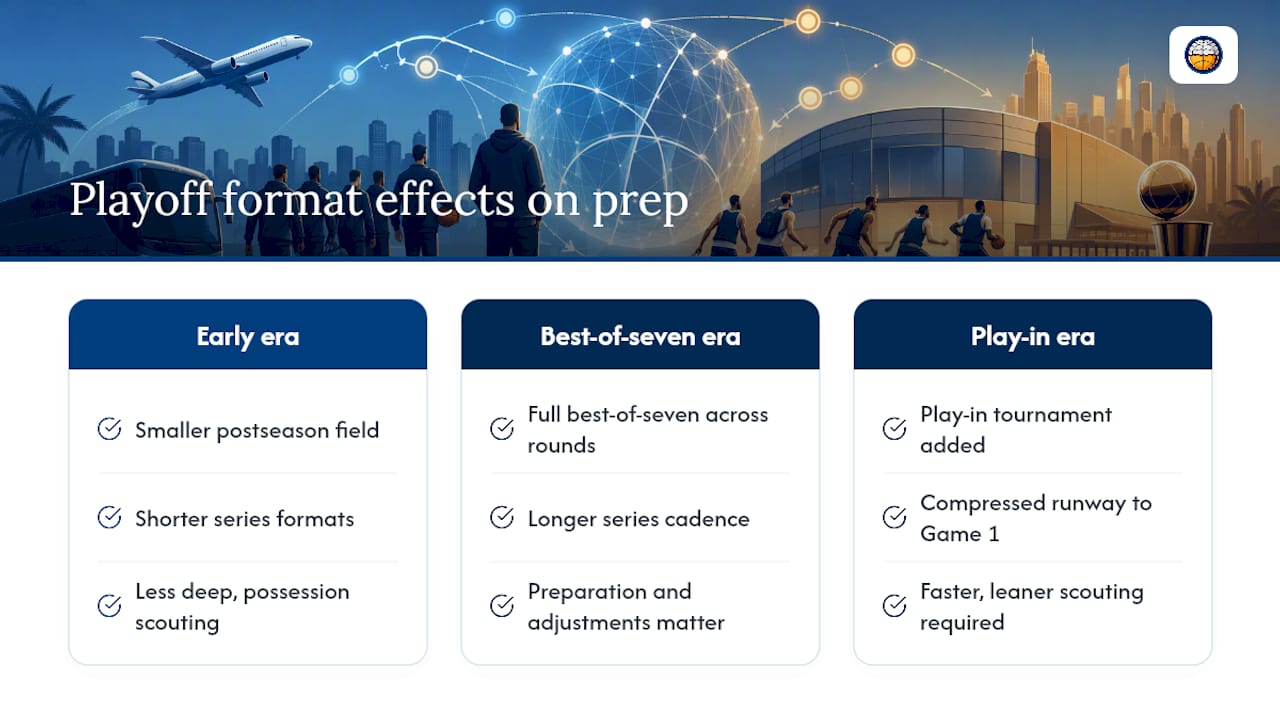
The postseason structure coaches operate inside has grown considerably since the league’s early decades, and each expansion reshaped how staffs allocate prep time. Early NBA postseasons featured a smaller field and shorter series formats in some rounds, meaning less time for the kind of deep, possession-level scouting that defines modern playoff prep.
The move to a fully best-of-seven format across every round, completed league-wide in the mid-2000s, changed the calculus for coaching staffs entirely. Shorter series rewarded talent and matchup luck. Longer series reward preparation, adjustment speed, and depth, which is exactly why the modern scouting dossier and Game 3 commitment window carry so much tactical weight today, they simply didn’t matter as much when a series could end in five games or fewer.
The introduction of the play-in tournament added another structural layer, compressing the runway between the regular season and Game 1 for several teams each year. That change alone forced staffs to build faster, leaner versions of their scouting and install process, since a team fighting through the play-in doesn’t get the same week-long recon window a top seed does.
What hasn’t changed is the core tactical rhythm once a series starts: an information-gathering phase in Games 1 and 2, a commitment phase around Game 3, and an execution phase in the closing games. That rhythm has held remarkably steady even as the surrounding format evolved, which is part of why the weekly prep templates described earlier still work regardless of which round or era you’re coaching in.
How Are Ties in the Standings Broken for Playoff Seeding?
Seeding disputes get resolved through a set order of tie-breaking criteria rather than a single rule, and the order matters because it changes which games in your regular season carry extra weight down the stretch.
Head-to-head record between the tied teams gets checked first. If that’s still even, the league moves to division record for teams in the same division, then conference record, then a broader look at record against playoff-eligible opponents, and eventually strength of schedule if the tie somehow persists through every earlier criterion.
For a coaching staff, this means late-season games against direct seeding rivals deserve real attention in your rotation and rest planning, since a head-to-head tiebreaker can swing homecourt advantage for an entire series before it even starts. It’s worth tracking your team’s position against these criteria in the final few weeks of the regular season, not just your overall record, since the seed you land determines everything from your opponent to your travel schedule to how many rest days you get before Game 1.
How Does Playoff Scheduling Affect Rest and Recovery?
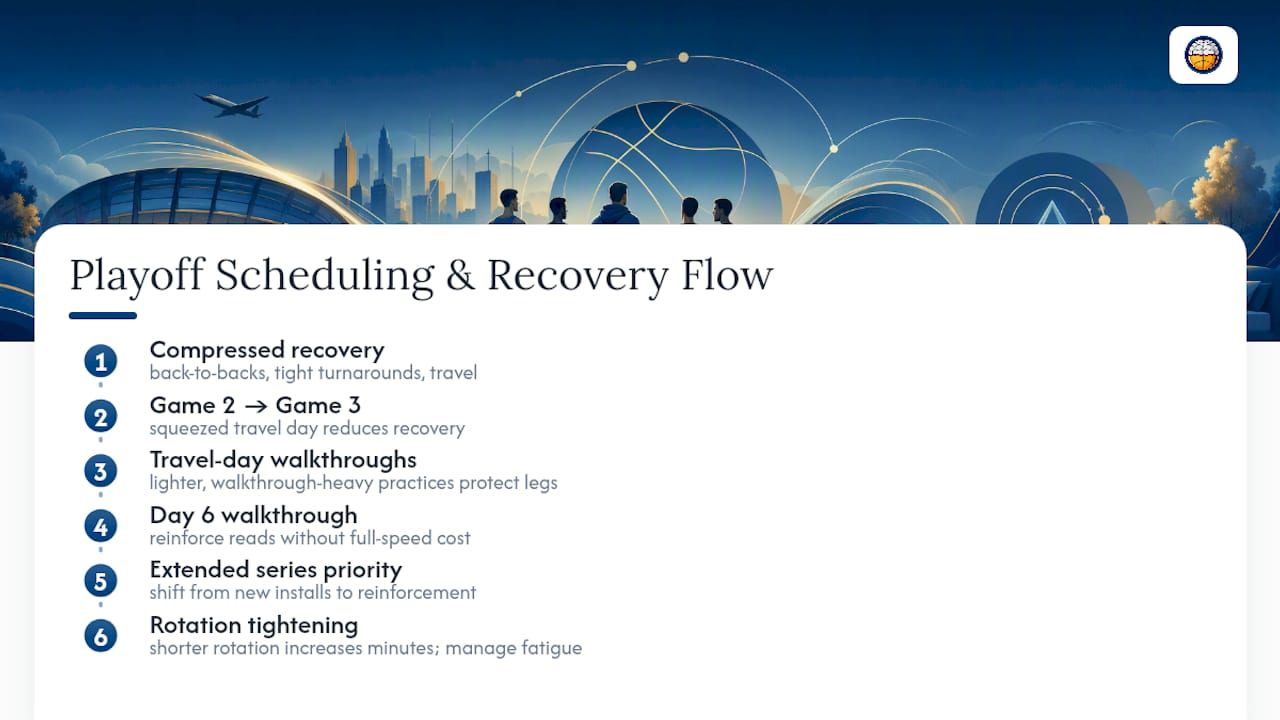
Playoff scheduling compresses recovery time in ways the regular season doesn’t, and it shows up directly in how you should structure practice intensity across a series. Back-to-back road games, tight turnarounds between games in the same series, and travel days that eat into practice time all force trade-offs between installing new material and protecting player bodies.
The 2-2-1-1-1 location pattern described earlier creates predictable stress points. The shift from Games 2 to 3, when the series moves to the lower seed’s arena, often includes a travel day squeezed between two games, leaving less recovery time than a typical week during the regular season. Staffs that build a lighter, walkthrough-heavy practice on travel days protect legs better than staffs that try to cram full-speed installs into a shortened window.
This is also why the Day 6 walkthrough in the Game 1 week template matters so much: it’s designed to reinforce reads without the physical cost of a full-speed practice. As a series extends past five or six games, that same principle applies to every non-game day. The priority shifts from adding new material to reinforcing what’s already installed, since fatigue accumulates across games in ways that regular-season rest days don’t fully account for.
Rotation tightening, covered in the Game 3 adjustment section, isn’t just a tactical decision at that point in a series. It’s also a recovery decision, since a shorter rotation means your best players are absorbing more minutes precisely when travel and turnaround time are working against their recovery.
What Coaching Philosophies Are Unique to Playoff Basketball?
Playoff coaching philosophy differs from regular-season approach in a few consistent ways, and recognizing them early in your prep helps you avoid regular-season habits that don’t translate to series play.
The shift toward matchup hunting over balanced offense is probably the most visible change. Regular-season offenses often aim for equal touches and shot distribution. Playoff offenses aim relentlessly at whichever defender is the weakest link, even if that means one or two players see a disproportionate share of possessions in a given game.
Defensive philosophy shifts too, usually toward more conservative, less gambling-oriented schemes. Steals and forced turnovers matter less over a seven-game series than simply preventing efficient shots, since a live-ball turnover in transition can cost more than it saves against a team that’s had a full week to prepare its transition offense specifically against your gambling habits.
Closing-unit identity becomes its own coaching decision separate from starting lineup identity. Many staffs run a five-man group in the final five minutes that barely resembles their starting lineup, built entirely around who can defend switches, shoot under pressure, and execute the ATO library without hesitation. Reviewing decision-making principles with your closing group specifically, separate from your full-roster install, pays off exactly when a series gets tight in the fourth quarter.
Why Practice-Ready Systems Beat Theory-Heavy Playbooks
Most playoff coaching content focuses on abstract principles: spacing theory, defensive rotation philosophy, pace-and-space concepts. That material has value, but it rarely tells a coach what to actually install on a Tuesday afternoon in Game 1 week.
The gap between playoff theory and playoff practice shows up most clearly in the ATO library. Plenty of coaches understand the principles of good spacing and decoy actions. Far fewer have eight to twelve actual sets drawn up, sequenced across a series, and drilled under shot-clock fatigue before Game 1 tips off. Understanding a concept and having it ready to run under pressure are two different skill sets, and the second one is what actually wins close games in May and June.
The conventional advice to “simplify for the playoffs” is correct but incomplete. Simplifying without a system for scouting, sequencing, and rotation decisions just means running fewer plays with the same amount of guesswork. The staffs that adjust fastest by Game 3 aren’t the ones who simplified the most. They’re the ones who had a repeatable weekly process already built, so the Game 3 commitment point becomes a scheduled decision rather than a scramble.
Prioritize the workflow before the plays. A great ATO means little without a scouting process that tells you when to use it.
— Dejan
Playoff Playbooks That Skip the Guesswork
You’ve seen the workflow: scout, install, sequence ATOs, tighten rotations by Game 3. Building all of that from scratch under a compressed playoff calendar is where most staffs run out of hours, not ideas. Playbooks can give you a finished starting point instead of a blank whiteboard.
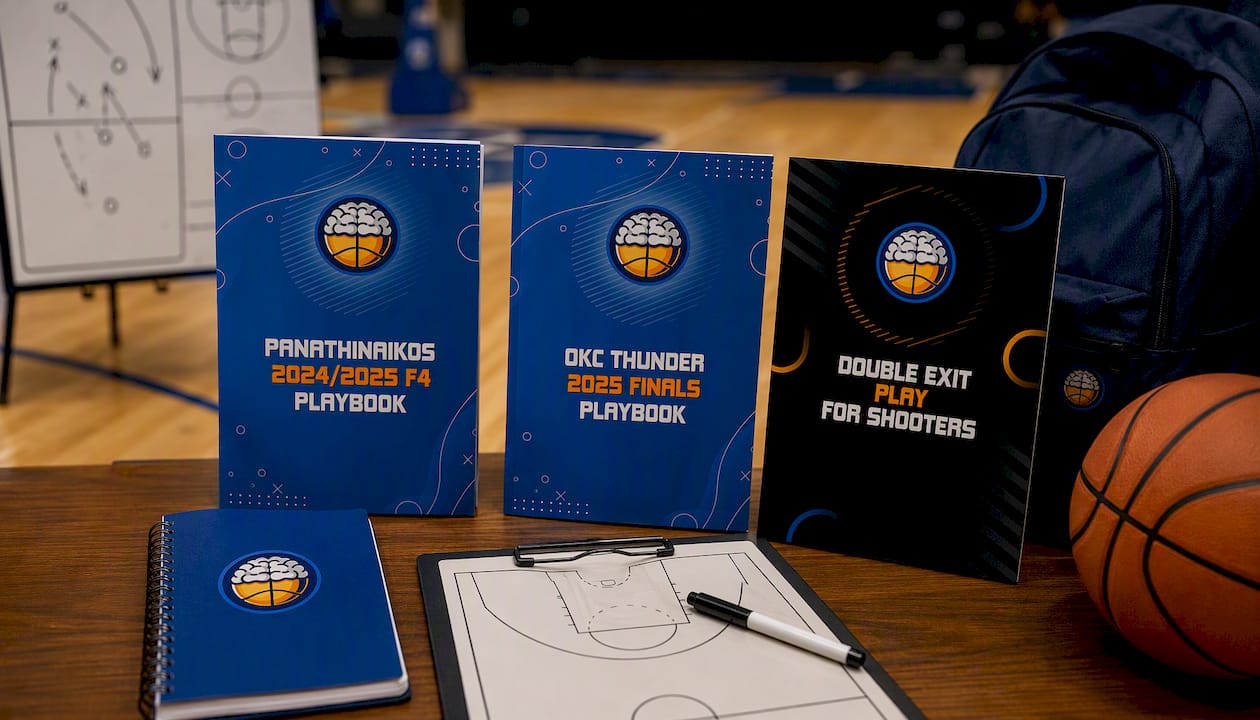
The Panathinaikos 2024/2025 F4 Playbook breaks down a full advanced playoff-style install, useful reference material for Day 4 and 5 of your Game 1 week when you’re finalizing coverage decisions and ATO packages. The OKC Thunder 2025 Finals Playbook focuses specifically on Finals-caliber ATOs and matchup notes, a direct fit for building your own sequenced ATO library across Games 1 through 5. And if you need one high-value addition rather than a full playbook, the Double Exit Play For Shooters gives you a single, ready-to-install action built for late-clock shooter spacing.
Download the playbook that matches your Day 4 to 6 install window and start running the sets in your next practice.
FAQ
How Long Should a Playoff Rotation Be?
Most staffs tighten to seven or eight players by Game 3, dropping anyone logging minimal effective minutes with a negative on/off impact across the first two games.
When Should You Introduce New ATOs During a Series?
Run your most reliable sets in Games 1 and 2, then introduce reserve sets with a real wrinkle by Game 3, once the opponent has built counters to your early-series calls.
How Much Should Practice Volume Change Across a Series?
Practice intensity should shift from install-heavy in the first week to reinforcement-heavy as the series extends, with lighter, walkthrough-focused sessions on travel days between Games 2 and 3.
What’s the Fastest Way to Install a Playoff ATO Library?
Starting from a pre-built resource, like a finals-style playbook with drawn-up ATOs and matchup notes, cuts install time significantly compared to designing 8 to 12 sets from scratch during a compressed Game 1 week.
How Do You Decide Which Defender to Target in Matchup Hunting?
Identify the defender whose closeouts, hedges, or rotations break down most often on film, then build 4 to 8 targeted sets designed to repeatedly force that exact decision.