

TL;DR:
- Opponent scouting turns game film and player tendencies into tactical intelligence to guide game plans. Coaches use organized film, tagging, and standardized reports to analyze recent games and identify patterns that reveal opponent weaknesses. Delivering concise reports through live walkthroughs helps players retain critical insights and improves game-day execution.
Opponent scouting is defined as the process of converting game film and player tendencies into clear, tactical intelligence your team can act on. Coaches who know how to scout opponents give their players a concrete advantage before tip-off. The best scouting workflows combine film tagging, pattern recognition, and concise reporting to turn raw footage into a game plan. This guide walks you through every step, from the tools you need to the reports you deliver.
How to scout opponents: tools and materials you need first
Effective scouting starts with the right setup. Without organized materials, even the best film becomes noise.
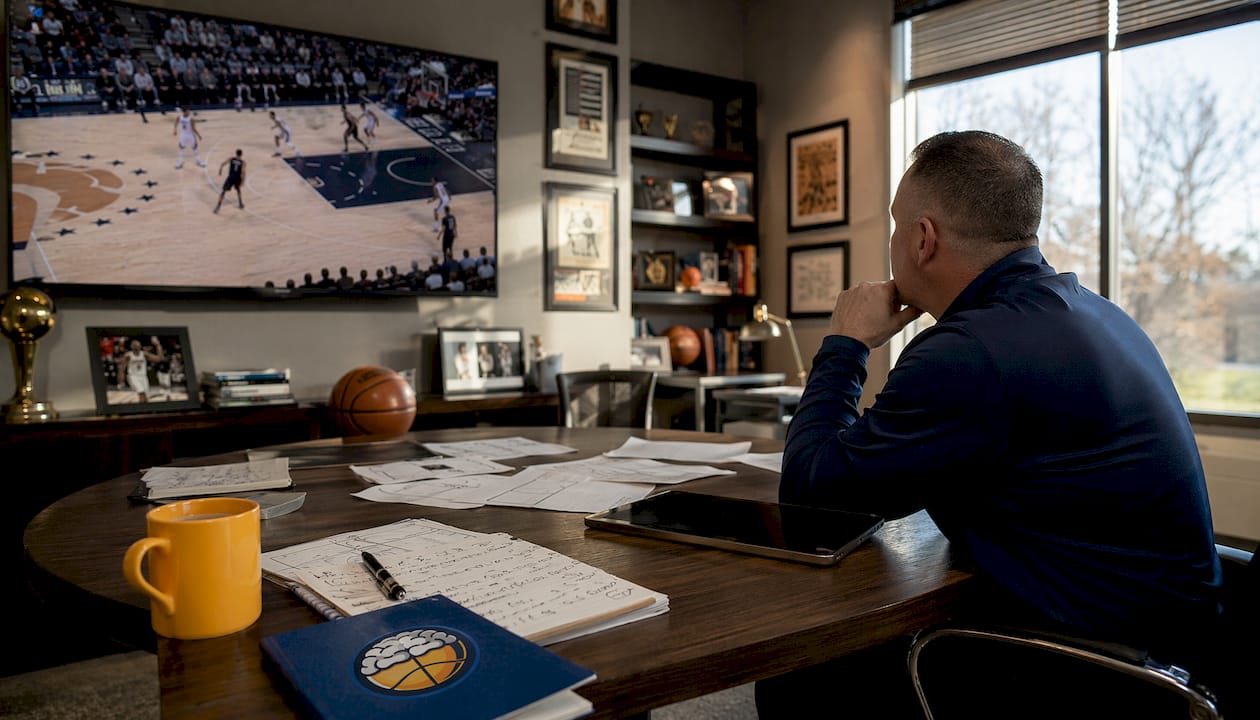
Film sources and tagging software. You need access to recent game footage, ideally from the last 30 days of your opponent’s schedule. Most coaches use video platforms that allow possession-by-possession tagging. Tag each possession by action type, personnel on the floor, coverage faced, and outcome. Tagged possessions cut analysis time from 60–90 minutes per player down to 30–40 minutes. That time savings adds up fast across a full rotation.
Physical scouting materials. Not every coach works with a full analytics staff. A clipboard, a printed scouting checklist, and a structured note sheet are enough to capture what matters during live observation. The key is consistency. Use the same format every time so your notes are comparable across games.
Standardized templates. A template forces you to ask the same questions for every player. That consistency is what makes patterns visible. Without a standard format, you end up with scattered notes that are hard to compare and harder to present to players.
Here is a quick reference for the core scouting materials:
| Material | Purpose | Format |
|---|---|---|
| Game film (last 30 days) | Identify patterns and tendencies | Digital video platform |
| Possession tagging sheet | Log action, personnel, outcome | Spreadsheet or app |
| Player tendency template | Capture six key fields per player | Printed or digital form |
| Scouting report draft | Deliver findings to coaching staff | 1 page per player |
| Live walkthrough notes | Prep player-facing delivery | Bullet points on clipboard |
How do you analyze opponent game film step by step?
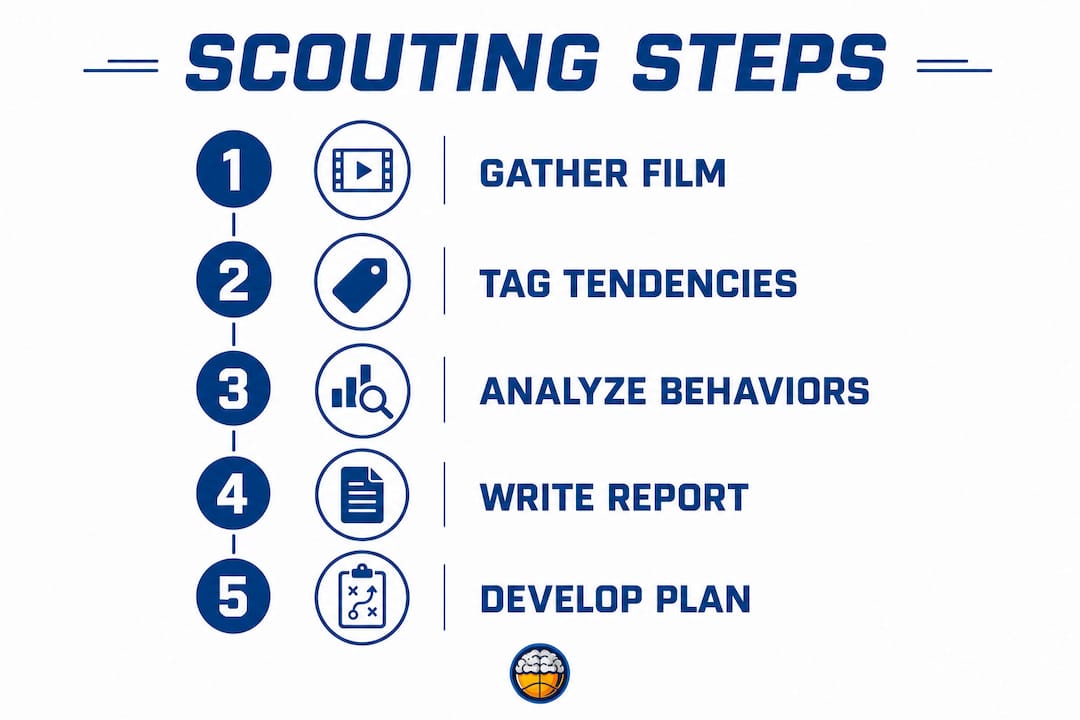
The 5-step scout method is the industry standard for breaking down opponent tendencies. It covers sampling, tagging, pattern identification, filtering, and delivery.
- Sample the last 30 days of games. This window covers 12–15 games for most teams. It reflects current form and recent adjustments, not habits from three months ago.
- Tag every possession by category. Log the action type (pick-and-roll, isolation, post-up), the personnel involved, the coverage the offense faced, and the outcome. This is the most time-consuming step, but it is where the real intelligence lives.
- Identify primary patterns. Focus on behaviors that appear in 40% or more of possessions. Patterns below that threshold are too inconsistent to build a game plan around.
- Filter for exploitable tendencies. Not every pattern is a weakness. Ask whether your team has the personnel and scheme to take advantage of what you found. A tendency is only useful if you can counter it.
- Prepare your deliverables. Turn your tagged data into a report, a walkthrough plan, and specific coverage calls. The output must be usable on the court, not just readable on paper.
Pro Tip: Context matters when reading film. Filter scouting data for game-state effects, such as garbage-time possessions or plays run while protecting a large lead, to avoid building a game plan around misleading patterns.
A playoff-level breakdown of one opponent requires roughly 40–65 hours of analyst work, including 30–50 hours of film and 10–15 hours cross-referencing teams of similar style. That number tells you how serious high-level scouting actually is.
One category worth extra attention is micro-behaviors. These are small, subtle habits that never show up in a box score. Micro-behaviors include things like a guard’s eye drop before a skip pass, a hesitation move a ball-handler uses when he is not confident, or a big man who slows his decision-making against a blitz. These details decide possessions at the margin.
How do you write a scouting report players will actually use?
The most common mistake coaches make is writing a report that reads like a statistics catalog. Reducing a scouting report from 15 pages to around 4 pages increases player absorption from roughly 10% to over 80%. That is not a small difference. It is the difference between players who know what to do and players who freeze.
The six-question framework covers every rotation player you need to address:
- Dominant hand. Which direction does the player prefer to attack?
- Preferred spots. Where on the floor does he create and finish?
- Primary action. What is his go-to move or play type?
- Defensive matchup. Who guards him, and what does that matchup demand?
- Foul rate signal. Does he draw fouls at a high rate, and how does he get to the line?
- Quiet edge. What is the one non-obvious detail that changes how you guard him?
Six questions across 6–8 rotation players gives you 36–48 data points. That is enough for a complete, concise report. Keep each player section to one page. The full report should run 4–6 pages total.
Pro Tip: Pair every tendency with a specific response. Effective reports do not just list what an opponent does. They tell your players exactly what to do about it.
The best delivery method is a live court walkthrough, not a document review. Players physically replicate opponent actions during the walkthrough. That physical repetition builds retention far beyond reading alone. A 20-minute walkthrough beats a 40-page PDF every time.
How do you turn scouting data into a game plan?
Scouting intelligence is only useful when it connects directly to your team’s scheme and personnel. Raw data does not win games. Applied data does.
Start with personnel matchups. Your scouting report tells you which opposing player is the primary threat and where he operates. Match your best defender to that player and build your coverage calls around limiting his preferred spots. If your report shows a ball-handler who struggles against blitz coverage, call the blitz early and see how he responds.
Use scouting to set your coverage calls for specific situations:
- Pick-and-roll defense. Know whether the ball-handler pulls up or turns the corner. That tells you whether to hedge, drop, or switch.
- Set plays after timeouts. Most teams run the same two or three plays out of timeouts. Tag those in film and prepare your defense in advance.
- Late-game scenarios. Know who takes the last shot, from where, and off what action. Prepare a specific coverage for that exact situation.
- Transition defense. Identify which players push pace and which ones slow down after a made basket. That tells you where to load up in transition.
Contingency planning matters just as much as the primary game plan. Scouting prepares players psychologically by giving them knowledge of opponent weaknesses before the game starts. Players who know what is coming do not panic when it happens. That psychological readiness is a real competitive advantage, not a soft benefit.
Align your scouting findings with your team’s strengths. If your defense is built on switching, do not build a game plan that requires hard hedging just because the film suggests it might work. Use your scouting to find the overlap between what the opponent does poorly and what your team does well.
Scouting is a process, not a document
The biggest shift I made in my own coaching was treating scouting as an ongoing process rather than a one-time deliverable. Early in my career, I would put together a solid report before a game and consider the job done. That approach fails the moment an opponent makes adjustments.
Scouting reports should evolve throughout a series or a season as opponents adapt. A report that was accurate in game one of a playoff series may be actively misleading by game three. The best scouts I have worked with update their reports after every game, not just before the next one.
The other thing I have seen coaches underestimate is the gap between a written report and a live walkthrough. Players absorb information differently when they are on their feet and moving. A pregame scout walkthrough where players physically run through opponent actions builds the kind of muscle memory that holds up under pressure. A printed report does not.
The coaches who get the most from scouting are the ones who treat it as a conversation with their players, not a lecture. Ask your players what they noticed on film. Their observations often catch things you missed.
— Dejan
Hoop Mentality resources for your scouting workflow
Putting a scouting system together from scratch takes time. Hoop Mentality has done the structural work for you.
The Editable Scouting Report Template is built around the six-question framework and formats each player section for one-page delivery. It cuts report creation time significantly and keeps your output consistent across your staff. For coaches who want a full preparation system, the Basketball Template Bundle combines scouting report formats, film analysis workflows, and game plan tools in one package. Every resource is editable, coach-tested, and ready to use before your next game.
FAQ
What is opponent scouting in basketball?
Opponent scouting is the process of analyzing game film and player tendencies to build a tactical game plan. It covers film review, pattern identification, and report creation for coaching staff and players.
How many games should you review when scouting an opponent?
The industry standard is the last 30 days of game film, which typically covers 12–15 games. This window reflects current form and recent adjustments rather than outdated habits.
How long does it take to scout an opponent?
A concise player report takes 30–40 minutes of film analysis per player using tagged possessions. A full playoff-level breakdown can require 40–65 hours of total analyst work.
What should a basketball scouting report include?
Each rotation player section should answer six questions: dominant hand, preferred spots, primary action, defensive matchup, foul rate, and one quiet edge detail. The full report should run 4–6 pages.
How do you deliver a scouting report to players?
A live court walkthrough is the most effective delivery method. Players physically replicate opponent actions, which builds retention far beyond reading a printed report.
Key takeaways
Effective opponent scouting requires structured film analysis, a six-question player framework, and concise reports delivered through live walkthroughs to maximize player retention and game-day readiness.
| Point | Details |
|---|---|
| Sample recent film | Review the last 30 days of opponent games to capture current tendencies, not outdated habits. |
| Tag possessions by category | Log action type, personnel, coverage, and outcome to identify patterns occurring in 40% or more of possessions. |
| Keep reports short | Limit reports to 4–6 pages total; shorter reports increase player absorption from roughly 10% to over 80%. |
| Use the six-question framework | Answer six fields per rotation player to build a complete, concise, and usable scouting profile. |
| Deliver with a live walkthrough | Physical replication of opponent actions during practice builds retention that printed reports cannot match. |