

TL;DR:
- Closeout drills train defenders to rapidly close the gap, contest shots, and prevent penetration on the perimeter.
- Using the “Close, Contest, Contain” framework, coaches teach players to execute each phase with proper mechanics and communication.
A basketball closeout drill is a defensive exercise that trains players to rapidly close the gap to a perimeter offensive player, contest the shot, and prevent penetration. The industry standard framework for this skill is “Close, Contest, Contain,” and every effective closeout drill builds on those three actions. Coaches who want to explain closeout drills to their players need more than a definition. They need a system. This guide breaks down the mechanics, variations, common coaching errors, and a practical progression you can run at your next practice.
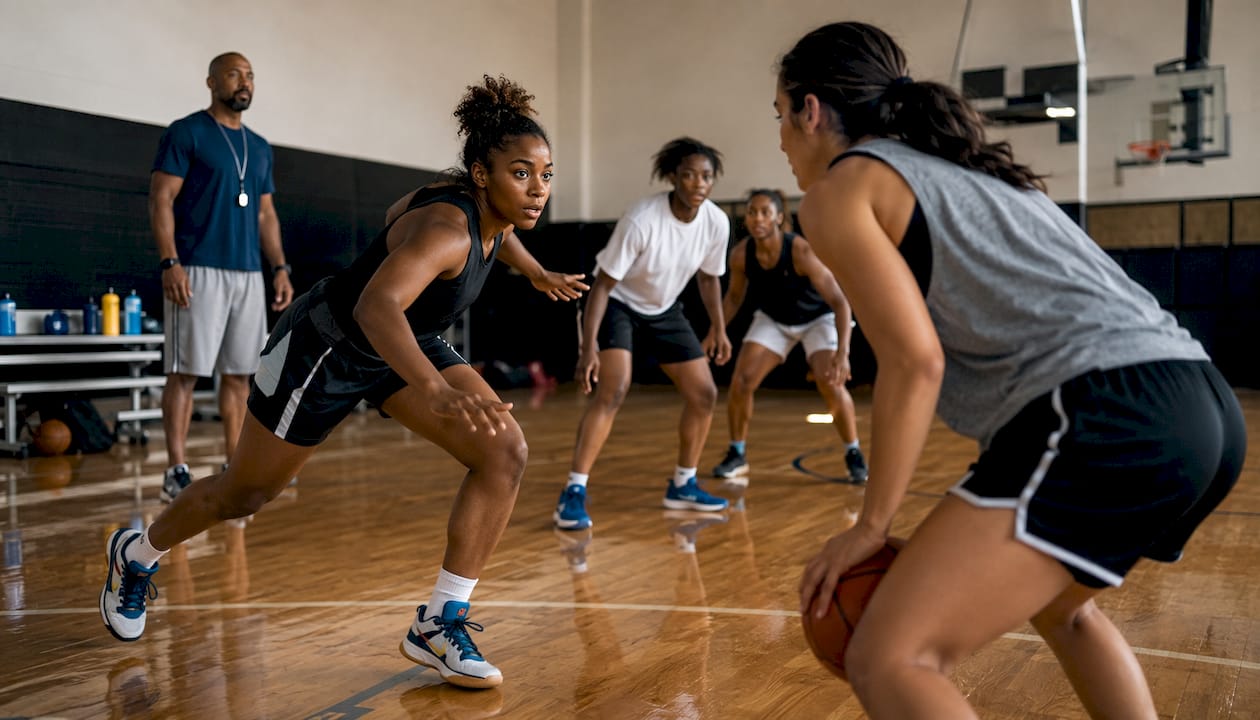
What are closeout drills and why do they matter?
A closeout drill simulates the moment a defender must leave their position and sprint to contest an offensive player receiving a perimeter pass. The drill
to sharpen timing, footwork, and decision-making under realistic conditions. That specificity is what separates closeout training from generic defensive footwork work.
The defensive goal is threefold: contest the shot without fouling, prevent the offensive player from driving middle, and recover if the ball moves. Teams that execute this consistently force opponents into lower-percentage looks. Contested shots carry a significantly lower shooting percentage than open ones. That gap in shot quality is the direct result of disciplined closeout execution.
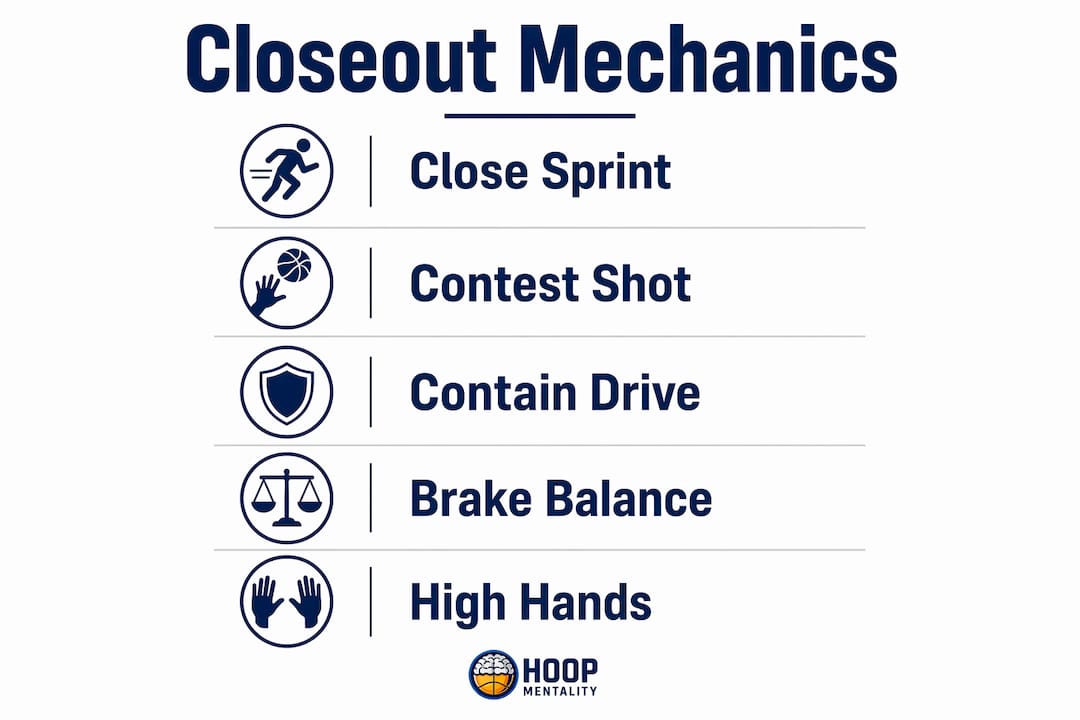
The “Close, Contest, Contain” framework is the recognized industry standard for teaching this skill. Each word maps to a distinct physical action. Coaches who teach all three together build defenders who arrive with purpose, not just speed.
What are the key mechanics of effective closeouts?
Correct body mechanics separate a closeout that creates offensive indecision from one that creates a defensive foul. Every rep in practice should reinforce the same movement pattern.
The core mechanics of an effective closeout:
- Sprint on the air. Move toward your assignment while the ball is in flight, not after the catch. Early movement on the pass cuts down the offensive player’s reaction time and limits their options before they even catch the ball.
- Chop your steps. As you close the final few feet, transition from a full sprint into short, rapid “choppy steps.” This lowers your center of gravity and acts as a braking system. Choppy steps prevent momentum errors that send defenders flying past the ball handler.
- Raise one hand high. Elevate the hand closest to the shooting pocket. This contests the shot line without reaching, which reduces foul risk.
- Stay low and wide. Maintain an athletic stance with your feet outside your shoulders. A low base lets you change direction instantly if the offensive player drives.
- Contain the middle. Force the offensive player toward the sideline or baseline, not toward the paint. Giving up the middle is the most costly defensive error on a closeout.
- Keep active feet. Never stop moving once you arrive. Shuffle and mirror the ball handler’s movements to stay between them and the basket.
Pro Tip: Tell your players to think “brake and balance” the moment they enter the final three feet of a closeout. The sprint gets them there. The brake keeps them in position.
The “Close, Contest, Contain” framework gives players a verbal cue for each phase. “Close” is the sprint. “Contest” is the high hand. “Contain” is the low stance that stops the drive. Coaches who teach shot contesting as a separate skill alongside closeout mechanics see faster player development because each concept gets focused repetition.
How do closeout drills vary based on offensive threat?
Not every offensive player is the same threat. A catch-and-shoot specialist demands a different closeout than a drive-first guard. Defenders must read the threat level and adjust their technique before they arrive, not after.
Long closeout vs. short closeout
A long closeout applies to shooters. The defender closes hard and fast, prioritizing the contest of the shot. The goal is to get a hand in the shooter’s face before the ball leaves their hands.
A short closeout applies to drivers. The defender slows down earlier, stays lower, and uses a “stunt” to disrupt the driving lane. Stunting means a quick, aggressive step toward the ball handler to freeze their first step, without fully committing to stopping the drive.
Reading the cues
Defenders use two primary cues to decide which technique to apply:
- Catch position. If the offensive player catches in a shooting stance with feet set, apply the long closeout. Contest the shot immediately.
- Catch position with live dribble. If the player catches on the move or with their dribble still alive, apply the short closeout. Prioritize containing the drive.
- Scouting information. In practice, coaches can call out the offensive player’s role (“shooter” or “driver”) before the pass to train recognition. Progress to silent reps where defenders must read independently.
- Body language. Shoulders square to the basket signal a shot. A shoulder dip or weight shift toward the paint signals a drive.
2-on-2 gap closeout drill
The 2-on-2 gap closeout drill is the most effective interactive method for building this recognition. Two defenders start in help position. A coach or passer moves the ball, and both defenders must close out simultaneously, each reading their own matchup. The drill forces communication and individual decision-making at the same time. It also exposes the most common error in team defense: one defender closes correctly while the other over-commits, leaving a gap.
What are common coaching challenges when teaching closeout drills?
Teaching closeout drills reveals predictable errors. Knowing them in advance lets you correct them before they become habits.
- High center of gravity on arrival. Players sprint in fully upright and run past the ball handler. The fix is drilling choppy steps as a standalone skill before adding the full closeout sequence.
- Moving after the catch, not during the pass. Players wait to see where the ball goes before moving. Sprint on the air is the correction. Defenders must read the pass and move simultaneously.
- Silence during drills. Players who close out without calling “Ball!” or “Help!” create rotation breakdowns. Verbal communication during drills is not optional. It builds the habit that prevents defensive lapses in games.
- Speed without purpose. A defender who sprints at a shooter with arms down is not contesting the shot. Effective defenders arrive with a high hand that creates shooter indecision, not just physical proximity.
- Ignoring cognitive load. Coaches who run closeout drills as pure physical conditioning miss half the value. The drill is also a decision-making exercise. Build in reads, reactions, and choices every rep.
Pro Tip: Run a “freeze” drill where you blow the whistle mid-closeout and players hold their position. Check their stance, hand height, and foot placement. This gives you a clear snapshot of technique under fatigue.
Common coaching mistakes in basketball often involve drilling the physical action without the mental component. Closeout drills are one of the clearest examples of where that shortcut costs you. Players who only practice the sprint will arrive fast and out of control. Players who practice the read will arrive prepared.
How can coaches implement and progress closeout drills in practice?
A structured progression builds skill faster than random repetition. Start simple, add complexity, and finish at game speed.
| Drill stage | Setup | Focus |
|---|---|---|
| 1-on-1 basic closeout | One passer, one defender, one offensive player | Sprint timing and choppy steps |
| 1-on-1 live | Same setup, offensive player can shoot or drive | Reading threat level and technique selection |
| 2-on-2 gap closeout | Coach passes, two defenders close simultaneously | Communication and rotation |
| 2-on-2 continuous | Rapid ball movement by coach, defenders rotate | Endurance, communication, and technique under fatigue |
| Game-speed competitive | Full defensive possession rules apply | Applying all skills under competitive pressure |
The 2-on-2 continuous closeout drill is the highest-value format for team defense. The coach passes quickly between two offensive players, and both defenders must close out, recover, and rotate on every pass. This drill builds endurance alongside technique. It also forces defenders to communicate constantly, calling “Ball!” and “Help!” on every possession.
Pro Tip: Use video review after a 2-on-2 continuous session. Show players their hand height, stance width, and step timing on screen. Visual feedback accelerates correction faster than verbal coaching alone.
Coaches building guard-specific defensive skills can pair closeout work with the Transition DHO Drill for Guards to connect closeout recovery with transition defense. For players who need continuous repetition across multiple skills, the Skill Improving Infinite Loop Drills format keeps defensive movement sharp across a full practice session. Big men benefit from the Big Man Dual Action Drill, which applies closeout principles to post and perimeter situations specific to their role.
Key Takeaways
Effective closeout drills build defensive discipline by combining sprint timing, choppy steps, high hands, and verbal communication into one repeatable system.
| Point | Details |
|---|---|
| Use the “Close, Contest, Contain” framework | This three-phase structure gives players a clear verbal cue for each stage of the closeout. |
| Sprint on the air, not after the catch | Moving during the pass cuts offensive reaction time and limits the ball handler’s options. |
| Choppy steps prevent momentum errors | Short, rapid steps lower the center of gravity and allow instant direction changes on arrival. |
| Match technique to offensive threat | Use long closeouts for shooters and short closeouts with stunting for drivers. |
| Communication is non-negotiable | Calling “Ball!” and “Help!” during drills builds the rotation habits that prevent game breakdowns. |
Why I think most coaches underteach the mental side of closeouts
Most coaches I’ve worked with teach closeouts as a footwork drill. Sprint, chop, hand up. That’s the physical sequence, and it’s correct. But the drill only works if the player is thinking before they move.
The mental piece is anticipation. A defender who reads the pass and moves during the flight of the ball arrives in time. A defender who waits for the catch arrives late, no matter how fast they are. That distinction is the difference between a contested shot and an open look. I’ve seen physically gifted players lose this battle repeatedly because no one taught them to read the pass.
The second thing coaches underteach is the decision at arrival. Does the offensive player want to shoot or drive? That read has to happen in the final two steps of the closeout. If you haven’t drilled it, players default to one technique for every situation. That predictability is easy to exploit.
Communication is the third piece most coaches treat as optional. When defenders call “Ball!” and “Help!” out loud, they stay mentally engaged. Silent drills produce silent defenders. Silent defenders miss rotations. Build the habit in practice and it shows up in games.
Patience matters here. Young players need many reps before the read becomes automatic. The physical skill comes first, then the decision-making, then the communication. Rushing any stage produces defenders who look right in practice and break down in games. Trust the progression.
— Dejan
Hoop Mentality resources for your closeout training
Hoop Mentality builds coaching resources around real practice needs. The drill products below connect directly to the closeout skills covered in this guide.
The Skill Improving Infinite Loop Drills give your players continuous defensive movement repetitions across a full session. The Transition DHO Drill for Guards pairs closeout recovery with guard-specific transition reads. The Big Man Dual Action Drill applies closeout mechanics to big-man situations. Each resource comes with clear setup instructions and coaching points, so you spend less time organizing and more time coaching.
FAQ
What is a closeout drill in basketball?
A closeout drill trains defenders to sprint from a help position to contest a perimeter offensive player receiving a pass. The drill builds timing, footwork, and shot-contesting technique in a game-realistic format.
What does “Close, Contest, Contain” mean?
“Close” is the sprint to the offensive player. “Contest” is raising a hand to challenge the shot. “Contain” is the low stance that stops the drive. Together, they form the standard three-phase framework for effective closeout defense.
What is the difference between a long and short closeout?
A long closeout closes hard and fast to contest a shooter. A short closeout slows down earlier and uses a stunt to disrupt a driver’s first step without over-committing.
Why do defenders need to move during the pass, not after the catch?
Moving during the pass, known as “sprint on the air,” limits the offensive player’s reaction time and forces them to make decisions before they are ready. Waiting until after the catch gives the offensive player a full second of advantage.
How do you teach communication during closeout drills?
Require defenders to call “Ball!” when closing out and “Help!” when rotating to a new assignment. Make verbal calls mandatory on every rep so the habit transfers automatically to game situations.