

TL;DR:
- Effective closeouts combine speed, balance, and tactical judgment to contest shots and prevent drives. Coaches should tailor closeout intensity based on scouting data, emphasizing proper footwork, hand positioning, and communication. Proper training, including drills and pre-game decisions, strengthens team defense and minimizes breakdowns.
A defensive closeout is a defender’s rapid, controlled movement toward a shooter to contest a shot and prevent offensive penetration. Explaining defensive closeouts to your players means teaching a skill that combines speed, balance, footwork, and tactical judgment in one fluid sequence. Done poorly, a closeout results in a foul or a blown-by drive. Done well, it forces a contested shot and funnels the offense into your help defense. This guide breaks down the techniques, scouting applications, drill progressions, and communication systems coaches need to build elite closeout defense.
What are defensive closeouts and why do they matter?
A defensive closeout is the standard industry term for the movement a defender makes when recovering to challenge a shooter who has just received a pass. The goal is to contest the shot without giving up a drive. Every time a ball swings to an open shooter, a closeout is required. Failing to execute one leaves the offense with an uncontested look, which is the most damaging outcome in perimeter defense.
Closeouts matter because they sit at the intersection of individual skill and team defense. A single defender who overruns a closeout can collapse an entire defensive scheme. The offensive player drives, the help defense collapses, and the ball moves to an open corner. One bad closeout creates a chain reaction. Teaching your players to close out correctly is one of the highest-leverage defensive investments you can make.
The skill also demands physical conditioning. Defenders close out repeatedly throughout a game, often after sprinting in transition or recovering from a screen. Fatigue degrades technique. That is why closeout training must include conditioning elements, not just isolated repetitions.
What are the key techniques involved in effective defensive closeouts?
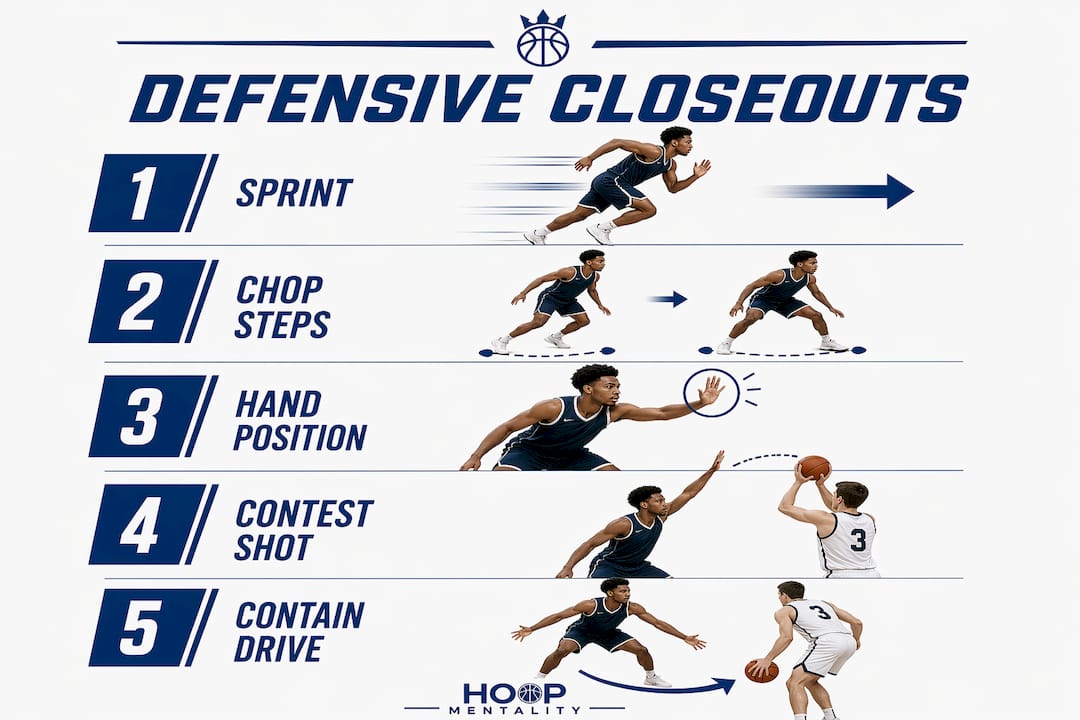
Effective defensive closeout technique follows a two-phase footwork model. The defender sprints first, then transitions to short controlled chop steps around the 8-foot mark. The sprint closes distance fast. The chop steps restore balance and directional control before contact. Skipping the chop step phase is the most common error at every level.
Phase one: the sprint
The defender reads the pass in the air and immediately sprints toward the shooter. The angle of the sprint matters. Defenders should aim slightly to the shooter’s strong hand side, not directly at the chest. This positioning forces the offensive player toward the help side if they choose to drive.
Phase two: chop steps and hand positioning
At roughly 8 feet from the shooter, the defender drops into short, quick chop steps. This transition is non-negotiable. A defender who arrives at full speed cannot change direction if the offensive player pump fakes. The chop step phase is what separates a controlled closeout from a reckless lunge.
Hand positioning follows a clear rule. One hand goes high on the shooter’s strong-hand side to contest the shot. The other hand stays near the hip for lateral mobility. Two hands up reduces a defender’s ability to slide laterally. The high hand also shrinks the shooter’s visual window, making the rim appear smaller without sacrificing the defender’s ability to move.
- Sprint phase: Close distance immediately when the pass leaves the passer’s hands.
- Chop step transition: Begin short steps at the 8-foot mark to regain balance.
- Hand positioning: One hand high on the strong side, one hand low near the hip.
- Stance on arrival: Land in an athletic stance, knees bent, weight centered, ready to slide.
- Feet discipline: Never leave your feet on a pump fake. Stay grounded and contest from the floor.
Pro Tip: Tell your players to “arrive alive.” The goal is not to get there fast. The goal is to get there fast and still be in control when you arrive.
How do scouting and player tendencies influence closeout strategies?
Closeout aggressiveness is not one-size-fits-all. Scouting reports on three-point percentage directly inform how a defender closes out on a specific opponent. A poor shooter gets a short closeout. The defender sits back slightly, takes away the drive, and concedes the low-percentage shot. A strong shooter gets a full closeout, even if it risks opening a drive.
This distinction is critical for coaches to teach explicitly. Players default to one closeout style for every opponent. That is a mistake. The defender closing out on a 40% three-point shooter should behave differently than one closing out on a player who has not made a three all season.
Scouting-based closeout decisions also affect your team’s help defense alignment. When a defender closes out short on a poor shooter, the help side can stay connected to their assignments. When a defender closes out full on a dangerous shooter, the help side must be ready to rotate on a drive. Your closeout strategy and your help defense scheme must match.
- Full closeout (shooters): Sprint hard, arrive with high hand, accept drive risk, trust help defense.
- Short closeout (drivers or poor shooters): Close to mid-range, sit in stance, take away the drive, concede the pull-up.
- Funnel principle: The “Close, Contest, Contain” framework directs offensive players toward help defenders, not baseline.
- Scouting integration: Review opponent shooting charts before practice so players know their assignments.
Closeout distance and technique should always be tailored to the opponent’s tendencies. Coaches who build this habit into their pre-game preparation give defenders a clear decision before the ball is even passed.
What drills and progressions best develop defensive closeout skills?
Drill progressions build closeout skills in layers. Starting with live 1-on-1 situations before players have mastered the footwork produces bad habits at game speed. The correct sequence moves from isolated mechanics to partner work to competitive situations.
- Stance and footwork emphasis: Players practice the sprint-to-chop-step transition without a ball. Focus on the exact distance where the transition begins and the body position on arrival.
- Partner closeouts with verbal cues: One player holds a ball, the other closes out from the help position. The ball-holder calls “shot” or “drive” after the closeout arrives, and the defender reacts. Add the verbal call “BALL!” as the defender closes out.
- Closeout cut-offs: The offensive player catches and immediately attacks. The defender must contain the drive using proper footwork. No reaching, no lunging.
- Live 1-on-1: Full competitive repetitions with a passer, a shooter, and a defender. The defender starts in help position and must close out before the catch.
- Continuous 2-on-2 closeout drill: Two offensive players pass the ball repeatedly while two defenders alternate closeout and help positions. This drill builds conditioning and forces constant communication.
The 2-on-2 continuous format is particularly effective because it replicates game fatigue. Defenders cannot rest between repetitions. Each pass forces a new decision. The drill progressions work best when coaches synchronize the chop step timing with the ball’s flight time, so defenders arrive just as the shooter catches.
Pro Tip: Run the 2-on-2 continuous drill at the end of practice when players are already tired. Closeouts in games happen in the fourth quarter, not the first. Train the skill under fatigue.
You can find additional drill sequencing ideas that integrate closeout work into full practice sessions at Hoopmentality.
How to troubleshoot common errors in defensive closeouts?
Most closeout breakdowns trace back to three root causes: poor body position, undisciplined footwork, and leaving the feet too early. Upright or forward-weighted defenders are beaten consistently, even when they arrive on time. Speed without balance is useless.
- Upright stance: Defenders who arrive standing tall cannot slide laterally. Require bent knees and a low center of gravity on every closeout arrival.
- Oversprinting: Players who skip the chop step phase arrive out of control. Mark the 8-foot transition point on the court during practice to build the habit.
- Leaving feet on pump fakes: This is the most costly error. A defender in the air cannot contest a drive. Drill the rule: contest from the floor, always.
- Hesitant hand positioning: Players who arrive with both hands low give the shooter a clean look. Require the high hand to go up before the feet stop moving.
- Passive effort: Defenders who jog to a closeout give the shooter time to set their feet. Closeouts must be sprinted, every time.
Anticipation and balance are more important than raw speed. A defender who reads the pass early and closes out under control is more effective than a faster defender who arrives out of position. Coaches should reward controlled arrivals in practice, not just fast ones.
Pro Tip: Film your players during closeout drills and show them their body position on arrival. Most players believe they are lower than they actually are. Video removes the argument.
A defensive drill checklist can help you track which errors your team repeats most often and prioritize the right corrections each week.
How does communication and teamwork factor into closeout defense?
Closeouts do not happen in isolation. Every closeout creates a gap in the defense that the help side must cover. Without communication, that gap becomes an open driving lane or a skip pass to an unguarded shooter. Verbal cues are the connective tissue of closeout defense.
The calls “Ball!” and “Help!” are the two most important words in closeout defense. “Ball!” signals that a defender is closing out and taking primary responsibility. “Help!” signals that a teammate is covering the gap. These calls must happen on every possession, not just when the defense is scrambling.
“Communication during closeouts is not optional. It is the mechanism that turns five individual defenders into one coordinated unit.”
- “Ball!” call: The closing-out defender announces their role as they sprint. This alerts help defenders to shift.
- “Help!” call: The help-side defender confirms coverage before the drive happens, not after.
- Drill integration: The 2-on-2 continuous drill requires both calls on every pass. Silence is a correctable error.
- Rotation awareness: Defenders must know who is covering the drive before the ball is passed. Pre-pass communication prevents scramble defense.
- Consistent chatter: Encourage constant talking throughout every defensive possession. Quiet defenders are reactive defenders.
The Close, Contest, Contain framework works only when the “Contain” phase is supported by a help defender who has already communicated their position. Closeout defense is a team skill, not an individual one.
Key takeaways
Effective defensive closeouts require a two-phase footwork model, scouting-informed decisions, and constant verbal communication to function as a team defensive system.
| Point | Details |
|---|---|
| Two-phase footwork | Sprint to close distance, then transition to chop steps at 8 feet for balance and control. |
| Hand positioning | One hand high on the strong side contests the shot; the other stays low for lateral mobility. |
| Scouting-based decisions | Adjust closeout length and aggressiveness based on each opponent’s shooting and driving tendencies. |
| Drill progressions | Build from isolated footwork to partner drills to live 2-on-2 situations under game-like fatigue. |
| Communication is required | “Ball!” and “Help!” calls coordinate roles and prevent defensive breakdowns on every closeout. |
What I’ve learned coaching closeouts at every level
Closeouts are where defensive effort becomes visible. You can hide a player’s positioning errors in a zone, but you cannot hide a bad closeout. The ball swings, the defender reacts, and everyone in the gym sees what happens next. That visibility is actually a coaching advantage. Closeouts give you immediate, objective feedback on your team’s defensive habits.
The biggest mistake I see coaches make is treating closeouts as a conditioning drill rather than a skill drill. They run players through closeout repetitions to get them tired, not to build technique. The result is fast, sloppy defenders who arrive out of control and get beaten by the first pump fake they see.
The detail that changed my teams most was teaching the chop step transition as a deliberate, coached moment. I started marking the 8-foot line on the court with tape during practice. Players had a physical cue to begin their transition. Within two weeks, the number of blown-by drives in our closeout drills dropped significantly. The tape came off after a month. The habit stayed.
Scouting integration is the other piece most coaches skip. Your players should know before practice which opponents they will close out hard and which ones they will sit back on. That decision should be made in the film room, not in the moment of a game. When defenders have a pre-made decision, they execute faster and with more confidence.
Closeout defense is a foundation skill. Get it right, and your entire perimeter defense becomes harder to attack.
— Dejan
Structured closeout training from Hoopmentality
Hoopmentality builds coaching resources around the skills that win games. Closeout defense is one of them.

The Big Man Dual Action Drill includes defensive closeout progressions built specifically for post and perimeter defenders, with clear coaching cues and drill sequences you can run immediately. The Game Preparation Guide with Weekly Practice Plan gives you a full practice structure that integrates closeout work into your weekly schedule, from early-week fundamentals to pre-game sharpening. Both resources are built from real coaching experience and designed to save you preparation time while improving your team’s defensive execution.
FAQ
What is a defensive closeout in basketball?
A defensive closeout is a defender’s rapid movement toward a shooter to contest a shot and prevent a drive. It combines a sprint phase and a controlled chop step phase to arrive in a balanced, contest-ready position.
Why are chop steps important in a closeout?
Chop steps at the 8-foot mark restore balance after the sprint and prevent defenders from overrunning the shooter. Without them, defenders arrive out of control and are easily beaten by a pump fake or a drive.
How does scouting change closeout technique?
Poor shooters receive short closeouts to take away the drive. Strong shooters receive full closeouts to contest the shot, even if it creates drive risk. Coaches use opponent shooting data to assign closeout length before games.
What verbal cues should defenders use during closeouts?
Defenders call “Ball!” when closing out to signal primary responsibility. Help-side defenders call “Help!” to confirm gap coverage. Both calls must happen on every possession to coordinate the team defense.
How do you drill defensive closeouts effectively?
Start with isolated footwork, progress to partner closeouts with verbal cues, then move to live 1-on-1 and 2-on-2 continuous drills. Run the most competitive repetitions at the end of practice to simulate game fatigue.