


TL;DR:
- Consistent short defensive practice sessions improve skill retention and system development.
- Fundamental mechanics like stance, footwork, and communication are crucial for effective defense.
- Tailor defensive checklists and drills to team level, emphasizing simplicity, focus, and progress tracking.
Practice time is limited. Every minute on the court counts. Without a clear plan, defensive fundamentals get rushed, skipped, or repeated without purpose. Consistent 10-15 minute sessions focused on defense yield significantly better retention than long, infrequent blocks. A well-built defensive drill checklist removes the guesswork. It keeps your staff aligned, your players accountable, and your defensive system developing week by week. This article lays out exactly what belongs on that checklist, how to structure it across a full practice week, and how to adapt it for your team’s specific level and situation.
Table of Contents
- Establishing core defensive fundamentals
- Top defensive drills every checklist needs
- Structuring your practice with checklists
- Adapting checklists for situations and levels
- Our take: The overlooked power of constraints and simplicity
- Bring your checklist to life with game-ready resources
- Frequently asked questions
Key Takeaways
| Point | Details |
|---|---|
| Start with fundamentals | Build your checklist on stance, footwork, and proper closeout habits for sustained defensive growth. |
| Prioritize key drills | Include shell, closeout, and on-ball pressure drills to guarantee comprehensive team development. |
| Use checklists to organize | Segment defensive practice by fundamentals, team, and situational reps for the most efficient sessions. |
| Adapt to team needs | Customize your checklist for youth, high school, and late-game strategies, updating as your team evolves. |
| Keep it simple and consistent | Limit checklist bloat and focus on clear cues and communication to drive real improvement. |
Establishing core defensive fundamentals
Before you can build a checklist, you need to know what belongs on it. The foundation of any great defense starts with individual mechanics. These are the building blocks. Get them wrong, and your team’s systems will break down regardless of the scheme you run.
Defensive stance basics are the starting point for every session. According to tested coaching frameworks, core defensive mechanics include a proper stance with knees bent, butt low, chest up, active hands, and feet at shoulder width. This position allows players to move quickly in any direction without losing balance. It sounds simple. But keeping players honest about their stance under game pressure is a daily coaching challenge.
Footwork comes next. Players must learn to slide without crossing their feet. Crossing feet is one of the most common mistakes at every level, and it leads to blown assignments. Zig-zag drills and mirror drills train the habit of clean lateral movement. Run these daily, not just when you remember to.
Closeouts are another checklist non-negotiable. A closeout starts with a sprint, then a chop step to gather and contest without fouling. Players who skip the chop step either foul or get blown past. Both outcomes hurt your defense. Drill the full sequence every session.
Help-side positioning teaches players to jump to the ball on every pass. Denying passes and staying connected to the help rotation requires constant awareness. It’s a skill that only develops through repetition and communication.
Speaking of communication, this is the element most coaches undervalue in individual drill work. Active hands are visible. Verbal communication is audible. Both signal engagement. If your players go through stance and footwork drills in silence, you’re training the wrong habit.
Here is a core fundamentals checklist to use as your baseline:
- Stance check: Knees bent, butt low, chest up, feet shoulder width
- Footwork: Slides without crossing feet, zig-zag and mirror drills complete
- Closeouts: Sprint, chop step, hand up without fouling
- On-ball pressure: Active hands, guard your yard, stay in front
- Help-side: Jump to ball, deny passes, maintain rotation awareness
- Communication: Verbal calls on every rep, not just game situations
Pro Tip: Use a single cue for each mechanic. “Low and wide” for stance, “chop and contest” for closeouts. Short cues stick. Long corrections during drills kill momentum.
You can also explore basketball defense tips for additional cue language and coaching frameworks that save time during practice.
With the foundation laid, it’s time to move from the basics to the essential team concepts that unify your defense.
Top defensive drills every checklist needs
Now that you’ve identified the critical fundamentals, selecting the right mix of drills brings these elements to life in practice. Not every drill is equal. Some build individual habits. Others develop team instincts. Your checklist needs both.
The shell drill is the non-negotiable starting point for team defense. It is a foundational 4-on-4 drill that teaches positioning across four roles: ball, deny, help, and support. Players learn to rotate on passes and dribble penetration, communicate position calls, use peripheral vision, and recover after rotations. Run it without it and your team’s rotations will always be a step late.
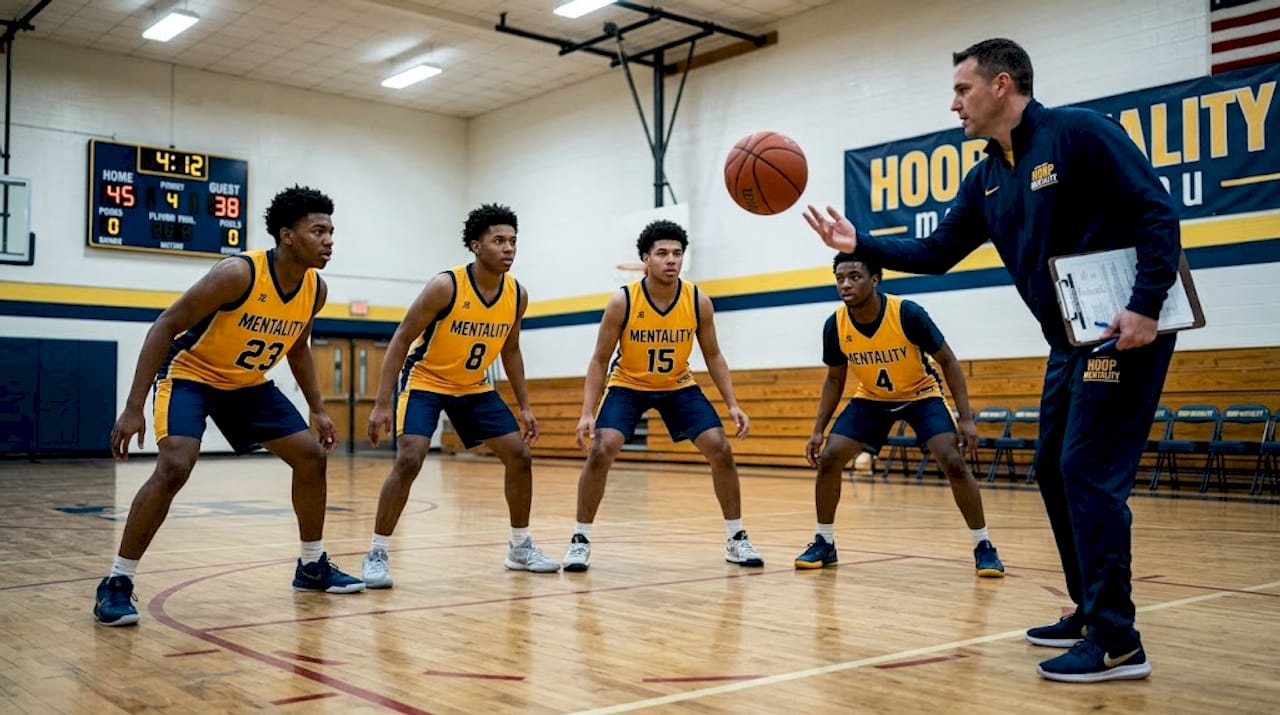
Beyond the shell drill, game-ready drills like Closeout Assignments, On-Ball Habits, and 2-on-1 Bear directly target specific defensive weaknesses. Closeout Assignments are situational: you adjust the closeout technique based on whether the offensive player is a known shooter or driver. On-Ball Habits focus on the stick hand and reaction speed. The 2-on-1 Bear drill builds help instincts fast.
Here is a numbered list of must-have drills and their primary focus:
- Shell drill (4-on-4): Team positioning, rotations, communication
- Closeout Assignments: Shot contestation, situational decision-making
- On-Ball Habits: Stick hand, reaction to live dribble
- Zig-zag/mirror drills: Footwork, lateral speed, staying in front
- 2-on-1 Bear: Help-side instincts, rotation speed
- Post 4D: Post defense, wall up, rotation, charges
- 1-on-1 Elbow: Individual containment, live defensive reps
- Charge/Deflection drills: Culture, effort habits, deflection stats
“The best defensive teams are not the ones running the most drills. They’re the ones running fewer drills with greater intention and communication.”
Here is a quick comparison to help you balance individual and team-focused reps:
| Drill | Focus | Individual or team | When to use |
|---|---|---|---|
| Shell drill | Positioning and rotations | Team | Daily, every practice |
| Closeout Assignments | Shot contestation | Individual | After stance and footwork block |
| 2-on-1 Bear | Help instincts | Small group | Mid-practice intensity block |
| 1-on-1 Elbow | Containment | Individual | Competitive rep block |
| Charge/Deflection drills | Effort culture | Team | End of session, high energy |
| Post 4D | Post coverage | Small group | Big-man focused sessions |
You can review defensive drills impact data to see how specific drills translate to measurable game improvement. Knowing the return on each drill helps you prioritize when time is short.
Structuring your practice with checklists
Once you’ve decided on your critical drills, it’s crucial to know where and how each fits into the practice routine. A checklist only works when it maps to a real practice structure. Random drill selection, even with great drills, produces inconsistent results.
The proven approach is to segment practice into four blocks: fundamentals, individual, team, and competitive. Each block builds on the last. Start with 5 minutes of stance and slides. Move into individual mirror or zig-zag work. Progress to shell drill and team rotations. Finish with live 1-on-1 or competitive situations.
Sessions should run 10 to 30 minutes total, scheduled 2 to 3 times per week. The closeout drill improves shot contesting by 20% when practiced consistently. The same data shows 1-on-1 defense effectiveness improves by 25% with regular focused reps. Shell drill run for 15 to 20 minutes per session builds team synergy measurably faster than running it for 5 minutes once a week.
Here is a sample weekly practice layout:
| Day | Block 1 (5 min) | Block 2 (10 min) | Block 3 (10 min) | Block 4 (5 min) |
|---|---|---|---|---|
| Monday | Stance and slides | Zig-zag and mirror | Shell drill | 1-on-1 competitive |
| Wednesday | Stance and slides | Closeout Assignments | Shell drill rotations | Charge/Deflection |
| Friday | Stance review | On-Ball Habits | 2-on-1 Bear | Post 4D + review |
This structure gives you the coaching checklist essentials framework to stay consistent. The table above is a starting point, not a fixed rule. Adjust based on your team’s gaps each week.
Use these metrics to track progress:
- Closeouts without fouls: Count per session, target improvement each week
- Stops and turnovers forced: Track live rep outcomes in competitive blocks
- Verbal cues per rep: Count communication calls during shell drill
- Containment time: How long players stay in front in 1-on-1 situations
Pro Tip: Keep a simple weekly tracking sheet on a clipboard. After each defensive block, write the drill name, time spent, and one metric. Over four weeks, the data shows you exactly where improvement is happening and where it isn’t. This makes your checklist a living tool, not a static list.
For additional ideas on how to sequence and assess defensive concepts, the defensive concepts guide offers structured breakdowns that align with this practice block model.
Adapting checklists for situations and levels
A checklist’s value grows when it flexes to fit players, opponents, and game situations. A single universal list does not serve a youth team and a varsity program equally. Recognizing this is what separates functional coaching tools from paper that sits in a binder.
For youth teams, youth focus should emphasize fun and skill quality over full team systems. Run fewer drills with more repetition on each. Teach stance, slides, and closeouts before introducing shell. Skip the complex rotation language early. Keep verbal cues short and repeat them every session so they become automatic.
For high school and varsity programs, the checklist expands. Add full shell drill progressions, pick-and-roll coverage, and zone adjustment blocks. Players at this level can handle more situational complexity, but only if the individual foundation is solid. Don’t skip to team systems if your players still cross their feet on slides.
Here are targeted checklist elements by level and system:
- Youth (ages 8 to 12): Stance, slides, 1-on-1 containment basics, fun effort drills like deflections
- Middle school (ages 12 to 14): Add closeouts, help-side positioning, basic shell without rotations
- High school: Full shell with rotations, pick-and-roll coverage, zone vs man adjustments, communication accountability
- Man-to-man focus: Closeout Assignments, On-Ball Habits, 1-on-1 Elbow, shell rotations
- Zone focus: Shell with zone spacing concepts, sag principles, deny lane positioning
The endgame defense strategy is a specific area where your checklist needs a dedicated section. Endgame situations are high-pressure and require pre-planned decisions. An end-game defensive checklist should cover your best lineup for one stop in under 7 seconds, how to contain penetration, rebounding assignments against big lineups, whether to press or zone in comeback situations, how to handle small-ball shooting lineups, staying home on three-point shooters, foul technique, a designated fouler, and trap positioning on perimeter drives.
Common checklist pitfalls coaches should monitor include:
- Overhelping: Leaving shooters open while helping on drives. Treat this as seriously as under-helping.
- Silent rotations: Players rotating without calling out switches. Fix this by making communication mandatory in every drill, not just games.
- Head-down sliding: Players who look at the ball carrier’s feet instead of their hips. Use hip-read drills to correct this.
- Skipping fundamentals to get to team drills: This is the most common mistake. Team systems break when individual mechanics are weak.
Pro Tip: Print a laminated one-page checklist for the bench. On one side, put your standard defensive drill order. On the other, put your endgame defensive checklist. Use it in real time during games. It removes hesitation in high-pressure moments.
Find practical templates and frameworks in the defensive adjustment tips resource to help you build the level-specific versions of your checklist quickly.
Our take: The overlooked power of constraints and simplicity
Most coaches assume a better checklist means a longer checklist. We disagree. The teams that defend best are typically running fewer drills with tighter constraints, not more drills with looser ones.
Constraints work because they force focus. A drill run with a 20-second time limit produces more effort and attention than the same drill with no clock. A rule that requires two verbal calls per possession produces better communication than just telling players to talk. These small rules create habits faster than repetition alone.
Common pitfalls like head-down sliding, late rotations, and silent defense are fixed faster through accountability constraints than through correction alone. Wall checks after drills, film review of specific plays, and partner accountability systems all accelerate improvement. They make the checklist feel real, not theoretical.
We also encourage coaches to review drill impact research before adding new drills to their checklist. If a drill doesn’t have a clear outcome you can measure, it probably doesn’t belong on the list yet.
Keep your checklist to 6 to 8 items per session. Trim ruthlessly. Consistency over 10 weeks with a focused list beats variety every time.
Bring your checklist to life with game-ready resources
For coaches ready to take their checklist from the page to the hardwood, Hoop Mentality offers proven tools to make it seamless.

The Basketball Practice Plan Template gives you a ready-made structure to plug your defensive drills directly into a full practice schedule. No more building from scratch each week. The Big Man Dual Action Drill is a targeted resource for post defense and rotation work, fitting directly into the Post 4D block of your checklist. Both tools are built from real coaching experience and designed to save you time while keeping your defensive system sharp and organized. Explore the full resource library at Hoop Mentality and find what your checklist is missing.
Frequently asked questions
What are the most important defensive drills for team practices?
The shell drill teaches positioning, rotations, and communication in a 4-on-4 format, making it the core of any team defensive program. Closeout Assignments and on-ball pressure drills round out the essentials.
How long should defensive drill sessions last for best results?
Consistent 10-15 minute sessions run 2 to 3 times per week produce better retention and improvement than longer, infrequent practice blocks. Short and focused beats long and scattered every time.
How can I measure improvement in team defense?
Track closeouts without fouls, stops, turnovers forced, verbal communication calls, and containment time during practice reps to get a clear picture of where your defense is improving and where it still needs work.
How should youth defensive checklists differ from high school or varsity?
Youth checklists prioritize fun and skill quality with fewer, simpler fundamentals, while high school checklists include full team systems like shell progressions, pick-and-roll coverage, and man-to-zone adjustment work.