

Run age-appropriate, fundamentals-first basketball youth drills. Pick a few drills per age group from the lists below, and follow a practice template lasting up to one hour, and you get measurable improvement within a few sessions. Printable practice-plan templates make the whole thing copyable.
TL;DR:
- Kids aged 3 to 5 need short, simple drills focused on catching, bouncing, and walking with a ball, using a mini ball and a low hoop or target.
- Children aged 6 to 9 can handle longer drills emphasizing stationary dribbling, passing, and close-range shooting, with graduated skill complexity.
- Pre-teens aged 10 to 13 are capable of more advanced drills involving live decision-making, two-ball dribbling, and defending under moderate pressure.
- Practice sessions should follow a structured 45 to 60-minute plan, starting with warm-ups, then ball-handling, shooting, game-like drills, and ending with conditioning and cool-downs.
- Progressively increase drill difficulty only after proper mechanics are established, and always monitor for signs of fatigue or poor form to prevent injuries.
Table of Contents
- Basketball Youth Drills by Age Group
- Core Basketball Skill Drills That Actually Move the Needle
- A 45 to 60 Minute Basketball Practice Template You Can Copy
- Making Drills Harder Without Breaking Good Form
- Games That Sneak In Skill Work
- Why the Drill Order in This Guide Isn’t Random
- Warm-Ups and Cool-Downs That Protect Young Players
- Teaching Teamwork Through the Drills Themselves
- Keeping Basketball Drills Safe for Growing Bodies
- Short Reps Beat Long Sessions
- Printable Practice Plans That Match This Exact Session
- Sources
- FAQ
Basketball Youth Drills by Age Group
A 4-year-old and a 12-year-old have almost nothing in common on a basketball court, and treating them the same is the fastest way to lose both of them. USA Basketball groups its skill guidance by age for exactly this reason, prioritizing correct mechanics over how far or how fast a kid can go.
Ages 3 to 5. Attention span runs a few minutes per activity, and coordination is still developing. Priorities: two-hand catching, bouncing a ball to self, walking while dribbling, and rolling the ball to a partner. Use a size 3 (mini) ball and a hoop no higher than 6 feet, or a floor target if no hoop is available.
Ages 6 to 9. Attention runs 10 to 15 minutes per drill, and kids can now chain two skills together (dribble then pass). Priorities: stationary dribbling with both hands, chest and bounce passing, one-hand form shooting close to the rim, and jump stops. Use a size 5 ball and a 7 to 8 foot hoop when adjustable.
Ages 10 to 13. Attention runs 15 to 20 minutes, and this group can handle live decision-making and moderate defensive pressure. Priorities: two-ball dribbling, three-spot shooting, live-defender passing drills, and pivot combinations under pressure. Use a size 6 or 7 ball depending on league rules, with a full 10 foot hoop.
- Ages 3 to 5: rolling, catching, walking dribble, mini ball, low hoop or target
- Ages 6 to 9: stationary dribble, chest/bounce pass, close-range form shooting, jump stop
- Ages 10 to 13: two-ball dribble, three-spot shooting, live-defender passing, pivot combos
Session length should scale with the group too: short sessions for the youngest kids, medium-length for elementary-age players, and longer sessions for pre-teens who can sustain focus longer.
Core Basketball Skill Drills That Actually Move the Needle
Five skill categories cover almost every basketball youth drill worth running: shooting, dribbling, passing, footwork, and defense. Beginner programs get the most traction when they build these in a specific order, starting with footwork and ball-handling before shooting, because tired legs and sloppy footwork wreck shooting form fast.
- Form shooting. Stand 3 feet from the hoop, one hand only, elbow in, and focus on a soft release with backspin. Do 10 makes before moving back a step. The most common error is a flat elbow. Fix it by having the player “shake hands with the rim” on the follow-through.
- One-hand close-range shooting. Same setup as form shooting but off one dribble into a catch-and-shoot. Ten reps per hand build shoulder symmetry early.
- Three-spot shooting. Once form is consistent, add three spots around the key (each 45 degrees) and rotate 5 shots per spot. Track makes out of 15 total.
- Layup progression. Start with a stationary layup off the correct foot, then add a one-dribble approach, then a full-speed approach. Fifteen reps split evenly between hands.
- Stationary pound dribble. Both hands, waist height, 30 seconds each hand, eyes up. The common error is watching the ball. Cue: “eyes on me, not the ball.”
- Cone dribble. Set 5 cones in a zigzag, weave through using the outside hand on each cone. Two full passes, weak hand only on the second pass.
- Two-ball dribbling. Both balls bounced simultaneously, then alternating. This isolates weak-hand control faster than almost any single-ball drill.
- Partner chest and bounce passing. Ten reps each type at 10 feet, then move to 15 feet. Cue: step into the pass, not just arms.
- Diamond passing. Four players in a diamond shape passing in sequence, adding a second ball once the pattern is clean.
- Jump stop and pivot. Catch the ball on the move, land both feet at once, then pivot on the ball of one foot without dragging.
- Defensive stance and slide. Knees bent, hands active, slide without crossing feet. Add a closeout rep: sprint, then chop steps into a balanced stance.
Pro Tip: Track weak-hand reps separately from strong-hand reps for a full week. Most youth players get 3 to 4 times more strong-hand touches unless a coach forces the split.
Hoop Mentality’s best youth basketball drills for kids guide breaks each of these down further with age-specific variations, and the 7 essential basketball skills resource maps them to a full-season teaching order.
A 45 to 60 Minute Basketball Practice Template You Can Copy
Practice sequencing matters as much as drill selection. Ball-handling goes first while legs are fresh, shooting starts close to the rim before extending range, and conditioning always comes last so fatigue never contaminates skill mechanics.
- Warm-up (5 minutes): dynamic stretches, jogging, and easy ball touches
- Ball-handling (10 to 15 minutes): stationary pound, cone dribble, two-ball work
- Shooting (15 to 20 minutes): form shooting, close-range work, three-spot progression
- Game situations (10 to 15 minutes): live passing, jump stop/pivot combos, small-sided scrimmage
- Conditioning and cooldown (5 to 10 minutes): light footwork drills, stretching
For team practices, split the group into 3 stations rotating every 8 to 10 minutes to keep everyone active. For a parent-child routine at home, a 10 to 15 minute daily session covering just ball-handling and form shooting produces steady gains without needing a full hoop setup, according to at-home drill guidance from ProSkills Basketball.
Quick progress checks: track makes out of 10 in form shooting, count successful jump stop/pivot combos out of 5 attempts, and log weak-hand dribble touches versus strong-hand touches.
Making Drills Harder Without Breaking Good Form
Quality comes before difficulty, always. Add speed, distance, or defensive pressure only once a player’s form holds steady, a principle USA Basketball’s foundational guidance backs directly. Rushing a kid from a stationary drill to a live one before mechanics stick just teaches bad habits faster.
- Lower the hoop or use a lighter ball before adding shooting distance
- Move from a passive defender to a lightly active one before full-speed defense
- Add a decision-making trigger (a coach’s signal, a defender’s position) only after the base movement is automatic
Pro Tip: Watch for three red flags that a drill is too advanced: shooting form collapses under speed, make/success rate drops by half or more, or the player’s focus visibly wanders. Any one of those means dial it back a step.
Hoop Mentality’s basketball skill progressions guide walks through week-by-week scaling if you want a longer runway than a single practice.
Games That Sneak In Skill Work
- Knockout (skill version): two shooters, make-to-eliminate, targets shooting form under time pressure. Increase difficulty for older kids with a three-point line only.
- Numbers game: call a number, players dribble that many crossovers before shooting, reinforcing ball control.
- Relay dribbling: teams race cone-to-cone using only the weak hand, building control without them realizing it.
- Free-throw challenge: first to 5 makes wins, reinforcing routine and focus under mild pressure.
- Partner pass race: two lines pass and move down the court, targeting passing accuracy on the move.
- Mirror defense: partners mirror each other’s slides for 30 seconds, sharpening stance and footwork.
Most of these need only half a court and a few cones. Hoop Mentality’s fun basketball warm-up drills guide has more variations built for the same age brackets.
Why the Drill Order in This Guide Isn’t Random
Practices fail more often from bad sequencing than bad drills. Doing stationary ball-handling in a hallway or on the sideline before gym time even opens saves the hoop for drills that actually need it, and skipping skill work once players are fatigued avoids grooving sloppy patterns that take weeks to unlearn.
- Check weak-hand reps every practice, not just once a month
- Track success rate, not just effort. A drill run wrong 20 times teaches the wrong thing 20 times
- Run through a short coaching cue checklist before each block: stance, eyes, follow-through
Hoop Mentality’s basketball shooting checklist and practice plan template both map directly onto the session blocks covered above, giving coaches a printable version of the same structure.
Warm-Ups and Cool-Downs That Protect Young Players
Youth basketball injuries cluster around ankles, knees, and growth-plate stress, and most of it is preventable with a real warm-up instead of a rushed lap around the gym. Start with light jogging or skipping for 2 minutes to raise heart rate, then move into dynamic stretches: leg swings, walking lunges, arm circles, and ankle rolls. Static stretching (holding a stretch without movement) works better after practice than before it, since cold muscles don’t respond well to long holds.
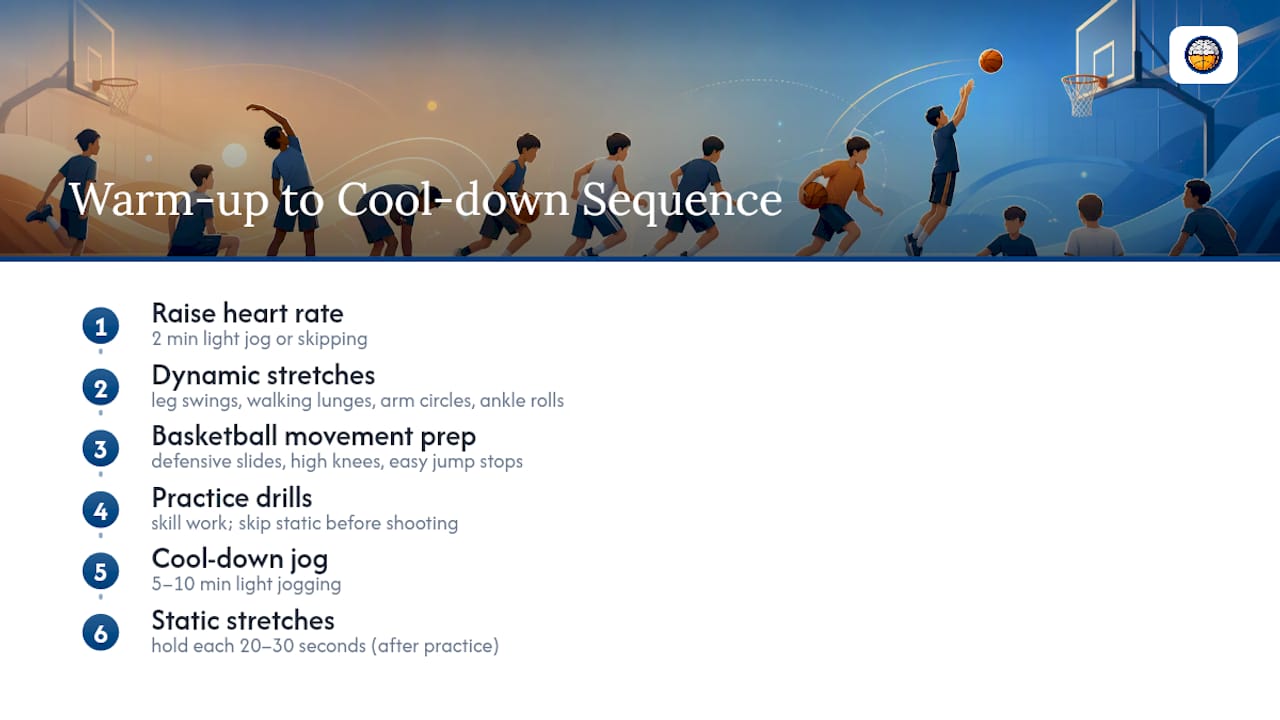
Once the body is warm, add basketball-specific movement prep: defensive slides, high knees, and a few easy jump stops. This primes the exact joints and muscles the practice will stress, cutting down on rolled ankles during cone drills or dribble work.
Cool-downs matter just as much and get skipped constantly. Five to 10 minutes of light jogging followed by static stretches, holding each for 20 to 30 seconds, helps young muscles recover and reduces next-day soreness that can make a kid dread the next practice. For players under 8, keep cool-downs playful. A slow “animal walk” stretch game works better than asking a 6-year-old to hold a hamstring stretch quietly.
Pro Tip: Skip static stretching before shooting drills specifically. Cold, over-stretched muscles can actually reduce shooting power and accuracy for the first several minutes.
Teaching Teamwork Through the Drills Themselves
Basketball is a communication sport before it’s a skill sport, and youth practices are the easiest place to build that habit early. Passing drills like diamond passing or partner chest passing already require players to call a teammate’s name before throwing, so make that verbal cue mandatory instead of optional. A pass thrown without a name called doesn’t count, even if it’s caught clean.
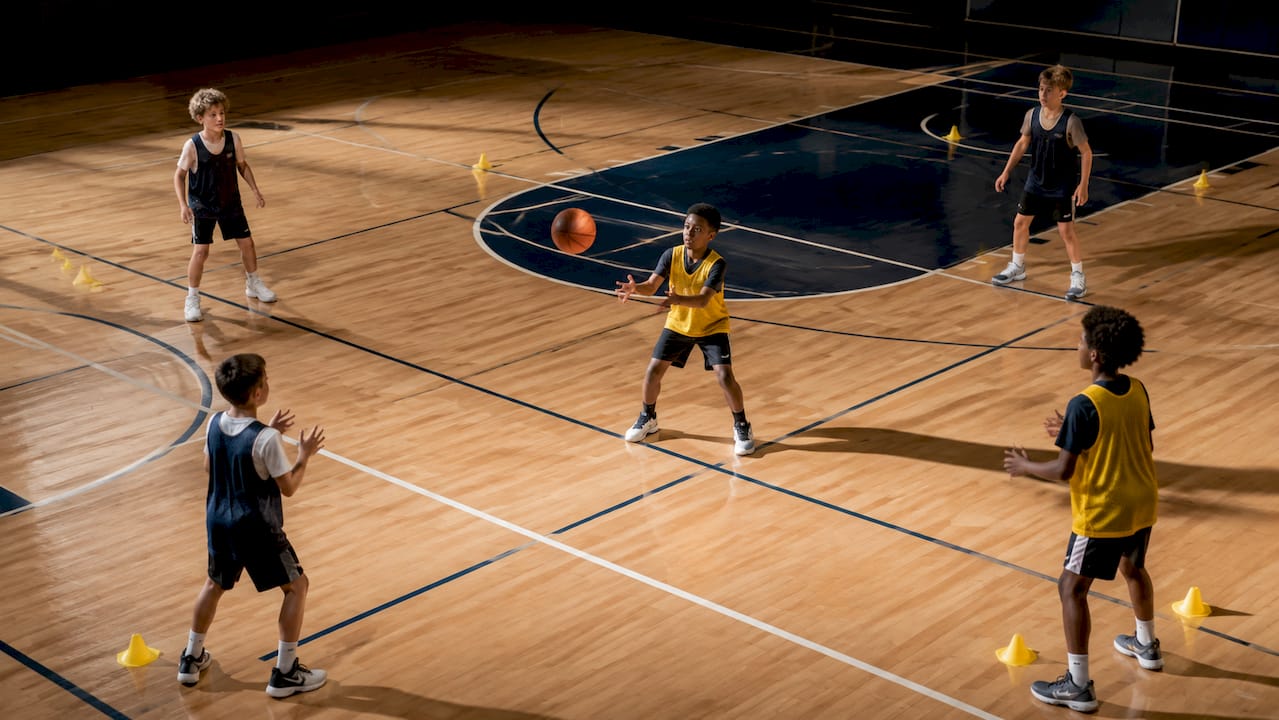
Small-sided scrimmages (2-on-2 or 3-on-3) are more valuable for teamwork than full 5-on-5 games at younger ages, because every player touches the ball far more often and has to talk through screens, cuts, and defensive switches. Add a rule where players must call “switch” or “help” out loud during defensive drills. It feels awkward for the first few sessions and becomes automatic within two or three weeks.
Rotating team captains for water breaks or huddles, even for 8-year-olds, gives kids ownership over communication rather than treating it as something only the coach handles. For pre-teens, add a simple film-room habit: after a scrimmage, ask two players to explain out loud what the defense was doing before the next possession starts. That single habit builds more game intelligence than an extra shooting drill would.
Keeping Basketball Drills Safe for Growing Bodies
Youth players are more prone to overuse injuries than acute ones, largely because growth plates are still open and repetitive stress from too much shooting or jumping adds up fast. Limit high-impact jumping drills (layup finishes, rebounding work) to 10 to 15 minutes total per practice for players under 10, and never run them on back-to-back days without at least one recovery day between.
Watch hydration closely, especially in warm gyms. A quick water break every 15 to 20 minutes keeps young bodies from overheating, since kids are less efficient at regulating body temperature than adults and often won’t ask for water on their own.
Footwear matters more than most coaches assume. Shoes that are too big cause ankle rolls during cone and defensive slide drills, and worn-out soles reduce grip on gym floors that are already slippery from dust or sweat. Check laces and fit at the start of every session, not just the first day of the season.
Finally, never run a drill through pain. If a player says a knee, ankle, or shin hurts during a drill, stop that player’s participation for the day rather than pushing through “just one more rep.” Youth injuries that get ignored early tend to turn into season-ending problems by midseason.
Short Reps Beat Long Sessions
Coaches who run focused, well-sequenced 45-minute practices consistently see faster skill gains than ones running unstructured 90-minute sessions. Kids lose focus, form breaks down, and the extra time mostly grooves bad habits instead of good ones. Shorter, sharper practice built around 2 or 3 clear drills wins almost every time.
Pick a small number of drills to focus on and track progress consistently.
Try the Basketball Practice Plan Template this week and run it exactly as written before changing anything. The structure does more work than any single drill on the list.
— Dejan
Printable Practice Plans That Match This Exact Session
Building this practice from scratch every week is where most coaches lose time they should be spending with players. Downloadable resources are built to slot directly into the age-segmented, fundamentals-first structure covered above, so the prep work is already done.

The Basketball Practice Plan Template gives you the exact 45 to 60 minute timed blocks from this guide in an editable format, ready to print before your next session. The Basketball Starter Pack For Coaches bundles that template with progressive drill PDFs covering shooting, dribbling, and passing, so new coaches aren’t building sessions from a blank page. For teams focused specifically on shooting mechanics, the Basketball Shooting Bundle For Coaches covers form shooting through three-spot progressions in more depth than a single practice allows. Coaches wanting to isolate ball-handling reps can add the Skill Improving Infinite Loop Drills, built around repeatable weak-hand and two-ball sequences.
These resources are available as ready-to-use PDFs for instant download after purchase. Download the practice plan template and run this week’s session without writing a single drill from scratch.
Sources
- Skills and Drills for Players - USA Basketball
- Basketball Drills for Beginners: 12 Essential Drills to Build Real Fundamentals
- Basketball Drills: Practice Guide 2026 | 143 Basketball Haven
- 10 Best Youth Basketball Drills to Do at Home
FAQ
What are some fun basketball drills for youth?
Knockout, the numbers game, relay dribbling, and free-throw challenges all reinforce real skills like shooting form and ball control while keeping kids engaged through light competition.
What are five basic basketball drills for beginners?
Form shooting, stationary pound dribbling, partner chest passing, jump stop and pivot, and defensive stance and slide cover the five core skill areas every beginner needs.
How do you structure a youth basketball practice?
Start with a 5-minute warm-up, then 10 to 15 minutes of ball-handling, 15 to 20 minutes of shooting, 10 to 15 minutes of game situations, and finish with 5 to 10 minutes of conditioning and cooldown.
What are some good training drills for basketball?
Two-ball dribbling, three-spot shooting, diamond passing, and live-defender closeouts are strong training drills once a player’s basic form is consistent.
How young can kids start basketball drills?
Kids as young as 3 can start with simple catching, rolling, and walking-dribble drills using a mini ball, scaling up to full skill drills by age 6 or 7.