

Run the 60-minute plan below for ages 7 to 11, and the 90-minute plan for ages 12 to 14. Both are timed block by block, with drill names, rep counts, and coaching cues built in, so there is no guesswork at the gym door. Each script maps directly onto a printable Basketball Practice Plan Template from Hoop Mentality, so you can write it once and reuse it all season.
TL;DR:
- Practice durations should be tailored to age: 45-60 minutes for ages 7-8, 60-75 minutes for ages 9-11, and 75-90 minutes for ages 12-14, focusing on appropriate skill levels.
- Using parallel stations for different age groups keeps both younger and older players engaged at their skill level, avoiding boredom or overload.
- The most effective drills have clear setups, simple coaching cues, and high rep density, especially for ball handling, passing, and shooting skills.
- Keeping practice well-structured with a timed, eight-block plan ensures continuous engagement and minimizes long waiting times for players.
- A printable, pre-planned template with specified time blocks simplifies session preparation, promoting consistency and adaptability across practices.
Table of Contents
- Sample Youth Basketball Practice Plan for Ages 7 to 11 (60 Minutes)
- Sample Youth Basketball Practice Plan for Ages 12 to 14 (90 Minutes)
- What Age Group Needs What Practice Length?
- Drills and Station Setups That Work for Beginner to Intermediate Teams
- First Practice Checklist and Five Goals to Set
- How to Build a One-Page Practice Plan Template
- Equipment and Gym Management for Small Coaching Staffs
- Where Hoop Mentality Templates Fit Into These Plans
- A Coaching Note on What Actually Matters at Practice
- Skip the Blank Page, Print the Plan Instead
- Sources
- FAQ
Sample Youth Basketball Practice Plan for Ages 7 to 11 (60 Minutes)
This is the plan to hand a brand new assistant coach and trust them to run it. Every block has a clock, a setup, and a coaching cue attached, following the same 8-block structure (warm-up, ball handling, passing, shooting, defense, team concepts, scrimmage, cooldown) used in Jr. NBA’s downloadable starter plans.
0:00 to 0:08, dynamic warm-up
Line players up on the baseline in groups of four or five so nobody waits.
- High knees down, backward jog back (1 minute)
- Butt kicks down, lateral shuffle back (1 minute)
- Skip and reach down, jog back (1 minute)
- Defensive slide down, sprint back (2 minutes)
- Stretch: quads, hamstrings, calves (3 minutes)
Coaching cue: “Chest up, eyes forward” on every rep. It fixes posture before the ball ever touches a hand.
0:08 to 0:18, ball handling station
Split into two lines at half court. One line dribbles right hand only to the far line, the other dribbles left hand only back.
- Stationary pounds, right hand, 20 reps
- Stationary pounds, left hand, 20 reps
- Crossover in place, 15 reps
- Cone weave (5 cones, 6 feet apart), 2 trips each direction
Pro Tip: Call out “weak hand only” during water breaks. Kids default to their dominant hand the second you look away, and the extra reminder buys you three or four more weak-hand touches per player.
0:18 to 0:26, passing and footwork
Partner up. Chest pass, 10 reps each, then bounce pass, 10 reps each, standing 8 feet apart. Progress to a walking give-and-go down the sideline, one partner passes and cuts, the other returns it and cuts back.
Finish with a 90-second pivot ladder: catch, pivot front foot, pivot back foot, repeat down the line.
0:26 to 0:36, shooting block
Two lines at each basket if you have two hoops available.
- Form shooting, 2 feet from rim, 10 makes before moving back
- Layup lines, right-hand approach, 8 reps
- Layup lines, left-hand approach, 8 reps
- Catch-and-shoot from the block, 6 reps each side
Keep the layup line moving. A player who has to wait more than 15 seconds between reps starts fidgeting, and that’s when you lose the group’s attention.
0:36 to 0:44, defense block
Partner up, one offense, one defense, both in the paint.
- Defensive stance hold, 20 seconds, switch
- Lateral slide drill, 4 slides right, 4 slides left, no crossing feet
- Mirror drill: offense moves side to side slowly, defense mirrors and stays low
Coaching cue: “Hands up, butt down.” Say it every rep until it sticks.
0:44 to 0:50, team concept
Walk through basic spacing. Put four players on the floor and have them spread to the corners and wing, then rotate one pass at a time so everyone touches the ball and learns to fill the open spot.
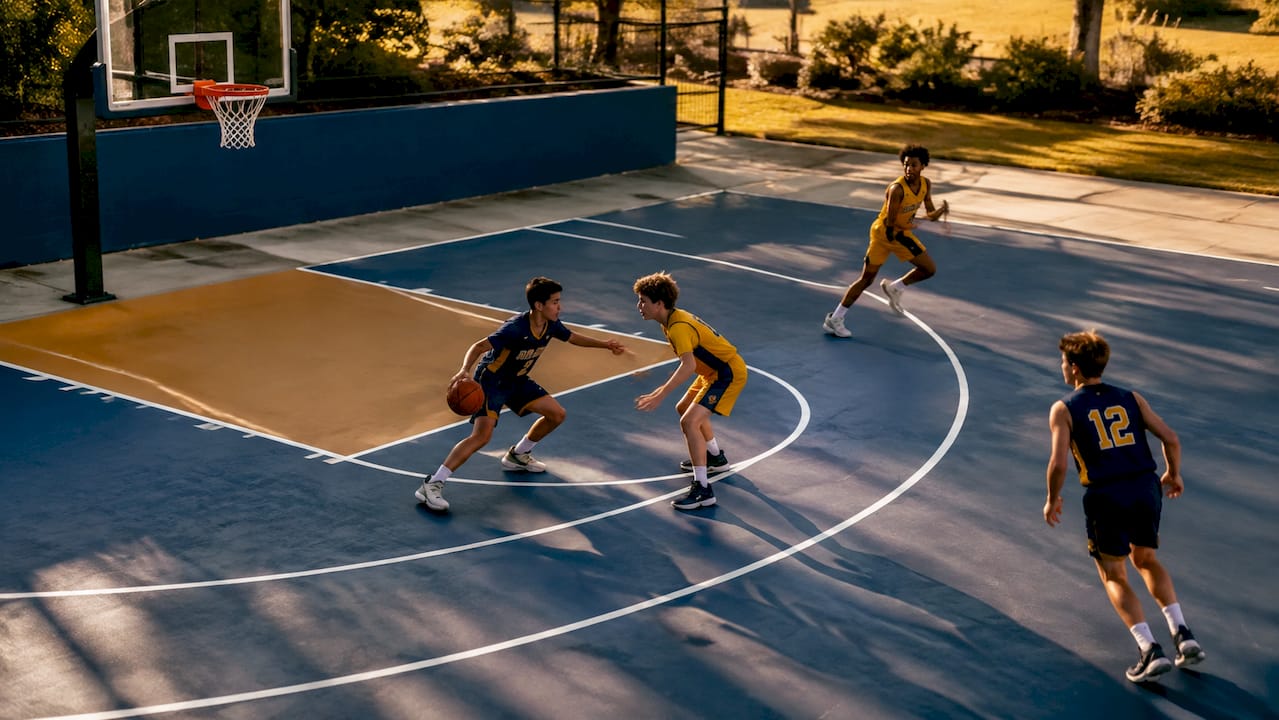
0:50 to 0:57, small-sided scrimmage
Run 3v3 on a half court, or 3v3 on both baskets if you have two hoops, so every player gets game reps instead of standing in line. Stop play every 60 to 90 seconds to fix one specific mistake, then restart from that spot rather than resetting the whole possession.
0:57 to 1:00, cooldown
Gather at half court. Ask each player to say one thing they got better at. It takes 90 seconds and sends every kid home with a concrete answer for the car ride.
What keeps this plan moving:
- Two lines max at any station, never a single line of ten
- Pre-set your rotations before players arrive so you’re not organizing on the fly
- Sub liberally during the scrimmage block, nobody sits more than one rotation
Sample Youth Basketball Practice Plan for Ages 12 to 14 (90 Minutes)
Older, more experienced teams need the extra 30 minutes for decision-making, not just more reps. This script stretches the shooting and team-system blocks and adds a full team-defense segment that the 60-minute plan skips, a natural way to expand a shorter session as players mature, a progression outlined in MasterClass’s breakdown of practice structure.
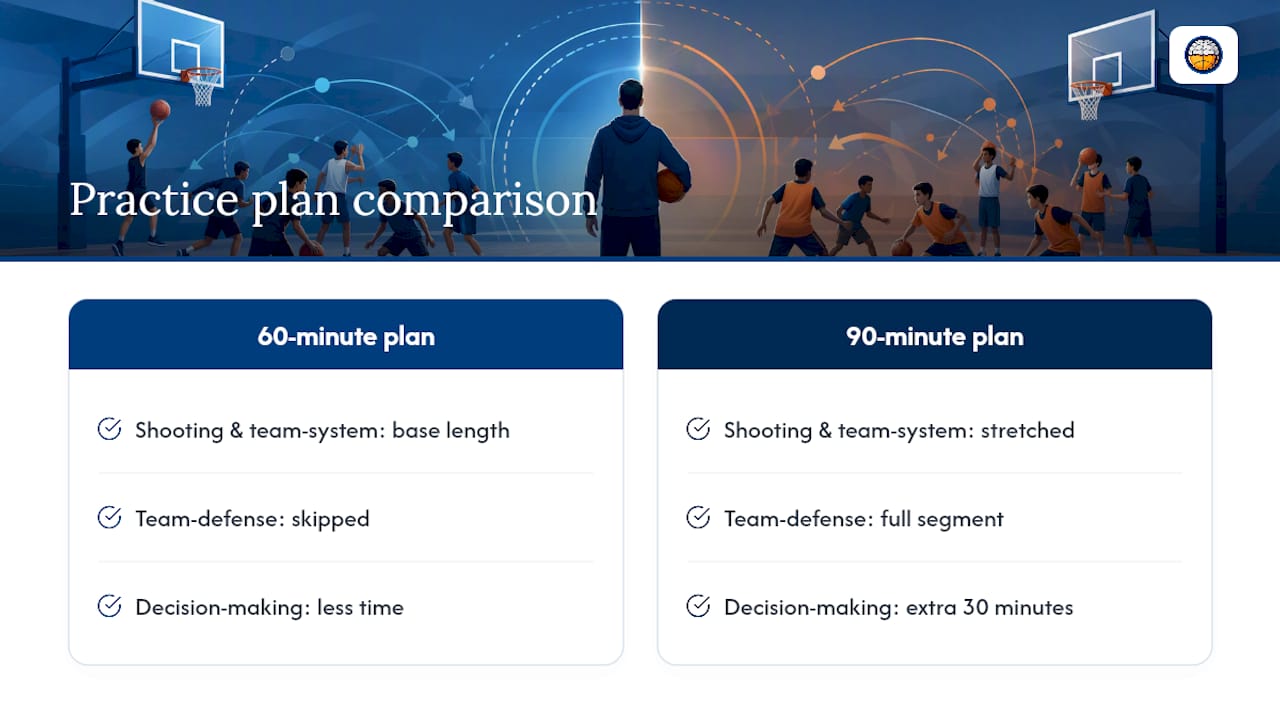
0:00 to 0:10, extended warm-up and activation
Same dynamic movements as the younger group, but add a 3-minute activation series: jump rope or lateral bounds, plus a 90-second competitive tag game to raise energy before ball work starts.
0:10 to 0:22, advanced ball handling and transition dribbles
- Two-ball rhythmic dribbling, stationary, 30 seconds
- Between-the-legs and behind-the-back combo moves, 10 reps each
- Full-court transition dribble at game speed, attacking a cone at half court and finishing at the rim
- Change-of-pace attack move, 3 reps per player
0:22 to 0:32, passing and cutting
Run a 3-player give-and-go with a backdoor option: two passers on the wing and top of the key, one cutter reads the defender and either cuts to the ball or backdoor to the rim. Rotate every 4 reps.
0:32 to 0:47, shooting
- Spot-up catch-and-shoot from five marked spots, 5 makes each spot
- Off-the-dribble pull-up, 2 dribbles into a jump shot, 8 reps
- Free-throw routine, 10 shots, tracked for makes
0:47 to 0:59, defense: shell and closeouts
Run 4-on-0 shell drill first so players learn help-side positioning without an offense to react to. Progress to closeout footwork: sprint from the paint to contest a shot on the perimeter, land in a balanced stance.
0:59 to 1:11, team offense
Walk through a basic motion offense or one set play, using cuts and screens to create an open shot. A blank court diagram on a clipboard makes this five times faster than explaining it verbally.
1:11 to 1:19, team defense
Cover help rotations and, if your league allows zone, basic 2-3 zone principles. Keep it to one concept per practice. Layering three new defensive ideas in one session guarantees none of them stick.
1:19 to 1:27, controlled scrimmage
Play 5v5 and stop the action whenever you see the same mistake twice. Fix it on the spot, then restart from that exact position on the floor rather than resetting to a jump ball.
1:27 to 1:30, cooldown
Static stretch and one-sentence individual feedback for each player.
Scaling the 90-minute plan:
- To condense to 75 minutes: trim the shooting block by 5 minutes and the team-defense block by 10
- To expand to 120 minutes: add a second scrimmage segment and a conditioning finisher
- Keep the warm-up and cooldown fixed length regardless of total time
What Age Group Needs What Practice Length?
Matching the session to the age group matters more than the drills themselves. A 13-year-old bored by 8-foot rims learns nothing, and a 7-year-old drowning in a 90-minute practice checks out by minute 40.
- Ages 7 to 8: 45 to 60 minutes, lowered or 8-foot rim, size 5 ball, focus on fun, basic dribbling, and catching
- Ages 9 to 11: 60 to 75 minutes, 9-foot rim, size 6 ball, focus on layups, jump stops, and core fundamentals
- Ages 12 to 14: 75 to 90 minutes, usually full-size rim depending on league rules, focus on decision-making and team systems
Official youth basketball guidelines recommend weekly practice loads that scale with age, roughly 5 hours a week for 9 to 11 year-olds and up to 10 hours a week for 12 to 14 year-olds across practices and games combined. Lowering the rim and using a smaller ball for younger players is not a compromise. It measurably increases shooting success and helps form develop correctly from the start.
If your roster spans a wide age range, run parallel stations instead of one drill for everyone. Younger players do a simplified version of the rep while older players add a decision-making wrinkle, like defending it live or adding a second option, so both groups stay engaged at the right difficulty.
Drills and Station Setups That Work for Beginner to Intermediate Teams
Good drills aren’t complicated. They just need a clear setup, a rep target, and a coaching cue the player can hear in one word.
Ball handling
- Stationary weak-hand series: 20 pounds, low and controlled, weak hand only
- Cone weave with change of pace: 5 cones, alternate slow and explosive speed between cones
- Two-ball rhythmic dribbling: both balls bounce simultaneously for 30 seconds, builds coordination fast
Passing and footwork
- Chest and bounce pass circuit: three players in a triangle, rotate passer every 10 passes
- Partner give-and-go: pass and cut, catch and finish
- Pivot footwork ladder: catch, pivot, pass, repeat down a line of cones
Shooting
- Form shooting close to the rim: one hand under the ball, other hand as a guide, 10 makes before stepping back
- Catch-and-shoot progression: start at 5 feet, move back a foot every 5 makes
- Layup lines with correct footwork: right hand off the right foot, left hand off the left foot, every single rep
Defense
- Stance and slide drill: low hips, hands active, no crossing feet
- Mirror drill: defender mirrors an offensive player’s movement for 20 seconds
- Shell principles for older groups: 4-on-0 positioning before adding live offense
Small-sided games
- 2v2 or 3v3 half court to teach spacing and one-on-one reads
- 3v3 on two baskets simultaneously, doubles the number of games running and cuts standing-around time in half
Pro Tip: Station-based rotations with 3v3 games built in give every player more touches per minute than a full 5v5 scrimmage does, because nobody is standing three passes away from the ball waiting for a turn.
First Practice Checklist and Five Goals to Set
The first practice sets the tone for the entire season. Get the logistics right and the basketball part takes care of itself.
Checklist before players arrive:
- Post an arrival plan: where parents drop off, where players sit
- Designate a meet spot on the court, same spot every practice
- Establish one stop signal (a whistle, a raised hand) and teach it in the first two minutes
- Set up a water station players can reach without leaving the gym
- Pre-sort equipment into station piles before the first player walks in
- Collect emergency contact info and t-shirt sizes on a clipboard by the door
Five goals for practice one:
- Learn every player’s name by the water break
- Dribble under control at a walking pace, both hands
- Catch and pass with two hands, no bobbles
- Layup footwork on both sides of the rim
- Basic defensive stance, knees bent, hands up
Use the “1 demo then 3 reps” rule for every new skill. Show it once, then let players attempt it three times before you correct anything. Coaches who explain for two full minutes lose the room before the ball even moves.
How to Build a One-Page Practice Plan Template
Every plan in this article follows the same eight-block skeleton: dynamic warm-up, ball handling, passing and footwork, shooting, defense, team concepts, scrimmage, cooldown. Write it once on a single sheet with a time column, a drill column, and a notes column for coaching cues, and you never start a practice from a blank page again. Hoop Mentality’s practice plan examples show several filled-in versions if you want a model to copy before building your own.
Minute allocation scales with total practice length.
| Practice length | Warm-up | Skill work | Team concepts | Scrimmage | Cooldown |
|---|---|---|---|---|---|
| 60 minutes | 8 min | 24 min | 6 min | 19 min | 3 min |
| 90 minutes | 10 min | 37 min | 24 min | 14 min | 5 min |
A simple three-week rotation keeps a season from feeling repetitive: week one emphasizes ball handling and shooting form, week two shifts toward passing and a team offense concept, week three folds it all into longer scrimmage blocks with live defense.
Equipment and Gym Management for Small Coaching Staffs
You don’t need much gear to run any plan above, but the setup matters as much as the equipment list.
- One ball per player for individual drills, undersized appropriately for age
- 8 to 10 cones for weaves and spacing markers
- Flat discs for footwork ladders, they don’t roll like cones do
- A set of pinnies for scrimmage teams
- Whistle, stopwatch, and clipboard for the coach
If you only have one hoop, run shooting and layup drills in sequence rather than parallel, and shrink your scrimmage to half court. Two hoops let you run 3v3 games simultaneously on both baskets, which doubles the reps every player gets in the same amount of time.
Brief any parent volunteer in 30 seconds flat: assign them a single job, line manager, rebounder, or safety adult watching the water station, and tell them exactly where to stand. One clear job beats a vague “help out.”
Where Hoop Mentality Templates Fit Into These Plans
Every block in the scripts above has a corresponding field on a printed template, which is the whole point of building one before the season starts. Drop the Basketball Practice Plan Template into either the 60- or 90-minute script and you have a printable, clipboard-ready sheet with time blocks already labeled.
- Use the template’s notes column to jot the coaching cue for each drill before practice, not during it
- Pair both with the Basketball Template Bundle if you also need scouting sheets for game day
Downloadable one-page plans consistently cut prep time and keep sessions consistent from week to week, according to Jr. NBA’s rookie practice plan library, which is exactly why a fillable template outperforms rebuilding a plan from scratch every Tuesday night.
A Coaching Note on What Actually Matters at Practice
Most new coaches over-plan the parts that matter least and under-plan the parts that matter most. A perfectly diagrammed motion offense is worthless if half the team is standing in line waiting for a turn. Rep density beats rep complexity, every time, at every age.
The other lesson worth repeating: fun isn’t the opposite of structure, it’s the result of it. A tight, well-paced practice where nobody stands around for more than 15 seconds feels fun to a 9-year-old even if you never mention the word. A loose, unplanned practice where kids wait in long lines feels like a chore, no matter how much you smile while running it.
Write the plan on one page before you walk into the gym. Then adjust it Tuesday based on what didn’t work Monday. That loop, plan, run, adjust, is the entire job.
— Dejan
Skip the Blank Page, Print the Plan Instead
Every script in this article was built to drop straight onto a printable template, no rebuilding required. Hoop Mentality’s Basketball Practice Plan Template turns either the 60-minute or 90-minute plan above into a clipboard-ready one-pager with the time blocks, drills, and notes column already laid out.
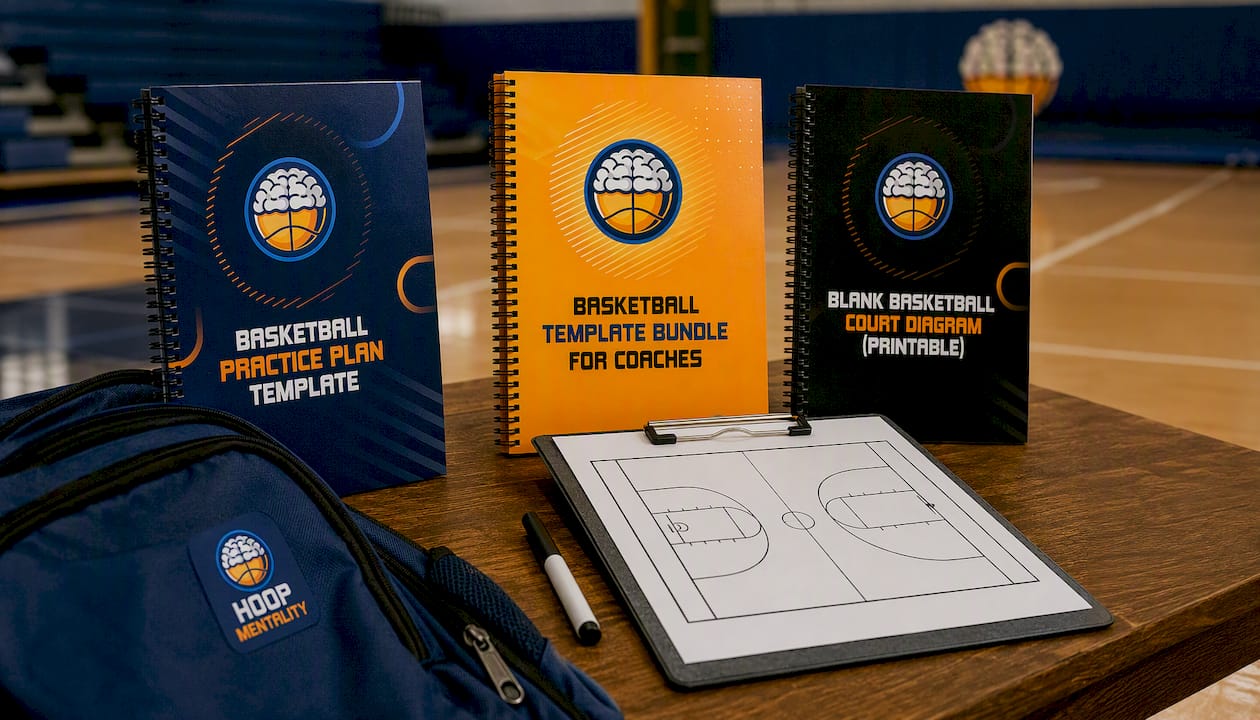
If you’re prepping for a full season rather than one practice, the Basketball Template Bundle adds scouting sheets and additional practice templates so you’re not rebuilding a new document every week. For the team-concept and set-play blocks, the Blank Basketball Court Diagram gives you a printable court to sketch spacing and plays before you’re standing in front of the team trying to explain it from memory. Coaches who work with a systematic scouting process, similar to methods used in tennis talent evaluation, tend to prep faster because the framework is already built. Download the template, fill in tonight’s session, and print it before your next practice.
Sources
- Starter Practice Plans - NBA.com
- Basketball Practice Plan: How to Structure a Basketball Practice - MasterClass
- Youth basketball guidelines
FAQ
What are the 5 D’s of basketball?
Definitions vary by coach and program, but a common version covers Dribbling, Defense, Discipline, Dedication, and Decision-making, five areas coaches often use to frame practice priorities for youth teams.
How many hours should a 12 year old practice basketball?
Youth guidelines suggest up to roughly 10 hours per week of combined practice and game time for players ages 12 to 14, spread across two or three sessions rather than one long block.
How long should a youth basketball practice be?
Ages 7 to 8 do best with 45 to 60 minutes, ages 9 to 11 with 60 to 75 minutes, and ages 12 to 14 with 75 to 90 minutes, scaling up as attention span and skill level increase.
What should be included in a basketball practice plan template?
An effective template covers eight blocks: dynamic warm-up, ball handling, passing and footwork, shooting, defense, team concepts, scrimmage, and cooldown, each with a time allotment and a notes column for coaching cues.
How do you keep youth basketball drills from getting boring?
Keep lines to two players deep, run stations on multiple baskets when possible, and switch drills every 8 to 10 minutes so nobody stands still long enough to lose focus.