

TL;DR:
- Structured, basketball-specific warm-ups significantly reduce injury risk and improve performance metrics.
- Proper warm-up routines enhance speed, power, agility, and decision-making on the court.
- Customizing warm-ups based on age, position, and individual needs maximizes safety and athletic gains.
Most coaches know warm-ups matter. But knowing and doing are two different things. Too many teams treat the pre-practice or pre-game warm-up as optional time, a loose jog and a few stretches before the real work begins. That mindset is costing players their health and costing teams wins. Evidence shows that structured, basketball-specific warm-up routines can cut lower extremity injuries by 30 to 50% and improve sprint speed, jump height, and agility in measurable ways. This guide breaks down exactly what the research says, how to customize routines for your players, and how to track results so your warm-ups actually deliver.
Table of Contents
- Why warm-up routines matter: Evidence and injury prevention
- The impact of warm-ups on performance: Speed, power, and agility
- Customizing warm-up routines: Age, position, and special cases
- Designing and tracking effective warm-up routines: Steps for coaches
- The surprising truth: Most teams miss the warm-up advantage
- Take your team’s prep to the next level
- Frequently asked questions
Key Takeaways
| Point | Details |
|---|---|
| Cut injury risk | Structured warm-up routines can reduce basketball injuries by up to 50%, especially for knees and ankles. |
| Boost performance fast | Dynamic, cognitive, evidence-based warm-ups improve sprint, jump, and agility by 4–5% instantly. |
| Customize every routine | Adapting warm-ups for age, gender, and skill level gets better results and prevents more injuries. |
| Track and refine | Coaches should monitor injuries and performance for 8–10 weeks, adjusting routines based on player feedback. |
Why warm-up routines matter: Evidence and injury prevention
Let’s be direct. Skipping or rushing warm-ups is one of the most common and costly mistakes in basketball coaching. The injuries and prevention guide from Hoop Mentality makes this clear, and the research backs it up hard.
Warm-up routines significantly reduce lower extremity injury risk in basketball, particularly ACL tears and ankle sprains. These are the injuries that end seasons and, sometimes, careers. The STOP-X program is one of the most studied neuromuscular warm-up protocols in basketball, and its results are striking.
“Programs like STOP-X reduced dynamic knee valgus by 52.86% and lumbopelvic dysfunction by 51.45% within 8 weeks.”
Dynamic knee valgus, where the knee caves inward during landing, is one of the leading mechanical causes of ACL injuries. Cutting that risk by more than half in just eight weeks is not a minor gain. It is a season-saving shift.
Neuromuscular programs reduce knee and ankle injuries by 36% on average across basketball populations. That number holds across age groups and competition levels. The mechanism is straightforward: these routines train the muscles around the knee and ankle to fire correctly and in the right sequence, so joints are protected during explosive movements.
Here is how injury outcomes compare across warm-up approaches:
| Warm-up type | Injury reduction | Key benefit |
|---|---|---|
| No structured warm-up | 0% | None |
| Static stretching only | 5 to 10% | Minimal protection |
| General dynamic warm-up | 15 to 25% | Better than static |
| Neuromuscular protocol (e.g., STOP-X) | 36 to 50% | Maximum protection |
The difference between the top and bottom rows is not small. It is the difference between a healthy roster and a depleted one by mid-season. Coaches who want to explore pregame routines for elite athletes will find that the best programs at every level treat warm-ups as a non-negotiable part of preparation, not an afterthought.
For coaches who want a full breakdown of how to structure these routines from start to finish, the guide on structuring basketball warm-ups is a strong next resource.
Now that you know why skipping warm-ups can sideline your best athletes, let’s look at how the right routine can also unlock better performance.
The impact of warm-ups on performance: Speed, power, and agility
Warm-ups are not just about staying healthy. Done right, they make your players faster, more explosive, and sharper on the court from the opening tip.
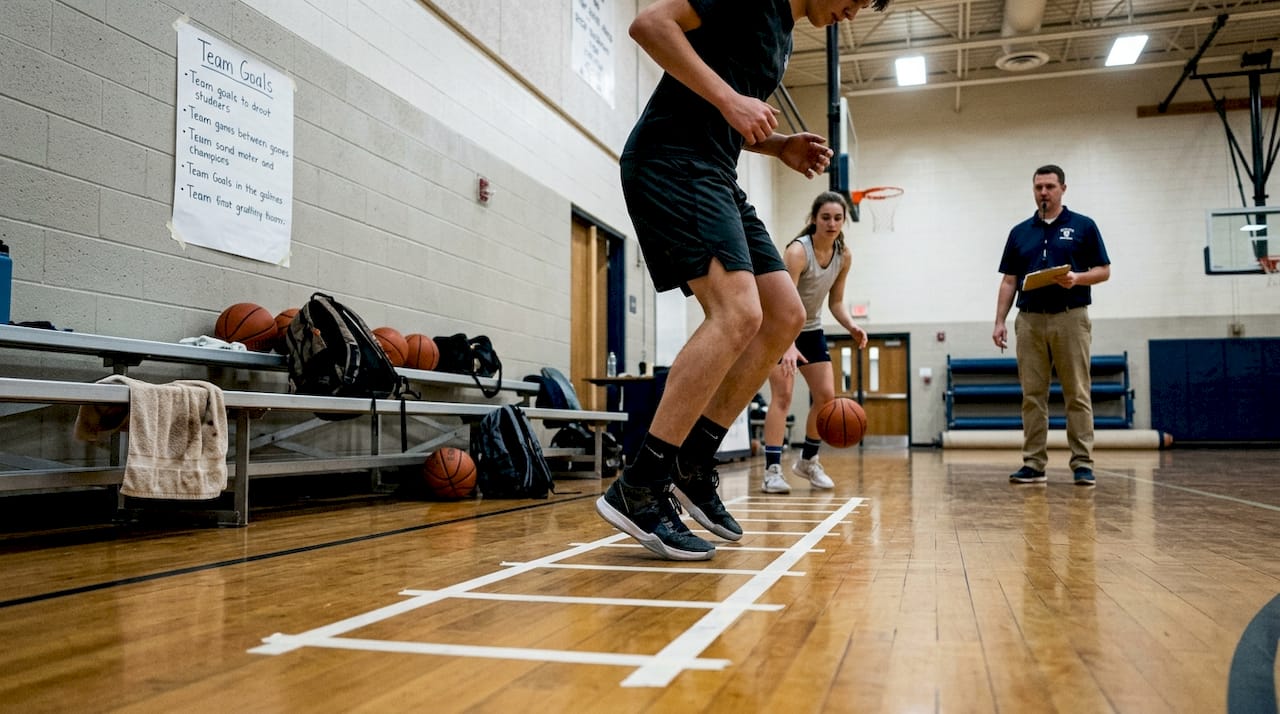
Neuromuscular and dynamic warm-ups enhance performance metrics including sprint speed, jump height, agility, and power output. The gains are immediate and measurable. Players who complete a proper dynamic warm-up before competition perform better in the first quarter than those who do not. That is not a small edge in a close game.
Here is how traditional static warm-ups compare to dynamic and cognitive approaches:
| Performance metric | Static stretching | Dynamic warm-up | Cognitive dynamic warm-up |
|---|---|---|---|
| Sprint speed | No improvement | +2 to 3% | +3 to 4% |
| Vertical jump | Slight decrease | +3 to 5% | +4 to 5% |
| Agility | No improvement | +3% | +4 to 5% |
| Decision speed | No improvement | Slight improvement | Significant improvement |
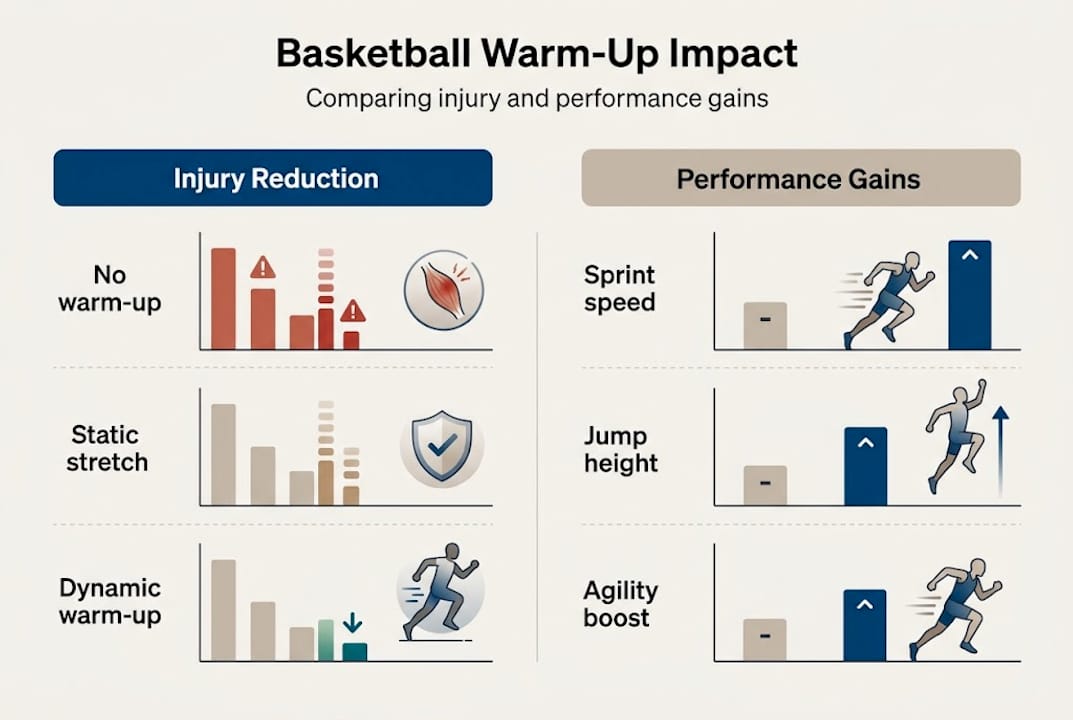
The cognitive warm-up column is where things get interesting. Adding decision-making elements, such as reading defensive cues or reacting to verbal commands during movement drills, primes the brain alongside the body. Basketball is a read-and-react sport. Your warm-up should reflect that.
Half-time re-warm-up with core strength prevents the decline in countermovement jump and agility that typically happens during the break. Most coaches ignore halftime warm-up entirely. The ones who do not have a measurable advantage in third-quarter performance.
Key performance benefits of dynamic warm-up routines:
- Jump height increases of 4 to 5% before tip-off
- Sprint speed gains of 2 to 4% on first-step quickness
- Improved agility scores on change-of-direction tests
- Faster reaction times and sharper on-court decision making
- Better focus and mental readiness entering competition
Pro Tip: Add one open-skill drill to your warm-up, such as a 3-on-2 shell read or a quick decision-making passing sequence. It bridges the gap between physical prep and game-speed thinking. More warmup tips for coaches can help you build this into your routine without adding extra time.
Improved performance is more than just a nice side effect. But not all warm-ups deliver the same boost, and some approaches are far superior when matched to your specific players.
Customizing warm-up routines: Age, position, and special cases
One routine does not fit every team. A high school girls team has different needs than a college men’s program. A point guard needs different prep than a center. Recognizing this is what separates good coaches from great ones.
Basketball-specific warm-ups outperform general programs like FIFA 11+ in agility improvements. The Basket-Up protocol, designed specifically for basketball movement patterns, produced better results than generic injury prevention programs. Sport-specific movement is the key variable.
Female players with dynamic knee valgus benefit significantly from targeted neuromuscular programs. Female athletes are at higher ACL injury risk due to biomechanical and hormonal factors. Programs like STOP-X that address landing mechanics directly are especially valuable for girls and women’s programs. This is not optional for coaches working with female athletes. It is essential.
For youth teams, the challenge is different. Younger players have shorter attention spans and lower baseline fitness. Fun matters. Buy-in matters. A warm-up that feels like a game is one players will actually do with full effort.
Here are the keys to customizing your warm-up routine:
- Assess player needs. Look at injury history, movement quality, and fitness level. A player who has had ankle sprains needs more ankle stability work built in.
- Apply position-specific focus. Guards need more lateral quickness and reaction drills. Bigs need hip mobility and landing mechanics. Build that into the last phase of the warm-up.
- Adapt for special situations. Halftime, back-to-back games, and cold weather all require adjustments. A 5-minute re-warm-up at halftime protects third-quarter performance.
- Tailor for age and gender. Youth and female athletes need targeted programs, not scaled-down adult versions.
Pro Tip: With youth teams, frame warm-up drills as competitions. First group to complete the agility ladder correctly wins. Motivation goes up, effort goes up, and the warm-up actually works. Check out youth warm-up drills and cardio drills for youth for ready-to-use options. For building long-term player development, skill progressions for youth pairs well with a strong warm-up foundation.
Once you see that one-size-fits-all routines are not enough, it is time to get tactical with proven variations.
Designing and tracking effective warm-up routines: Steps for coaches
Knowing what works is only half the job. Implementing it consistently and measuring whether it is actually helping your team is the other half.
Consistent 8 to 10 week programs yield 30 to 50% injury reductions, and acute effects include 4 to 5% jump improvements after a single session. That means you get short-term performance gains right away and long-term injury protection as the routine becomes habit.
Stat callout: Teams that stick with evidence-based warm-ups for a full season reduce injury risk by 30 to 50%. That is fewer missed games, fewer player absences, and a healthier roster when the playoffs arrive.
Here is how to build, run, and track your warm-up system:
- Plan the structure. Use a 3-phase format: general activation (2 to 3 minutes), dynamic movement (5 to 7 minutes), sport-specific prep (3 to 5 minutes). Total time: 10 to 15 minutes.
- Commit to a cycle. Run the same core routine for 8 to 10 weeks before evaluating. Changing it every week prevents adaptation.
- Track injury data. Log every soft tissue injury, its location, and when it happened. Compare month-over-month. The trend should go down.
- Measure performance markers. Use a simple vertical jump test or 5-10-5 agility drill at weeks 1, 4, and 8. Document the numbers.
- Collect player feedback. Ask players how they feel entering practice and games. Soreness, energy, and readiness are all useful signals. The guide on collecting player feedback has practical methods for doing this without adding admin burden.
- Adjust based on data. If injuries are still high in a specific area, add targeted exercises. If players report fatigue, check warm-up intensity.
Avoid rushing or skipping warm-ups, as 80% of youth teams do, which directly increases injury rates. That number is not a warning. It is a description of what most programs are currently doing wrong.
With a tailored approach in hand, here is how to make warm-ups a winning habit and prove their effectiveness.
The surprising truth: Most teams miss the warm-up advantage
Here is something most coaching articles will not tell you. The warm-up is not the boring part before practice. It is one of the highest-leverage activities a coach controls.
80% of youth teams rush or skip warm-ups, missing out on significant performance and injury reduction gains. That means the bar is low. Coaches who commit to a structured, basketball-specific routine are already ahead of four out of five programs at the youth level.
At the elite level, the gap is even more visible. Teams with dedicated warm-up protocols have healthier rosters, more consistent performance in early game minutes, and better third-quarter output after halftime. That is not coincidence. It is the result of treating warm-ups as a system, not a suggestion.
The mindset shift is simple. Stop viewing the warm-up as a chore players have to get through. Start viewing it as the first drill of every practice and game, one that sets the physical and mental tone for everything that follows. Coaches who make this shift, even with limited time and resources, consistently see the injury and performance results the research promises. The advanced structuring tips available at Hoop Mentality make that shift practical and fast.
Take your team’s prep to the next level
If you are ready to put these concepts into practice, here is where to start.
Hoop Mentality has built resources specifically for coaches who want to stop guessing and start using proven systems. The basketball practice plan template gives you a ready-to-use structure that integrates warm-up routines directly into your practice flow.

For game-day preparation, the game preparation guide walks you through weekly planning that includes pre-game warm-up protocols. Both resources are built from real coaching experience. Use them to make evidence-based warm-ups a non-negotiable part of your program, starting with your next practice.
Frequently asked questions
What type of warm-up is most effective for basketball players?
Dynamic and basketball-specific neuromuscular warm-ups are most effective. Basketball-specific warm-ups outperform generic protocols for agility, combining movement, sport-specific patterns, and decision-making elements.
How long should a proper basketball warm-up routine last?
A full routine should last 10 to 15 minutes, including cognitive and sport-specific drills. Consistent 8 to 10 week routines produce the strongest long-term results for both injury prevention and performance.
What performance benefits can coaches expect from optimal warm-ups?
Expect 4 to 5% improvements in jump and sprint, plus quicker on-court decision making and better agility. Modern warm-ups yield these gains in jump, sprint, and reaction time consistently across studies.
Should warm-up routines change for youth or female players?
Yes, routines must be tailored to age, skill level, and specific needs. STOP-X improved landing mechanics and reduced injury risk specifically in female athletes, making targeted programs essential for those groups.
How can coaches track if their warm-up routines are working?
Track through injury rates, performance metrics like vertical jump and agility scores, and player feedback after 8 to 10 weeks. Coaches should monitor all three data points together for the clearest picture of routine effectiveness.