

Basketball time rules change based on level: the NBA plays four 12-minute quarters (48 minutes), FIBA and NCAA use 10-minute quarters or 20-minute halves (40 minutes), and high school runs 32 minutes. Shot clocks range from 24 to 35 seconds depending on the rulebook, and every clock is a stop-clock, meaning a 40-minute game routinely takes two hours or more to finish.
TL;DR:
- The NBA plays four 12-minute quarters, resulting in about two hours of real time, including stoppages, fouls, and timeouts, which can extend game length significantly.
- FIBA and NCAA men’s basketball both use 10- or 20-minute halves, while high school games typically run around 30 minutes with quarters often lasting 8 minutes or less.
- The shot clock is 24 seconds in the NBA and FIBA, but 30 seconds in NCAA men’s and women’s games, affecting offensive pace and decision-making speed.
- The game clock stops for every whistle, such as fouls, out-of-bounds, or timeouts, causing a discrepancy between regulation minutes and actual game duration.
- Proper practice drills, like 0.1-second inbound plays and shot-clock pressure workouts, are essential to minimize turnovers caused by timing rule violations at different levels.
Table of Contents
- Standard Playing Time by League and Level
- Shot Clock Rules and Possession Time Limits
- How the Game Clock Starts, Stops, and Restarts
- Timeouts and Mandatory Break Rules Across Leagues
- Overtime Length and End-of-Period Procedures
- Common Timing Violations and How Coaches Prevent Them
- Turning the Rulebook Into Practice Plans
- Why Rulebook Fluency Separates Good Coaches From Great Ones
- Coaching Resources Built Around Game-Clock Reality
- Where to Verify the Exact Rule for Your Competition
- Sources
- FAQ
Standard Playing Time by League and Level
The clock length is the easiest number to memorize, but the format around it (quarters versus halves, break lengths, overtime rules) changes just as much from one level to the next.
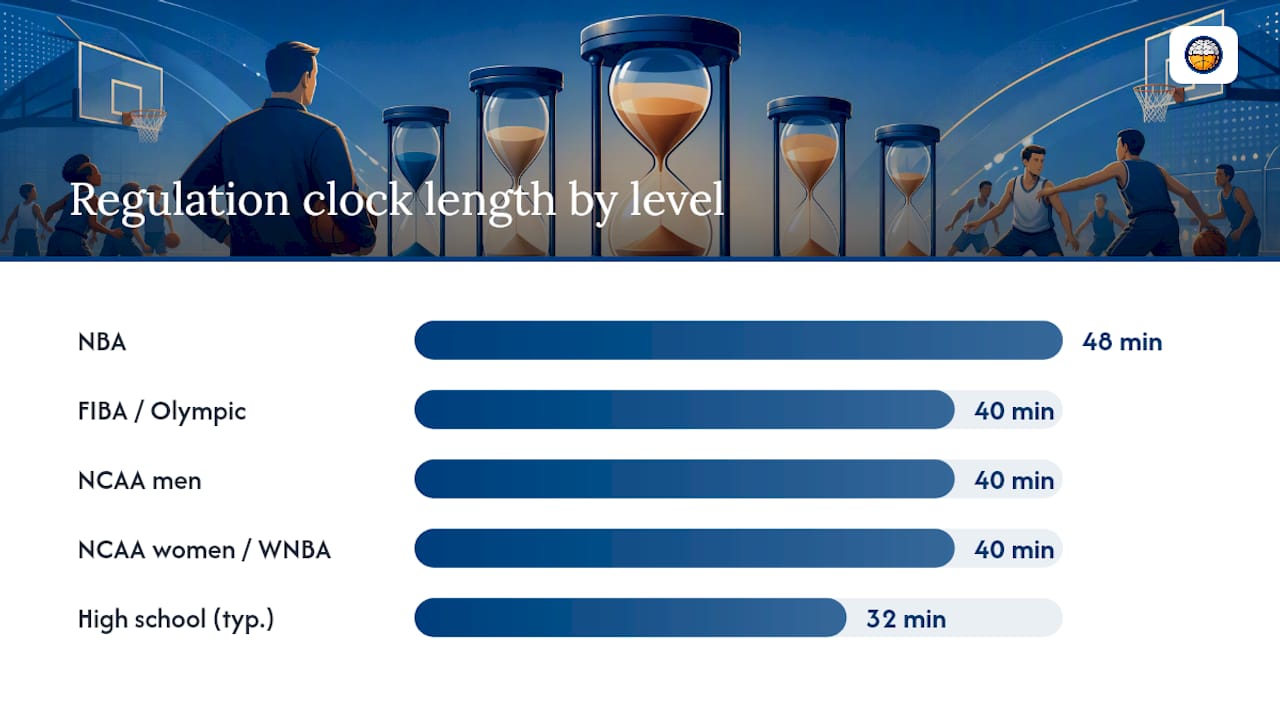
The NBA runs four 12-minute quarters for 48 minutes of regulation basketball, with a 15-minute halftime, according to NBA Rule No. 5. FIBA, which governs Olympic and most international play, uses four 10-minute quarters for 40 minutes total, also with a 15-minute half-time break under FIBA’s Official Rules. NCAA men’s basketball plays two 20-minute halves, while NCAA women’s basketball moved to four 10-minute quarters to align more closely with FIBA and WNBA formats. High school basketball in most U.S. states runs quarters of varying lengths, often around 8 minutes each, totaling about 30 minutes of clock time, though some state associations shorten that further for youth divisions.
Here’s how regulation time breaks down by level:
- NBA: Four 12-minute quarters, 48 minutes total
- FIBA / Olympic: Four 10-minute quarters, 40 minutes total
- NCAA men: Two 20-minute halves, 40 minutes total
- NCAA women / WNBA: Four 10-minute quarters, 40 minutes total
- High school (typical): Four 8-minute quarters, 32 minutes total
- Youth leagues: Often four 6- to 8-minute quarters, varying by age division
None of those numbers reflect how long you’ll actually sit in the gym. A 48-minute NBA game typically takes 2 to 2.5 hours in real time once you add fouls, timeouts, replay reviews, and halftime, according to Under Armour’s breakdown of game length. College games generally wrap up around two hours, and high school contests run closer to 1.5 hours. That gap between game-clock minutes and real-world minutes is the single most misunderstood part of basketball time rules, and it matters for anyone scheduling a gym, a broadcast window, or a tournament bracket.
Shot Clock Rules and Possession Time Limits
The shot clock decides how fast a team must attempt a shot, and it varies more across rulebooks than almost any other timing rule.
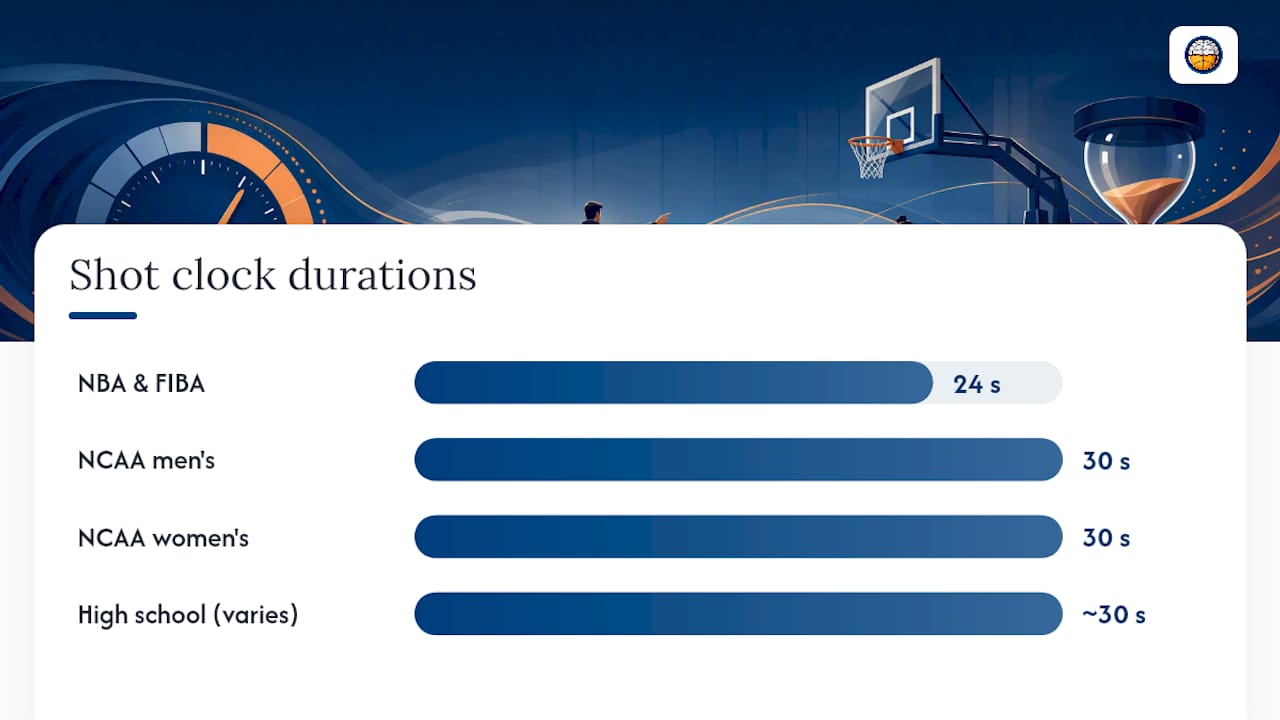
The NBA and FIBA both use a shot clock close to 24 seconds, forcing teams to get a shot attempt (one that hits the rim) within that window or surrender the ball, per the historical rundown in Wikipedia’s rules of basketball entry. NCAA men’s basketball uses a 30-second shot clock, a reduction from earlier longer durations. NCAA women’s basketball also runs a 30-second clock. High school basketball shot clock usage varies widely; some states have adopted one with durations often around 30 seconds.
Reset rules add another layer coaches need to track:
- A made basket resets the clock to the full duration for the new possession.
- An offensive rebound typically resets the shot clock fully in FIBA and the NBA, but some college and high school rules use a shortened 14-second reset after an offensive rebound in specific situations.
- A defensive touch that clearly changes team control resets the clock; a shot that only grazes the rim usually does not.
- Held-ball and jump-ball situations reset the clock based on which team gains possession.
The shot clock has not always looked the way it does now. FIBA and the NBA settled on 24 seconds decades ago to eliminate stalling tactics, while the NCAA held onto a longer clock far longer, only trimming it from 35 to 30 seconds in 2015 to speed up a game that had grown increasingly stagnant. For coaches, the practical takeaway is simple: a 24-second clock demands faster half-court sets and quicker decision-making than a 30-second or no-shot-clock system, and your offensive philosophy should reflect whichever rulebook you’re playing under.
How the Game Clock Starts, Stops, and Restarts
Basketball’s game clock is a stop-clock, not a running clock like soccer’s. It halts on every whistle: fouls, out-of-bounds calls, timeouts, jump balls, and official replay reviews all freeze it immediately, according to Ducksters’ explainer on clock timing. That single mechanic is why a 12-minute NBA quarter can eat up 30 real-world minutes when fouls pile up late in a close game.
Restarting the clock follows specific triggers, not just an official’s judgment call:
- Inbound passes: The clock restarts the instant the ball touches a player on the court, not when the passer releases it.
- Free throws: The clock stays stopped until the ball touches a player on the court after the final attempt (or the last make, if the ball stays live).
- Jump balls: The clock restarts the moment a player legally taps the ball.
- Live-ball turnovers without a whistle: The clock keeps running since no stoppage occurred.
Officials also work with a minimum time display of 0.1 second. If a foul happens with less than that showing, referees determine whether any real time actually remained, per FIBA’s Article 8 and Article 9 procedures. That rule is exactly why you’ll sometimes see a team draw up an inbound play with 0.1 second left instead of assuming the game is already over. A well-designed lob or tip-in play can still score in that sliver of time.
Pro Tip: Practice your 0.1-second and 0.3-second inbound plays separately. At 0.1, only a tip or dunk can count; at 0.3, a caught-and-shot attempt becomes legal. Confusing the two costs you a live possession.
Timeouts and Mandatory Break Rules Across Leagues
Timeout counts and lengths differ enough between leagues that a strategy built for one system can backfire in another.
The NBA grants each team several charged timeouts per game, with restrictions on usage late in the fourth quarter, according to the NBA rulebook. FIBA allows a limited number of timeouts per team per half and overtime, generally shorter in duration than NBA timeouts. NCAA basketball layers in mandatory media timeouts on top of team-called ones, which is why college broadcasts feel more segmented than international games. High school timeout rules vary by state but usually grant multiple team timeouts of varying lengths.
A few operational details matter more than the raw counts:
- Only players and coaches on the bench can typically request a timeout; a player must have the ball or possession stopped via a dead ball first.
- Media and mandatory timeouts are scheduled at fixed clock stoppages (often the first dead ball under specific minute marks) rather than by team request.
- Unused timeouts almost never carry into overtime in full; most rulebooks grant a reduced allotment for extra periods.
- Late-game timeout restrictions exist specifically to keep the final minutes from stalling out for broadcast or pace reasons.
Coaches who treat every timeout the same waste a resource that’s genuinely limited. A deeper breakdown of when to call one lives in Hoop Mentality’s guide to timeout strategy.
Overtime Length and End-of-Period Procedures
Overtime periods run shorter than regulation quarters, and the procedure for repeated ties is the same across nearly every rulebook: play again until someone wins.
The NBA and FIBA both use 5-minute overtime periods, and if the score remains tied, teams play as many additional 5-minute periods as necessary, per the NBA rulebook and FIBA’s official rules. Some high school associations shorten overtime to 4 minutes to keep already-long nights from stretching further.
A few procedural details carry over from regulation into overtime:
- Team fouls typically reset at the start of each overtime period, though players keep their individual foul totals.
- Each team usually gets at least one fresh timeout for overtime, even if they exhausted their regulation allotment.
- The 0.1-second minimum display and referee discretion on late fouls apply in overtime exactly as they do in regulation.
- There is no maximum number of overtime periods; games have gone to six or more extra periods at various competitive levels.
Common Timing Violations and How Coaches Prevent Them
Timing violations turn into turnovers fast, and the specific thresholds shift depending on which rulebook governs your game.
The offense must advance the ball past half court within a set time after gaining possession, which is typically 8 or 10 seconds depending on the league rules, a difference traced in Wikipedia’s rules of basketball overview. Rules enforce a 5-second limit on closely guarded players to act and on inbounding the ball after certain stoppages, varying by league. The 3-second rule prohibits an offensive player from camping in the lane for more than 3 seconds without being active in a play.
Practical countermeasures worth drilling:
- Run backcourt press-break drills that force ball handlers to beat both the defense and the clock, not just the defense.
- Rehearse inbound reads specifically against pressure so the 5-second inbound violation never becomes a live risk.
- Rotate lane-occupying players on a count, not on instinct, to avoid 3-second calls during set plays.
Pro Tip: Have an assistant count out loud during scrimmages for backcourt and closely guarded situations. Players internalize timing limits far faster when they hear the count instead of just reading about it.
Turning the Rulebook Into Practice Plans
Knowing the rule is one thing. Building practice around it is another, and that’s where most of the actual coaching work happens.
End-of-clock situations deserve their own drill category: run 0.1 and 0.3-second inbound reps weekly, not just before a close game reminds you to. Shot-clock pressure drills, where you start possessions with 8 or 10 seconds instead of a full 24, force guards to make faster reads under the exact conditions late-game situations create. Pair that work with a simple late-game decision checklist covering timeout inventory, foul situation, and which inbound play fits the time remaining.
A few Hoop Mentality resources map directly onto these needs:
- The Basketball Player Code Of Conduct Template sets clear bench and timing expectations, useful for enforcing how your players handle timeouts and dead-ball situations.
- The Basketball Pre-Game Warm Up Routine structures your pregame minutes so warm-ups don’t eat into shootaround time before tip-off.
- The Basketball Shooting Workout For Guards builds the quick-trigger shooting mechanics guards need when operating inside a shrinking shot clock.
More templates for managing the clock during games are in Hoop Mentality’s time management guide for coaches.
Why Rulebook Fluency Separates Good Coaches From Great Ones
Most coaches learn their own league’s timing rules and stop there. That’s a mistake, even if you never coach outside your division. Understanding why FIBA runs a 24-second clock while the NCAA only recently dropped to 30 tells you something about pace philosophy that improves how you scout any opponent, not just ones from a different level.
The conventional advice, “just know your league’s rules,” undersells how often timing rules decide games at the margins. A team that hasn’t drilled the 0.1-second inbound or doesn’t know its backcourt count under pressure gives away possessions that have nothing to do with talent. Coaches often over-invest in play design and under-invest in clock literacy, and the clock doesn’t care how good your set play is if you never get the ball across midcourt in time.
If there’s one place to start, it’s the stop-clock mechanics in Section 4 and the backcourt and closely guarded counts in Section 7. Those two areas cause more preventable turnovers than any zone defense or press ever will.
— Dejan
Coaching Resources Built Around Game-Clock Reality
Hoop Mentality builds its resources around exactly the timing pressure this article covers, not generic drill lists disconnected from the clock. If you’re tired of guessing how to structure practice time around shot-clock pressure and end-of-quarter situations, these three downloads solve specific problems instead of general ones.
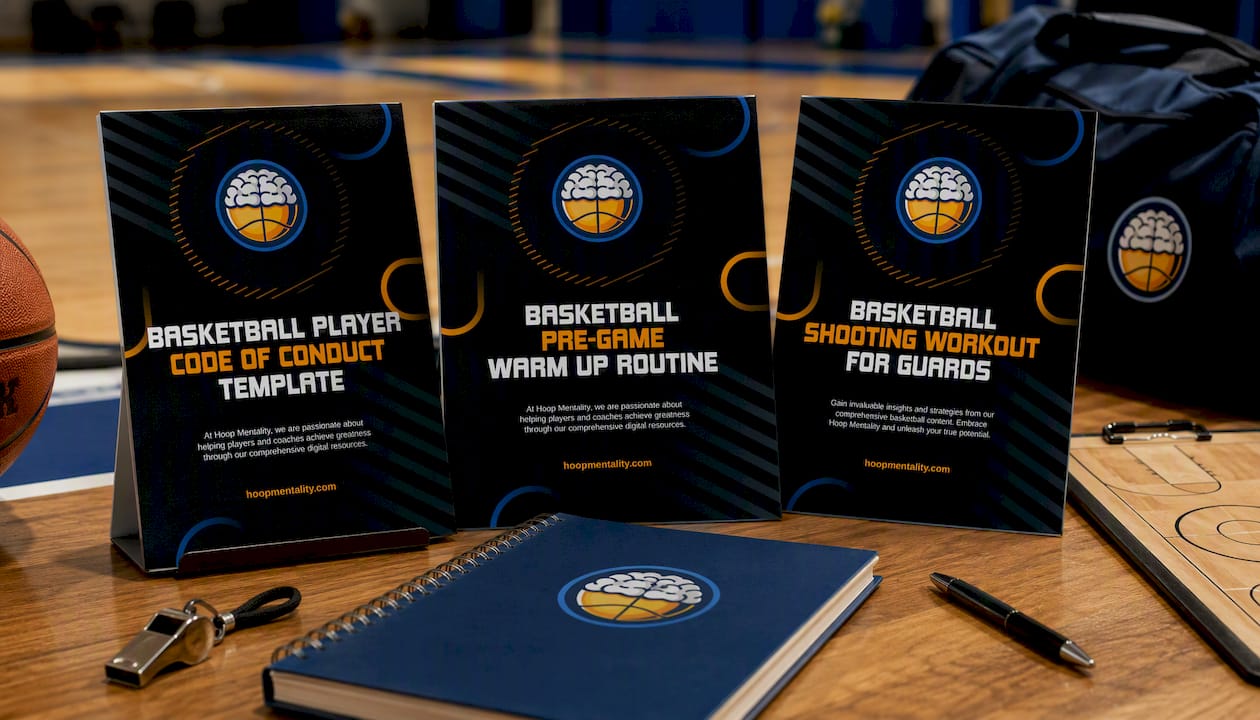
The Basketball Player Code Of Conduct Template gives you a ready framework for bench behavior during timeouts and dead-ball moments, so you’re not improvising rules mid-season. The Basketball Pre-Game Warm Up Routine structures your pregame clock so warm-ups end exactly when they should, not five minutes into your shootaround window. The Basketball Shooting Workout For Guards trains the quick-catch, quick-release mechanics guards need when your shot clock is 24 or 30 seconds instead of unlimited. Built from real coaching experience, each download is ready to use the same day you buy it. Download the one that matches your most pressing timing gap and put it in front of your team before your next practice.
Where to Verify the Exact Rule for Your Competition
For the precise wording that applies to your level, go to the primary source. NBA Rule No. 5 covers professional scoring and timing in full detail. FIBA’s Official Rules governs international and Olympic play. Under Armour’s game-length breakdown and Ducksters’ clock explainer offer accessible summaries for coaches new to a level. Always confirm against your own league’s current rulebook before a season starts, since state and conference associations sometimes adjust national standards.
Sources
- RULE NO. 5: Scoring and Timing | NBA Official
- FIBA Official Basketball Rules 2026 (PDF)
- How Long Is a Basketball Game? | Under Armour
- Basketball: The Clock and Timing | Ducksters
- Rules of basketball - Wikipedia
FAQ
Is basketball played in quarters or halves?
Basketball is played in quarters at most competitive levels (NBA, FIBA, WNBA, and NCAA women), but NCAA men’s basketball uses two 20-minute halves instead of four quarters.
Are basketball games 90 minutes long?
No. Regulation game-clock time ranges from 32 minutes (high school) to 48 minutes (NBA), but real-world duration including stoppages usually runs 1.5 to 2.5 hours, per Under Armour’s timing breakdown.
How long is an NBA overtime period?
NBA overtime periods run 5 minutes each, and teams play additional 5-minute periods until the tie breaks, per the NBA rulebook.
What is the shot clock difference between the NBA and NCAA?
The NBA and FIBA both use a shot clock close to 24 seconds, while NCAA men’s and women’s basketball use a 30-second shot clock, a change from the previous 35 seconds in men’s play.
Why does the game clock stop so often?
Basketball uses a stop-clock system that halts time on every whistle, including fouls, out-of-bounds calls, and timeouts, which is why a 48-minute NBA game often takes over two hours to finish, according to Ducksters.