

Run this sequence before every game: 2 minutes of dynamic warm-up, 3 minutes of layup lines, 2 minutes of close-out defense, 3 minutes of shooting, and 2 minutes of transition reps. That’s your 12-minute baseline. Structured warm-up programs have been shown to reduce injury rates in youth athletes by about 36%. Kevin Durant’s approach says it plainly: he uses pregame time to program both movement and decision-making through game-speed repetition, so the opening tip feels like a continuation of the warm-up, not a cold start.
Here’s a quick-start assignment sheet:
- Point guard: leads dynamic warm-up, runs the shooting sequence
- Wings: rotate through layup lines, then move to close-out defense
- Bigs: start with layup lines, finish with transition reps
- Assistants: run one station each to eliminate dead air
Timed template at a glance:
- Minutes 1–2: Dynamic warm-up (full team)
- Minutes 3–5: Layup lines (2-line or 3-line)
- Minutes 6–7: Close-out defense
- Minutes 8–10: Shooting sequences
- Minutes 11–12: 3-on-2 transition rep
Table of Contents
- What should you do before taking the court?
- Which layup drills work best before a game?
- How do you run close-out and defensive warm-ups?
- What shooting sequences should you run pregame?
- How do you run transition and team drills pregame?
- Sample timed pregame routines you can run today
- How do you build mental focus before tipoff?
- Key Takeaways
- The routine that actually changes how your team starts games
- Hoop Mentality has a ready-made pregame routine for coaches
- Useful sources and further reading
- FAQ
What should you do before taking the court?
The body needs a progression, not just movement. Five phases cover it cleanly.
- General warm: 60–90 seconds of light jogging, shuffles, and backpedals to raise core temperature.
- Dynamic mobility: leg swings, hip circles, ankle rotations. Keep each movement flowing, never held.
- Activation: glute bridges, lateral band walks, or bodyweight squats to fire the posterior chain.
- Movement prep: defensive slides, drop steps, and change-of-direction cuts at 70% effort.
- Neuromuscular priming: two or three explosive jumps or sprint starts to prime fast-twitch fibers.
Avoid long static stretching before play. Static holds can briefly reduce explosive output, which is the opposite of what you need at tipoff. Keep every movement dynamic and progressive.
Coaching cues: call out “stay low on the slides,” “full extension on the swings,” and “land soft” on the jump priming. These cues double as reminders of game-speed habits.
Scaling by time and age:
- 3 minutes: phases 1 and 5 only — jog, slides, two explosive jumps.
- 5 minutes: phases 1, 2, and 5 — add hip circles and leg swings.
- 10 minutes: all five phases at full length.
- Youth teams (under 14): cut the neuromuscular priming to one jump, extend the mobility phase, and keep cues simple and verbal.
- Older players (30+): add 60 seconds to the general warm and mobility phases before any explosive work.
Pro Tip: Link the warm-up structure to your first defensive assignment. If you open in a zone, finish the movement prep with zone-slide footwork. Players arrive mentally set.
Stat: A meta-analysis of 21,576 young athletes found that neuromuscular and balance-focused warm-up routines reduced injury rates by about 36%.
Which layup drills work best before a game?
Classic 2-line layup
- Split players into two lines at half-court, one on each side.
- The ball starts on the right line. Player passes to the left line and cuts to the basket.
- Left-line player catches, passes back to the cutter for the finish.
- Both lines rotate: shooter goes to the opposite line, passer follows their pass.
- Run 10 makes per side, then switch to the left-hand finish.
Coaching cues: “Catch in stride,” “attack the rim at game speed,” “no lazy layups.”
3-line layup
- Three lines: ball-handler at the top, wings on each elbow.
- Ball-handler drives, passes to either wing cutting baseline, wing finishes.
- Rotate: driver goes to the wing line, wing goes to the top.
- Target: 12 makes before moving on.
Vanderveer-style backdoor cut
- Wing sets up on the wing, takes one step toward the ball, then cuts hard backdoor.
- Passer at the top reads the cut and delivers a bounce pass to the paint.
- Finisher catches on the move and lays up with the inside hand.
- Run 8 reps per side.
Progressions:
- Start with stationary catch-and-finish to groove the footwork.
- Move to full-speed cuts with a live pass.
- Add a passive closeout defender in the final set to simulate contest pressure.
Pro Tip: Tell your players: “Every layup in warm-up is a layup you’ve already made in the game.” That mental frame raises effort on reps that coaches often let slide.
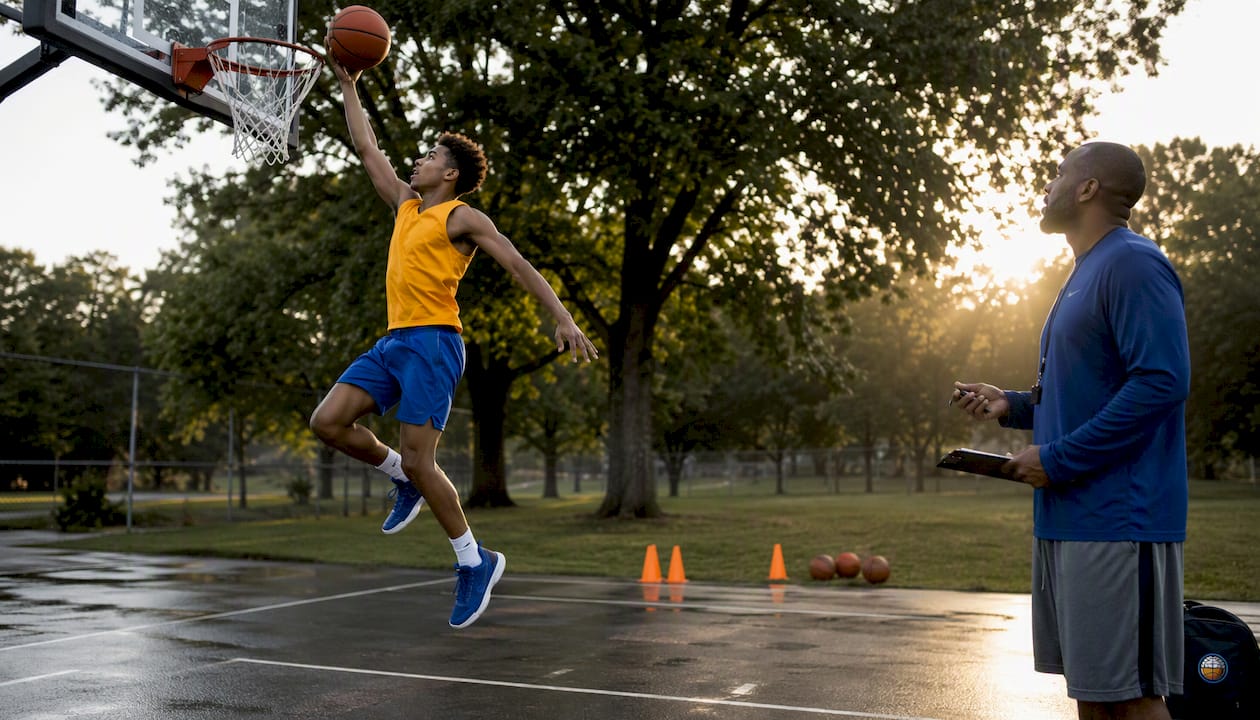
How do you run close-out and defensive warm-ups?
Defense sets the tone before the ball is even tipped. Keep the heart rate controlled but the feet sharp.
Simple close-out drill
- Defender starts under the basket. Offensive player stands at the three-point line.
- Coach or passer throws to the offensive player.
- Defender sprints out, chops feet at the arc, and contests without fouling.
- Offensive player pump-fakes once; defender stays disciplined.
- Switch roles after 5 reps each.
Coaching cues: “High hand on the contest,” “chop your feet early,” “no reaching.”
Small-sided close-out work (3-on-3 or 4-on-4)
- Set up half-court with three offensive players spaced at the arc.
- Defense closes out on a skip pass, communicates rotations aloud.
- No full drives; offense is limited to one pass and a shot or kick-out.
- Run 4 possessions, then rotate offense to defense.
Key points:
- Keep intensity at 80%. This is rehearsal, not a scrimmage.
- Assign one assistant to run this station while you oversee layup lines.
- Call out communication failures immediately: “Who’s got ball? Say it.”
Avoid dead air between reps. Assign an assistant to reset the ball and keep the next pair ready. Players standing idle for more than 10 seconds lose the activation you just built.
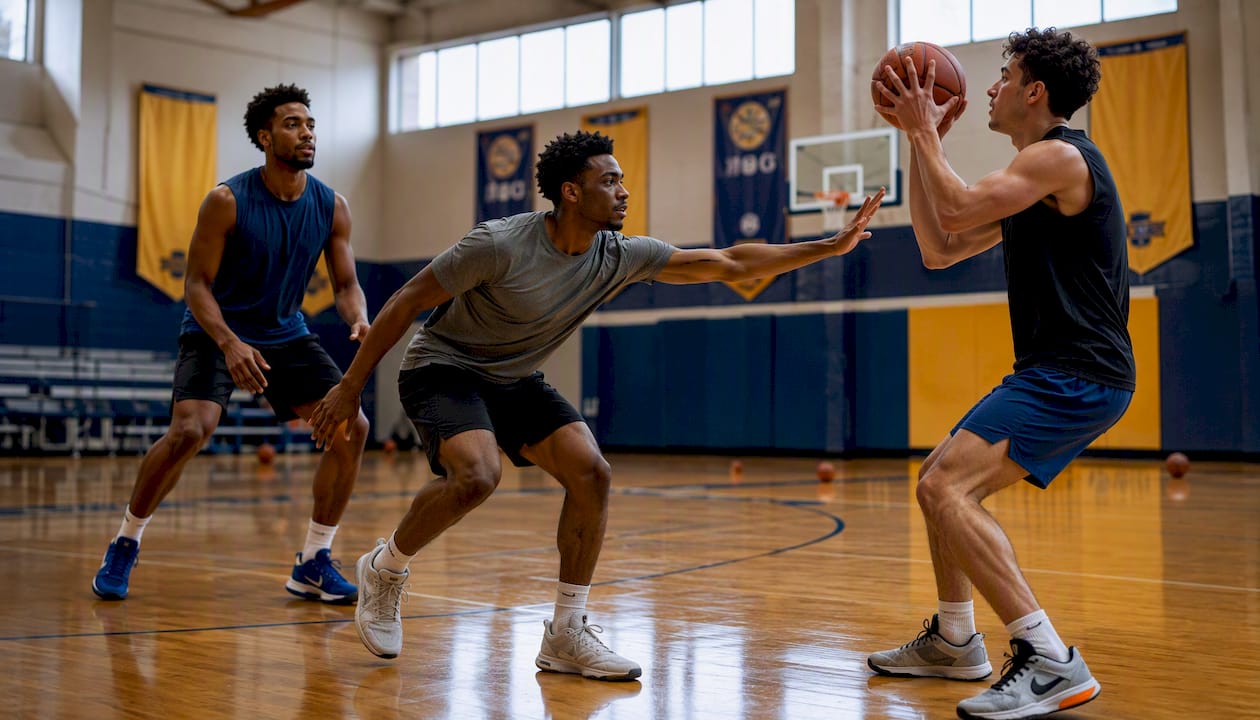
What shooting sequences should you run pregame?
Cutter shooting
- Two lines: one at the elbow, one at the wing.
- Elbow player passes to the wing and cuts to the basket.
- Wing passes back to the cutter for a catch-and-finish or pull-up.
- Run 10 makes per side.
Coaching cues: “Read the defense on the catch,” “square your shoulders before you shoot.”
Endline cutter shooting
- Cutter starts in the corner, cuts hard along the baseline.
- Passer at the high post delivers a leading pass.
- Shooter catches on the move and finishes with a mid-range or short floater.
- 8 reps per player.
Open freelance shooting
- Players spread to five spots: both corners, both wings, and the top of the key.
- Each player takes 3 shots per spot, moving clockwise.
- Focus on game-speed catch-and-shoot mechanics, not volume.
Free-throw work
- Every player shoots 2 free throws in sequence before rotating.
- Use the same pre-shot routine every time: dribble count, breath, shot.
- Target: 80% team make rate before moving on.
Spacing note: add a passive closeout in the final freelance set to raise realism. One defender rotates through all five spots, closing out without contesting hard.
How do you run transition and team drills pregame?
3-on-2 / 2-on-1 advantage drill
- Three offensive players start at half-court; two defenders are set in the paint.
- Offense attacks. Priority: take the open shot, not the forced drive.
- After the shot or turnover, two offensive players become defenders for the next group.
- Run 6 reps total.
Coaching cues: “Ball-handler, read the drop,” “wings, fill the lanes wide,” “defenders, no fouling on the finish.”
7-man half-court flow
- Seven players rotate through three positions: point, wing, and corner.
- Ball moves two passes before a shot is taken.
- After the shot, the shooter becomes the next defender.
- Works with as few as 5 players by shortening the rotation.
Full-court weave
- Three players weave from baseline to baseline, passing and following the pass.
- No dribbling. Finish with a layup.
- Run 4 trips. Keep the pace controlled — this is timing work, not conditioning.
Key points:
- Keep transition reps under 6 minutes total pregame.
- Prioritize decision quality over speed in the 3-on-2.
- The pregame warm-up is the first play of the game; every transition rep should mirror your actual fast-break system.
Sample timed pregame routines you can run today
| Time Block | 5-Minute Template | 10-Minute Template | 15-Minute Template |
|---|---|---|---|
| 1–2 minutes | Dynamic warm-up (phases 1+5) | Dynamic warm-up (all 5 phases) | Dynamic warm-up (all 5 phases, extended) |
| 3–4 minutes | 2-line layups (10 makes) | 2-line layups (10 makes per side) | 3-line layups + Vanderveer cuts |
| — | 2 free throws per player | Close-out drill (5 reps each) | Close-out drill + 3-on-3 (4 possessions) |
| 5–7 minutes | — | Cutter shooting (10 makes per side) | Cutter + endline cutter shooting |
| 8–10 minutes | — | 3-on-2 (6 reps) | Freelance shooting + free throws |
| 10–15 minutes | — | — | 3-on-2 + 7-man half-court flow |
Player assignments (10-minute template):
- Assistant 1 runs layup lines and tracks makes.
- Assistant 2 manages close-out station and resets the ball.
- Head coach oversees shooting and calls transition reps.
Adaptation notes:
- Tournament play (back-to-back games): use the 5-minute template for the second game. Cut layups to 6 makes and skip the transition rep.
- Youth teams: replace the 7-man flow with a simple 2-on-1 and reduce free-throw volume to 1 per player.
- Shortened windows (under 5 minutes): a focused 5-minute routine that includes layups, defensive slides, and one game-like drill prepares players effectively when every rep is intentional and done at game speed.
How do you build mental focus before tipoff?
Physical activation is only half the equation. The final 10–15 minutes before tip should include a deliberate “lock-in” window where players shift from social mode to competitive focus.
Elite athletes use a short pregame lock-in to separate fan interactions from mental preparation. Coaches can standardize this window by calling the team in 12–15 minutes before tip and running a brief focus sequence.
Practical lock-in checklist:
- Three-focus priorities: remind players of the three things they control — effort, communication, and shot selection.
- 2-minute breathing cue: four counts in, four counts hold, four counts out. Run two rounds as a team.
- Visualization prompt: “Picture your first defensive assignment. See yourself in position before the ball is inbounded.”
Coaching script (15-minute window):
- Minutes 15–12: finish physical warm-up, transition to huddle.
- Minutes 12–10: three-focus priorities, spoken aloud by a team captain.
- Minutes 10–8: breathing sequence, eyes closed or focused on the floor.
- Minutes 8–0: quiet activation, individual visualization, no phones.
The goal is “tension in the legs, but calm in the mind.” Players should feel physically ready and mentally settled, not hyped to the point of poor decision-making in the opening minutes.
Pro Tip: Pair the lock-in window with your mental readiness guide for a complete pre-tip protocol. The physical and mental sequences reinforce each other when they run back-to-back.
Key Takeaways
A structured basketball pregame routine covering dynamic warm-up, layups, defense, shooting, and a short live rep reduces injury risk and primes players for the opening possession.
| Point | Details |
|---|---|
| Structured warm-ups cut injury risk | A meta-analysis of 21,576 athletes found structured routines reduce injuries by about 36%. |
| Five minutes is enough when reps are intentional | A focused 5-minute routine with layups, slides, and one game-like drill prepares players effectively at game speed. |
| Assign roles to eliminate dead air | Give each assistant a station to run so no player stands idle between reps. |
| Lock-in window before tip | A 10–15 minute quiet window with breathing cues and visualization improves focus without over-activating players. |
| Hoop Mentality resources | The Basketball Pre-Game Warm Up Routine gives coaches a ready-made, structured routine to run immediately. |
The routine that actually changes how your team starts games
Most coaches underestimate how much the first two minutes of a game are decided before tipoff. Teams that start slow usually warmed up slowly. The connection is direct.
The conventional wisdom says a longer warm-up is a better warm-up. It isn’t. A 25-minute session full of casual shooting and low-effort layups does less than a tight 10-minute block where every rep mirrors a game action. The elite-player model confirms this: targeted, game-speed repetition primes both the body and the decision-making system. Duration is not the variable. Intentionality is.
The other thing coaches get wrong is treating the mental prep as optional. It isn’t a bonus. The lock-in window is where you convert physical readiness into competitive focus. Skip it, and you’ll watch your players make the same early-possession mistakes they make in practice when they’re not locked in.
Test this structure in your next three games. Run the 10-minute template exactly as written. Track your first-quarter points and turnovers. The data will tell you whether to adjust.
Hoop Mentality has a ready-made pregame routine for coaches
Coaches who want a complete, print-ready solution can skip the build-from-scratch work. The Basketball Pre-Game Warm Up Routine from Hoop Mentality is a structured, ready-to-run package with timed templates, drill diagrams, player assignments, and coaching cues built in. You open it, hand it to your assistants, and run it.
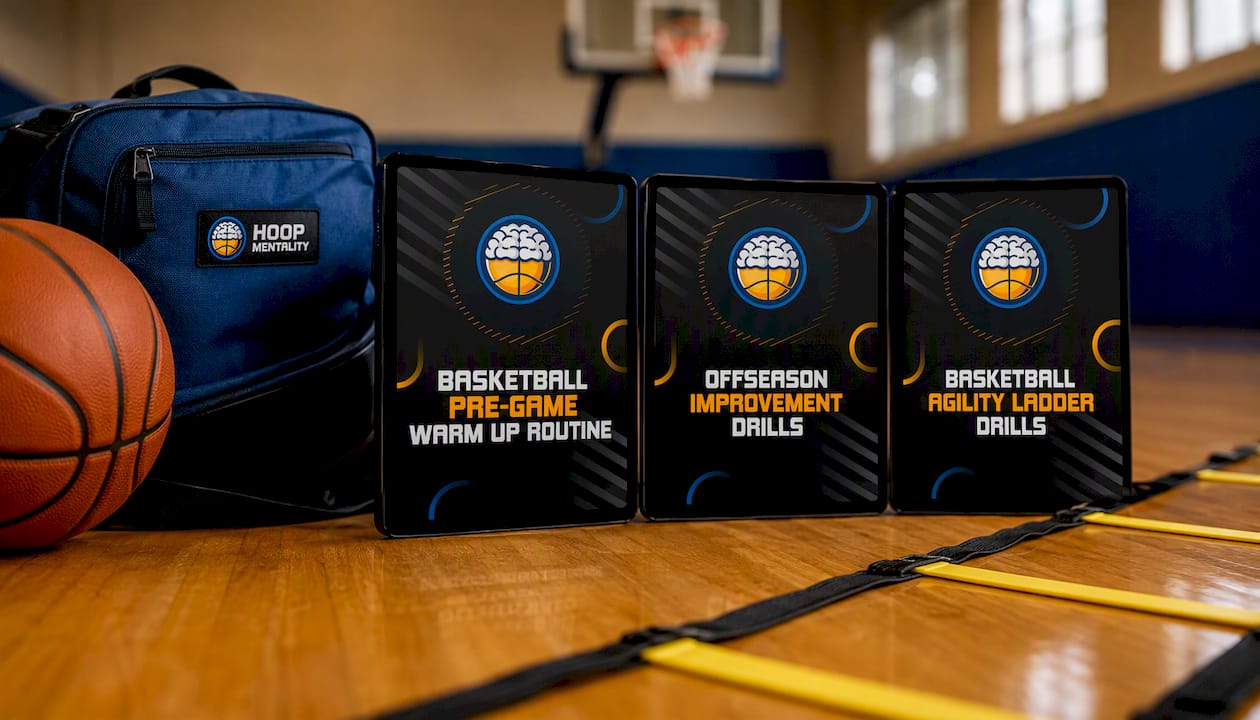
For coaches building a longer development program, the Basketball Offseason Improvement Drills package extends the same drill logic into a full offseason plan. And if footwork and quickness are a priority in your pregame activation, the Basketball Agility Ladder Drills resource slots directly into the movement prep phase. All three are available now at Hoop Mentality.
Useful sources and further reading
- Kevin Durant’s Pregame Routine — Yahoo Sports
- Kevin Durant’s Pregame Routine — The Athletic / NYTimes
- Caitlin Clark Pregame Warm-Up — ESPN
- How to Structure Warm Up for Basketball Teams — Hoop Mentality
- How to Get Ready for a Basketball Game Mentally — Hoop Mentality
- 7 Fun Basketball Warm Up Drills for Youth Coaches — Hoop Mentality
- Basketball Warm-Up Routines: Cut Injuries 30%, Boost Performance — Hoop Mentality
FAQ
How long should basketball pregame drills take?
Ten to fifteen minutes covers all blocks for most teams. A focused 5-minute routine works when time is limited, as long as every rep is done at game speed.
What drills should you always include in a pregame routine?
Layup lines, a close-out drill, and at least one shooting sequence are the minimum. Add a 3-on-2 transition rep when time allows.
Should you do static stretching before a basketball game?
No. Dynamic movement-based warm-ups are recommended instead. Static holds can briefly reduce explosive performance, which is counterproductive before tipoff.
How do you mentally prepare a team before a game?
Use a 10–15 minute lock-in window: state three focus priorities, run a 2-minute breathing sequence, and give players a short visualization prompt before the opening tip.
Where can coaches find a ready-made pregame routine?
Hoop Mentality’s Basketball Pre-Game Warm Up Routine includes timed templates, drill diagrams, and player assignments coaches can use immediately.