


TL;DR:
- Being an assistant basketball coach involves managing recruiting, player development, tactical analysis, and program operations with multiple critical responsibilities. Success depends on specialization, effective communication, and strategic focus on recruiting to advance in coaching careers. Strong organizational skills, technological proficiency, emotional intelligence, and role clarity are essential to excel in this demanding position.
Being an assistant coach in basketball is one of the most complex jobs in the sport. You wear a dozen hats before the opening tip and wear a dozen more during the game. Understanding the full scope of assistant coach roles, from recruiting and player development to tactical analysis and program administration, separates coaches who make a real impact from those who just fill a seat on the bench. This article breaks down the 10 most critical responsibilities so you know exactly what the job demands and how to excel at each one.
Table of Contents
- Key takeaways
- 1. Recruiting and talent evaluation
- 2. Player development and individual skill coaching
- 3. Tactical preparation and game-day adjustments
- 4. Administrative and operational duties
- 5. Building the bridge between players and the head coach
- 6. Specialized roles and pathways to head coaching
- 7. Managing player morale and mental well-being
- My take on what being an assistant coach really requires
- Tools to sharpen your assistant coaching impact
- FAQ
Key takeaways
| Point | Details |
|---|---|
| Recruiting is the top priority | Recruiting dominates off-season time, often consuming more than half of an assistant’s available hours. |
| Player development requires specialization | Assistants assigned to position groups produce better individual results than those without a defined development focus. |
| Game-day tactics need preparation | Effective scouting reports and in-game communication keep the head coach focused on decisions, not data overload. |
| Administration is unavoidable | Scheduling, compliance, and logistics are core assistant coach duties that directly affect program stability. |
| Specialization drives promotion | Assistants who master a defined area, such as analytics or defense, earn faster pathways to associate or head coach roles. |
1. Recruiting and talent evaluation
Recruiting comprises 50 to 60% of off-season time for assistant coaches in revenue-generating sports. That number alone tells you where to focus your energy when games are not being played.
Your recruiting responsibilities cover prospect identification, live evaluations at AAU tournaments, and systematic pipeline management. You are not just watching players. You are building relationships with families, maintaining communication logs, and tracking each prospect through a multi-month process.
At the collegiate level, NCAA compliance tasks like contact logs, official visit coordination, and eligibility monitoring are non-negotiable parts of the assistant coach job description. One compliance error can cost your program a prospect or trigger institutional penalties.
The transfer portal has added a new layer. Assistants spend 40 to 50% of off-season recruiting time managing portal prospects alongside traditional high school pipelines. Speed matters. A portal prospect can commit elsewhere within 72 hours of entering.
- Track every prospect interaction in a recruiting database
- Build direct relationships with AAU coaches and high school programs
- Monitor the transfer portal daily during open windows
- Maintain detailed compliance documentation for every contact
Pro Tip: Create a tiered prospect board with clear criteria for each tier. Review it weekly. Priorities shift fast, and a structured system stops you from chasing the wrong targets while missing the right ones.
2. Player development and individual skill coaching
Player development is where assistant coaches leave the most visible fingerprint on a roster. When a sophomore guard suddenly becomes a reliable three-point shooter in March, that result traces back to hundreds of individual sessions run by an assistant.
Most programs assign each assistant a position group. Guards, wings, and big men each have specific skill needs, and coaching those needs requires real position expertise. A skills development workflow gives you the structure to run those sessions without reinventing the plan every week.
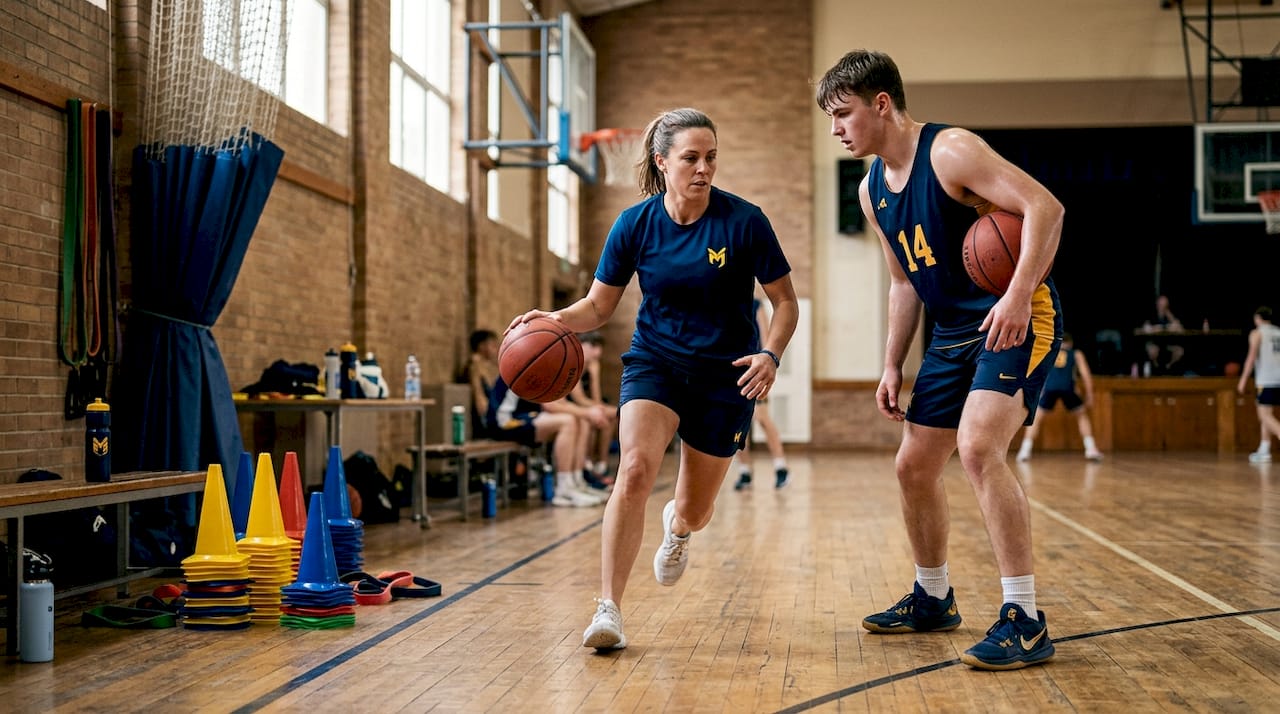
Video tools like Hudl and Synergy are now standard equipment for this work. Video analysis tools help assistants prepare personalized feedback clips that show players exactly what needs to change. Telling a player their footwork is late is less effective than showing it on a screen.
You also coordinate with strength and conditioning staff to align physical training with skill work. A wing player building lateral quickness in the weight room should be running defensive slide drills at practice, not the other way around.
- Run position-specific skill sessions at least three times per week during the season
- Use film to create individualized feedback for each player in your group
- Collaborate with strength staff to connect physical and skill training timelines
- Focus on one or two correctable habits per player per month
Pro Tip: Keep a development log for every player in your group. Record what you worked on, what improved, and what still needs attention. That log becomes your evaluation tool and your evidence during end-of-season review conversations.
3. Tactical preparation and game-day adjustments
This is where assistant coaching responsibilities get both technical and time-sensitive. Your tactical work happens in two phases. Before the game, you build the scouting report. During the game, you apply it in real time.
Tools like Synergy Sports and Hudl have become standard for opponent analysis. You pull data on shot tendencies, pick-and-roll coverage preferences, transition habits, and set play frequencies. That raw data becomes a scouting report that the entire staff can use.
The challenge on game day is filtering. Effective assistants distill large volumes of analyst data into concise, actionable advice for the head coach. Dumping every statistic you found on the head coach during a timeout does more damage than good.
| Phase | Assistant coach focus | Key output |
|---|---|---|
| Pre-game prep | Opponent scouting and film breakdown | Advance scouting report |
| Game-time | Monitoring tendencies and tracking patterns | Substitution and adjustment input |
| Halftime | Summarizing first-half data | Concise tactical adjustments |
| Post-game | Reviewing what worked against the scouted plan | Film notes for next practice |
Pro Tip: Assign each assistant a specific area to monitor during the game, such as transition defense or ball-screen coverage. One assistant watching everything misses everything. Divided responsibilities produce precise information.
Check the defensive adjustment tips resource for specific frameworks that translate directly into halftime adjustments.
4. Administrative and operational duties
Nobody talks about this part of the assistant coach job description at clinics, but it consumes a significant portion of your actual work week. Assistant coaches handle scheduling, equipment management, and compliance documentation to keep the program running correctly.
Practice scheduling involves coordinating facility availability, player academic commitments, training staff schedules, and film sessions. One conflict in that grid creates a cascading problem that costs everyone time.
Travel logistics include hotel blocks, flight bookings, meal coordination, and equipment shipping. At smaller programs, assistants own all of it. At larger programs, you supervise it. Either way, the responsibility lands on the coaching staff.
Recruiting calendars require particular precision. Official visits have strict NCAA windows, and missing a deadline or scheduling a conflict reflects poorly on the program in front of a family you are trying to impress.
- Maintain a master program calendar updated daily
- Confirm compliance on all recruiting communications before sending
- Coordinate equipment inventory before and after every road trip
- Manage practice plan logistics in coordination with the head coach
5. Building the bridge between players and the head coach
The interpersonal dimension of assistant coach roles is real, and it does not get taught in most coaching textbooks. You sit between the head coach’s authority and the players’ daily experience. Done well, this position makes the whole team function better. Done poorly, it creates division.
The assistant serves as the trusted intermediary who maintains locker room harmony while reinforcing the head coach’s standards. That is a precise balance. Players need to trust you enough to be honest with you, but they cannot lose respect for the head coach in the process.
“The best assistant coaches I’ve observed don’t just relay messages. They translate them. They understand what the head coach means and communicate it in a way that each individual player can receive.”
Younger players especially need a go-to person on staff. The adjustment from high school or junior college to a college program is significant. An assistant who proactively checks in with freshmen catches attitude or motivation problems before they become locker room problems.
Pro Tip: Schedule informal one-on-one check-ins with your assigned players at least once every two weeks. Not about basketball. About how they are doing. That relationship capital is what allows difficult conversations to land well when you need to deliver them.
6. Specialized roles and pathways to head coaching
Coaching staffs in 2026 increasingly prioritize specialized assistants who combine position expertise with analytical capability. The era of the generalist assistant who does a bit of everything is fading at high levels.
Assistants specializing in defensive, offensive, or analytical roles increase their chances of promotion to associate or head coach. Programs want to know what you specifically bring, not just that you are willing to do whatever is asked.
| Specialized role | Core focus | Career benefit |
|---|---|---|
| Offensive coordinator | Play design and offensive system execution | Attractive to programs building offensive identity |
| Defensive specialist | Personnel, scheme, and in-game adjustments | High demand at elite programs prioritizing defense |
| Player development coach | Individual skill growth and film work | Growing role at NBA G League and international levels |
| Analytics assistant | Data integration and shot quality tracking | Pathway into front office or senior coaching roles |
Career advancement is increasingly tied to developing unique tactical or analytical expertise that complements the head coach’s philosophy. If the head coach is a defense-first builder, becoming the best offensive mind on the staff creates a complementary value that is hard to replace.
- Identify your strongest coaching skill and build depth in it deliberately
- Study the tactical trends reshaping the game to stay ahead of evolving demands
- Build a coaching network outside your program to raise your visibility
- Document your contributions in a coaching portfolio with measurable outcomes
7. Managing player morale and mental well-being
Mental health awareness in basketball programs has grown significantly, and assistant coaches now carry more responsibility in this area than in past decades. You are not a therapist. But you are often the first person a player reaches out to when something is wrong.
Part of your role is recognizing when a player’s performance drop is technical and when it is emotional. A player averaging 14 points who suddenly looks disengaged in film sessions may not need a new shot drill. He may need a conversation.
Assistants protect and support the head coach during high-pressure moments, which includes buffering players from the intensity of a head coach’s reaction after a tough loss. That buffer keeps relationships intact and maintains focus for the next game.
Knowing which players need encouragement and which ones need direct accountability is an emotional intelligence skill. It develops with experience, but you can accelerate it by paying close attention and taking notes on how individual players respond to different types of feedback.
My take on what being an assistant coach really requires
I’ve watched a lot of assistants move up fast and a lot more stall out after a few years. The ones who advance are not always the sharpest tacticians. They are the ones who understood exactly what the role actually demands.
In my experience, the biggest mistake aspiring assistants make is treating every duty as equally important. Recruiting drives job security at the collegiate level more than any other single factor. If you are not producing commitments, your tactical brilliance will not save your position.
What I’ve also found is that technology has shifted the skill requirements faster than most coaches realize. Five years ago, knowing Synergy Sports was a differentiator. Now it’s a baseline expectation. The coaches I see getting hired now understand data but know how to translate it for a head coach in 30 seconds on the bench. That translation skill is where I’d focus if I were building my coaching identity today.
The role is often thankless in the short term. You prepare the scouting report, someone else delivers the halftime speech. You spend six months recruiting a kid, the head coach makes the announcement. That is the job. The coaches who struggle with visibility tend to burn out or become resentful. The ones who genuinely buy into what assistant coaching responsibilities require tend to grow steadily, build reputations, and get their shot when the timing is right.
— Dejan
Tools to sharpen your assistant coaching impact
Hoopmentality builds coaching resources specifically for assistants and head coaches who want structure, not just inspiration. If you are responsible for developing a big man on your roster, the Big Man Dual Action Drill gives you a ready-to-run skill session that targets post footwork and perimeter reads in a single drill. For broader session planning, the Basketball Practice Plan Template gives you a complete framework to organize every segment of practice with clear timing and objectives. Both tools are built from real coaching experience and are ready to use immediately.
FAQ
What are the main assistant coach responsibilities?
Assistant coach responsibilities cover recruiting, player development, opponent scouting, in-game tactical support, administrative coordination, and player relationship management. Most assistants carry specific assignments within each area rather than owning all functions equally.
What does an assistant coach do during games?
During games, an assistant coach monitors opponent tendencies, tracks substitution patterns, filters data from analysts, and communicates concise adjustments to the head coach during timeouts. Each assistant typically focuses on a specific area to avoid information overlap.
How do assistant coaches advance to head coach roles?
Specialization accelerates promotion. Assistants who develop expertise in a defined area, such as defense, offense, or analytics, become more valuable and visible within the coaching profession, which creates clearer pathways to associate head coach or head coach positions.
How much time do assistant coaches spend recruiting?
Recruiting takes 50 to 60% of off-season time in college basketball programs. With the rise of the transfer portal, assistants now split that time between traditional high school pipelines and rapid evaluations of available portal players.
What skills does an assistant coach need?
Strong assistant coach skills include recruiting and relationship building, video analysis, position-specific player development knowledge, compliance awareness, communication under pressure, and the ability to distill complex data into clear, usable information for the head coach and players.