

TL;DR:
- A zone press is a full-court defensive system that guards court areas to force turnovers before crossing half court. It disrupts offensive rhythm by pressuring ball handlers, creating risky passes, and using formations like 1-2-1-1, 2-2-1, and 3-1-1 to trap opponents. The press emphasizes disruption over steals and works best against teams with weak ball handling, but requires proper teaching, communication, and stamina to manage its challenges.
A zone press is defined as a full-court defensive strategy where players guard assigned court areas rather than individual opponents, with the goal of forcing turnovers and disrupting offensive rhythm before the 8-second backcourt violation. Unlike man-to-man pressure, the zone press funnels ball handlers into trapping zones along the sidelines, creating forced passes and rushed decisions. Coaches at every level use it to change game tempo, generate easy scoring opportunities, and put weaker ball-handling teams under immediate stress. Common formations include the 1-2-1-1 diamond, the 2-2-1, and the 3-1-1, each with distinct player roles and trapping angles.
What is zone press and how does it differ from man-to-man pressure?
A zone press is a full-court defensive system where each defender is responsible for a zone, not a specific player. This is the core distinction from man-to-man press defense. In a man press, your defender follows one player everywhere. In a zone press, defenders hold their area and react to where the ball moves.
The zone press targets the 8-second rule directly. Offenses must advance the ball past half court within 8 seconds. A well-run zone press eats into that clock by forcing the ball handler to dribble laterally, make extra passes, or retreat. Each wasted second increases pressure on the offense and raises the chance of a mistake.
The zone press also differs in how it creates turnovers. Rather than gambling on individual steals, it forces multiple risky passes and resets before the offense even crosses half court. That cumulative pressure is what makes the press effective over a full game, not just in isolated moments.
Pro Tip: Run your zone press after made baskets, not just turnovers. The offense is still celebrating, and your team can set the press before they organize.
What are the common zone press formations?
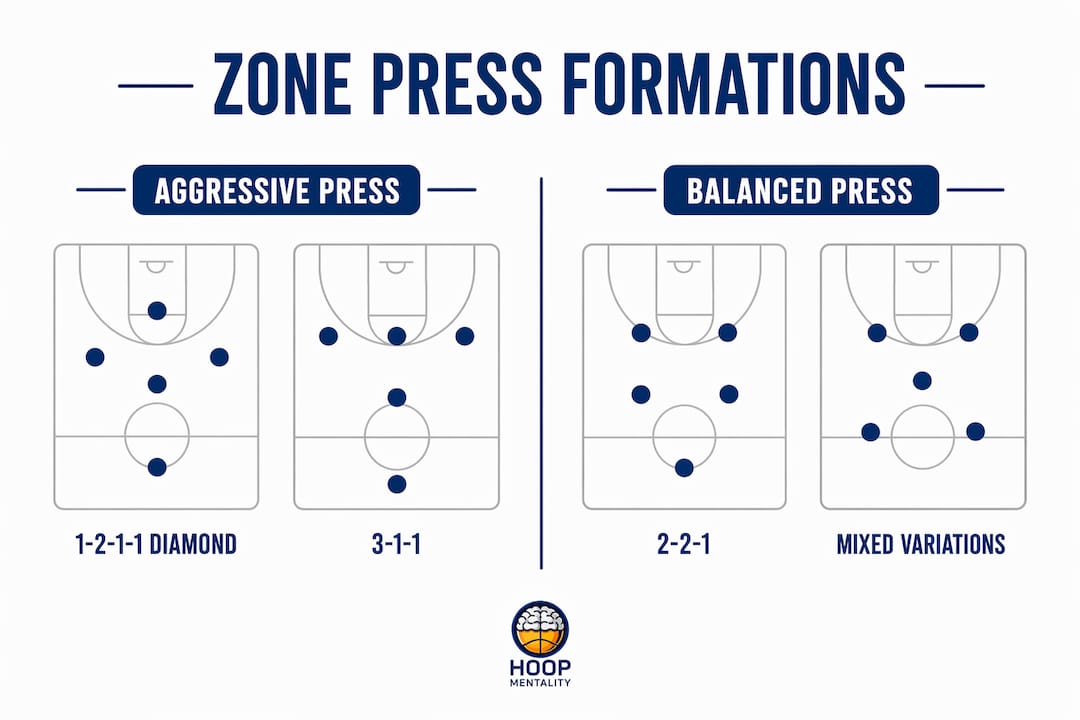
Zone press formations vary in alignment, but three setups dominate at most levels: the 1-2-1-1 diamond, the 2-2-1, and the 3-1-1. Each formation uses different starting positions to create trapping opportunities and funnel the offense away from the middle of the court.
1-2-1-1 diamond press
The 1-2-1-1 features a front guard at the inbound line, two forwards positioned on each sideline near the free-throw line extended, a centerfield player near half court, and a safety defender near the basket. The front guard pressures the inbound pass. Once the ball is caught, the nearest forward rotates to trap with the front guard along the sideline. The centerfield player anticipates the skip pass and cuts off the next receiver. This formation creates the tightest trapping angles and works best against teams that struggle to make quick, accurate passes under pressure.
2-2-1 press
The 2-2-1 starts with two guards at the inbound line, two forwards at half court, and one safety back. It is less aggressive at the point of inbound but creates strong traps once the ball crosses the timeline. Coaches often use the 2-2-1 when they want to apply pressure without fully committing to a high-risk trap near the baseline. It also gives the defense a cleaner path back into a half-court zone if the press breaks down.
3-1-1 press
The 3-1-1 places three defenders across the half-court line, one in the middle, and one safety. It is designed to trap near the sideline and exploit rushed decisions late in the 8-second count. The three-front alignment makes it difficult for the offense to find a clean outlet pass and forces the ball into corners where trapping is easiest.
| Formation | Starting alignment | Best used when |
|---|---|---|
| 1-2-1-1 diamond | 1 front, 2 sides, 1 mid, 1 safety | Opponent struggles with ball handling |
| 2-2-1 | 2 front, 2 mid, 1 safety | You want pressure with recovery option |
| 3-1-1 | 3 across, 1 mid, 1 safety | Forcing sideline traps late in the count |
How does the zone press work to disrupt the offense?
The zone press works by disrupting opponent rhythm and forcing the offense into multiple difficult decisions before they can run any set play. The goal is not always an immediate steal. The real objective is to make the offense burn time, make a bad pass, or reset into a disorganized half-court set.
Trapping is the central tool. When the ball handler receives the inbound pass near a sideline, two defenders converge quickly to cut off the dribble. The remaining defenders shift to deny the most likely passing lanes. A trapped ball handler has three options: throw a risky cross-court pass, lob over the trap, or call timeout. All three outcomes benefit the defense.
Stunts add another layer. Rather than committing to a full trap every time, defenders use short, aggressive bursts to create hesitation. Stunts force indecision and passing mistakes without requiring defenders to fully leave their zones. This conserves energy and keeps the defense organized throughout the game.
The 8-second clock is the press’s best ally. As the count reaches 5 or 6 seconds, offenses panic. They throw desperation passes, skip the ball to covered receivers, or pick up the dribble with nowhere to go. A disciplined zone press team does not need to force a steal. It just needs to make the offense feel the clock.
- Trap the ball handler along the sideline, never in the middle of the court
- Deny the first pass back to the inbound passer
- Anticipate the skip pass with the centerfield or mid-zone defender
- Rotate quickly after a pass to reset the trap at the next catch point
- Use stunts on ball reversals to prevent clean resets
Pro Tip: Teach your defenders to “stunt and recover” rather than fully commit on every trap. A half-step toward the ball handler is often enough to force a bad pass without leaving a passing lane open.
What are the benefits and challenges of zone press defense?
The zone press delivers clear benefits when used correctly. It forces turnovers, speeds up the game’s tempo, and limits the offense’s ability to run organized sets. Teams with athletic, high-energy defenders gain the most from pressing because they can sustain pressure across multiple possessions.
The zone press limits paint access by funneling the offense to the perimeter and sidelines. This forces outside shots rather than layups or post touches. However, this creates a real tradeoff. If the opponent shoots well from outside, the press can actually hurt you by giving them open catch-and-shoot opportunities off broken traps.
Benefits of zone press defense:
- Generates turnovers through trapping and forced passes
- Disrupts offensive sets before they can be organized
- Increases defensive tempo and controls game pace
- Puts psychological pressure on ball handlers and point guards
- Creates fast-break scoring opportunities off turnovers
Challenges to manage:
- Vulnerable to teams with strong outside shooters
- Requires high stamina and consistent communication
- Breakdowns in rotation lead to easy layups
- Less effective against experienced, composed point guards
- Demands significant practice time to run correctly
The zone press is a high-risk, high-reward tool. Its effectiveness depends heavily on the opponent’s skill set. Coaches who scout opponents well and choose the right moments to press will get far more out of it than those who run it indiscriminately. A good scouting report template helps you identify which opponents are most vulnerable to press pressure before game day.
How can coaches teach and implement an effective zone press?
Teaching a zone press starts with communication, positioning, and anticipation. Players need to understand their zone assignments before they can execute traps, stunts, or rotations at game speed. Start with walk-through sessions where you move players into position manually and explain the trigger points for each rotation.
Build continuity between half-court and full-court defense
One of the most effective teaching strategies is building continuity between your half-court zone and your press. Consistent defensive slides across both systems reduce the cognitive load on players. When your zone press uses the same footwork and rotation principles as your half-court zone, players do not need to switch mental gears. They focus on trapping angles instead of remembering two separate systems. This approach speeds up learning and builds player confidence faster than teaching the press in isolation.
Key drills for zone press development
- Inbound trap drill. Set up the press formation and have a scout team inbound the ball. Defenders practice converging on the first catch point and denying the outlet pass. Run this until the trap timing is automatic.
- Stunt and recover drill. Forwards practice stunting toward the ball on reversals, then snapping back to their zone before the pass arrives. This builds the quick-twitch reaction needed for effective stunts.
- 3-on-2 press break drill. Run the offense with three players against two defenders to simulate the spacing the press creates. Defenders practice cutting off passing lanes without over-committing.
- Full-court 5-on-5 press drill. Run the complete press in live situations. Stop play when rotations break down and correct positioning in real time.
- Clock pressure drill. Start the 8-second count at 4 seconds to simulate late-count pressure. Offense must advance the ball; defense focuses on trapping and denying clean outlets.
Common mistakes and how to fix them
Defenders often over-rotate and leave shooters open on the weak side. Fix this by drilling the “stunt and recover” technique until it becomes instinctive. Another common error is trapping in the middle of the court, which gives the offense four passing options instead of two. Teach your players to always push the ball toward the sideline before trapping. Finally, poor communication leads to missed rotations. Require verbal calls on every pass during practice so the habit carries into games.
Pro Tip: Use zone defense teaching methods that connect your press rotations to your half-court zone slides. Players who see the connection learn both systems faster and execute them with more confidence.
Key Takeaways
The zone press is most effective when it forces multiple difficult passes and disrupts offensive rhythm, not just when it produces immediate steals.
| Point | Details |
|---|---|
| Core definition | A zone press guards court areas, not players, to force turnovers before half court. |
| Top formations | The 1-2-1-1, 2-2-1, and 3-1-1 each create different trapping angles and recovery options. |
| Stunts over full traps | Short, aggressive stunts conserve energy and force mistakes without full defensive commitment. |
| Teaching continuity | Linking press rotations to half-court zone slides speeds up learning and reduces errors. |
| Know the tradeoffs | Zone press limits paint access but exposes the defense to open outside shooters if traps break down. |
Why the zone press is more about disruption than steals
Coaches who run the zone press expecting steals on every possession will be disappointed. The real value of the press shows up in the possessions after the press. When you force an offense to make three extra passes, reverse the ball twice, and burn 6 seconds just to cross half court, they arrive in their half-court set rattled and disorganized. That is when your defense wins.
I have seen teams run a press for an entire quarter without recording a single steal and still outscore the opponent 14 to 4 in that stretch. The turnovers came from rushed shot-clock violations, off-balance jump shots, and broken plays. None of those show up in the steal column, but all of them came directly from press pressure.
The forward bump technique is one of the most underused tools in the zone press. When a forward aggressively stunts on a ball reversal and then snaps back to deny the passing lane, it creates a split-second hesitation in the ball handler. That hesitation is enough. The offense either holds the ball too long or throws a pass into a covered lane. Neither outcome requires a full trap or a gamble.
Team chemistry matters more in a zone press than in almost any other defensive system. Players who trust each other’s rotations will hold their zones longer and stunt more aggressively. Players who doubt their teammates will cheat toward the ball and leave shooters open. Building that trust in practice, through repetition and clear communication standards, is what separates a press that works from one that falls apart in the second half.
— Dejan
Coaching resources for zone press defense
Hoop Mentality builds resources specifically for coaches who want to teach structured defensive systems without spending hours creating materials from scratch.

The Basketball Template Bundle for Coaches includes zone press defensive guides, practice plan templates, and drill frameworks built around real coaching experience. Every resource is ready to use and easy to adapt for your roster. Coaches who want a focused starting point for the 2-2-1 press can also check the Hybrid 2-2-1 Zone Press Defense Guide, which covers positioning, rotations, and drills in one structured format. Both resources help you spend less time planning and more time coaching.
FAQ
What is zone press in basketball?
A zone press is a full-court defensive strategy where players guard assigned court areas rather than individual opponents. Its primary goal is to force turnovers and disrupt offensive flow before the offense crosses half court.
How does zone press differ from man-to-man press?
In a zone press, defenders hold assigned areas and react to ball movement. In a man-to-man press, each defender follows one specific player across the full court.
What is the most common zone press formation?
The 1-2-1-1 diamond press is one of the most widely used formations. It features a front guard, two sideline forwards, a centerfield player near half court, and one safety defender near the basket.
When should a coach use a zone press?
A zone press works best against teams with weak ball handlers, limited passing under pressure, or poor composure late in the shot clock. It is most effective when used selectively rather than for entire games.
What are the biggest risks of running a zone press?
The main risk is leaving outside shooters open when traps break down. The zone press also demands high stamina and strong communication, so fatigue and poor rotations can lead to easy layups for the offense.