

TL;DR:
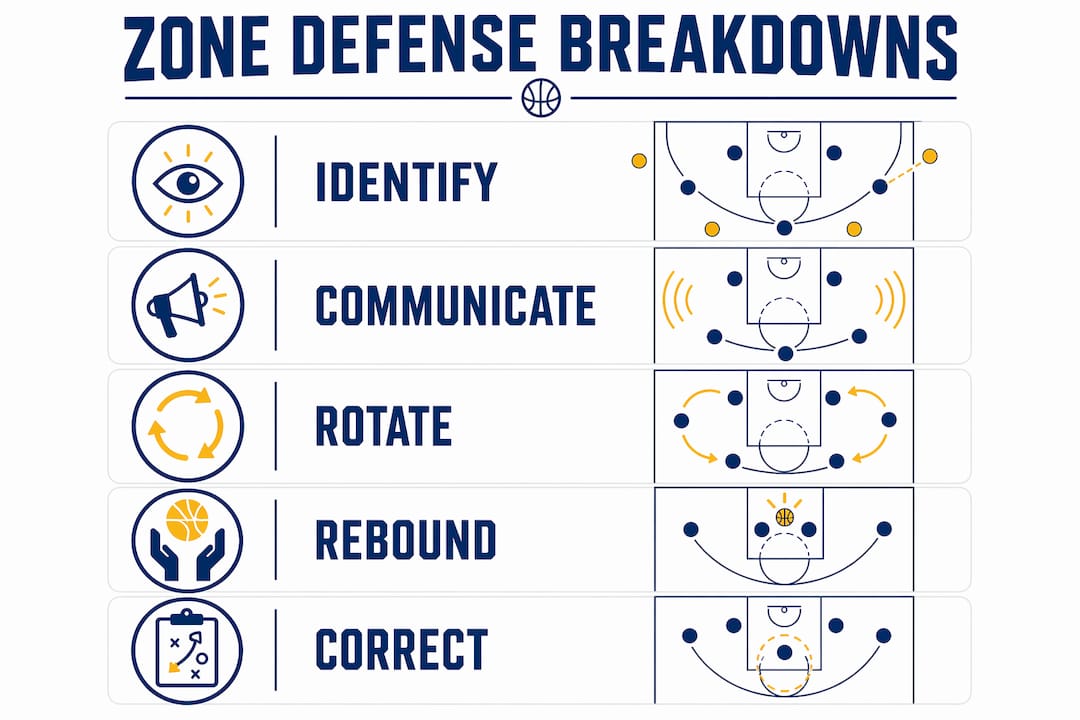
- Zone defense breakdowns occur when positional errors or miscommunication cause coverage collapse, leading to open shots or drives. Coaches analyze film to identify patterns, correct specific issues through targeted drills, and emphasize communication to maintain structural integrity during games. Consistent practice, precise film review, and clear verbal cues are essential to fixing recurring zone defense failures.
Zone defense breakdown is defined as the moment coordinated area coverage collapses due to positional errors, miscommunication, or missed rotations. Every coach running a 2-3, 3-2, or 1-3-1 zone has watched a well-designed defense fall apart in real time, often from the same repeatable mistakes. This zone defense breakdown guide gives you a systematic method to identify those failure points, analyze them on film using tools like Hudl and XbotGo, and correct them through targeted drills and communication work. Fix the patterns, and the defense holds. Ignore them, and the same gaps appear every game.
What are the common zone defense types and formations?
Zone defense types fall into three primary formations used at every level of basketball: the 2-3, the 3-2, and the 1-3-1. Each assigns players to areas of the court rather than individual opponents. That spatial responsibility is the foundation of every zone, and it is also where most breakdowns begin.
The 2-3 zone places two defenders at the top of the key near the free-throw line and three defenders between the three-point arc and the rim, with the center anchoring the paint. It protects the interior well but leaves the corners and high post exposed. The 3-2 flips that structure, putting three defenders across the perimeter and two near the basket, which pressures ball handlers but creates vulnerability in the mid-post and short corner. The 1-3-1 uses a point defender, three across the middle, and a baseline rover, generating trapping opportunities but requiring precise rotation to avoid open corner threes.
Beyond these three, coaches also deploy the 2-1-2 and 2-2-1, which are variants that alter spacing and coverage emphasis within the 2-3 base. The 2-1-2 drops the middle defender lower to protect the paint more aggressively. The 2-2-1 pushes both back defenders higher, useful for pressing situations or disrupting half-court entries.
| Zone Type | Strength | Vulnerability |
|---|---|---|
| 2-3 | Paint protection, interior defense | Corners, high post |
| 3-2 | Perimeter pressure, guard disruption | Mid-post, short corner |
| 1-3-1 | Trapping, ball pressure | Corner threes, baseline |
| 2-1-2 | Reinforced paint coverage | Wing gaps |
| 2-2-1 | Press disruption, ball denial | Weak-side rebounds |
Matching zone type to opponent tendencies is the first strategic decision a coach makes. A team that shoots well from the corners punishes a 2-3 zone. A team with a dominant high-post player dismantles a 3-2. Understanding which formation you run and why sets the context for every breakdown you will eventually need to fix.
How can coaches analyze zone defense breakdowns on film?
Film analysis is the most direct method for identifying consistent failure modes in zone defense. Possession-by-possession review lets you freeze specific moments, called read points, where the defense either holds or collapses. The goal is not to watch the whole game again. The goal is to isolate the exact frame where coverage breaks down.
Start your film process with staff-only review before involving players. Watch for the same breakdown appearing across multiple possessions. If your post defender cheats toward the corner before the skip pass arrives three times in one half, that is a pattern, not a mistake. Patterns are what you bring to practice. Single errors are what you address individually.
- Identify your read points. For a 2-3 zone, freeze the frame the moment a skip pass is thrown. Check where all five defenders are positioned relative to their zones.
- Label the specific breakdown before showing players. “Our center drifts to the corner before the catch” is a precise cue. “We need better defense” is not.
- Show players clips comparing correct and broken rotations side by side. This accelerates learning more than verbal explanation alone.
- Limit each film session to one correction focus. Coaches who address five problems in one session fix zero of them.
- Use XbotGo or Hudl to tag and clip specific breakdown moments for quick retrieval during practice or halftime.
Pro Tip: After every film session, write one sentence that describes the single correction your team will work on in the next practice. Put it on the whiteboard before players arrive. One focus beats five every time.
Showing players repeated film of the same specific breakdown with a clear visual cue improves retention and positioning accuracy faster than general feedback. The film is not punishment. It is the most specific teaching tool you have.
What miscommunications and positional errors cause zone breakdowns?
Communication lapses in screen coverage, passing lane alerts, and help defense rotations are the most common causes of open shots and drives against zone defenses. These are not effort problems. They are spatial awareness and habit problems.
The five most recurring positional errors in zone defense are:
- Early corner cheat. The post defender slides toward the corner before the ball arrives, leaving the paint unguarded. This is the most common breakdown in 2-3 and 3-2 zones.
- Rover beaten at the high post. In a 3-2 or 1-3-1, the middle defender fails to cut off the high-post entry, giving the offense a direct line to the paint.
- Wings not sinking on ball reversal. When the ball swings from one side to the other, wing defenders must drop toward the baseline. Failing to sink on reversal leaves the short corner and mid-post open.
- Slow corner trap close-out. In trapping zones, the second defender arrives late, giving the ball handler time to pass out of the trap before pressure arrives.
- Rebounding by visual tracking. Defenders watch the ball instead of locating and boxing out opponents. This is the primary cause of offensive rebound opportunities in zone defense.
Zone defenses guard areas, not individuals, which means rebounding requires a deliberate decision to find a body and make contact. Defenders who track the ball visually leave offensive players free to crash the glass. Coaching must address body positioning and contact habits, not just effort.
Coordinated communication for calling screens, passing direction, and weak-side alerts is what holds zone coverage together under pressure. Without those verbal cues, defenders make individual decisions that conflict with their teammates’ movements. The result is gaps, mismatches, and open looks.
What drills and adjustments fix zone defense breakdowns?
Adjusting zone defense means modifying rotations, player responsibilities, and formation details based on what the opponent is attacking. Rigid systems that never adapt give offenses a repeatable blueprint to exploit.
- Rotation responsibility drill. Run your zone with no offense. Call out ball positions verbally and have defenders move to their correct spots on each call. Freeze and check alignment after every movement. This builds spatial habit before live pressure arrives.
- Skip pass rebounding drill. Throw skip passes from wing to wing while defenders practice locating and boxing out a designated offensive player on each catch. The focus is contact and positioning, not ball watching.
- Communication call drill. Assign specific verbal calls for each zone situation: “ball,” “skip,” “screen,” “corner,” “help.” Run five-on-five with the rule that any uncalled situation results in a dead ball and a reset. Players learn fast when silence has a consequence.
- Hybrid zone integration. Introduce trapping principles on specific ball positions, such as the corner or the high post, while maintaining base zone coverage elsewhere. Combining man-to-man principles with zone rotations creates unpredictability that offenses struggle to prepare for.
- Video feedback cycle. Film practice, clip the same drill from two sessions, and show players the improvement or regression. Concrete visual progress motivates continued focus.
Pro Tip: Run your rotation responsibility drill at the start of every practice, not just when the zone breaks down in games. Fifteen minutes of daily repetition builds the spatial memory that holds under game pressure.
| Drill | Breakdown it fixes | Key coaching cue |
|---|---|---|
| Rotation responsibility | Positional drift, coverage gaps | “Freeze and check your spot” |
| Skip pass rebounding | Offensive rebounds, ball watching | “Find a body before the ball” |
| Communication call | Silent breakdowns, missed alerts | “No call, no credit” |
| Hybrid zone integration | Predictable rotations | “Trap on the catch, recover fast” |
Reviewing defensive rotations in detail helps coaches see exactly where player movements break down relative to the zone structure. That context makes drill selection more precise and practice time more productive.
How do you troubleshoot zone defense breakdowns during games?
Real-time troubleshooting requires coaches and players to recognize breakdown signals before the scoreboard forces the conversation. The signs are visible if you know what to watch.
- Opponent ball movement accelerates. When the offense starts moving the ball faster than your defense rotates, the zone is already a step behind. Call a timeout before the gap widens.
- The same spot gets attacked twice. One open look is a mistake. Two open looks from the same position is a pattern. Address it immediately, not at halftime.
- Fatigue changes spacing. Tired defenders shrink their coverage area without realizing it. Zone depth and spacing must be adjusted dynamically, not just at the start of possessions.
- Communication goes quiet. When you stop hearing calls from your defenders, the zone is running on individual instinct rather than coordinated coverage. Remind players verbally during dead balls.
- Offensive rebounds increase. More than one offensive rebound per quarter from the same area signals a consistent box-out failure. Identify which defender is watching the ball and address it directly.
Use timeout moments for single, specific corrections. “Get back to your spots on skip passes” is a correction. “We need to play better defense” is not. Defensive adjustment tips for in-game situations give coaches a structured way to respond to these signals without disrupting team rhythm.
Key takeaways
Zone defense holds when every player understands their spatial role, communicates consistently, and executes rotations before the offense forces a reaction.
| Point | Details |
|---|---|
| Know your zone type | Match the 2-3, 3-2, or 1-3-1 to opponent tendencies before the game starts. |
| Use film with precision | Freeze read points, label one correction, and show players side-by-side clips. |
| Fix communication first | Verbal calls for screens, skips, and help defense prevent most coverage gaps. |
| Box out by contact | Teach defenders to find a body before tracking the ball to eliminate offensive rebounds. |
| Drill rotations daily | Fifteen minutes of daily rotation work builds the spatial memory that holds under pressure. |
Why film and communication are the real zone defense fixes
I have watched coaches spend entire practices running zone sets without ever addressing why the defense broke down in the first place. The players run the drill correctly in practice, then make the same mistake in the game. The problem is not effort. It is that the players do not understand the spatial rule they violated.
The single biggest shift I made as a coach was stopping film sessions that tried to fix everything at once. One possession, one breakdown, one correction. Show the clip. Name the spatial rule. Run the drill that addresses it. Come back the next day and show the improvement. Players respond to that cycle because it is specific and fair.
The other thing coaches underestimate is how much zone defense depends on talking. Man-to-man defense can survive on individual instinct. Zone defense cannot. When players go quiet, the zone dies. I started grading communication in practice, not just positioning, and the difference in game performance was immediate.
The coaches who master zone defense are not the ones with the most complex schemes. They are the ones who identify the same two or three breakdowns their team makes, fix those specifically, and build communication habits that hold under fatigue and pressure. That is the whole system.
— Dejan
Get structured zone defense resources from Hoopmentality
Fixing zone defense breakdowns takes more than film review. It takes structured practice time with drills built around the specific failures your team repeats.

Hoopmentality’s Basketball Practice Plan Template gives you a ready-to-use framework for organizing zone defense work into focused, progressive sessions. Pair it with the Big Man Dual Action Drill to address post defender activity and rebounding positioning, two of the most common zone breakdown points. Both resources are built from real coaching experience and designed to save you time while giving your players clear, repeatable systems to execute.
FAQ
What is a zone defense breakdown?
A zone defense breakdown occurs when one or more defenders fail to cover their assigned area, creating an open shot or driving lane for the offense. It is caused by positional drift, missed communication, or slow rotation.
What are the most common zone defense types?
The three most common zone defense types are the 2-3, the 3-2, and the 1-3-1. Each assigns players to court areas rather than individual opponents, with different strengths and coverage gaps.
How do you identify zone breakdowns on film?
Freeze the frame at specific read points, such as the moment a skip pass is thrown, and check all five defender positions relative to their zones. Look for the same breakdown appearing across multiple possessions before bringing it to practice.
Why does rebounding fail in zone defense?
Rebounding failures in zone defense happen when defenders watch the ball instead of locating and making contact with an offensive player. Zone defense guards areas, not people, so box-out assignments must be taught explicitly.
How do you fix communication breakdowns in zone defense?
Assign specific verbal calls for every zone situation and enforce them in practice with a dead-ball rule for silence. Communication calls for screens, passes, and weak-side alerts are the primary mechanism that keeps zone coverage coordinated under pressure.