

Coaching a high school basketball team means juggling practice schedules, developing skills, and preparing for difficult matchups. Consistent scouting is a challenge when each assistant focuses on different game details. The right scouting template brings clarity by standardizing how coaches collect and present information, creating a unified language for strategy. This article highlights how effective templates help your staff evaluate opponents, sharpen game plans, and accelerate player development across every competition level.
Table of Contents
- Defining Scouting Templates And Their Role
- Types Of Scouting Templates For Coaches
- Key Features Driving Effective Game Prep
- Real-World Benefits For High School Teams
- Common Pitfalls And How To Avoid Them
Key Takeaways
| Point | Details |
|---|---|
| Importance of Scouting Templates | Scouting templates standardize data collection, ensuring all coaches evaluate opponents uniformly. This leads to more effective preparation and communication. |
| Types of Templates | Different situations require different templates, such as individual player, team overview, and real-time game templates. Selecting the right template is crucial for specific scouting goals. |
| Actionable Data Organization | Effective templates must organize data in a way that guides decision-making, connecting observations to clear actions in games. Clarity and simplicity enhance understanding. |
| Building a Culture of Preparation | Implementing scouting templates cultivates a program culture focused on accountability and attention to detail, leading to improved player performance and strategic execution. |
Defining Scouting Templates and Their Role
A scouting template is a structured document that standardizes how you collect, organize, and present information about opposing players and teams. It’s the framework that turns scattered observations into actionable coaching insights.
Think of it as your playbook for preparation. Without templates, scouting becomes inconsistent—one assistant notes shooting form, another tracks defensive switches, and nobody captures the same data. With templates, every coach on your staff evaluates opponents the same way.
What Makes a Scouting Template Work
Effective templates share common features:
- Consistent structure that your entire staff understands
- Clear categories for player strengths, weaknesses, and tendencies
- Quick reference sections you can scan in 30 seconds
- Space for video timestamps linking analysis to film clips
- Player statistics alongside visual observations
The best templates mirror how structured coaching frameworks develop your team’s competencies. Just as scouting organizations use qualification cards to define required skills, basketball coaches use scouting templates to define what information matters most.
Your template becomes the language your coaching staff speaks. When everyone uses the same format, communication tightens. Your assistant coach doesn’t say “their point guard is quick”—they fill in the template’s speed rating and recovery metrics.
Why High School Coaches Need Them
You’re managing multiple responsibilities. You’re planning practices, developing your players, and now you’re supposed to scout opponents thoroughly. Scouting templates remove decision fatigue.
Without templates, you waste time:
- Deciding what to write down while watching film
- Searching through pages of notes for one stat
- Repeating the same analysis across different formats
- Explaining to players why your scouting data doesn’t match what your assistant reported
Templates solve this immediately. You watch film, fill in boxes, move forward.
A well-designed template turns 45 minutes of film study into actionable game plans that your players understand.
Your team also benefits. When you present scouting information consistently—same format, same details, same emphasis—players absorb it faster. They know exactly what to expect from their defensive assignment because your data is precise and repeatable.
The Connection to Competitive Success
Templates aren’t busywork. They directly impact performance because they force you to focus on what matters. You can’t scout everything. You can’t track every player across the court on every possession. Templates make you choose your priorities and stick to them.
When you’re down five with two minutes left, you don’t improvise your defense. You execute the adjustments you planned based on your scouting data. That data only matters if it’s organized, accurate, and accessible—exactly what templates provide.
Pro tip: Start with one simple template for individual player analysis before creating team-level sheets. Master the basics first, then expand your system as your comfort grows.
Types of Scouting Templates for Coaches
Not all scouting templates look the same. Different situations demand different formats. Your opponent might require a team overview template, while your next matchup needs detailed individual player analysis. The key is matching the template to your actual needs.
Think about what you’re trying to accomplish before you create or select a template. Are you breaking down their offense? Identifying defensive weaknesses? Preparing your players for specific matchups? Each goal has a template that fits best.
Individual Player Scouting Templates
These focus on one opponent’s player—usually someone your team will face directly. You’re tracking their tendencies, strengths, and exploitable weaknesses.
Individual templates typically include:
- Offensive tendencies (pick-and-roll frequency, three-point volume, driving patterns)
- Defensive positioning and recovery ability
- Foul trouble history and technical fouls
- Fatigue patterns (do they slow down in the fourth quarter?)
- Personal matchup data (how they perform against specific defenses)
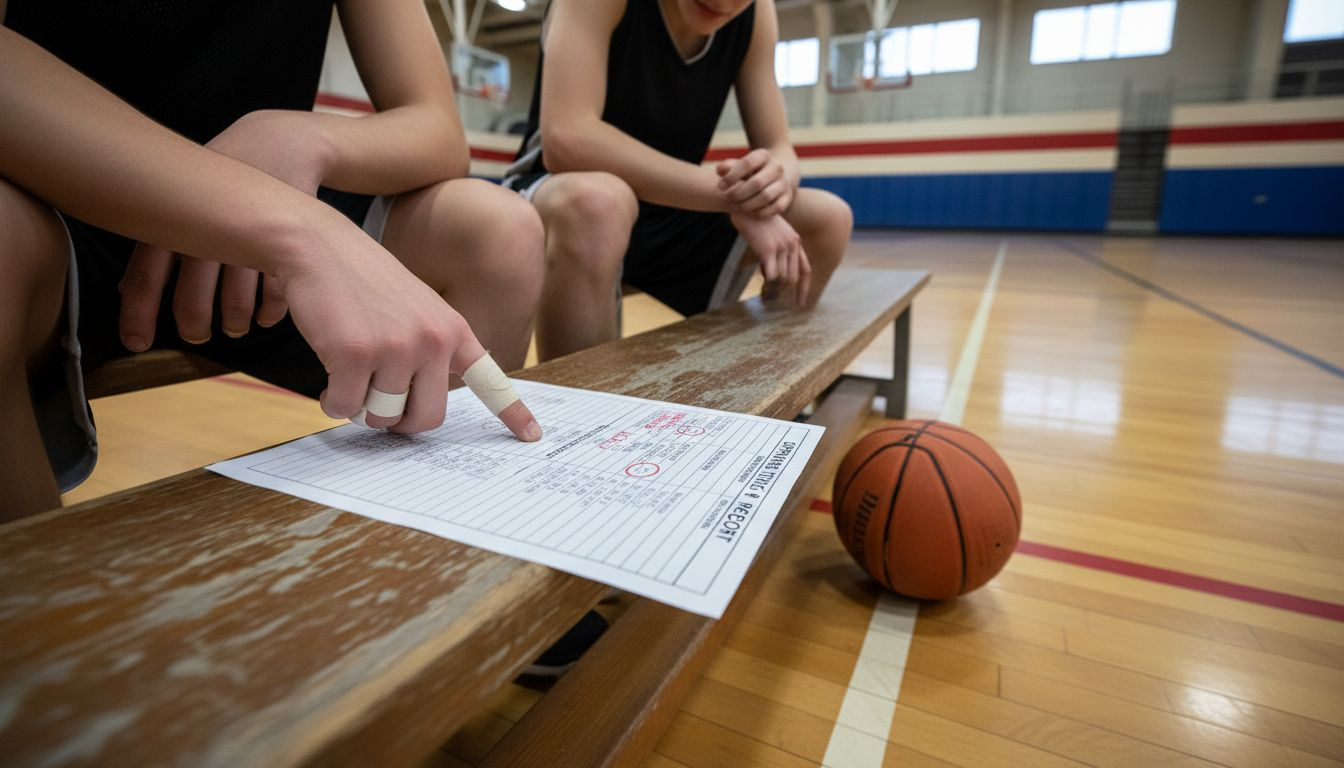
You’ll use these before games to prepare your defender. “Here’s what number 23 does on the wing” becomes much more powerful when you can show film clips and specific statistics.
Team Overview Scouting Templates
These give you the big picture of how an entire team functions. You’re analyzing their system, not individual players.
Team templates capture:
- Overall offensive and defensive philosophy
- Pace of play and transition tendencies
- Key player combinations and lineups
- Bench performance patterns
- In-game adjustments they typically make
This is your pre-game film session summary—the 10-minute version your players need to understand what they’re walking into.
Opponent Matchup Templates
These compare your team directly to theirs. You’re looking for advantages and vulnerabilities from a relative perspective.
Matchup templates answer questions like:
- Where can we exploit their defense?
- Which of our players will have easiest scoring opportunities?
- Where will we struggle defensively?
- What adjustments do we need to make?
These often include side-by-side comparisons: your scoring versus their defense, your ball handling versus their pressure, etc.
Real-Time Game Templates
These templates stay on the bench during games. They’re simplified versions designed for quick reference during timeouts or between possessions.
Game-time templates feature:
- Essential tendencies (3-4 key points, not 20)
- Quick-scan formatting that works in dim gym lighting
- Key lineup information and substitution patterns
- Critical adjustment reminders
Different coaching approaches require customized frameworks that align with your system, just like how scouting organizations develop role-specific training tools. Your template must reflect how your team actually plays and communicates.
The right template becomes invisible during competition—your players execute without thinking about the format.
You don’t need every template type for every opponent. Start with what solves your immediate problem. If defensive preparation is your focus, build strong individual player templates first. If you’re struggling with overall strategy, prioritize team overview formats.
Here’s how the main types of scouting templates differ for high school coaches:
| Template Type | Primary Purpose | Most Useful Situation | Key Information Focus |
|---|---|---|---|
| Individual Player | Analyze opponent’s player habits | Assigning defenders to matchups | Tendencies, strengths, weaknesses |
| Team Overview | Understand overall team strategy | Pre-game film sessions | System philosophy, key lineups |
| Opponent Matchup | Reveal comparative advantages | Planning offensive/defensive adjustments | Side-by-side team strengths |
| Real-Time Game | Quick bench reference during games | Immediate timeout decisions | Essential tendencies, lineups |
Pro tip: Keep your most critical template (usually individual defender matchups) formatted for easy scanning under game pressure—large fonts, minimal text, maximum clarity.
Key Features Driving Effective Game Prep
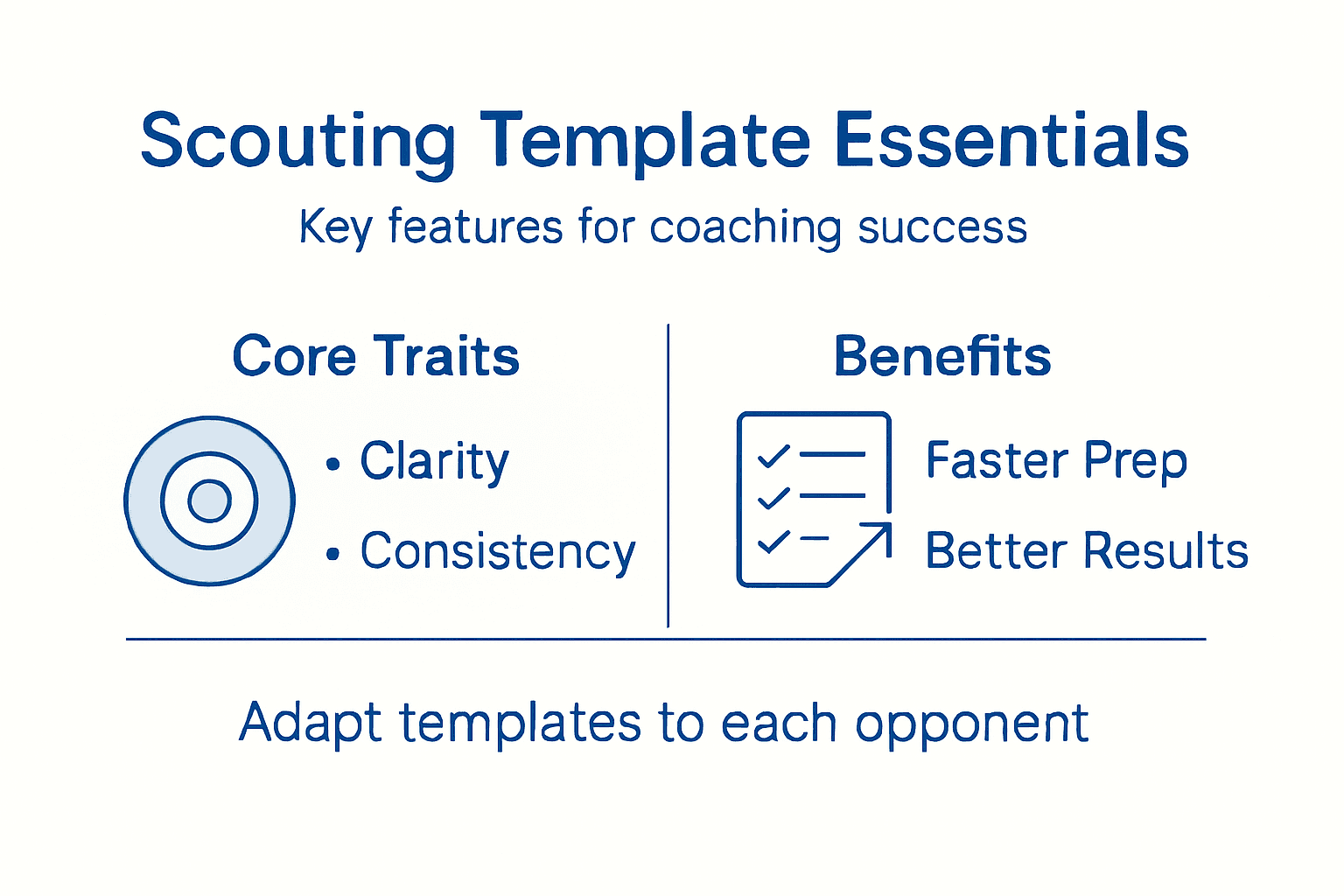
The best scouting templates share specific characteristics that make them actually useful during preparation and competition. A template might look professional, but if it doesn’t drive action, it’s just paperwork.
Effective templates focus on clear objectives. You know exactly what information you’re collecting and why. You’re not filling in boxes randomly—every field serves a purpose for your upcoming game.
Clarity and Simplicity
Your template should answer one question immediately: “What do I need to know right now?”
Complicated templates create friction. Your assistant coach hesitates. Your players get confused. You waste time explaining the format instead of discussing strategy.
Clear templates feature:
- One main idea per section
- Minimal text, maximum information
- Visual hierarchy that guides the eye
- Terms your staff uses in actual conversation
When your point guard sees a template labeled “Defensive Switches,” they understand instantly what they’re reading. No interpretation needed.
Actionable Data Organization
Information means nothing if you can’t act on it. Your template must organize data so decisions become obvious.
If you note that their shooting guard “struggles on the wing,” that’s observation, not action. But if your template shows “shooting guard: 34% from wing, prefers baseline drive,” your team knows exactly how to defend.
Effective preparation relies on immediate feedback and skill demonstration that players can apply in real game situations. Your scouting template delivers this connection.
Templates that turn data into specific player assignments are the ones that actually change game outcomes.
Organize your information so the link between observation and action is obvious. “They run pick-and-roll on 31% of possessions” connects to “Our center must recover on the roll.” See the difference?
Consistency Across Your Program
Every coach on your staff must use the template the same way. Otherwise, the data becomes unreliable.
Consistency means:
- Same categories for every opponent
- Same rating scales (don’t mix “excellent/good/poor” with “1-10”)
- Same definitions (everyone agrees what “recovery ability” means)
- Same level of detail (not five players thoroughly analyzed, two barely sketched)
Your assistant coach shouldn’t wonder what someone meant by “fast.” Your template defines it: “Gets into defensive position within 0.8 seconds of opponent receiving the ball.”
Adaptability for Different Situations
One template doesn’t fit conference play, playoff games, and tournament opponents equally.
Your system needs flexibility:
- Condensed version for quick pregame reviews
- Detailed version for practice preparation
- Matchup-specific modifications for unusual opponents
- Simplified format for younger or less experienced players
The best templates adapt without requiring you to rebuild them from scratch each time.
Pro tip: Create one master template, then save simplified versions for different purposes—game day bench copy, player handout, practice whiteboard version—all pulling from the same source information.
Real-World Benefits for High School Teams
Scouting templates don’t just improve your game plans. They transform how your entire team operates, thinks, and develops as competitors and people.
When you implement scouting templates, you’re not just adding another form to your coaching routine. You’re building a culture where preparation matters, accountability is clear, and players understand exactly what success requires.
Faster, Sharper Game Preparation
Your team prepares more efficiently when information is organized the same way every time.
Without templates:
- You spend 90 minutes watching film and scribbling notes
- Your assistant coach spends another hour deciphering your handwriting
- Your players wait while you figure out what to tell them
- Game time arrives and you’re still clarifying details
With templates:
- Film review happens in 45 minutes
- Your staff immediately understands the data
- Players get clear, concise scouting info before practice
- You adjust strategy during the week, not during timeout calls
That efficiency compounds. You recover preparation time you can reinvest into skill development, conditioning, or team building.
Stronger Player Development Through Understanding
Players perform better when they understand why they’re making decisions on the court.
Structured scouting frameworks build leadership skills and personal growth that extend far beyond basketball. When your point guard sees a scouting template showing that their defender struggles with left-hand drives, they’re not just receiving information—they’re learning to analyze problems and identify solutions.
Your team starts thinking like coaches. They recognize patterns. They anticipate adjustments. They take ownership of execution.
Players who understand scouting data become intelligent competitors, not just players following orders.
Consistency Across Competition Levels
Your conference opponents see the same preparation quality. Your tournament teams execute the same scouting system they practiced with all season.
This consistency matters:
- No confusion when you face unfamiliar opponents in tournaments
- Your younger players learn the same system as veterans
- Substitute players step in without explaining the process again
- Your team’s identity stays intact across different matchups
Consistency builds confidence. Your bench players know how to access scouting information. Your freshmen understand the template language. Everyone operates from the same playbook.
Measurable Preparation Quality
Templates create accountability. You can track what you scouted, how thoroughly, and what adjustments actually resulted from that analysis.
You notice patterns:
- Which opponents you prepare best against
- Which scouting categories drive actual adjustments
- Which players benefit most from specific preparation
- Where your scouting misses the mark
This data helps you improve your scouting system year to year. You’re not guessing about preparation effectiveness—you’re measuring it.
Team Culture Focused on Details
When scouting templates are part of your routine, you communicate to your team that details matter.
Your players see:
- Coaches investing time in preparation
- Strategic decisions based on opponent analysis
- Film study leading directly to game adjustments
- Scouting information guiding practice focus
This builds a program culture where winning comes from work, not luck. Your players understand that excellence requires attention to what opponents do, how to adjust, and executing adjustments with precision.
Pro tip: Share simplified scouting summaries with your team before games—not the entire template, just the three to four critical adjustments they need to execute. This shows your preparation and focuses their attention where it matters most.
Common Pitfalls and How to Avoid Them
Good templates go bad when coaches use them carelessly. The tool itself isn’t the problem—how you apply it is. Knowing what can derail your scouting process helps you avoid expensive mistakes.
Many coaching errors stem from how you gather and interpret scouting information. Your template is only as good as the thinking behind it.
Confirmation Bias in Scouting
Your brain naturally seeks information that confirms what you already believe. This destroys scouting accuracy.
You notice their point guard misses a three-pointer. You write “poor three-point shooter” on your template. Then you ignore the next two makes because they don’t fit your narrative. That’s confirmation bias.
Cognitive biases like anchoring and confirmation bias undermine evaluation fairness and lead to skewed decision-making. You make personnel adjustments based on incomplete data.
Avoid this by:
- Recording statistics, not opinions (“34% from three” not “bad shooter”)
- Tracking minimum sample sizes before drawing conclusions
- Watching complete games, not highlight reels
- Asking assistants to challenge your assumptions
Numbers don’t lie, but selective watching does. Record complete data, not just what surprises you.
Overreliance on Templates Without Context
Templates are frameworks, not laws. Applying them rigidly without adjusting for unique situations wastes their value.
You have a template category for “defensive recovery speed.” But what if their defender just returned from injury? What if they’re playing in foul trouble? Context matters.
Ineffective template use results from rigid procedures without adaptation to specific circumstances. Your template must serve your needs, not the reverse.
Stay flexible:
- Use templates as starting points, not final answers
- Add context notes explaining unusual performance
- Adjust categories when opponents don’t fit standard patterns
- Review scouting with fresh eyes before games
Too Much Information
You don’t need every stat for every player. Templates bloated with data become useless.
Filling out a 47-question template per player means:
- You never finish scouting
- Your staff ignores half the information
- Your players can’t remember what matters
- You waste time on details that don’t affect game plans
Start minimal. Track only what directly changes how you play. Add categories only when you actually use the information.
Inconsistent Application
Your template only works if everyone uses it the same way. One coach rates “defensive intensity” as 1-10, another uses “poor/fair/good.” Now your data is worthless.
Before rolling out templates:
- Define every category clearly
- Show examples of what ratings mean
- Have your staff practice together
- Review early scouting for consistency
- Adjust templates based on what doesn’t work
Common coaching mistakes often stem from inconsistent implementation and unclear expectations. Your template is only effective when your entire staff trusts it.
Below is a summary of the most common pitfalls coaches face when implementing scouting templates:
| Pitfall | Why It Happens | Resulting Problem | Solution |
|---|---|---|---|
| Confirmation Bias | Favoring expected outcomes | Misleading player evaluations | Use objective stats only |
| Overreliance on Templates | Rigid procedures replace context | Poor adaptation to new situations | Add context notes, stay flexible |
| Too Much Information | Excessive data collection | Ineffective communication, confusion | Track only actionable items |
| Inconsistent Application | Varied staff practices | Unreliable and contradictory data | Standardize rating scales, definitions |
Ignoring Film While Trusting Templates
Your scouting data should guide your film study, not replace it. Coaches sometimes skip watching opponents because “the template covers it.”
Bad idea. Film reveals nuance that checkboxes miss. You see how their center moves without the ball. You notice pick-and-roll timing. You catch desperation plays when they’re down.
Templates organize your observations. They don’t create them.
Pro tip: Before finalizing any scouting template, watch a full game film without filling anything out. See what information you actually need to notice. Then build your template around those real observations, not theoretical categories.
Streamline Your Scouting Process and Win More Games Today
Coaches face the challenge of transforming scattered observations into clear, actionable game plans while managing limited time and resources. This article highlights how using scouting templates can save time, improve communication, and ensure consistent preparation across your coaching staff. If you struggle with organizing scouting data, reducing confirmation bias, or communicating adjustments effectively to your players, leveraging professional resources designed specifically for these problems can make a big difference.
Take control of your game preparation with resources from Hoop Mentality. Our proven scouting templates and practice plans help you capture essential opponent tendencies, assign defensive matchups clearly, and keep your entire staff aligned. By integrating easy-to-use scouting templates with proven drills and strategy guides, you can focus on developing intelligent, confident players who execute with precision. Start improving your competitive edge now by exploring our collection designed to eliminate preparation chaos and boost your team’s performance. Visit Hoop Mentality and see how organized scouting delivers results. Learn more about organizing your scouting system with Hoop Mentality’s coaching resources.
Frequently Asked Questions
What is the purpose of a scouting template in coaching?
A scouting template standardizes how coaches collect, organize, and present information about opposing players and teams, ensuring consistent analysis and actionable insights.
How do scouting templates improve game preparation for coaches?
Scouting templates streamline the preparation process by organizing crucial data in a clear format, allowing coaches to focus on key strategies rather than deciphering scattered notes.
What types of scouting templates should high school coaches use?
High school coaches can benefit from various templates, including individual player scouting templates, team overview templates, opponent matchup templates, and real-time game templates, depending on their specific needs.
How can coaches avoid common pitfalls when using scouting templates?
To avoid pitfalls, coaches should ensure clarity and consistency in template usage, focus on actionable information rather than excessive data, and maintain flexibility to adapt templates based on specific opponents or situations.
Recommended
- The Role of Scouting Templates in Basketball – Hoop Mentality
- Basketball Scouting Workflow for Winning Team Preparation – Hoop Mentality
- Scouting Report Strategies for Winning Basketball – Hoop Mentality
- How to Create Scouting Reports for Winning Basketball Teams – Hoop Mentality
- Understanding Why Climbers Need Training Boards - Gripnatic