

TL;DR:
- Defensive rules are specific standards that guide each player’s actions during defense in basketball. They help teams execute consistently under pressure, build trust, and prevent breakdowns. Coaches should establish and regularly reinforce five to eight clear rules connected to their overall defensive philosophy.
Defensive rules are predefined behavioral standards that govern how every player on your team acts on defense, possession by possession. Understanding why set defensive rules matter is the first step toward building a defense that holds up when the game is on the line. A high-performing defense serves three core purposes: preventing points, gaining possession, and creating scoring opportunities from defensive stops. Without written rules tied to those purposes, your defensive system is just a collection of good intentions that falls apart under pressure.
Why set defensive rules for your basketball team?
Defensive rules are the difference between a team that reacts and a team that executes. Groups without shared standards experience more stress, more confusion, and more breakdowns at critical moments. That finding applies directly to basketball: when players do not know what is expected of them on defense, they guess. Guessing leads to blown coverages, miscommunications, and easy baskets for the opponent.
The benefits of setting clear defensive rules go beyond stopping the ball. They include:
- Shared expectations. Every player knows their role before the possession starts, not after the mistake happens.
- Reduced confusion. Rules shape consistent behavior across the group, providing stability and routine that players can rely on in high-stress moments.
- Fairness and accountability. Rules apply to everyone equally. A starter and a reserve are held to the same defensive standard, which builds trust within the roster.
- Psychological safety. Clear expectations reduce anxiety. Players who know exactly what to do play with more confidence and less hesitation.
- Repeatability. Defense is a skill that must be practiced the same way every day. Rules give you a consistent framework to drill against.
Pro Tip: Post your defensive rules in the locker room and reference them by name during film sessions. When players hear the same language in practice, film, and games, the rules become automatic.
The importance of defensive rules shows up most clearly in close games. When the score is tied with two minutes left, players revert to their training. If that training is built on clear, repeated rules, they execute. If it is not, they improvise.

How do defensive rules connect to your team’s defensive philosophy?
Defensive rules do not exist in isolation. They sit at the bottom of a four-layer hierarchy, and understanding that structure is what separates coaches who build lasting defenses from those who patch problems game by game.
Defensive philosophy should be structured hierarchically, with each layer supporting the next:
- Mentality. This is the foundation. Discipline, effort, and attitude are not tactics. They are values. Mentality is what your players believe about defense before they ever step on the court.
- Strategy. This is your overall plan. Do you want to limit three-point attempts? Force baseline? Protect the paint? Strategy defines your priorities for an entire game or season.
- Tactics. These are the specific coverages, rotations, and assignments you use to execute your strategy. Ball screen coverage, help-side positioning, and closeout technique all live here.
- Rules. These are the concrete behavioral standards that make your mentality, strategy, and tactics real. Rules tell players exactly what to do in specific situations.
Most coaches make a critical error at the top of this hierarchy. Coaching staffs often jump straight into tactics before establishing a defensive mentality. The result is a team that can run a scheme but does not know why, and collapses when the scheme gets tested.
“Unless your defensive philosophy is codified and regularly referenced, it remains just thoughts prone to failure under stress. Mentality is the space between the ears and the foundation of everything that follows.” — Blevins, defensive coaching expert
Writing defensive rules and referencing them constantly transforms them from ideas into a functioning system. A rule that lives only in the coach’s head is not a rule. It is a preference. Write it down, put it on the whiteboard, and say it out loud every day.
What are practical guidelines for creating effective defensive rules?
The best defensive rules share three qualities: they are clear, specific, and enforceable. Vague rules are less effective than concrete ones. “Play hard” is not a rule. “Close out under control with a hand up” is a rule. The difference is that a player can execute the second one and a coach can correct it.
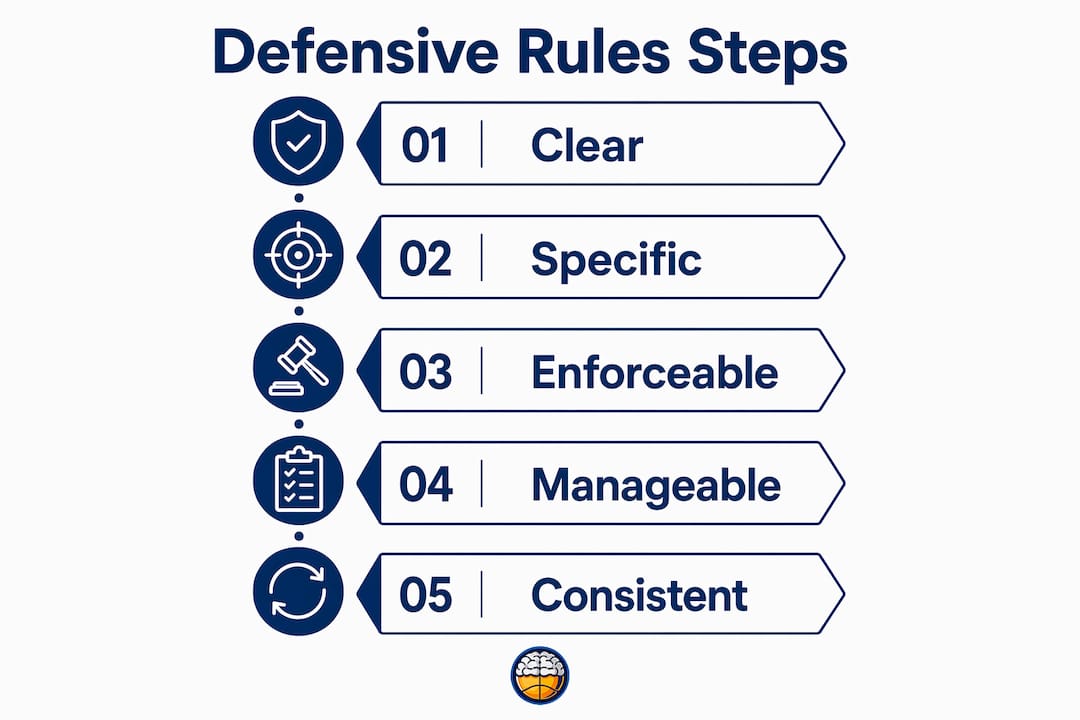
Here is a practical framework for building your defensive rule set:
| Rule quality | Weak example | Strong example |
|---|---|---|
| Specificity | “Guard your man” | “Stay between your man and the basket on ball” |
| Enforceability | “Help on defense” | “Help off ball on any drive to the paint” |
| Simplicity | “Be aware of cutters” | “See ball and man at all times” |
| Connection to purpose | “Don’t give up threes” | “Closeout short on shooters, contest without fouling” |
Keep your total number of rules manageable. Coaches who write 20 defensive rules end up with players who remember none of them. Aim for five to eight core rules that cover your most important defensive priorities. Each rule should connect directly back to one of the three core defensive purposes: preventing points, gaining possession, or creating offense from defense.
Consistent enforcement matters as much as the rules themselves. Clear shared defensive rules create a calmer environment that supports player confidence and accountability. When you enforce a rule in practice on Tuesday, players trust that the same standard applies on Friday night. Inconsistency destroys that trust faster than any opponent can.
Pro Tip: Build at least one drill per practice that specifically targets a defensive rule. If your rule is “help off ball on penetration,” run a 3-on-3 shell drill and stop play every time the rule is broken. Repetition in practice is the only way rules become automatic in games. You can find ready-to-use defensive drill frameworks to build these sessions faster.
How do defensive rules help teams execute under pressure?
Clear defensive rules reduce decision fatigue. Teams with clear defensive rules and philosophy perform more consistently and adapt faster during games. That consistency comes from one source: players who know the rule do not have to think. They act.
The benefits of defensive rules under game pressure include:
- Automatic execution. When a rule is drilled enough, it becomes a reflex. A player who has closed out under control 500 times in practice does not hesitate in a game.
- Split-second decision support. Rules answer the “what do I do?” question before it gets asked. A player who knows the rule on ball screen coverage does not freeze when the screen comes.
- Defensive chemistry. Shared rules build trust between teammates. When your help defender knows you will stay attached to your man, they can commit to the help. That trust is the foundation of defensive cohesion.
- Adaptability. Rules create a hierarchy of principles. When an opponent makes an adjustment, players know which rule takes priority. That clarity prevents panic.
- Mental toughness. Defensive cohesion takes significantly more time to develop than offensive skill, but teams that build a defensive identity are better equipped to grind out wins in high-stakes games.
The impact of defensive regulations on game performance is cumulative. One possession of clean execution builds into two, then ten, then a defensive identity that opponents have to prepare for. That identity starts with the rules you write and enforce every day in practice.
Key Takeaways
Defensive rules are the concrete behavioral standards that make a team’s defensive philosophy real, repeatable, and effective under pressure.
| Point | Details |
|---|---|
| Rules prevent chaos | Shared defensive standards reduce confusion and give every player clear expectations before each possession. |
| Philosophy comes first | Rules must sit within a hierarchy of mentality, strategy, and tactics to have lasting impact. |
| Specificity drives execution | Concrete rules like “close out under control” are enforceable; vague rules like “play hard” are not. |
| Limit your rule count | Five to eight core rules are more effective than twenty that players cannot remember under pressure. |
| Consistency builds identity | Enforcing the same rules in practice and games creates defensive cohesion and long-term team trust. |
What I’ve learned from coaches who skip this step
Coaches who skip writing defensive rules almost always say the same thing: “My players know what I expect.” They do not. Players know what you corrected last Tuesday. They do not know the full system unless you have written it down and referenced it constantly.
The most common mistake I see is treating defense as a reaction rather than a proactive system. Proactive rules enable calm execution; fear-based responses lead to chaos. A team that plays defense out of fear of getting scored on is always one bad possession away from falling apart. A team that plays defense from a set of shared rules has something to return to when things go wrong.
Writing the rules is only half the job. The other half is revisiting them. Post them. Say them before practice. Ask players to recite them. When a rule gets broken in a game, reference it by name in the film session. That repetition is what builds mental toughness and accountability. It also builds leadership. When your veteran players start correcting each other using the rule language, you have built something real.
Defensive rules should also evolve. A rule that works for a young team learning the basics may need to be refined as your roster matures. The best coaches treat their defensive rules as a living document, not a one-time assignment. Review them at the start of each season, adjust them based on your personnel, and make sure every player can explain them in their own words. That is how you build a defensive mentality that lasts.
— Dejan
Coaching resources to support your defensive system
Building a complete defensive system takes more than good intentions. You need organized tools that help you teach, track, and reinforce your rules every day.

Hoop Mentality’s Basketball Starter Pack for Coaches gives you ready-to-use practice plans, drill frameworks, and strategy guides built around real coaching experience. The resources are designed to help you move from writing defensive rules to actually teaching them, with clear structure your players can follow. If you want templates that support your full defensive philosophy, the Basketball Template Bundle covers practice planning, player communication, and system documentation in one place. Both resources save you time and give your defense the structure it needs to hold up when it matters.
FAQ
What are defensive rules in basketball?
Defensive rules are concrete behavioral standards that tell players exactly what to do on defense in specific situations. They translate a team’s defensive philosophy into repeatable, enforceable actions.
Why implement defense tactics before establishing rules?
You should not. Tactics without rules and mentality as a foundation collapse under game pressure. Coaches should establish mentality and written rules before layering in specific tactical schemes.
How many defensive rules should a team have?
Five to eight core rules is the practical target. More than that and players cannot recall them automatically during games, which defeats the purpose of having rules at all.
How do defensive rules reduce player stress?
Clear shared rules reduce stress by eliminating uncertainty. When players know exactly what is expected, they play with confidence instead of hesitation.
How often should coaches revisit defensive rules?
Review your defensive rules at the start of each season and after major opponent adjustments. Rules should evolve with your roster’s skill level and your team’s defensive identity.