

Man-to-man defense is a defensive system where each of your five players guards one opponent. That player is responsible for stopping that opponent from scoring, rebounding or receiving passes. Defenders also help teammates when a ball handler gets by. For a coach, it is the base defense to learn first, because it teaches every player the same fundamentals. Our Basketball Drills collection gives you ready-to-use practice material to build it.
TL;DR
- Man-to-man means one defender, one assigned opponent, plus help for teammates.
- Assignments are usually made by size, speed and role.
- Core habits: stance, ball-you-man positioning, denial, help, recovery and closing out.
- Strengths: clear accountability, pressure on passing lanes, and a defender for every box out.
- Weaknesses: physical demands, mismatches, and a need for disciplined help and talk.
- Teach it in small groups first, then build to five-on-five.
Table of Contents
- What man-to-man defense means
- How to make defensive assignments
- The core habits of good man-to-man
- Strengths of man-to-man defense
- Weaknesses and how to coach around them
- Man-to-man vs. zone
- How to teach man-to-man in practice
- Common mistakes to fix
- What to run with younger or newer teams
- Promo: build your defense with ready-made resources
- Our perspective
- FAQ
- Sources
What man-to-man defense means
Each defender gets a specific opposing player. The University of Georgia’s online basketball chapter describes it this way. It also says defenders must help a teammate when a ball handler beats that teammate.
That last part matters. Man-to-man is not five separate duels. It is a team defense built from five individual jobs.
Here is what each defender owns:
- Keep the assigned player from scoring.
- Keep that player from rebounding.
- Keep that player from receiving passes.
- Help a teammate who has been beaten.
The opposite approach is zone defense. In a zone, each defender covers an area of the floor instead of a person. We cover that contrast below.
How to make defensive assignments
Match players by size, speed and role. Your point guard usually guards the other team’s ball handler. Your biggest player usually guards their biggest. Wings match wings.
Start with these steps:
- List the opponent’s five players by position and skill.
- Note their best scorer and their best passer.
- Match your defenders by size and speed first.
- Put your best on-ball defender on the most dangerous scorer.
- Tell every player their assignment before the game, and again at each dead ball.
Scouting makes this faster. Our Basketball Templates collection has editable scouting templates, so you can record each opponent’s strengths and tendencies and build assignments from the page.
Assignments change in a game. Fouls, injuries and mismatches force switches. Players need to know who they guard next, not only who they guard first.
The core habits of good man-to-man
A system is only as good as the habits behind it. These are the ones to coach first.
Stance and ball pressure
The defender on the ball stays low, balanced and close enough to contest a shot. The goal is to slow the dribbler and force the offense to use clock. Pressure on the ball starts the whole chain. If the ball is pressured, passes are harder, and help defenders have time to move.
The ball-you-man triangle
Off the ball, a defender sees both the ball and the assigned player. Think of a triangle: ball, you, man. Whenever the ball or the offensive player moves, the triangle changes. Players adjust their position with it. Teach this as constant motion, not a spot on the floor.
Jump to the ball
When the ball is passed, every defender moves. The defender who guarded the passer drops toward the ball. The others shift their angles. Jumping to the ball on every pass keeps the team connected and makes help possible.
Denial
A defender one pass away from the ball can deny that pass. The defender takes a position that blocks the passing lane, with one hand and foot in it and eyes on both ball and player. Denial makes the offense work for the ball. The further the ball is from the basket, the more you can pressure.
Help and recovery
When a ball handler beats a defender, a teammate steps over to stop the drive. That is help. Once the threat is gone, the helper goes back to the original assignment. That is recovery. Help without recovery leaves shooters open.
Closing out
A close-out is how a helper returns to a shooter. The defender sprints most of the way, then shortens steps and gets a hand up, ready to stay in front of a drive. Poor close-outs turn good help into open threes. Practice them often.
These habits can be seen on film. If you record practice, a clip of off-ball movement shows whether the triangle is moving at the right time. This guide on filming and watching off-ball movement shows what to look for in the footage.
Strengths of man-to-man defense
The strengths are practical.
Accountability. Every player knows their job. If a player scores, you know who was responsible. That makes coaching feedback specific.
Pressure on passing lanes. A Red Bull guide to defense types notes that man-to-man can pressure passing lanes. Denial turns this into a team habit.
Better rebounding position. The same guide notes that each defender has an opponent to box out. In a zone, defenders can find no one near them when a shot goes up. In man-to-man, the assignment is clear.
Skill development. Every player has to learn stance, footwork, communication and effort. Those skills transfer to any defense you run later. This is why many coaches of young teams start here.
Weaknesses and how to coach around them
Every defense asks for something. Man-to-man asks for three things, and each one is something you can train.
Physical demand. Defenders move on every possession. Conditioning matters. Build it into practice instead of leaving it for after practice.
Mismatches. If your defender is slower or smaller than the opponent, that player can score. Coaches handle this with assignment changes, help rules and, at times, a different defense for a stretch.
Reliance on help and talk. The Red Bull guide points to disciplined help and communication as the defense’s demands. Teach calls early: “ball,” “help,” “screen,” “switch.” Make players say them in every drill.
These are demands, not flaws. A team that trains them has a defense with no hidden gaps.
Man-to-man vs. zone
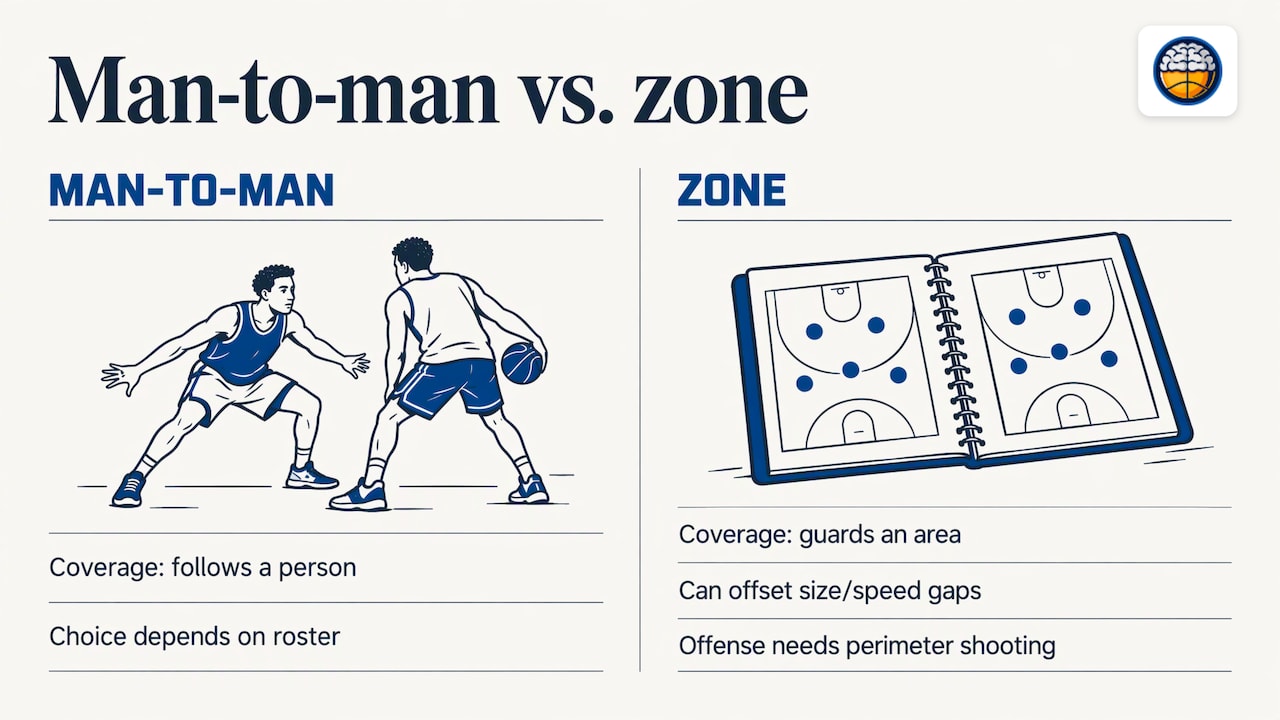
In man-to-man, a defender follows a person. In zone, a defender guards an area. The University of Georgia chapter says a zone can suit a team that cannot match up with opponents because of size or speed differences. It adds that zones put different demands on the offense, which has to shoot well from the perimeter and pass quickly.
So the choice is about your roster and your opponent. A coach can change defenses during a game. Many do.
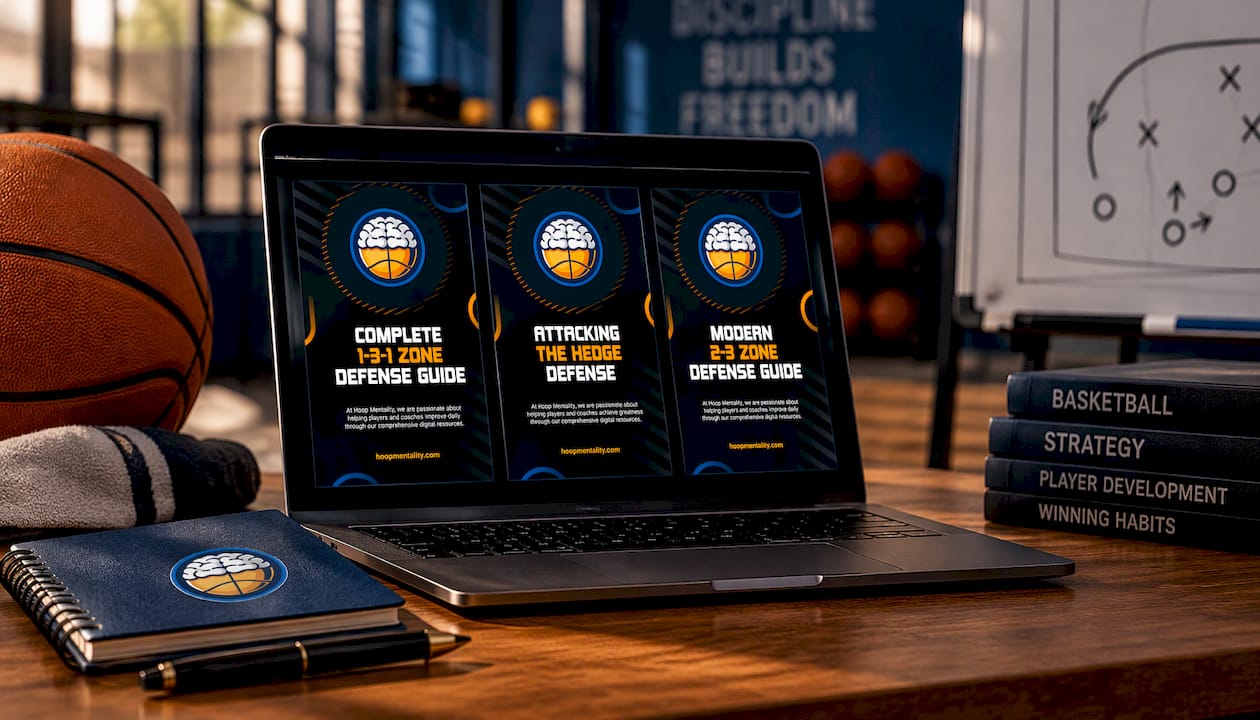
If you want a zone option beside your man-to-man, we offer the Modern 2-3 Zone Defense Guide and the Complete 1-3-1 Zone Defense Guide V2.0. For a hybrid, read our explanation of the matchup zone, which blends person and area coverage.
How to teach man-to-man in practice
Build the defense from small to large. Do not start with five-on-five.
Step 1: Individual footwork
Start with stance, slides and closing out. Players need these before any team drill works. Keep reps short and demand quality.
Step 2: Two-on-two and three-on-three
Small groups give each player many reps. Use them to teach denial, help and recovery. Add a screen once players understand help.
Step 3: Four-on-four shell drill
The shell drill is the standard tool. The Minneapolis Park and Recreation Board’s drill handout describes a four-on-four setup. It teaches ball pressure, denial and contest positioning, and defenders change roles as the ball is passed.
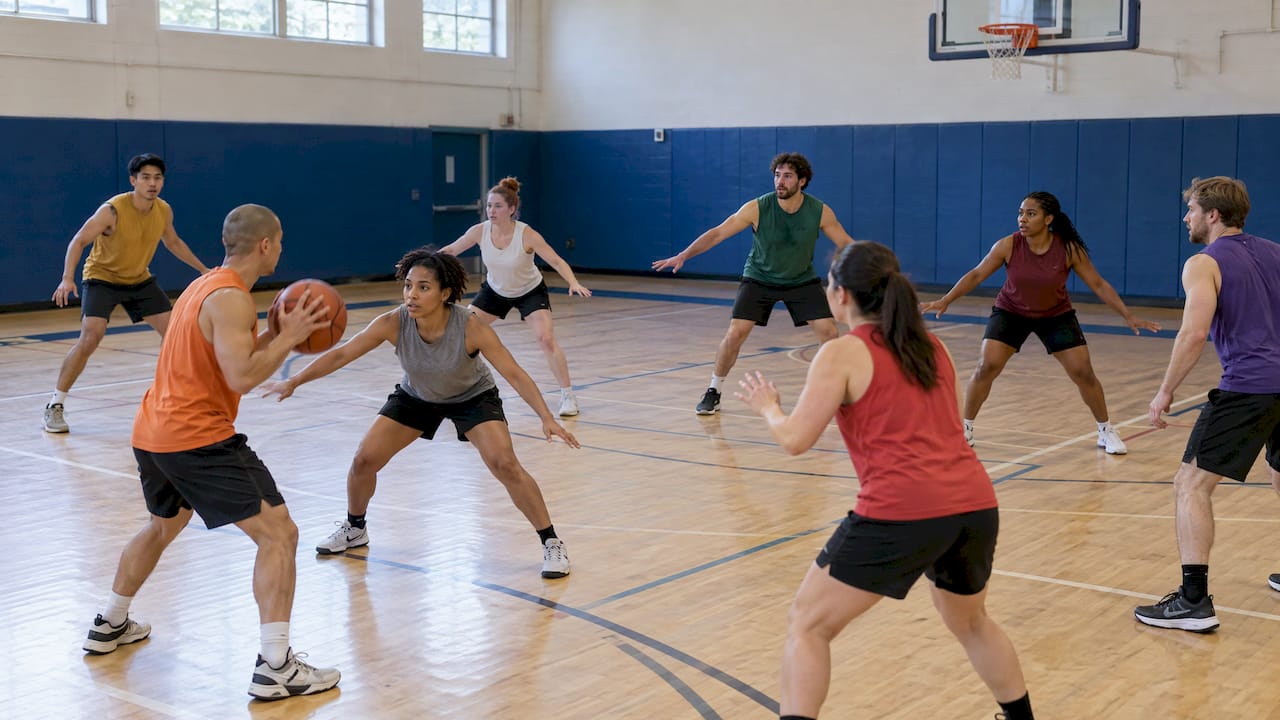
The offense passes, and the defense moves with each pass. Nobody shoots at first. The point is positioning. Later you can let the offense cut, drive and shoot.
Our article on the shell drill covers its goals, variations and the skills it teaches. See the key variations when you are ready to add screens and drives.
Step 4: Five-on-five live
Play live with rules. Award a point for a stop. Count deflections. Stop play when a player is out of position and show the fix right away.
Step 5: Review
Use film or a simple chart. Look at who got beat, who helped and who recovered. Share one or two points with the team, not ten.
A full practice plan keeps these steps in order. Our Basketball Playbooks and drills collections are written for coaches who need to organize practice time and move from one stage to the next.
Common mistakes to fix
- Ball watching. The defender looks only at the ball and loses the assigned player. Fix it with the triangle.
- Standing still after a pass. The defender waits. Fix it by requiring a jump on every pass.
- Late help. The helper arrives after the drive. Fix it by stating where help starts.
- No recovery. The helper stays near the ball. Fix it by naming the recovery in every drill.
- Silent defense. Players do not talk. Fix it with required calls.
What to run with younger or newer teams
Most young players benefit from learning man-to-man first. They learn to move their feet, find the ball and take responsibility for a player. Start with the habits above. Keep assignments simple, and keep your drills short. Add screens and switching only when players handle the basics.
Promo: build your defense with ready-made resources
You can plan a defensive season from scratch. You can also start from resources built from real coaching practice. Hoop Mentality sells downloadable PDFs and videos: playbooks, progressive drills, scouting templates, practice plans and strategy guides. Access is instant after payment.
For a defense-first practice plan, start with the Basketball Drills collection. Our Man to Man Defense Guide for Basketball Coaches 2026 goes deeper into the system.
Browse the Basketball Guides for more coaching systems.
Our perspective
Man-to-man works when every player knows the same rules. That is a teaching problem more than a talent problem.
We build our resources from real coaching practice, and they are designed to adapt to different teams. A coach with a clear drill progression, a scouting template and a practice plan spends less time guessing and more time coaching. Players hear the same words every day.
Our drills, playbooks and templates are made to work together. Teach the footwork. Layer in the shell. Scout the opponent. Assign matchups. Review the film. Each step feeds the next.
That is how a defense becomes a habit.
Dejan
FAQ
What is man-to-man defense in basketball?
It is a defense where each player guards one opponent. The defender tries to stop that player from scoring, rebounding or receiving the ball. Defenders also help teammates who get beaten.
How do you decide who guards whom?
Match by size, speed and role. Your best on-ball defender usually takes the best scorer. Adjust as fouls, injuries and mismatches change the game.
Is man-to-man better than zone?
Neither is better in every game. Man-to-man gives clear accountability and builds fundamentals. A zone can suit a team facing size or speed mismatches. Many coaches teach man-to-man first and add a zone as a second option.
What drill teaches man-to-man best?
The four-on-four shell drill is the standard. It teaches ball pressure, denial, help and recovery as the ball moves. Start without shooting, then add cuts and drives.
Sources
- University of Georgia, Basketball Strategies chapter
- Red Bull, 4 Types of Defense in Basketball Guide
- Minneapolis Park and Recreation Board, Basketball Drills handout