

TL;DR:
- Man-to-man defense assigns each player responsibility for guarding a specific opponent to prevent scoring and disrupt offensive flow. Consistent enforcement of core rules, proper positioning, communication, and drills build effective defensive habits that are crucial at all levels of basketball.
Man-to-man defense assigns each defender the responsibility of guarding a specific opponent throughout a possession. The goal is direct: prevent your assigned player from scoring, contest every shot, and disrupt the offensive flow. No zone coverage, no shared assignments. One defender, one offensive player, full accountability.
This is the foundation most coaches build everything else on. It demands communication, positioning, and effort from all five players simultaneously. One weak link breaks the whole structure. That’s what makes it both the most teachable and the most demanding defensive system in basketball.
Here’s what this guide covers:
- The core rules and principles every defender must follow
- Positioning and footwork techniques for on-ball and off-ball situations
- Strategic variations including full-court, half-court, and pack-line defense
- Drills and practice plans to build skills progressively
- Common coaching mistakes and how to fix them
- How to build a defensive identity through accountability and communication
What is the man to man defense guide every coach needs?
Man-to-man defense is the most direct defensive system in basketball. Each player guards one specific opponent, tracks their movement, and takes personal responsibility for stopping them. There is no zone to fall back on, no shared coverage to hide behind.
The core purpose is to reduce open shots and limit drives to the basket. When executed correctly, it forces the offense to work harder for every scoring opportunity. It also creates more turnover chances because defenders are close to their assignments and can jump passing lanes.
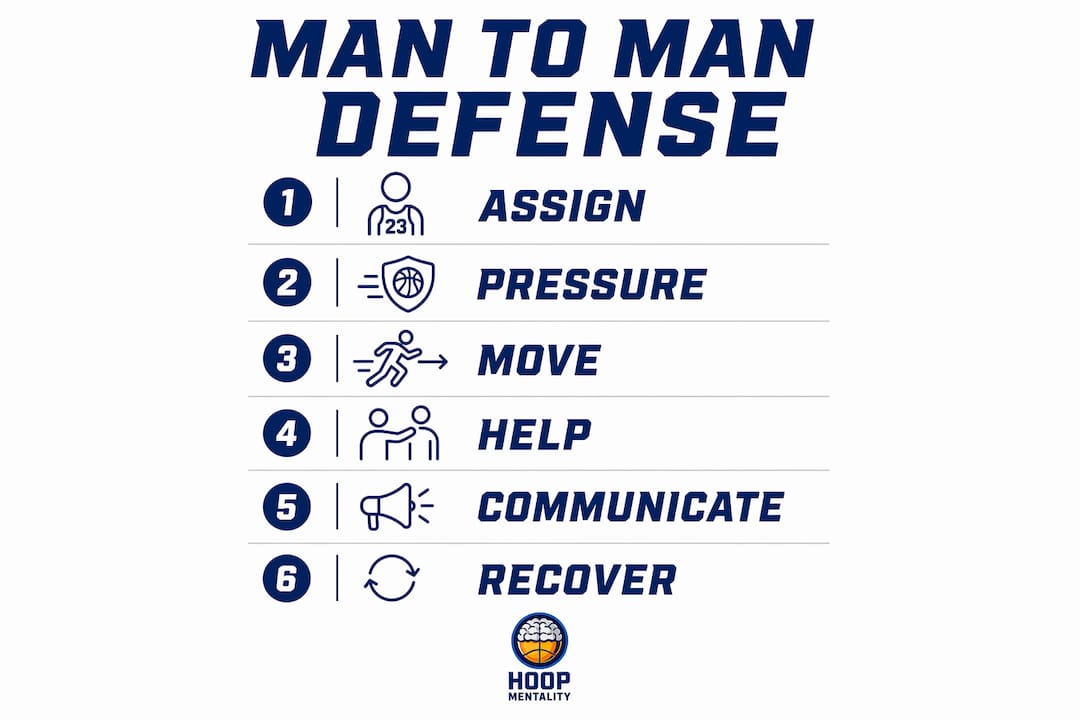
The benefits of man-to-man defense go beyond stopping points. It builds individual defensive habits, teaches players to compete one-on-one, and creates a culture of accountability. Every possession, every player has a job. That clarity is what makes it so effective at every level of the game.
What are the fundamental rules of man-to-man defense?
The rules of man-to-man defense are non-negotiable. Coach Jim Huber’s framework, built around 11 foundational bricks, gives coaches a clear checklist to hold players accountable every possession. These aren’t suggestions. They are standards.
Here are the core rules every defender must follow:
- No middle penetration. Force ball handlers to the sideline, not the lane.
- No face cuts. Deny direct cuts through the paint toward the ball.
- Move on the pass. Defenders must react before the catch, not after.
- Stay in your stance. All five defenders stay low and ready, not just the on-ball defender.
- Intense ball pressure. Make every dribble and pass difficult.
- No strangers. Know where every offensive player is at all times.
- Contest all shots. No open looks, no free releases.
- No second shots. Block out and secure the rebound every time.
These eight rules connect directly to Huber’s 11 bricks, which also include communication, transition defense, anticipation, help and recover, and the mindset of one play at a time. Each brick reinforces the others. Skip one and the defense develops holes.
In practice, apply these rules in every drill, not just scrimmages. When a player drops their stance during a shell drill, correct it immediately. When a defender fails to move on the pass, stop play and reset. Consistency in practice is what transfers to games.
Pro Tip: Post the 11 bricks on your practice facility wall. Before every defensive session, have players call out each brick together. It takes 30 seconds and builds the habit of thinking defensively before the drill even starts.
How do you teach proper defensive positioning and footwork?
Positioning and footwork are where man-to-man defense either holds or falls apart. Players can understand the rules conceptually and still give up easy baskets because their feet are wrong. Teach the physical mechanics first, then layer in the decision-making.
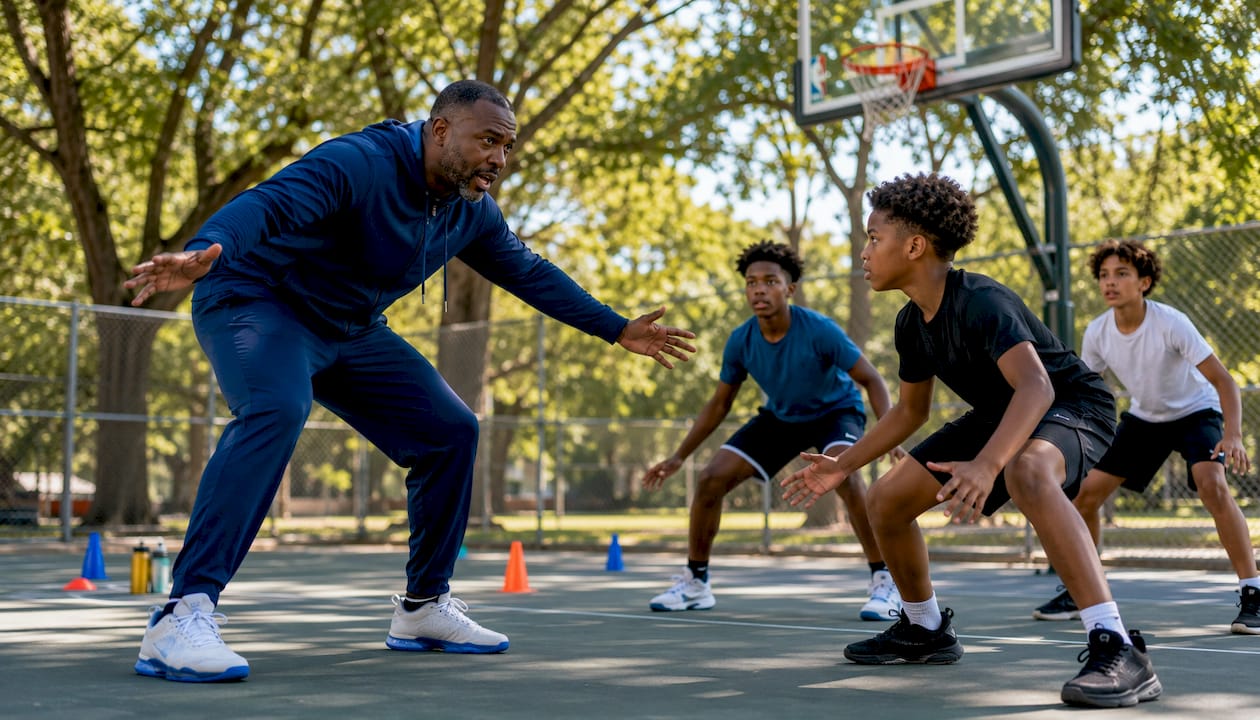
On-ball defensive stance
A proper defensive stance requires knees bent, back straight, arms active, and feet shoulder-width apart and ready to slide laterally. Weight stays on the balls of the feet, never the heels. This stance lets defenders react to direction changes without crossing their feet or losing balance.
Teach players to hold this stance for the entire possession, not just when the ball is live. Fatigue causes defenders to stand up. Standing up causes breakdowns.
Close-out technique
Close-outs are one of the most practiced and most misexecuted skills in man-to-man defense. The sequence is specific:
- Sprint toward the shooter on the pass.
- Chop your steps as you approach, shortening your stride to stay under control.
- Lower your body, weight back, butt down.
- Both hands high to contest the shot.
- Land with your top foot on the shooter’s top foot to cut off the drive.
Close-out drills develop foot speed, body control, and the discipline to finish the technique under pressure. Closing out too aggressively gives the offensive player a straight-line drive. Closing out too slowly gives them an open three. The chop-step is what creates the balance between the two.
Off-ball and help positioning
Off-ball defenders use two main positions depending on distance from the ball:
- One pass away: Play off the line, with your body between your player and the ball. Hand in the passing lane. Square to the player you’re guarding.
- Two passes away: Open stance, square to the area between the ball and your player. Be ready to help on a drive.
The help position is not passive. Defenders two passes away must be ready to step into the lane if a teammate gets beaten. After helping, they recover immediately to their assignment. This is the help-and-recover principle, Brick 8 in Huber’s framework.
Hand signals and non-verbal communication
Non-verbal cues keep the defense connected without giving away assignments to the offense. Common signals include:
- Pointing to your assigned player when you pick them up in transition.
- Open hand toward a teammate to signal you need help on a screen.
- Fist to signal a switch is coming on a ball screen.
- Verbal call of “ball” repeated loudly when you are the on-ball defender.
Teach these signals in practice before expecting them in games. Run drills where players cannot speak and must communicate only through signals. It forces them to stay aware of their teammates and builds the non-verbal vocabulary your defense needs.
What types of man-to-man defense strategies should coaches know?
Man-to-man defense is not one fixed system. Coaches can adjust the pressure, coverage depth, and switching rules based on the opponent’s strengths. The four main defensive strategy variations each serve a different purpose.
| Strategy | Court Area | Primary Goal | Best Used Against |
|---|---|---|---|
| Full-court man-to-man | Full court | Force turnovers, disrupt setup | Slow ball-handlers, weak passers |
| Half-court man-to-man | Half court | Conserve energy, apply individual pressure | Most offensive systems |
| Pack-line defense | Half court, near lane | Protect the paint, allow outside shots | Drive-heavy offenses |
| Switching man-to-man | Half court | Eliminate open shots off screens | Pick-and-roll heavy offenses |
Full-court man-to-man applies pressure from the moment the ball is inbounded. It’s physically demanding and works best in short bursts or against teams that struggle to advance the ball. The risk is foul trouble and defensive fatigue over a full game.
Half-court man-to-man is the baseline for most teams. Defenders pick up their assignments at half court and apply individual pressure within a defined area. It conserves energy while still holding players accountable for their matchups.
Pack-line defense keeps all five defenders close to the lane, creating a wall around the paint. Defenders play off their assignments slightly, daring the offense to shoot from outside. Hoop Mentality’s pack-line defense guide covers this system in full detail, including positioning rules and drill progressions.
Switching man-to-man requires all five players to be capable of guarding multiple positions. When a screen is set, defenders switch assignments rather than fighting through. It eliminates open shots off screens but can create size mismatches if not managed carefully.
What drills best teach man-to-man defense?
Drills build the habits that rules describe. The best man-to-man defense drills isolate one skill at a time, then combine them progressively until players can execute the full system under game pressure.
| Drill | Focus Area | Equipment | Key Objective |
|---|---|---|---|
| Close-out drill | Close-outs, foot speed | Ball, cones | Sprint, chop, contest without fouling |
| Shell drill | Positioning, help, rotations | Ball, 4 players | Reinforce all off-ball principles together |
| Transition defense drill | Sprint-back, communication | Ball, full court | Get all 5 back in under 4 seconds |
| 1-on-1 on-ball drill | Stance, footwork, ball pressure | Ball | Stay in front, force sideline |
| Post defense drill | Body position, denying entry | Ball, post player | Deny the entry pass, front or 3/4 |
Here is how to structure a progressive practice plan for man-to-man defense:
- Start with stance and footwork. Run defensive slide drills with no ball. Correct posture and foot position before adding any decision-making.
- Add the ball with 1-on-1 work. On-ball defense against a live dribbler. Focus on staying in front and forcing the sideline.
- Introduce close-outs. Coach or player passes to a wing, defender closes out using the sprint-chop-contest sequence.
- Run the shell drill. Four offensive players, four defenders, no dribble. Reinforce off-ball positioning, help, and communication on every pass.
- Add transition defense. Full-court drill where offense pushes in transition and defense must sprint back, communicate, and contain the ball handler.
- Scrimmage with rules. Live 5-on-5 with specific defensive rules enforced. Stop play when a rule is broken and correct it on the spot.
The shell drill is the most important drill in this progression. It reinforces close-outs, sprint-to-areas, proper help position, and communication all at once. Run it every practice until the movements are automatic.
Pro Tip: During the shell drill, require defenders to call out their position loudly: “Ball,” “Help,” or “Deny.” If a player goes silent, stop the drill. Silent defenders are lost defenders.
What coaching mistakes slow down man-to-man defense development?
Most man-to-man defense breakdowns trace back to coaching decisions, not player talent. The mistakes coaches make in teaching this system are predictable and fixable.
Common mistakes to watch for:
- Letting rules slide in practice. If you allow a defender to stand up in their stance during a drill, you are teaching them it’s acceptable. Rules must be enforced every repetition.
- Ignoring communication failures. A defender who doesn’t call out a screen or a switch is a liability. Treat communication lapses the same way you treat a missed assignment.
- Skipping the fundamentals stage. Coaches who jump straight to 5-on-5 before players understand stance, close-outs, and help positioning build a defense with no foundation.
- Failing to hold all five players accountable. Man-to-man defense requires all five players to execute simultaneously. Correcting only the player who gave up the basket misses the off-ball breakdowns that created the opening.
- Inconsistent feedback. Players need to know exactly what they did wrong and what the correct action looks like. Vague feedback like “play better defense” teaches nothing.
Addressing these mistakes requires a structured approach. Use Huber’s 11 bricks framework as your evaluation checklist. After each defensive possession in practice, identify which brick was violated. Name it specifically. Then correct it and run the possession again.
Player accountability also means tracking effort, not just technique. A defender who is in the right position but not contesting the shot is still failing. Hold players to both the physical standard and the effort standard every possession.
Pro Tip: Film your shell drills and review one clip per practice. Watching themselves on video is one of the fastest ways players internalize positioning errors. Keep the clip short, under two minutes, and focus on one specific correction.
How do accountability and communication build a defensive identity?
Defensive identity is not a talent issue. It’s a standards issue. Coach Jim Huber’s framework treats the 11 bricks as non-negotiables, meaning no exceptions, no possessions off. That standard, enforced consistently, is what separates teams with a real defensive identity from teams that just play defense sometimes.
Defensive intensity is a choice made by each player on every possession. One player who decides not to compete at full effort creates a gap the offense will find. This is why accountability cannot be selective. Every player, every possession, every brick.
Communication is the connective tissue of man-to-man defense. Teams with better verbal and non-verbal communication reduce defensive lapses and improve coordination on screens, rotations, and switches. Communication isn’t a soft skill in this system. It’s a technical requirement. Hoop Mentality’s guide on defensive talk in coaching breaks down exactly how to build this habit with your team.
“You need to emphasize it and hold your players accountable. You cannot let things slip. One play at a time. Every possession matters.” — Coach Jim Huber
The one-play-at-a-time mindset is the mental side of defensive identity. Players who dwell on a mistake or celebrate a stop too early lose focus on the next possession. Huber’s Brick 11 addresses this directly: every possession is a new opportunity to execute the system correctly. Coaches who reinforce this mindset build teams that compete for 32 or 40 minutes, not just when the game is close.
Pro Tip: After every defensive stop in practice, require all five players to call out one brick they executed well on that possession. It takes ten seconds and trains players to think about the system, not just react to the ball.
How do you adjust man-to-man defense against different offenses?
No offensive system looks the same, and man-to-man defense must adapt to what the offense presents. The adjustments are specific to the offensive threat, not general.
Against a pick-and-roll heavy offense, the two main options are switching and hedging. Switching keeps defenders attached to their assignments but can create mismatches. Hedging has the big defender step out to slow the ball handler while the guard recovers. The choice depends on your personnel. If your big can guard on the perimeter, switch. If not, hedge and recover.
Against a post-dominant offense, front the post or play 3/4 denial to cut off the entry pass. The on-ball defender must apply ball pressure to make the lob pass difficult. Off-ball defenders must be ready to help on the catch if the entry pass goes in.
Against a three-point shooting team, close-outs become the priority. Defenders cannot sag off shooters. Every close-out must be executed with the sprint-chop-contest sequence, and defenders must stay attached to their shooters on ball movement. Hoop Mentality’s defensive adjustment tips cover specific scenarios for adapting your coverage to different offensive threats.
Against a fast-break offense, transition defense is the adjustment. Huber’s framework sets a clear standard: all five defenders back, block to block, in under four seconds. The first three steps after a shot are the most important. Sprint first, communicate second, pick up assignments third. Teams that allow transition layups are not losing on defense. They are losing on effort.
Against a mismatch-seeking offense, teams that deliberately hunt favorable matchups through screening actions, your switching rules must be clear before the game. Decide which matchups you will protect and which you will accept. Communicate those rules to players before tip-off so there is no hesitation when a screen comes.
How do help defense and rotations work within man-to-man schemes?
Help defense is what keeps man-to-man from becoming five separate 1-on-1 battles. When one defender gets beaten, the system only holds if a teammate is already in position to help. That requires understanding where to be before the breakdown happens, not after.
The help position rule is straightforward. Defenders one pass away play off the line, body between their player and the ball, hand in the passing lane. Defenders two passes away open their stance and position themselves to see both the ball and their player. From this position, they can step into the lane the moment a teammate gets beaten on a drive.
Rotations follow a specific logic. When the help defender steps up to stop the drive, the next nearest defender must rotate to cover the player the helper just left. This chain reaction requires all five players to move simultaneously. If one player freezes, the rotation breaks and the offense gets an open shot.
The help-and-recover principle is Brick 8 for a reason. Helping is only half the job. After the help stop, the defender must sprint back to their assignment before the offense can swing the ball to them. A defender who helps and then stands in the lane has traded one problem for another.
Teach rotations in the shell drill before adding them to live play. Run the drill with a rule that the ball handler can drive at any time. Defenders must react to the drive, rotate correctly, and recover. Stop play after every rotation and confirm each player’s position before continuing. This is how rotations become automatic rather than reactive.
For coaches who want to expand beyond man-to-man, Hoop Mentality’s 2-3 zone defense guide and 1-3-1 zone defense guide provide complete systems for when a zone is the right call.
Key Takeaways
Man-to-man defense succeeds when all five players execute their individual responsibilities simultaneously, with consistent communication and effort on every possession.
| Point | Details |
|---|---|
| Individual accountability | Each defender is responsible for one opponent; one breakdown affects the whole defense. |
| 11 non-negotiable bricks | Coach Jim Huber’s framework sets clear standards coaches must enforce every possession. |
| Communication is technical | Verbal and non-verbal cues are required skills for managing screens, switches, and rotations. |
| Progressive drill structure | Build from stance and footwork to shell drills to live 5-on-5 before expecting game execution. |
| Adjustments are specific | Adapt coverage rules to the offensive threat: pick-and-roll, post play, shooting, or transition. |
FAQ
What is man-to-man defense in basketball?
Man-to-man defense assigns each defender the responsibility of guarding one specific offensive player throughout a possession. The goal is to prevent scoring by contesting shots, blocking passing lanes, and disrupting offensive flow.
What are the main types of man-to-man defense?
The four main types are full-court man-to-man, half-court man-to-man, pack-line defense, and switching man-to-man. Each variation adjusts court pressure and player roles to counter different offensive tactics.
How do you teach man-to-man defense to beginners?
Start with stance and footwork, then add 1-on-1 on-ball work, close-outs, and the shell drill before moving to live 5-on-5. Enforce the defensive rules every repetition so habits form correctly from the start.
Why is communication so important in man-to-man defense?
Communication helps players navigate screens, call switches, and coordinate help rotations. Teams that communicate consistently reduce defensive lapses and stay connected when the offense tries to create confusion.
What is the shell drill and why does it matter?
The shell drill uses four offensive players and four defenders with no dribble to reinforce off-ball positioning, close-outs, help defense, and communication all at once. It is the most effective single drill for building man-to-man defensive habits.