

Here are eight ready-to-use team objectives you can drop straight into your next practice plan: call and execute a high percentage of defensive switches within two seconds, complete a specific number of consecutive passes without a live-ball turnover in a half-court set, convert nearly one point per transition possession, secure several straight defensive rebounds before a play is considered “done,” communicate ball screens loudly enough for a teammate to react before contact, have multiple players verbally direct a play each game, aim for a strong percentage on catch-and-shoot mid-range attempts in practice reps, and reduce unforced turnovers by mid-season.
Pro Tip: Post one objective per practice on your whiteboard. Players internalize a single measurable target far faster than a paragraph of vague expectations.
These examples cover offense, defense, transition, rebounding, communication, and leadership. A youth team might simplify the rebounding target to “box out on every shot” without including the streak count, while a varsity or college group can chase the full numeric standard. The rest of this guide shows you how to write your own, adapt them by level, wire them into drills, and actually track whether they’re working.
Key Takeaways
Clear, measurable team objectives, tracked weekly and sequenced by season phase, are what separate a practice plan that develops players from one that just fills time.
| Point | Details |
|---|---|
| Write objectives as numbers | State what success looks like with a count, percentage, or time limit, not a vague feeling. |
| Adapt by level | Simplify targets for youth teams and add time or contact constraints for high school and adult teams. |
| Match drills to objectives | Every drill should train one specific objective with a constraint that forces the target behavior. |
| Track on a simple cadence | Log micro-metrics every practice, review communication and rebounding weekly, and check efficiency monthly. |
| Use Hoop Mentality templates | The Basketball Template Bundle and Starter Pack turn these objectives into plug-and-play weekly practice plans. |
Table of Contents
- Team Building Objectives Examples and Why They Beat Vague Goals
- How to Write SMART Team Objectives for Any Level
- Turning Objectives Into Drills and a Weekly Plan
- Simple Ways to Measure Team Objectives
- Sequencing Objectives Across a Season
- Coaching Habits That Make Objectives Stick
- Where Hoop Mentality Fits Into Your Practice Plan
- Sources
- FAQ
Team Building Objectives Examples and Why They Beat Vague Goals
“Get better on defense” is not an objective. It’s a wish. A real objective tells you what “better” looks like, by when, and how you’ll know you got there. That distinction is the entire difference between a practice plan that develops players and one that just fills two hours.
Coaching manuals treat this as foundational, not optional. The FIBA WABC Coaching Manual Level 3 frames season planning around defining where “there” is: a realistic timeframe, a clear vision, your team’s values, and measurable outcomes you can actually track. Without that definition, you’re coaching reactively, adjusting to whatever went wrong in the last game instead of building toward something specific.
A season plan that lacks a defined destination can’t be evaluated. You need a timeframe, a vision, stated values, and outcomes you can measure. Otherwise, “progress” is just a feeling, not a fact.
This is also where patience earns its keep. The USA Basketball LTAD guidebook is explicit that development should outrank short-term winning, especially with younger players, and that teamwork habits like “we over me” need to be required, not hoped for. Objectives written around habit formation and skill progress give you something to point to when a rough scoreboard night has parents or players questioning the plan.
How to Write SMART Team Objectives for Any Level
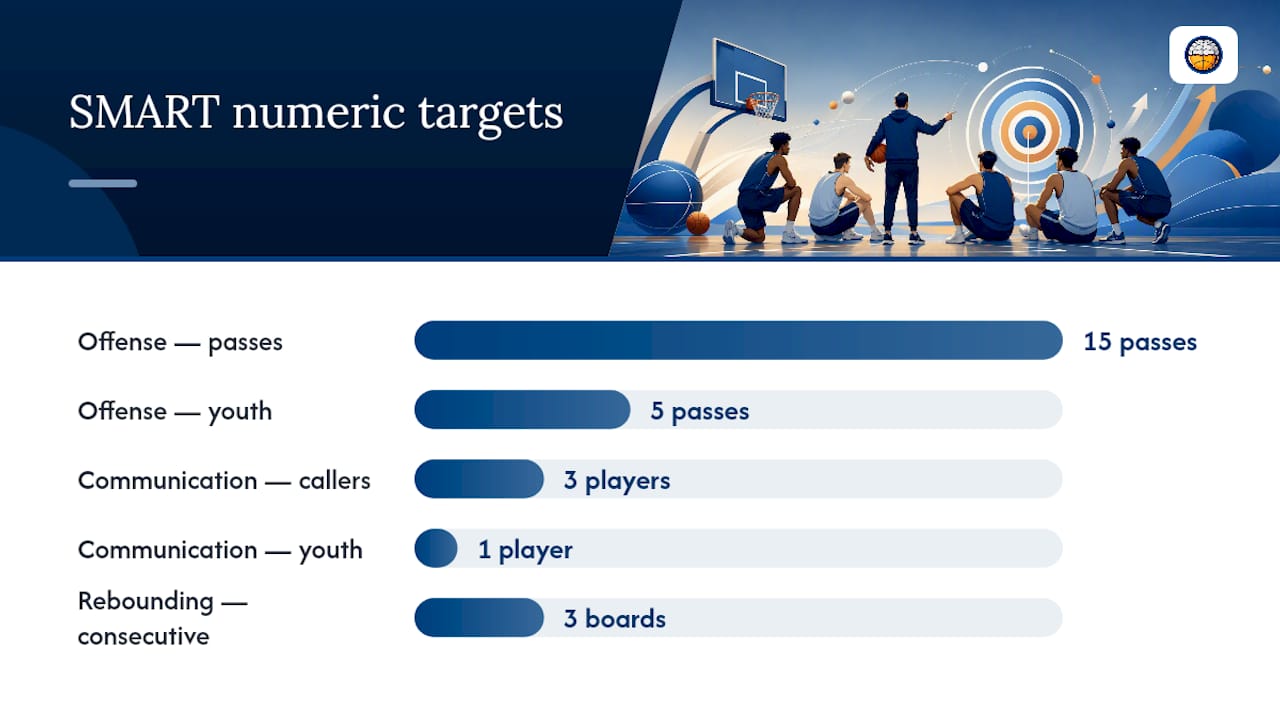
SMART turns a vague hope into something coachable: Specific names the exact behavior, Measurable attaches a number, Achievable keeps it realistic for the roster in front of you, Relevant ties it to what actually wins games at your level, and Time-bound gives it a deadline. “Improve rebounding” becomes “grab three consecutive defensive rebounds without conceding a putback, in four out of five scrimmage segments, by week three.” That’s a target a player can actually chase.
Here’s one example objective per coaching area, with level adaptations underneath:
-
Offense. Complete 15 straight passes in a half-court possession before shooting.
- Youth: Complete 5 passes, no dribble limit.
- High school/adult: Add a two-dribble cap per touch.
-
Defense. Execute 80% of on-ball screen switches within two seconds.
- Youth: Simply “call the screen” before switching; skip the time target.
- Adult: Add a “no blow-by” clause after the switch.
-
Transition. Score 0.9 points per possession off a defensive rebound within seven seconds.
- Youth: Just outlet and run, no scoring benchmark yet.
-
Rebounding. String three consecutive defensive boards before advancing the ball.
- This exact model comes from USA Basketball’s guidance on setting attainable practice finish lines.
-
Communication. Three or more players call out a screen or cut per possession.
- Youth: One verbal call per possession is a win.
- Leadership/culture. Rotate scrimmage captains weekly so four different players run a huddle by season’s end.
Checklist for converting any goal into a practice-ready objective:
- Does it name a specific action, not a feeling (“communicate” beats “be better”)?
- Can you count it during a live rep or scrimmage?
- Is the number realistic for this roster’s current skill floor?
- Does it map to a game situation you’ll actually see this season?
- Does it have a check-in date, not an open-ended “eventually”?
Turning Objectives Into Drills and a Weekly Plan
An objective without a drill is just a sentence on a whiteboard. Here’s how six of the objectives above map to actual practice work.
- Passing objective (15 straight passes): Run 4v4 shell drill with a “no dribble” constraint for five minutes. Cue: “Move on the pass, not the ball.”
- Switch objective (80% in two seconds): Use 2v2 ball-screen reps with a coach yelling “live” at random. Cue: “Talk before you touch.”
- Transition objective (0.9 PPP): Rebound and outlet drill, live defense sprinting back. Cue: “Outlet before your feet land.”
- Rebounding streak (three straight): Gap drill with three offensive rebounders crashing. Cue: “Find a body, hit a body.”
- Communication (three callers per possession): Scrimmage with a rule that a possession restarts if nobody calls the screen. Cue: “Silence costs you the play.”
- Leadership rotation: Assign a different “point captain” each water break to call the next set.
A simple three-session microcycle keeps this from feeling scattered. Monday is a skills day built around individual reps tied to shooting and ball handling objectives. Wednesday is a system day, heavy on the switch and passing drills tied to your offensive and defensive sets. Friday is game-prep day, where those same objectives get tested inside live scrimmage segments rather than isolated drills. This structure mirrors the standard progression in sample plans like the ones outlined at Huff Sports: warm-up, skill stations, shooting, defense, team strategy, scrimmage, cool down.
Progression follows three steps: introduce the skill in isolation, overload it with a constraint (fewer dribbles, a shot clock, a numbers disadvantage), then integrate it into a full scrimmage where it has to survive contact with real decision-making. The Basketball Coaching Level 2 handbook notes that manipulating simple constraints, like banning dribbling for a segment, is a low-cost way to force the exact behavior an objective demands.
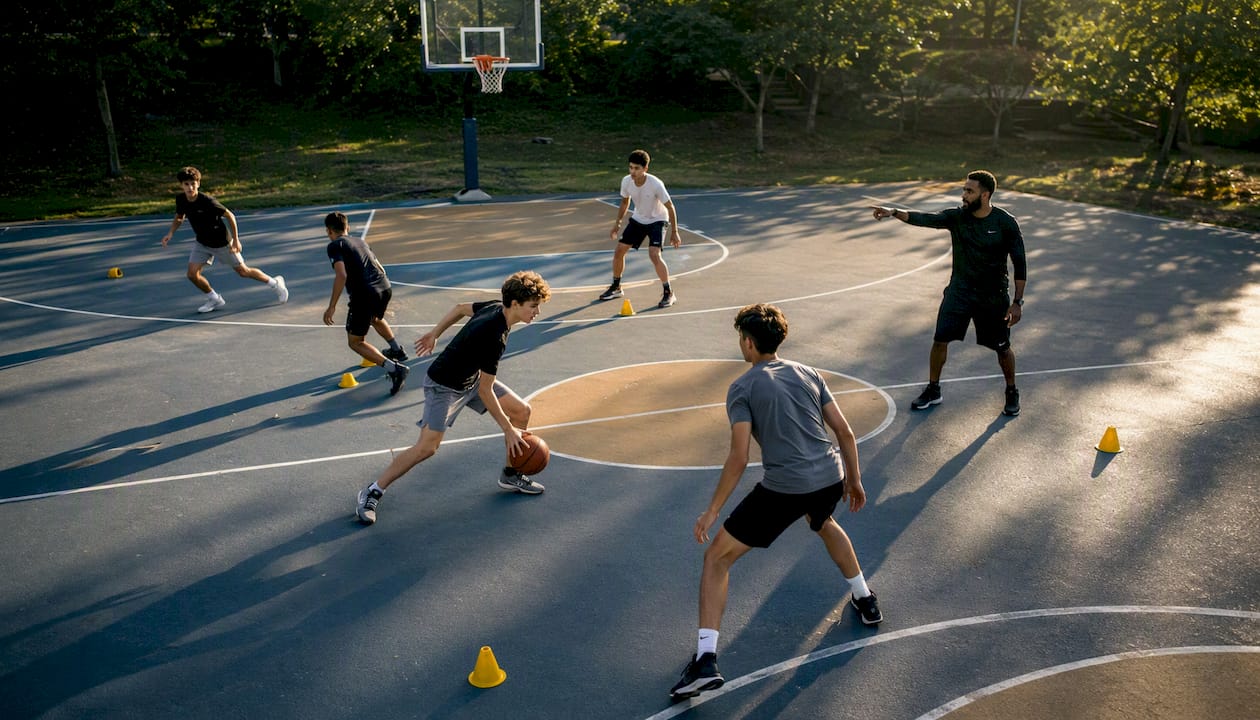
Pro Tip: If a drill doesn’t require a decision under pressure, it’s training a skill, not the objective. Add a defender, a shot clock, or a scoring consequence before you call it game-realistic.
Simple Ways to Measure Team Objectives
You don’t need analytics software to track most of these.
- Communication calls per defensive possession (tally during a scrimmage segment).
- Contested rebound percentage (boards where a defender made contact, divided by total defensive rebound chances).
- Transition points per possession (points scored within seven seconds of a defensive rebound).
- Turnovers per 20 possessions (a cleaner number than raw game turnovers, since it adjusts for pace).
Cadence matters as much as the metric itself. Track a micro-metric like passes-before-shot every single practice, since it takes thirty seconds to tally. Review communication and rebounding numbers weekly, comparing this week’s scrimmage tally to last week’s. Save transition efficiency and turnover rate for a monthly or phase-level review, since those numbers need more possessions to mean anything.
A basic tracking sheet needs five columns: objective, metric, baseline (where you started), target, and a weekly entry column. When a metric stalls for two straight weeks, that’s your signal to swap the drill, not the objective itself.
Sequencing Objectives Across a Season
Trying to fix everything in October is how coaches end up fixing nothing by February. Preseason should chase fundamentals and habit formation: passing discipline, footwork, basic rotations. The growth phase, typically mid-season, is where systems and conditioning take over: full defensive schemes, transition offense, situational subs. Peak or competition phase is about polish and reps under pressure: late-game execution, scouting-specific adjustments, free throw composure.
Break long-term ambitions into smaller measurable steps. A team that has to secure three rebounds in a row before advancing the ball learns the habit faster than one chasing an abstract “box out more” instruction all season.
A workable objective sequence might run: secure three defensive rebounds in a row, then outlet and run a fast break off that rebound, then convert that break into 0.9 points per transition possession by the competition phase. Limit yourself to two or three core objectives at a time, with one or two secondary ones in the background. More than that, and neither the players nor the practice plan can hold the focus. Swap a core objective out once it’s been consistently hit for two to three weeks straight.
Coaching Habits That Make Objectives Stick
The objective is only half the equation. How you reinforce it during the drill is what actually changes behavior. Use the same short cue every time (“talk before you touch,” “outlet before your feet land”) so players build a verbal trigger, not just a memory of a one-time correction.
- Give short corrective feedback immediately, not a lecture after the whistle.
- Remind players of their role before a rep, not just after a mistake.
- Celebrate small wins out loud (“that’s three straight boards, that’s the standard now”).
- Say “we” language after mistakes too: “we missed that rotation” beats singling out one player.
Multiple studies on team leadership, including the FIBA WABC manual’s guidance, point out that leadership works better distributed across several players rather than resting on one captain. Rotating who calls out communication objectives builds that habit directly. Role clarity has a measurable payoff too: teams that know exactly who’s handling the ball in a set turnover far less often than teams improvising on the fly.
A note from Dejan
Dejan has spent years building out practice plans and testing drill progressions with coaches who use Hoop Mentality resources on real teams, not just in theory. .
Where Hoop Mentality Fits Into Your Practice Plan
Writing the objective is the easy part. Turning it into a repeatable weekly structure without spending your Sunday night building spreadsheets is the part that actually burns coaches out. That’s the gap Hoop Mentality’s resources close.
If you’re just getting your system together, the Basketball Starter Pack For Coaches gives you ready-made practice blueprints you can adapt to the objectives above without building from a blank page. Coaches who already run a season but need better tracking lean on the Basketball Template Bundle For Coaches, which includes editable planning sheets you can drop straight into a weekly microcycle to log the metrics covered earlier. For the shooting-specific objectives, the Basketball Shooting Bundle For Coaches gives you drill progressions built around measurable shooting benchmarks instead of guesswork reps. And when your communication and transition objectives need to translate into an actual game plan, the Editable Scouting Report Template helps you tie opponent tendencies to the exact objectives your team has been drilling all week.
Pick the one resource that matches your biggest gap right now, download it, and plug it into next week’s practice plan.
Sources
- FIBA WABC Coaching Manual Level 3
- USA Basketball Player Development Curriculum
- Basketball coaching level 2 handbook
FAQ
What Makes a Good Team Building Objective in Basketball?
A good objective names a specific, countable behavior, like completing a set number of passes or defensive rotations, with a target number and a check-in date attached.
How Many Team Objectives Should a Coach Focus on at Once?
Stick to two or three core objectives at a time, with one or two secondary ones in the background, and swap one out once it’s been consistently hit for two to three weeks.
How Do You Adapt Objectives for Youth Teams?
Drop the numeric precision and time pressure for younger players. Focus on the core behavior itself, such as calling out a screen or boxing out, before adding counts or seconds.
What’s the Easiest Way to Track Team Objectives?
A five-column sheet with objective, metric, baseline, target, and weekly entries covers most needs. The Basketball Template Bundle For Coaches has this built in already.
How Often Should Objectives Change During a Season?
Shift core objectives at each phase transition, roughly preseason, growth, and peak, rather than changing them week to week, so players have time to build the habit before you move on.