

TL;DR:
- Pressing defense relies on synchronized reactions triggered by specific cues to create turnovers. Proper conditioning, communication, and spacing are essential prerequisites before implementation. Using staged drills from shadow play to live scrimmages enhances decision-making and reaction consistency.
A step by step pressing defense is a coordinated, trigger-based system where every player reacts to the same cue at the same moment to force turnovers and disrupt opponent rhythm. When coaches implement pressing defense correctly, it creates sustained pressure that compounds errors and shifts momentum. The system depends on three foundations: pressing triggers, defensive spacing, and collective timing. Without all three working together, the press breaks down fast. This guide gives you a sequential method to build the press from the ground up, covering prerequisites, drill progressions, tactical variations, and the most common mistakes coaches make when teaching defense principles to their teams.
What do you need before running a step by step pressing defense?
Pressing defense demands more from players than almost any other defensive system. Before you run a single pressing drill, your roster needs a physical and conceptual foundation.
Physical conditioning is the starting point. Fatigue reduces pressing effectiveness significantly after approximately 30 minutes of sustained pressing. That means your players must be fit enough to press in short, intense bursts and recover quickly between possessions. Conditioning sprints, defensive slides, and closeout repetitions should be part of every practice before you introduce pressing concepts.
Communication is the second prerequisite. Every player needs to know the same vocabulary: “ball,” “deny,” “help,” “trap,” and “release.” When players use different words for the same action, the press collapses into chaos. Establish your terminology in the first week and drill it verbally during every rep.
The third prerequisite is a shared understanding of defensive spacing. Players must know where to position relative to the ball, their opponent, and the basket at all times. Help defense and cover shadows, where a defender positions to block a passing lane without committing to the ball, are the building blocks of any press.
- Conditioning: Sprint intervals, defensive slides, and closeout drills at every practice
- Terminology: Standardize “trap,” “release,” “help,” and “ball” calls before pressing drills begin
- Spacing: Teach help-side positioning and passing lane denial as standalone skills first
- Shadow play: Run positioning exercises without opponents to automate movement patterns
- Pressing triggers: Identify your team’s specific cues before live reps begin
Pro Tip: Run shadow play drills at full speed for two weeks before introducing any live opposition. Players who can move to the right spot without thinking are ready to press. Players who still hesitate are not.
How do you execute pressing defense step by step in practice?
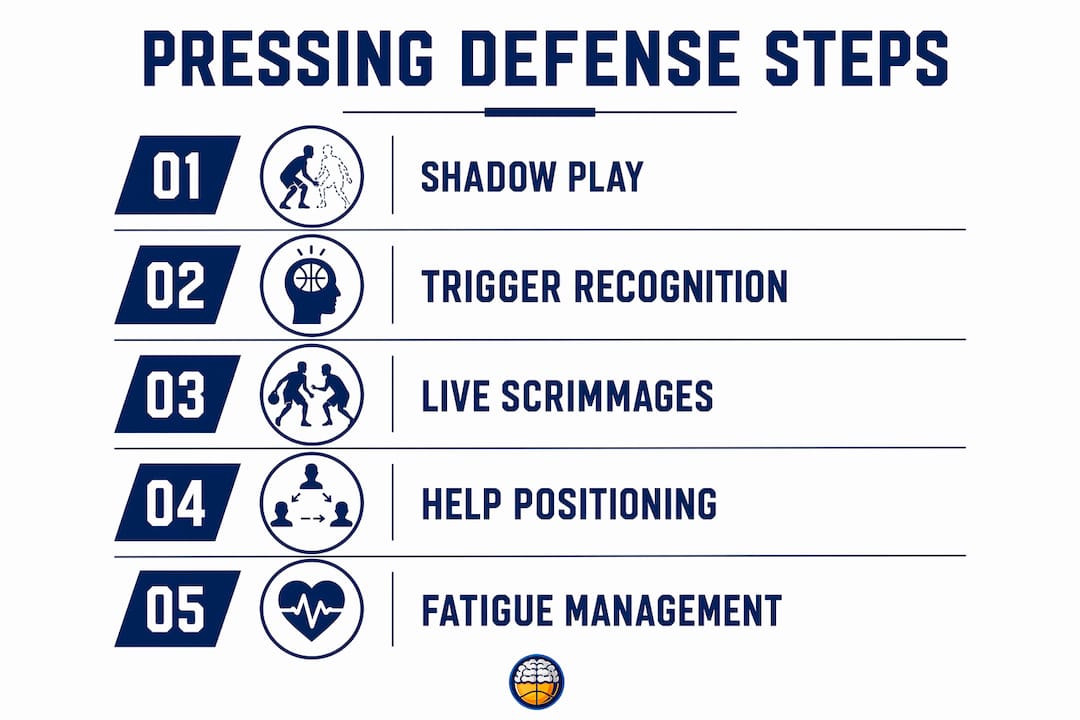
Progressive pressing implementation starts with shadow play drills and advances to small-sided games that emphasize pressing zones. This method automates reactions and builds decision-making under pressure. Use the following sequence.
-
Shadow play positioning. Run your press formation without opponents. Players move through their roles, hunters, helpers, blockers, and rest defenders, calling out their assignments as they go. Repeat until movement is automatic.
-
Introduce pressing triggers. Teach the four primary triggers: a poor ball reception, a backward pass, an opponent isolated near the sideline, and a player facing their own basket. Elite teams train at least 7 distinct pressing triggers to produce unified defensive reactions. Start with two or three and add more as players master the basics.
-
Small-sided trap drills. Use 3-on-2 or 4-on-3 drills in a half-court setting. The offensive group tries to escape the press. The defensive group applies pressure only on a trigger. This teaches patience. Players who press without a trigger create gaps.
-
Passing lane cutting. Drill the “helper” and “blocker” roles specifically. Helpers cut off the nearest escape pass at an angle. Blockers remove the second passing option. Geometry and blocking passing lanes create more effective pressure than sprinting at the ball carrier.
-
Rest defense assignment. One designated player stays behind the press at all times. A rest defender protects against direct long passes and prevents easy counter-attacks when the press breaks. Rotate this role so every player understands it.
-
Full-team scrimmage integration. Run your press in live 5-on-5 with a rule: the press activates only on a trigger. Coaches call “trigger” from the sideline when they see one, then let players react. Gradually remove the coaching prompt as players recognize triggers independently.
Pro Tip: Record your scrimmages and review one possession per practice where the press broke down. Players learn faster from watching their own mistakes than from verbal correction alone.
| Practice Stage | Focus | Duration |
|---|---|---|
| Shadow play | Positioning and role recognition | 2 weeks |
| Trigger drills | Identifying and reacting to cues | 1–2 weeks |
| Small-sided games | Trap execution and escape prevention | 2 weeks |
| Full-team scrimmage | Live integration with coaching prompts | Ongoing |
What pressing defense techniques work best for basketball teams?
The types of press defense available to coaches fall into two broad categories: man-to-man full-court press and zone press variants. Each has distinct strengths and fits different roster types.
Man-to-man full-court press
The man-to-man press assigns each defender a specific opponent across the full court. The hunter applies direct pressure on the ball handler. The other four defenders deny their opponents the ball while staying in position to help. This press works best with athletic, disciplined players who can stay in front of their opponent for extended possessions. The weakness is clear: one blown assignment opens a direct lane to the basket.
Zone press variants
Zone presses assign defenders to areas rather than players. The 1-2-1-1 diamond press funnels the ball handler toward a sideline trap, with two players waiting at the trap point and one blocking the outlet pass. The 2-2-1 press applies early pressure at half court and collapses into a trap near the three-point line. Zone presses are more forgiving of individual mistakes because help is built into the structure.
Trigger-based vs. continuous pressing
Trigger-based pressing activates only on a specific cue and resets to a standard defense otherwise. Continuous pressing applies pressure for the full possession. Trigger-based pressing is more sustainable. Counter-pressing focuses on a 5–8 second window after a turnover to reclaim possession, and pressing beyond that window risks defensive exposure. Continuous pressing drains players and creates fatigue gaps. Use trigger-based pressing as your default and reserve continuous pressing for short, high-stakes bursts.
- Man-to-man press: Best for athletic rosters; requires individual accountability
- 1-2-1-1 diamond press: Funnels ball to sideline traps; effective against poor ball handlers
- 2-2-1 press: Half-court pressure with built-in help structure; good for developing teams
- Trigger-based: Sustainable and disciplined; activates on cues only
- Continuous press: High-risk, high-reward; use in short bursts only
What are the most common pressing defense mistakes?
Most pressing failures trace back to one root cause: pressing without a trigger. Rushing to press without a trigger causes disorganized activity and creates high-risk spaces behind the defensive line. The fix is simple but requires patience: train your players to wait for the cue, every single time.
“Pressing is less about running hard and more about well-timed collective action and spatial control. Uncoordinated pressing does not create pressure. It creates open lanes.”
The second most common mistake is overcommitting the hunter. When the ball-side defender dives at the ball without help in place, the offense skips the pass and attacks the open side. Successful pressing requires balanced roles: hunters apply immediate pressure, helpers cover escape paths, blockers remove passing lanes, and rest defenders provide depth. All four roles must be filled before the press activates.
Poor spacing behind the press is the third failure point. When helpers crowd the trap instead of cutting off the next pass, the offense finds the third option easily. Teach your helpers to position at the midpoint between the trap and the next receiver, not at the trap itself.
Fatigue compounds every other mistake. Players who are tired press at the wrong angle, miss their trigger cues, and fail to recover to rest defense. Manage pressing intensity by rotating your press in and out of possessions rather than running it for full quarters.
Pro Tip: Assign a “press captain” on the court, usually your point guard, who calls the press on and off based on what they see. This teaches players to read the game and reduces coach-dependent decision-making.
Key Takeaways
A pressing defense succeeds only when every player reacts to the same trigger at the same moment, with clear roles, proper spacing, and a rest defender always in place.
| Point | Details |
|---|---|
| Build prerequisites first | Condition players and standardize terminology before running any pressing drill. |
| Use pressing triggers | Activate the press only on a specific cue to prevent gaps and disorganized pressure. |
| Assign four clear roles | Hunters, helpers, blockers, and rest defenders must all be filled before the press starts. |
| Progress through stages | Move from shadow play to small-sided games to full scrimmages before live game use. |
| Manage fatigue actively | Rotate the press in and out of possessions to maintain intensity and prevent breakdowns. |
Why geometry beats effort every time in pressing defense
Coaches often sell the press to players as a hustle play. Work harder, run faster, and you will force turnovers. That framing is wrong, and it costs teams more than it earns.
The press I respect most is the one that barely looks like effort from the sideline. Players are in the right spots, the trap forms without a sprint, and the ball handler has nowhere to go. That is geometry, not athleticism. Elite pressing teams design specific triggers pre-match based on opponent weaknesses and likely passing options. The best coaches I have watched do the same thing in basketball. They study the opponent’s ball handlers, find the weak side, and set the trap before the game starts.
The hardest part of coaching the press is convincing players to wait. Every instinct says attack the ball. But a press that fires a half-second early is a press that loses. Patience is the actual skill. Compactness and coordinated cover shadows prevent easy penetration far more reliably than raw aggression. Teach your players to trust the system, and the turnovers will come.
— Dejan
Hoop Mentality resources for building your press
Implementing a pressing defense takes structured practice plans, clear drill progressions, and ready-made templates that save you time on the whiteboard.

Hoop Mentality’s Basketball Starter Pack for Coaches includes drill templates, practice plans, and defensive strategy guides built for coaches at every level. If you want to analyze the opposing offense before you set your press, the scouting report template gives you a structured format to identify ball handler tendencies and weak-side passing habits. Both resources are ready to use from day one, so you spend less time preparing and more time coaching.
FAQ
What is a pressing defense in basketball?
A pressing defense is a coordinated system where defenders apply pressure on the ball handler and deny passing lanes across the full court or half court. The goal is to force turnovers through timing, spacing, and collective pressure rather than individual effort.
When should you activate a pressing defense?
Activate the press only on a defined trigger, such as a poor ball reception, a backward pass, or an opponent isolated near the sideline. Pressing without a trigger creates defensive gaps and exposes the basket to counter-attacks.
How long does it take to teach pressing defense?
Most teams need four to six weeks of progressive drilling, starting with shadow play and advancing to full scrimmages, before the press runs reliably in games. Rushing the timeline produces disorganized pressing that hurts more than it helps.
What is rest defense in a pressing system?
Rest defense is a designated player who stays behind the press to protect against long passes and counter-attacks. Without a rest defender, a single skip pass breaks the entire press and creates an easy scoring opportunity.
What is the best press for a young or developing team?
The 2-2-1 zone press is the best starting point for developing teams. Its built-in help structure covers individual mistakes, and it teaches spatial awareness and trap timing without requiring elite one-on-one defense.