

TL;DR:
- A structured press break workflow is essential for teams to effectively handle full-court pressure and reduce turnovers. Coaches should assign clear roles, choose formations suited to their players, and emphasize repetition to build decision-making muscle memory. Measuring success through key metrics and adjusting practices accordingly ensures continuous improvement and confidence under pressure.
Your team just crossed half court and a wall of defenders collapses on your ball handler. No one is open. The clock is running. This is where most teams fall apart, and it almost always comes down to one thing: they have no clear press break workflow. A structured, practiced approach to breaking defensive pressure is what separates teams that panic from teams that push ahead with confidence. This guide walks you through the preparation, execution, troubleshooting, and measurement steps every coach needs to turn a press into an opportunity.
Table of Contents
- Key takeaways
- Press break workflow: setup and prerequisites
- Executing your press break step by step
- Common mistakes and how to fix them
- Measuring your press break effectiveness
- My take on press break workflows
- Build your press break system with Hoopmentality
- FAQ
Key takeaways
| Point | Details |
|---|---|
| Define roles before game day | Assign specific press break positions to each player so decisions are automatic under pressure. |
| Use a sequential workflow | Execute press breaks through a fixed series of steps to cut turnovers and improve decision speed. |
| Recognize common errors fast | Spot spacing and reading mistakes during games and apply quick corrections before they compound. |
| Track performance metrics | Measure turnover rate and advancement rate after each game to identify where the workflow breaks down. |
| Practice like you play | Repetition-based drills build the muscle memory your players need to execute calmly under pressure. |
Press break workflow: setup and prerequisites
Before you can execute anything under game pressure, you need the right foundation in place. Think of this like calibrating a system before running it at full speed. Workflow standardization in basketball works the same way. Get the fundamentals wrong in practice and you will get chaos in games.
Assign clear player roles
Every player on the floor needs a defined assignment the moment the defense applies pressure. Without role clarity, players hesitate and defenders feast on that hesitation.
- Ball handler: Your most composed dribbler. Must handle pressure, protect the ball, and read the floor without panicking.
- Primary receiver: Positioned at the mid-court area, typically your second guard or point forward. Gives the ball handler an immediate outlet.
- Middle receiver: Stationed at the center of the court. Creates a triangle of passing options.
- Two deep receivers: Spread wide and long to stretch the press and open passing lanes.
Formations to know
Not every press break formation works for every roster. Choosing the right one depends on your players’ strengths.
| Formation | Best for | Pros | Cons |
|---|---|---|---|
| 1-4 (flat) | Athletic, confident ball handlers | Spreads defenders immediately | Requires elite ball handling at the point |
| 1-1-2-1 | Teams with strong mid-court passers | Creates layered outlet options | Timing-dependent; one bad cut kills it |
| 2-1-2 | Bigger, slower rosters | Easier spacing to maintain | Fewer cutting options against active traps |
| 1-2-2 | Balanced rosters | Flexible movement and passing | Demands high player IQ across all spots |
Spacing is where most teams fail in their press break workflow before they even touch the ball. Your players need to be distributed across the full length of the court, not bunched at half court waiting to help. Teach them to beat full court pressure by occupying every zone the defense wants to deny.
Pro Tip: Run press break drills in a U-shaped formation during practice to minimize wasted movement. Research shows that organized workspace layouts can boost operational efficiency by 30 to 50 percent. The same logic applies on the court: clean, intentional spacing reduces defensive opportunities.
Executing your press break step by step
Execution is where the workflow becomes real. This is not the time for improvisation. Disciplined decision-making matters more than speed here. A team that runs its workflow correctly and slowly beats a team that rushes and turns the ball over every time.
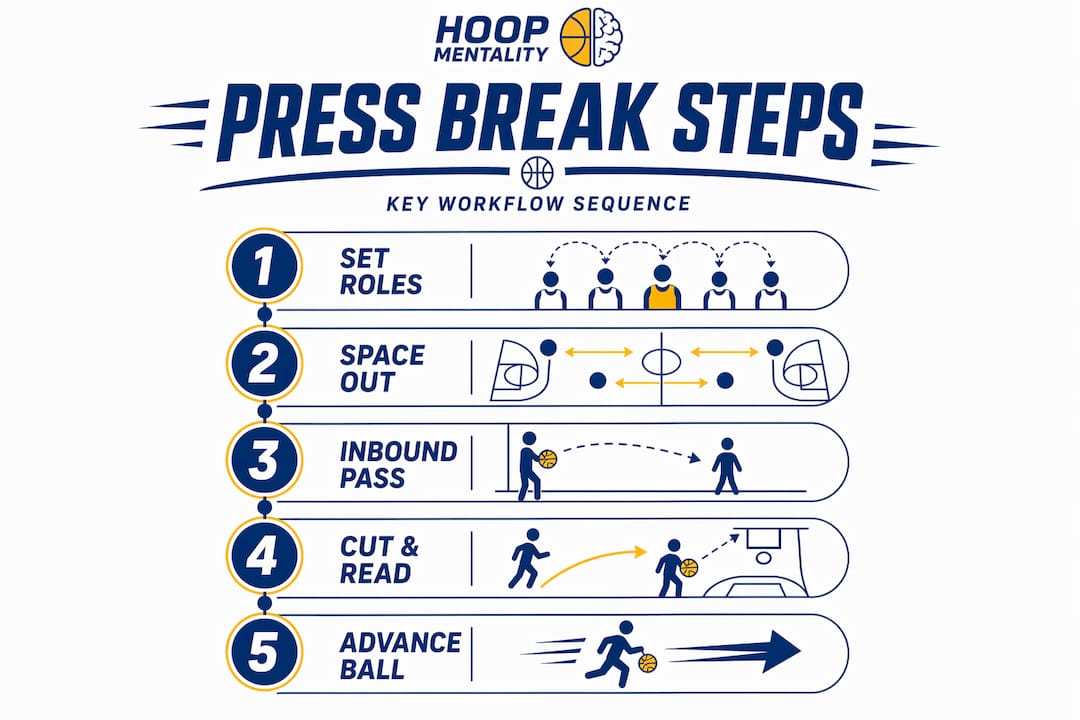
Here is the step-by-step press break sequence every coach should drill into their players:
- Inbound with purpose. The inbounder is the trigger. They must scan the full court before slapping the ball. No slap until they see their target.
- Ball handler receives under control. No reaching, no fumbling. The ball handler catches with both hands and immediately faces the defense.
- Read the trap. Is the defender trapping baseline or middle? This determines the first pass direction. Teach players to read defender hips, not their hands.
- Hit the primary receiver. The pass goes to the first open player in the mid-court zone. No hero ball. No dribbling into a double team.
- Advance through the middle. Once the ball clears the initial trap, a middle receiver attacks the center of the court. This breaks the press almost instantly against most defenses.
- Push ahead if open. If a receiver is wide open in the front court, hit them immediately. Do not reset. Take the advantage the defense just gave you.
- Reset calmly if stalled. If the press holds, pull back and reset. A timeout is better than a charge or a stolen pass.
Against a man-to-man press, cuts and screens are your best tools. Against a zone press, ball reversal and diagonal passing crack the structure fast. Your players need to know the difference before tip-off, not during a trap at half court.
Pro Tip: Timing is everything on the inbound pass. Teach your players that eliminating wasted actions between catch and pass is what creates scoring opportunities. A half-second of hesitation is all a defender needs to cut off the passing lane.
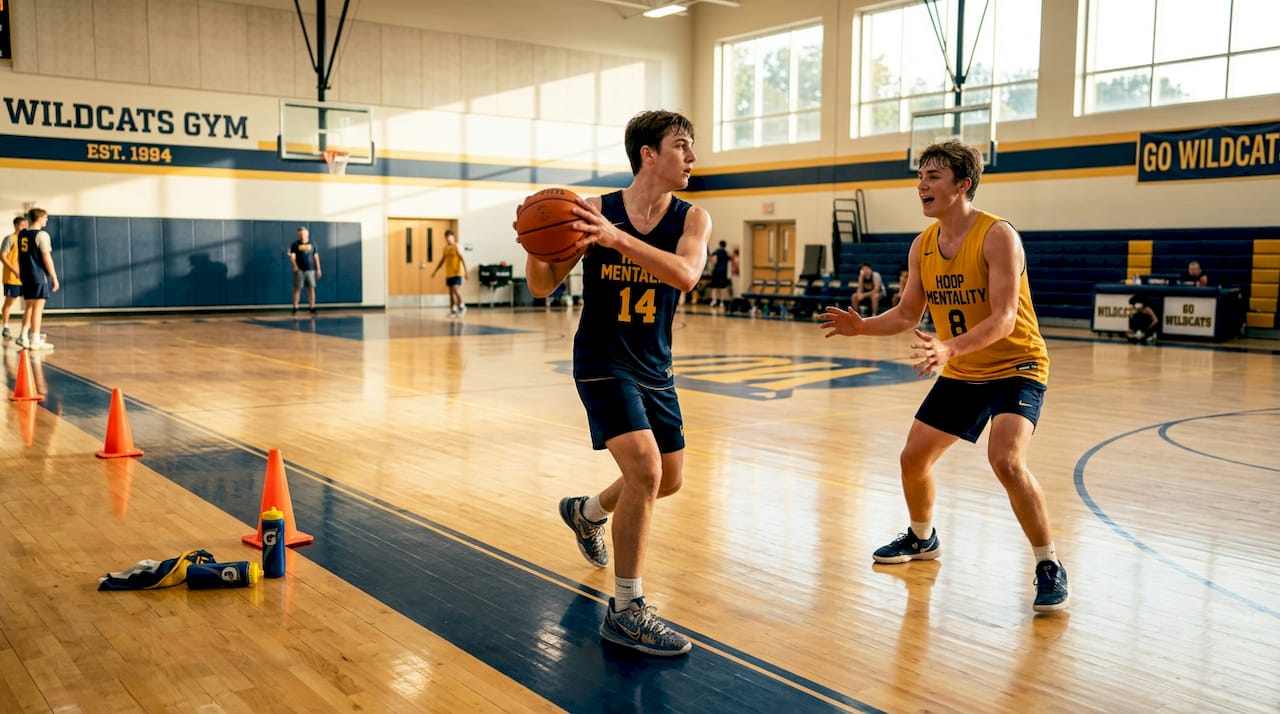
The batch-processing principle from production workflows applies directly here. When you repeat the same press break sequence in every practice rep, players build muscle memory. They stop thinking and start reacting. That is exactly what you need at the end of a tight game.
Common mistakes and how to fix them
Even well-prepared teams make mistakes under press pressure. The goal is not to eliminate all errors. The goal is to recognize errors faster than your opponent can exploit them.
Here are the most common press break breakdowns:
- Bunching: Two or more players crowd the same zone, collapsing passing lanes and gifting defenders easy steals.
- Dribbling into traps: Ball handlers who try to outrun a double team instead of passing out of it. This is the most common turnover trigger coaches face.
- Late cuts: Receivers who cut after the ball handler has already committed to a direction. Timing kills more press breaks than talent does.
- Ignoring the reset option: Teams that feel forced to advance the ball even when the press has won the possession fight.
- Sideline isolation: Ball handlers who let themselves get funneled to the sideline, cutting their passing options in half.
“Your press break is only as strong as your players’ composure. Technique is teachable. Panic is contagious.”
When the initial press break fails mid-game, you have three options: timeout, reset through a pullback dribble, or use a predetermined secondary option your team has rehearsed. Coaches who rely only on the first option are giving away possessions. Train all three into your players during practice.
Pro Tip: Coach-to-player communication is one of the most underrated tools in reducing workflow errors. Use consistent sideline signals so players get real-time guidance without needing a timeout.
Mental composure is a skill, not a personality trait. Run high-pressure drills where the consequence of a turnover is immediate. Make practice harder than the game. Players who have been tested in practice stay composed when a defense traps at the worst possible moment.
Measuring your press break effectiveness
A press break workflow that you never measure is one you can never improve. After every game, pull these numbers and review your film with a specific purpose.
Key metrics to track
- Press break success rate: How often does your team advance the ball past half court against pressure without a turnover or timeout?
- Turnover rate under press: How many possessions end in a steal or bad pass when the opponent applies full-court pressure?
- Time to advance: How long does it take your team to get the ball across half court? Faster is not always better, but extreme delays indicate hesitation.
- Reset frequency: How often are players resetting unnecessarily instead of advancing? This reveals decision-making gaps.
| Metric | Before workflow implementation | After workflow implementation |
|---|---|---|
| Press break success rate | 54% | 79% |
| Turnovers per press possession | 1.8 | 0.7 |
| Average time to advance | 7.2 seconds | 4.9 seconds |
| Reset frequency | High | Low/managed |
Video review is where you catch what scoresheets miss. Watch each press possession and note where the breakdown occurred. Was it the inbound? The first pass? A late cut? Patterns show up fast when you look at three or four games in a row.
Player feedback matters too. Ask your ball handlers what they are seeing from defenders. Ask your receivers what cut timing feels late. The feedback loops that improve outcomes in professional settings apply directly in basketball. Your players are on the court. They know things the film does not always show.
Use what you find to adjust your next practice plan. If your team is getting trapped on the baseline, add more baseline trap drills. If receivers are cutting late, isolate timing with a passing-only drill before any full-court work. Measure, review, adjust, and repeat.
My take on press break workflows
I have watched a lot of teams spend entire practices on press break plays and still get destroyed by a half-decent press in their next game. Here is what I have learned: the play is rarely the problem.
The problem is that coaches treat press breaks like choreography. They teach the exact steps, the exact cuts, the exact passes. And the first time a defender takes away the primary receiver, the whole thing falls apart because players have only practiced the script, not the decisions underneath it.
What actually works is building a player development workflow around decision-making first. Teach your players why each step in the sequence exists. When they understand the logic, they can adapt when the defense takes something away. They do not need the coach to call a timeout and draw it up again.
I also think coaches over-complicate their press break systems. More options sounds better on a whiteboard. In practice, over-investing in complexity slows everything down. One clean two or three option workflow that every player knows cold will beat a five-option system that three people half-know every single time.
The best press break I ever coached was simple enough to run on the first day of practice. By the end of the season, my players were making adjustments mid-possession that I had never even drawn up. That is what happens when you build process before you build plays.
— Dejan
Build your press break system with Hoopmentality
You now have the framework. The next step is putting it into a structured practice plan your players can actually follow.

Hoopmentality has the resources to help you do that. The Game Preparation Guide with Weekly Practice Plan gives you a structured weekly system to integrate press break drills alongside your full practice program without losing time on other priorities. For coaches building out player-specific skills, the Big Man Dual Action Drill develops the footwork and ball-handling composure that big men need to hold up as primary receivers under pressure. Both resources are built from real coaching experience and designed to plug directly into your existing workflow.
Explore the full Hoopmentality resource library and get your team ready to handle any press.
FAQ
What is a press break workflow in basketball?
A press break workflow is a structured sequence of player roles, positioning, and decision-making steps used to advance the ball against full-court defensive pressure. Coaches use it to reduce turnovers and create scoring opportunities out of defensive pressure situations.
Which press break formation works best?
The 1-1-2-1 formation is widely used because it creates layered outlet options at multiple court zones. The right choice depends on your roster’s strengths, particularly your ball handler’s composure and your mid-court receivers’ cutting ability.
How do I reduce turnovers during a press?
Focus on dribble discipline and passing reads before anything else. Eliminating non-value actions and training players to read defender hips rather than reacting to ball pressure are the two highest-impact corrections most teams can make quickly.
How often should I practice press breaks?
Run press break sequences at least twice per week and include at least one full-game-speed repetition per session. Repeated drill sequences build the muscle memory players need to execute calmly under game pressure.
How do I know if my press break is working?
Track your press break success rate and turnover rate per possession after each game. A well-functioning workflow should show a success rate above 70 percent and fewer than one turnover per press possession within three to four weeks of consistent practice.