

Use the editable Hoop Mentality Basketball Practice Plan Template to map any 60 to 90 minute practice in under five minutes. It’s a ready-to-use sheet built for basketball coaches, not a generic scheduling grid. The template gives you every field a practice plan needs, already formatted and ready to fill in.
Here’s what’s inside:
- Session date and total practice time
- Phase name (warm-up, skill work, scrimmage, cool-down)
- Start and end time for each block
- Drill name, objective, and reps or duration
- Equipment needed
- Coach notes field
- Player assignments
- Evaluation checkbox for tracking progress
Pro Tip: Print the court diagram alongside your plan so you can sketch spacing and rotations right next to the drill you’re running, instead of flipping between two separate documents.
The template comes in three formats: an editable spreadsheet, a printable PDF, and a printable court diagram. Grab whichever format matches how you actually run your bench, then customize it once and reuse it all season.
Key Takeaways
A basketball practice runs tighter when the plan enforces a clear theme, exact time-blocks, and a scripted transition between phases rather than relying on drill quality alone.
| Point | Details |
|---|---|
| One theme per session | Pick a single objective like closeouts or finishing to keep drills focused instead of scattered. |
| First minute is critical | Start each phase with one instruction and a demonstration; save logistics for the gaps between blocks. |
| Match phase length to age | Use 30 to 45 minute total sessions for mini ages, up to 90 minutes for competitive squads. |
| Rotate stations every 4 minutes | Reserve at least one basket for finishing and use floor stations for ball-handling and passing. |
| Use a ready-made template | Hoop Mentality’s editable practice plan template and court diagram bundle cover all the fields above without setup time. |
Table of Contents
- What Goes in Each Field of a Practice Plan Template
- 60, 75, and 90 Minute Practice Plans You Can Copy Today
- How to Customize the Template for Your Roster and Gym
- Running Drills So the Clock Never Beats You
- Warming Up and Cooling Down the Right Way
- Keeping Practice Safe as the Pace Picks Up
- What the Research Actually Tells Coaches to Prioritize
- Get the Full Practice Planning Toolkit From Hoop Mentality
- Sources
- FAQ
What Goes in Each Field of a Practice Plan Template
A blank hockey-style practice sheet only works if you know what each box is actually for. Basketball has its own logic, and the fields in this template reflect it.
Start with Theme/Objective. Every practice needs one clear focus, not five scattered ones. “Finishing through contact” or “half-court trap recognition” gives your whole staff a filter for what to keep and what to cut when time runs short. A session with a vague or absent theme tends to drift, and drift is where you lose the back half of practice.
Time-blocks come next. Write exact start and end times, not just durations. “3:05 to 3:12” forces a sharper transition than “7 minutes” because it ties the block to the clock on the wall, not a stopwatch someone has to remember to check.
- Set the theme first, before you touch a single drill.
- Block time in exact clock ranges, not floating durations.
- Write coach notes short, three to five words per drill, aimed at what to watch, not what to explain.
- Check the evaluation box the moment a drill ends, while the read is still fresh.
- Tag each drill to where it sits in your weekly progression, and note which court diagram it pairs with.
The evaluation checkbox matters more than it looks. A single check per drill, tracked over eight or ten practices, gives you a rough attendance-to-improvement record without a separate spreadsheet. That single habit is the fastest way to answer “is this kid actually getting better” without guessing from memory in December.
60, 75, and 90 Minute Practice Plans You Can Copy Today
A five-phase session skeleton, warm-up, individual skill, skill under pressure, small-sided game, and cool-down/review, scales cleanly across short and long slots. Below are three worked plans you can drop straight into the template.
60-minute plan (younger players, constrained gym time):
| Minutes | Block | Coaching Cue |
|---|---|---|
| — | Dynamic warm-up + ball handling | “Eyes up, not on the ball.” |
| 8 | Two skill stations (7 min each) | Rotate on the whistle, no standing. |
| 45 | 3-on-3 small-sided game | Play to a target score, not the clock. |
| 45-60 | Quick review + free throws | One takeaway per player, out loud. |
75-minute plan balances individual technique with team concepts: extend the warm-up to 10 minutes, run three skill stations at 8 minutes apiece, insert a 15-minute team-concept block (ball screens, closeouts), then close with a longer 20-minute small-sided game and a 7-minute review.
90-minute plan for competitive squads goes deeper: 10-minute warm-up, 20 minutes of individual skill development, a separate 15-minute offense block and 15-minute defense block, a 20-minute controlled scrimmage with live officiating, and a 10-minute film-style review using the whiteboard or court diagram.
- Keep the skeleton the same week to week; swap only the drills inside each block.
- Reserve full-court scrimmage time for the version of the plan with the most minutes, not the shortest.
- Build the review block into the plan itself, not as an afterthought when time runs out.
How to Customize the Template for Your Roster and Gym
Most club sessions run 60 to 90 minutes, but your roster size and basket count decide how those minutes actually get used. A template built for a 15-player roster on four baskets needs different station math than a five-player workout on one hoop.
- Rotate station groups every four to six minutes; that window keeps touches high without excessive downtime between rotations.
- Reserve at least one basket exclusively for finishing work, and build floor stations, ball-handling, passing, footwork, for players without a hoop.
- For mini and rookie ages, keep phases between 30 and 45 minutes total and shorten every block by roughly a third.
- Youth teams run comfortably at 45 to 60 minutes; high school and competitive club squads can extend to 60 to 90 without losing focus.
- Shorten blocks by cutting instruction time first, never by cutting reps, players learn by doing, not by listening longer.
Pro Tip: If you’re short on baskets, pair your weakest ball-handlers with your strongest shooters in station groups. The mismatch forces communication and keeps both players engaged instead of one dominating the drill.
Assign players to groups by need, not by friendship or convenience. A player who needs finishing reps but keeps landing in the passing station because that’s where his friends are isn’t getting what the practice plan promised him.
Running Drills So the Clock Never Beats You
The first minute of every new phase is the most important one for keeping a practice on schedule. Coaches who use that minute for individual check-ins, tying shoes, or repeating themselves lose the momentum a tight practice plan is supposed to protect.
- Give one short instruction and a physical demonstration in the first 30 to 45 seconds of each block, then get out of the way.
- Script transitions the same way every time: whistle, one line, whistle again to start the next station. Rehearse it with assistant coaches before the season starts, not during it.
- Avoid nonessential conversations in that opening minute; save equipment questions and water breaks for the gaps between phases, not inside them.
- Assign one staff member as timekeeper and another as flow manager, watching the first minute of each block for stragglers or confusion.
This division of labor matters more with larger staffs. A head coach running a drill can’t also watch whether the back station rotated on time, so that job belongs to someone else by design, not by accident.
Warming Up and Cooling Down the Right Way
A basketball-specific warm-up should move from general to specific in under ten minutes, featuring a curated list of balance and coordination drills to enhance athlete skill stations. Start with light jogging or jump-rope to raise heart rate, move into dynamic stretches (leg swings, lunges with a twist, arm circles), then finish with ball-handling drills that mimic the movements players will use in the session, crossovers, pull-back dribbles, quick first steps.
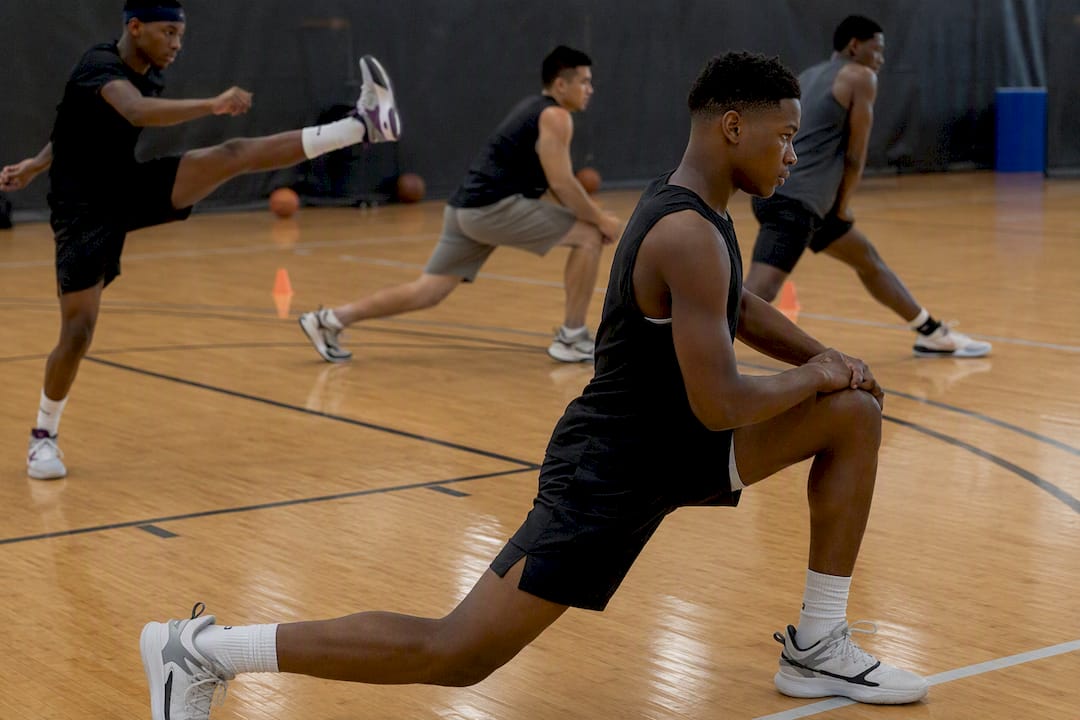
Skip static stretching before practice. Holding a hamstring stretch for 30 seconds before players move actually reduces explosive power in the minutes right after, which is the opposite of what a pregame or pre-practice routine should do. Save static stretching for the cool-down, where it helps with flexibility and recovery instead of working against it.
Cool-downs deserve a fixed slot on the template, not whatever time happens to be left. A five to seven minute block of light movement, easy shooting, walking laps, followed by static stretching targeting hips, hamstrings, and shoulders gives the body a chance to come down gradually instead of stopping cold after a scrimmage.
Use the cool-down window for the review portion of your plan too. Players retain feedback better once their heart rate has settled, and pairing physical recovery with a verbal recap means you’re not sacrificing either one to save time.
Keeping Practice Safe as the Pace Picks Up
Injury prevention in basketball practice starts with how you sequence the session, not just how careful individual drills are. Fatigue accumulates across a practice, and most non-contact injuries, ankle rolls, knee tweaks, cluster in the back third of a session when players are tired and mechanics break down.
Build in real water breaks, not just water availability. A 30-second pause every 15 to 20 minutes, written into the time-blocks on your plan, keeps hydration from becoming an afterthought that only happens when someone complains.
Watch footwear and floor conditions before the first whistle, a sweaty spot near a water station or an entry door is a common cause of falls that has nothing to do with the drill itself. Scrimmage and full-speed work should sit after a proper warm-up, never as the opening block, since cold muscles and unprepared joints absorb contact and quick cuts far worse than warmed-up ones.
For younger age groups, limit consecutive high-impact drills, repeated jump-landing or full-court sprints back to back, and build a short recovery block between them. If a player reports pain rather than normal fatigue, pull them from that drill immediately and note it in the coach notes field so the issue doesn’t get lost between practices.
What the Research Actually Tells Coaches to Prioritize
Most practice-planning advice focuses on drill selection, which drills build which skills. That’s the easy part. What actually separates a tight practice from a sloppy one is what happens in the transitions between drills, and that’s the piece most templates ignore entirely.
The Rutgers research on effective practice structure backs this up directly: the first minute of a new phase is the highest-leverage moment in the entire session, and it’s also the moment most coaches waste on logistics. A coach who has six great drills but no transition discipline will still lose ten to fifteen minutes of practice to standing around, explaining, and re-explaining. A coach with four solid drills and sharp starts will get more actual reps.
If you’re building your own plan for the first time, don’t start with the drills. Start with the skeleton, warm-up, skill, pressure, game, review, and the transition script between each block. The drills are interchangeable. A weak transition habit isn’t, and it compounds across a full season of practices. That’s the gap between a template that looks organized on paper and one that actually holds up when twelve players and three assistant coaches are moving at once.
— Dejan
Get the Full Practice Planning Toolkit From Hoop Mentality
The Basketball Practice Plan Template gives you every field covered in this article already built and formatted, no setup time required. The package includes the editable practice plan spreadsheet, a weekly planner drawn from the Game Preparation Guide With Weekly Practice Plan, and a printable court diagram for sketching plays and station setups.
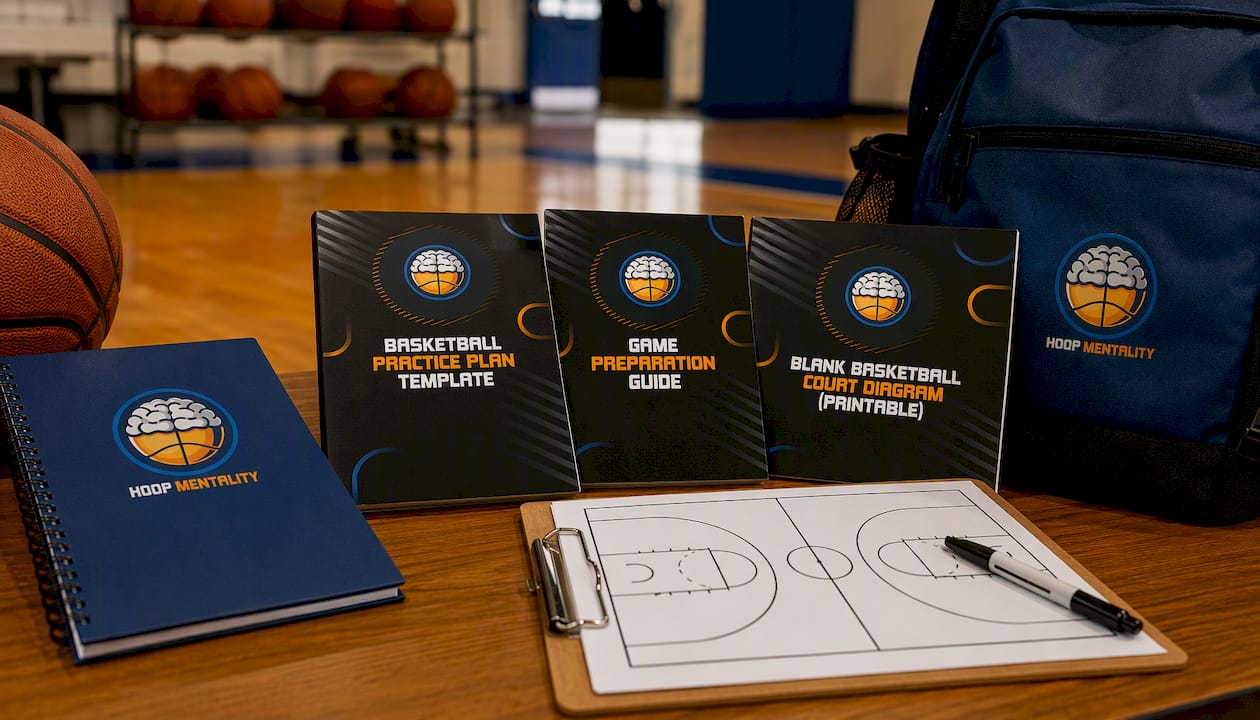
Instead of rebuilding a practice plan from scratch every week, you copy last week’s skeleton, swap the drills, and reuse the same fields your assistant coaches already know how to read. That consistency is what actually saves time over a season, not a fancier template, but the same one used the same way every week. Files download instantly after checkout in editable spreadsheet and printable PDF formats, so you can start filling in Tuesday’s practice the same day you buy it.
Sources
- Elements of effective practices - Rutgers Youth Sports Research Council
- Basketball Practice Plan (Free Templates & Drills) - StriveOn
FAQ
What Should a Basketball Practice Plan Template Include?
It should include session date, total time, phase names, exact start and end times, drill name and objective, equipment, coach notes, player assignments, and an evaluation checkbox for tracking progress.
How Long Should a Basketball Practice Be?
Most club sessions run 60 to 90 minutes, with youth teams closer to 45 to 60 minutes and mini age groups at 30 to 45 minutes.
How Many Drills Should Be in One Practice?
Four to six drills tied to one clear theme works better than a long list of unrelated drills, since depth on fewer skills beats shallow coverage of many.
Where Can I Get an Editable Basketball Practice Plan Template?
Hoop Mentality’s Basketball Practice Plan Template comes as an editable spreadsheet and printable PDF, with a weekly planner and court diagram included in the bundle.
How Do I Prevent Injuries During Practice?
Sequence high-impact drills after a proper warm-up, build in regular water breaks, and watch for fatigue-related mechanical breakdown in the final third of the session.