

TL;DR:
- Match-up defense is a hybrid system combining zone and man-to-man principles that adapts dynamically to offensive movements. It employs a five-layer framework including on-ball pressure, help positioning, scripted traps, X-rotation, and rim protection to disrupt offenses effectively. Training involves progressive installation, emphasizing communication, scouting, and incremental learning to ensure successful execution.
Match-up defense is defined as a hybrid defensive system that combines zone and man-to-man coverage, shifting responsibilities in real time based on offensive player movement. It is not a pure zone and not a pure man defense. It borrows the spacing logic of zone and the individual accountability of man coverage, creating a scheme that is harder to attack with standard offensive sets. High-level programs use it to disrupt offensive rhythm, neutralize star players, and protect against mismatches. Explaining match-up defense clearly requires understanding both its foundational rules and how it morphs during live play.

What are the essential rules and principles of match-up defense?
Match-up defense runs on a layered framework. Modern elite defenses build five overlapping layers to contain offenses effectively. Each layer has a specific job, and every player must know their role within all five.
The five layers are:
- Primary on-ball defense. The on-ball defender applies pressure, forces the ball away from the strong side, and dictates the offensive player’s options. This is the first line of disruption.
- Help positioning. Off-ball defenders do not stand in zone spots passively. They position based on ball location, one pass away, and two passes away rules. This mirrors man-to-man help principles inside a zone framework.
- Scripted trap triggers. Traps are not random. Coaches script when traps fire, typically on baseline drives, high post catches, or corner entries. Players must recognize the trigger and rotate immediately.
- X-rotation after traps. The X-rotation after traps is the most overlooked element in match-up defense. When two defenders trap, the remaining three must rotate in an X pattern to cover the open perimeter spots. Missing this rotation leads directly to open corner threes.
- Rim protection. The last defender back holds the paint. They do not leave to help on the perimeter until a rotation fills behind them. Rim protection is the final safety net.
These rules differ from traditional man defense because defenders guard areas first and then find their man. They differ from standard zone because defenders must follow cutters through their area and pick up specific players rather than stopping at zone boundaries.
Pro Tip: Teach the X-rotation in isolation before adding it to live scrimmages. Run it as a five-man walk-through drill until every player can name their rotation assignment without hesitation.
How does match-up defense morph and adapt during gameplay?
Morphing is what separates match-up defense from a static zone. The defense changes its shape and coverage principles based on where the ball moves. This is the element that confuses offenses most.
Here is how morphing works in sequence:
- Start in a 2-3 zone alignment. The two guards cover the top of the key. The three post players cover the wings and the paint. This is the base look.
- Shift to a 3-2 alignment on ball reversal. When the ball moves to the wing, the nearest post player steps up to the perimeter. The defense now shows three across the top and two in the paint. The offense sees a completely different look without a timeout.
- Switch to man principles on corner passes. Match-up zone defense neutralizes corner shooters by switching from zone principles to man-to-man coverage once the ball reaches the corner. The nearest defender closes out hard and guards the shooter man-to-man. This prevents the open corner three that kills standard zones.
- Fire corner trap packages. Defenses morph between zones and add aggressive traps in corners to force turnovers. The corner trap is a scripted package, not a freelance decision. Two defenders converge, and the X-rotation fires immediately.
- Adjust based on opponent personnel. If the opponent has a slow-footed center, keep him on the perimeter longer by holding the 3-2 look. If they have a dangerous corner shooter, assign a specific defender to shadow him regardless of zone alignment.
Pro Tip: Film your opponent’s corner entry patterns before the game. If they run corner entries on 60% of possessions, install the corner trap package as your primary morphing trigger for that game.
The confusion morphing creates is real. Offenses spend time in timeouts trying to identify what defense they are seeing. That mental load slows their execution and forces rushed decisions.
Match-up defense vs zone defense: what are the key benefits?
Match-up defense delivers advantages that neither pure zone nor pure man defense can match on their own. The comparison below shows where it wins.
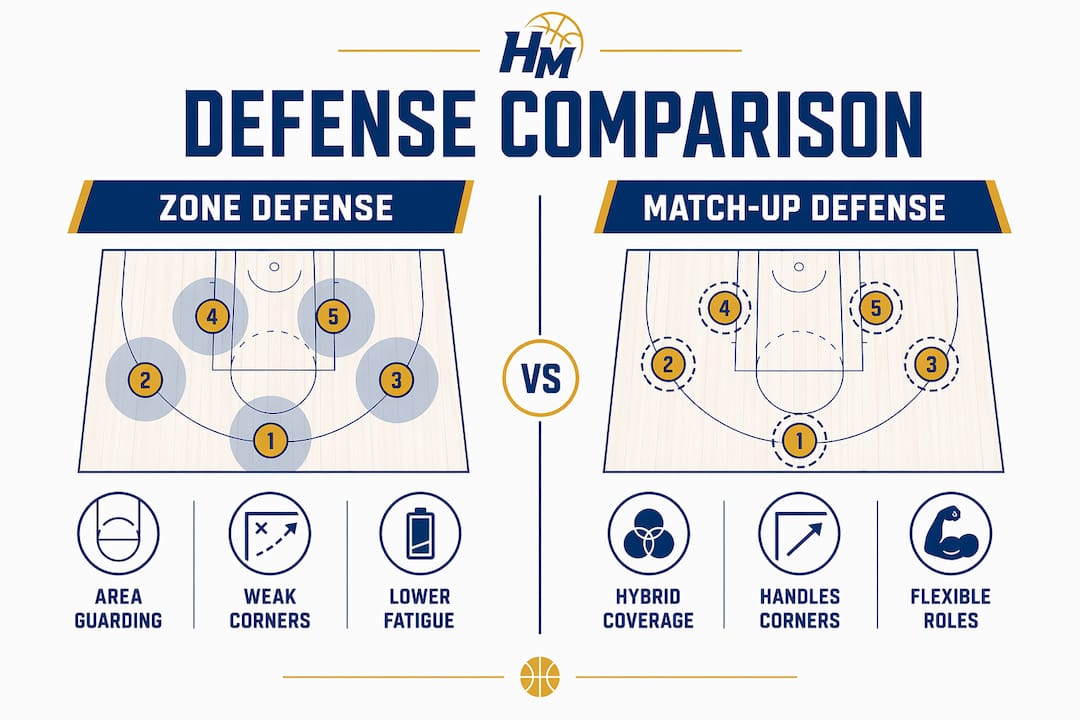
| Factor | Pure zone defense | Match-up defense |
|---|---|---|
| Handles corner shooters | Struggles, leaves corners open | Switches to man coverage in corners |
| Fatigue on defenders | Low physical demand | Moderate, less taxing than pure man |
| Tempo control | Moderate | High, dictates offensive pace |
| Counters star players | Relies on help rotations | Uses scripted traps and five-layer coverage |
| Adjusts to opponent personnel | Limited flexibility | High flexibility through morphing |
Match-up defense allows a team to dictate game tempo, force tough shots, and manage player fatigue better than pure man defense. That combination matters late in games and in back-to-back situations.
Pure zone defense has one well-known weakness: the skip pass to the corner. Match-up defense closes that gap by converting to man principles the moment the ball reaches the corner. Pure man defense demands elite individual defenders at every position. Match-up defense covers for weaker individual defenders by using zone spacing as a safety net.
The benefits of match-up defense also include personnel flexibility. You can hide a slower player in a zone spot while still applying man-to-man pressure where your best defenders are strongest. That kind of roster management is not possible in a pure man scheme.
How to implement match-up defense strategies effectively
Teaching match-up defense requires a progressive approach. Coaches should teach match-up defense progressively, starting with base zones and then layering morphing and trap elements to avoid overwhelming players. Dumping the full system on players in week one produces confusion, not execution.
Follow this teaching sequence:
- Week 1: Install the base 2-3 zone. Teach positioning, on-ball pressure rules, and basic help rotations. Run shell drill variations until players move without verbal prompts.
- Week 2: Add the 3-2 morph. Introduce the trigger for shifting from 2-3 to 3-2 alignment. Drill the shift on ball reversal until it is automatic.
- Week 3: Add corner man-to-man conversion. Teach players to recognize corner entries and convert their coverage. Drill closeouts from zone positions.
- Week 4: Add scripted trap packages. Install one trap trigger, run it in five-on-five, and add the X-rotation. Do not add a second trap package until the first is clean.
Communication is the skill that holds all of this together. Player communication and discipline are crucial to maintain cohesion in match-up defense, especially when executing traps and rotations. Players must call out ball location, trap triggers, and rotation assignments out loud on every possession.
Scouting shapes your match-up packages. Study opponent tendencies before each game. Identify their primary ball handlers, their corner shooters, and their pick-and-roll actions. Your ball screen defense assignments within the match-up scheme should reflect what you see on film, not a generic template.
Common pitfalls to avoid:
- Defenders freelancing traps. Traps must be scripted. Unscripted traps leave the X-rotation uncovered.
- Losing cutters at zone boundaries. Assign clear handoff rules for when a cutter moves from one defender’s area to another.
- Ignoring weak-side rebounding. Zone alignments can leave weak-side boards exposed. Assign a specific player to crash the offensive glass on every possession.
Pro Tip: Use the on-ball defense principles as your foundation before installing any zone elements. Players who cannot guard one-on-one will not execute match-up defense at a high level.
Key Takeaways
Match-up defense is the most flexible team defense available because it combines zone spacing with man-to-man accountability, allowing coaches to morph coverage, control tempo, and protect against personnel mismatches within a single system.
| Point | Details |
|---|---|
| Hybrid structure | Match-up defense blends zone and man-to-man principles, adapting in real time to offensive movement. |
| Five-layer framework | Effective execution requires on-ball pressure, help positioning, scripted traps, X-rotation, and rim protection. |
| Morphing is the key differentiator | Shifting between 2-3 and 3-2 alignments and converting to man in corners neutralizes standard offensive attacks. |
| Progressive teaching works | Install the base zone first, then add morphing and trap elements one week at a time to build clean execution. |
| Communication is non-negotiable | Players must call out triggers, rotations, and assignments verbally on every possession for the scheme to hold. |
Why match-up defense changed how I think about team defense
I spent years coaching man-to-man defense because I believed individual accountability was the only way to build defensive toughness. Match-up defense looked like a shortcut. I was wrong.
The first time I installed a match-up zone with a young team, I expected chaos. What I got instead was a defense that actually communicated. Players had to talk because the system demanded it. The zone spacing gave them a framework, and the man-to-man conversion rules gave them individual ownership. That combination produced better defensive habits than two years of pure man work had.
The hardest part is not the X-rotation or the morphing. The hardest part is convincing players that their zone position is not a place to rest. The moment a defender treats a zone spot as a passive assignment, the scheme breaks down. I now spend the first week of match-up installation doing nothing but on-ball pressure drills inside the zone framework. Players need to feel the individual accountability before they trust the collective structure.
One more thing: do not wait for a perfect roster to install this. Match-up defense is most valuable when your personnel is imperfect. It lets you hide a weak individual defender while keeping your best defenders in positions where they can dominate. That is not a compromise. That is smart roster management.
— Dejan
Build your match-up defense with Hoopmentality resources
Hoopmentality has the tools to take your match-up defense from concept to game-ready execution.

The Big Man Dual Action Drill targets rim protection and rotation timing, two skills that determine whether your match-up defense holds under pressure. For full system installation, the Game Preparation Guide includes weekly practice plans that cover defensive tactics progressively, exactly the structure coaches need when teaching morphing and trap packages. Both resources are built from real coaching experience and designed to save you time on the floor.
FAQ
What is match-up defense in basketball?
Match-up defense is a hybrid system that combines zone and man-to-man coverage, assigning defenders based on offensive player movement rather than fixed zone spots. It adapts in real time, making it harder to attack with standard offensive sets.
How is match-up defense different from a standard zone?
Standard zone defenses guard fixed areas and stop at zone boundaries. Match-up defense follows cutters, converts to man-to-man in specific situations like corner entries, and uses scripted traps to create turnovers.
What is the X-rotation and why does it matter?
The X-rotation is the rotation pattern the three non-trapping defenders execute after a scripted trap fires. It covers open perimeter spots and prevents corner threes. Missing it is the most common cause of defensive breakdowns in match-up zones.
What are the main benefits of match-up defense over pure man defense?
Match-up defense reduces individual fatigue, allows coaches to hide weaker defenders in zone spots, and gives teams a way to control tempo and force tough shots without requiring elite one-on-one defenders at every position.
How long does it take to teach match-up defense to a team?
A base match-up zone with one morphing element takes roughly three to four weeks of practice to execute cleanly. Adding elements incrementally prevents confusion and builds consistent execution before the next layer is introduced.