

The best inbound plays vs zone defense attack the high post and short corner immediately off the catch, then use overloads and skip passes to punish the slide before help arrives. Run stack and baseline sets that funnel the first pass to a high-post catcher or a short-corner cutter. Pick one primary play, one counter, and drill both until your team runs them without a huddle.
TL;DR:
- Inbound plays against zone defenses should target the high post and short corners to create quick scoring threats before the zone shifts into its base shape.
- Overloading one side and using skip passes rather than swing passes are essential to beat the zone’s slide and open up high-to-low or perimeter shots.
- Plays like Splitter, Middle, and 23 Stack are designed for rapid scoring and should be chosen based on game clock, shot necessity, and personnel strengths.
- Repetition drills from static to live, zone-rotating scenarios improve timing, spacing, and the ability to react to zone reactions from defenders.
- Ready-made playbooks focus on high-post and short-corner entries, providing diagrams and progressions tailored for coaching real game situations against a 2-3 zone.
Table of Contents
- What Makes Inbound Plays Vs Zone Defense Actually Work?
- Seven Named Inbound Plays That Attack the 2-3 Zone
- When Should You Call Each Inbound Play?
- How Do You Drill Inbound Plays Against a Zone?
- Why Inside-First Sequencing Beats Perimeter-Only Inbounds
- Ready-Made Playbooks for Attacking the 2-3 Zone
- Sources
- FAQ
What Makes Inbound Plays Vs Zone Defense Actually Work?
A 2-3 zone gives up ground in three predictable spots: the high post (the “nail” area between the top defenders), the short corners, and the wing seams where the top and bottom rows never fully connect. Every effective inbound play is built to hit one of those gaps on the first or second pass, before the zone can shift into its base shape. Attacking the high post and short corners forces the defense to rotate, which is exactly when clean perimeter looks and high-to-low feeds open up.
The offensive principles behind these plays are simple, even if the execution takes reps:
- Overload one side. Stack three offensive players against two defenders and the math favors you.
- Enter high before you enter low. A quick high-post touch collapses the zone’s back line.
- Use skip passes, not swing passes. A ball reversal that skips a defender beats the slide; one that goes side to side gives it time to recover.
- Screen the zone, not a man. Ball screens do little here; screen the passing lanes and rotation paths instead.
Nine core principles for beating zones all point back to overload and ball movement through the middle. In practice, that looks like a high-post catch that turns into a bounce pass to the short corner for a layup, a short-corner touch that draws two defenders and kicks out to a wide-open three, or a skip pass from strong-side wing to weak-side corner that catches the zone still sliding.
Pro Tip: Count “one, two” in your head after the inbound pass. If your team hasn’t touched the high post or short corner by “two,” the zone has already reset and you’re running a half-court possession instead of a broken-defense one.
Seven Named Inbound Plays That Attack the 2-3 Zone
Each of these plays comes from established baseline out-of-bounds libraries and targets a specific soft spot in the zone. Named baseline sets like these are worth having ready in your call sheet rather than drawing up on the fly.
- Splitter. Two inbounders split the baseline defenders while a cutter splits the seam between the low defenders. The entry pass goes to the splitting cutter for a layup, or reverses to the corner if the split gets sealed off. Needs a quick, decisive cutter more than a great shooter.
- 23 Stack. Players stack near the ball, then release in sequence: one to the short corner, one to the high post, one to the opposite wing. The first read is the high post; the counter is a direct skip to the weak corner. Works best with a passer who can see the floor from the elbow.
- Indiana. A staggered double screen frees a shooter curling to the wing while a big seals the short corner underneath. Primary target is the curl shooter; the counter is the short-corner dump if the top defender chases the curl too hard.
- Middle. The inbounder skips the catch-and-shoot options entirely and hits a cutter flashing straight to the high post off a baseline screen. This one demands a big who can catch and finish or find the short corner immediately.
- Iowa. A cross screen at the block frees a shooter to the corner while a second cutter lifts to the high post as the safety valve. Good for teams with two reliable shooters and a solid decision maker inbounding.
- Offset. The alignment intentionally overloads one side pre-snap, so the zone is already stretched before the ball moves. First look is the overloaded corner; the counter is a quick reversal to the now-thin weak side.
- 23 Box. A four-corner box alignment lets the inbounder read both short corners and the high post off one pass. It fits teams without a dominant scorer since the read, not the personnel, creates the shot.
When Should You Call Each Inbound Play?
Game situation should decide the call, not preference. Late in the clock, favor plays with the fastest first read, like Middle or Splitter, since both put the ball in a scoring area within one pass. When you need a three to tie, Indiana and Iowa are built for that shot because both isolate a shooter off a clean screen rather than hoping for a broken-play look. When two points will do, 23 Stack and 23 Box give you the highest-percentage short-corner and high-post options.
Reading the zone’s reaction matters as much as the play call itself:
- If the middle defender steps up to deny the high post, that opens a direct path to the short corner behind him.
- If the defense closes out aggressively on the first kick-out, that’s your cue to skip again rather than reset, since overloads that force a 3-on-2 create a short window that closes fast.
- If the defense traps the inbound passer, have a release valve who flashes to the middle of the floor immediately, then reverse away from the trap.
Build one contingency into every play: a re-screen if the first cutter is denied, a fake entry that reverses the whole action, or a weak-side overload if the strong side gets crowded. Teams that only know the “A” option of a play get stuck the moment a scout has seen it once.
How Do You Drill Inbound Plays Against a Zone?
Diagrams don’t win games. Reps do. Start every install with two warm-up drills before adding defense.
- High-post catch-and-finish: ten reps per big, catching at the elbow off a simulated inbound pass and scoring within one dribble. Track makes out of ten; aim for seven or better before moving on.
- Short-corner finishing: ten reps per wing player, catching in the short corner off a baseline screen and finishing through contact.
- Static walk-through: run the play with no defense so spacing and timing are clean.
- Live 5-on-5 with a sliding zone: run the same play against a defense that’s allowed to react and rotate, which is the step most teams skip and the one that actually converts a diagram into a live-game weapon.
- Timed baseline inbound under pressure: give the team five seconds, a five-second inbound violation looming, and a defense pressuring the catch.
Coaching cues matter more than the diagram. Watch the thrower’s pivot foot, since a travel on the inbound kills the possession before it starts. Time the cutter’s release to the pass, not before it. Angle screens toward the ball, not away from it, so the cutter’s path stays tight. Have one player call “skip” out loud the instant the second pass is available, since silent reads are the number one reason a good play dies in a real game.
Pro Tip: Film your live 5-on-5 reps from the baseline camera angle. It’s the only view that shows whether your cutters are actually hitting the seams or just running past them.
Why Inside-First Sequencing Beats Perimeter-Only Inbounds
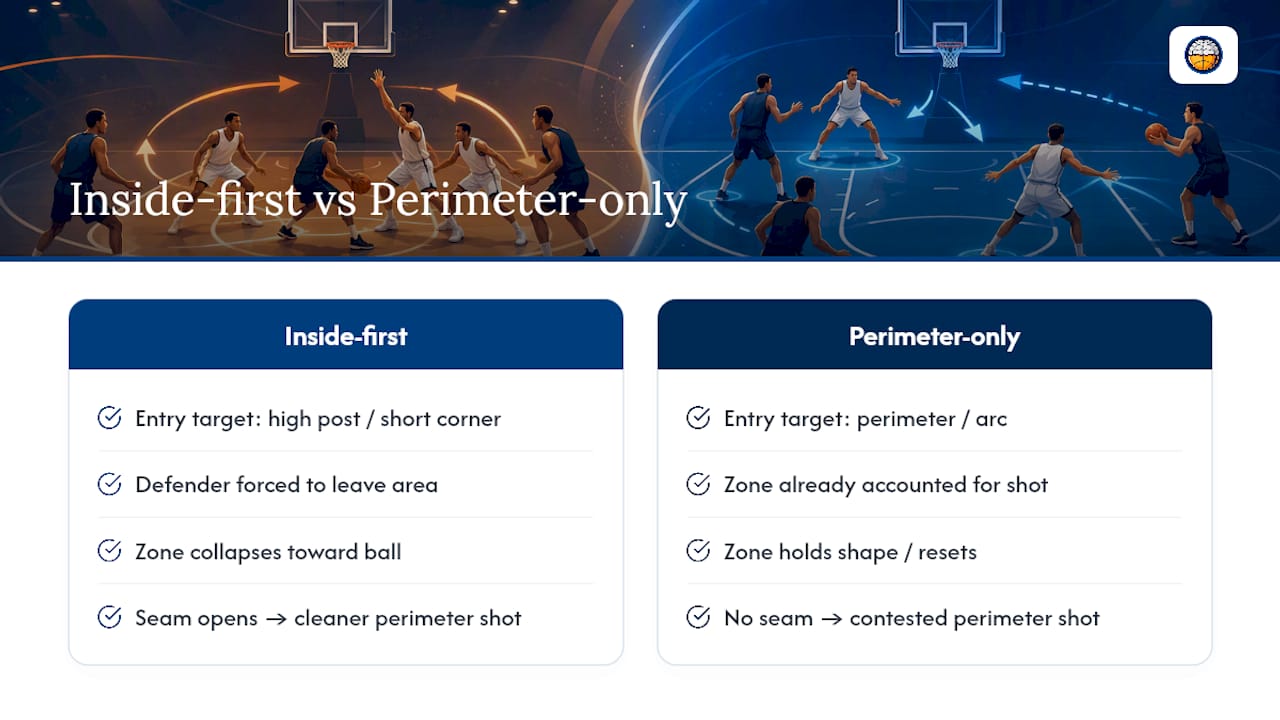
Too many teams treat inbound plays vs zone defense as a shooter’s game, drawing up quick threes and hoping the zone sags. It rarely works, because a set zone has already accounted for the catch-and-shoot look before the ball is even inbounded. The plays that actually break a 2-3 start inside, at the high post or short corner, because that’s the touch that forces a defender to leave his area and creates the seam a shooter needs.
Hoop Mentality’s internal review, Zone Offense: 30% More Scoring vs Zone Defenses, tracked exactly this pattern across tested sequences: teams that touched the high post or short corner before their first perimeter shot generated meaningfully more scoring chances than teams that skipped straight to the arc. One high school staff we’ve worked with saw it play out in a single quarter. A struggling team switched their late-game call from a corner-three special to a Middle entry, scored twice in a row off the high-post catch, and the zone abandoned its shape by the next timeout.
— Dejan
Ready-Made Playbooks for Attacking the 2-3 Zone
Reading about a high-post entry is one thing. Having the exact diagram, screen angle, and cutting path already drawn up for Tuesday’s practice is another. These resources are built from real coaching situations, not theory, so you’re installing plays that have already been stress-tested against live defenses.
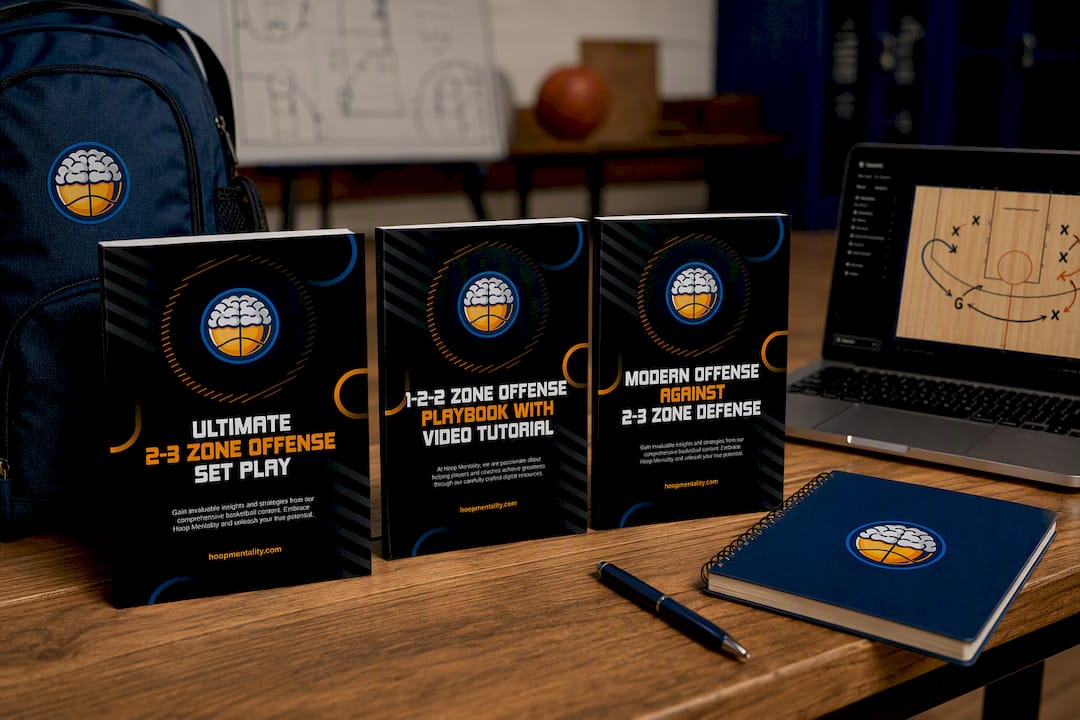
The Ultimate 2-3 Zone Offense Set Play gives you diagrams and practice progressions built specifically for the high-post and short-corner entries covered above, an easy next step if you want Splitter or Middle ready to install this week. If your opponents mix in a 1-2-2 front, the 1-2-2 Zone Offense Playbook with Video Tutorial walks through the video breakdown of each action so your staff can teach it the same way twice. For a broader system that expands past a single set play into full scoring sequences, the Modern Offense Against 2-3 Zone Defense covers the overload and skip concepts across an entire game plan.
Browse the full basketball playbooks collection, or pair any play with the basketball drills library to build out your next practice plan today.
Sources
Throw-in procedure and timing are governed by the FIBA official rules and echoed in the OBR rulebook. For deeper tactical reading, see Hoop Mentality’s guide on beating a 2-3 zone defense and the companion baseline out-of-bounds plays guide.
FAQ
What Is the Best Inbound Play Against a 2-3 Zone?
There’s no single best play for every team, but sets that force a quick high-post or short-corner touch, like Middle or Splitter, tend to score fastest because they attack the zone before it resets. The right choice depends on the clock, the score, and whether your personnel favors a big who can finish inside or a shooter who needs a clean screen.
How Many Seconds Do You Have to Inbound the Ball?
Under FIBA throw-in rules, a team has a limited number of seconds to release the inbound pass once the official hands over the ball or it becomes live at the boundary line, requiring quick action. That clock is why plays with a fast first read, rather than a slow multi-screen sequence, work best when time is tight.
Which Inbound Play Works Best for a Team Without a Dominant Scorer?
The 23 Box alignment is built for exactly that situation, since it lets the passer read both short corners and the high post off one entry pass rather than relying on one player creating a shot. Offset also works well because the pre-snap overload creates the advantage before anyone has to beat their defender one-on-one.
How Should Coaches Practice Inbound Plays Against a Zone?
Start static with no defense to lock in spacing and timing, then add a live, sliding zone in 5-on-5 so cutters learn to read real rotations instead of memorized paths. Finish with a timed, pressured rep to simulate game conditions, and finish drills like high-post catch-and-finish with a make target of seven out of ten reps before moving on.
Does Hoop Mentality Offer Ready-Made Plays for the 2-3 Zone?
Yes. The Ultimate 2-3 Zone Offense Set Play and Modern Offense Against 2-3 Zone Defense both include diagrams and practice progressions built around the high-post and short-corner entries covered in this guide. Current pricing for these products is available directly on the provider’s site.