

A 4-out, 1-in set stretches a zone and produces repeatable high-post and short-corner scoring seams once you have four perimeter creators and one mobile post who can seal or screen. Run it with the right personnel and expect more kick-outs, more clean post touches, and driving seams that a packed 2-3 or 3-2 zone can’t cover. The rest comes down to sequencing, screening, and reps.
TL;DR:
- Maintaining proper spacing by keeping perimeter players at least 15 feet apart prevents zone defenders from doubling up and reduces scoring opportunities for the defense.
- Reversing the ball is essential when nothing opens after initial reads, ensuring the offense stays unpredictable and the zone does not scramble.
- The quick post entry play requires the post to seal and read the defense, aiming for high-percentage looks rather than waiting passively for the ball.
- Using the skip to corner pass forces the farthest defender to travel the longest, increasing the chance of creating driving lanes or open shots.
- Effective screening, such as pin screens and flare screens, manipulates the zone’s rotation, especially if spacing and timing are consistently measured and corrected.
Table of Contents
- What Is the 4-Out 1-In Zone Offense?
- The Corners Variant: A Different Angle of Attack
- Three Plays You Can Install This Week
- How to Read Entries and Ball Reversal Against Any Zone Front
- Screens and Spacing That Actually Break a Zone
- A Two-Practice Plan to Install the Offense
- Where the Evidence Behind This System Comes From
- Common Mistakes I See Coaches Make With This Set
- Ready-Made Playbooks to Speed Up Installation
- Sources
- FAQ
What Is the 4-Out 1-In Zone Offense?
The 4-out 1-in zone offense places four players on the perimeter, spaced at the wings, corners, and top of the key, with one post player operating between the short corner and the high post. That single post occupies the space a zone defense relies on most, the middle. Coaches sometimes call this a “1-4 zone attack” or a “four-perimeter set,” but 4-out 1-in is the standard term you’ll hear at clinics and in coaching manuals.
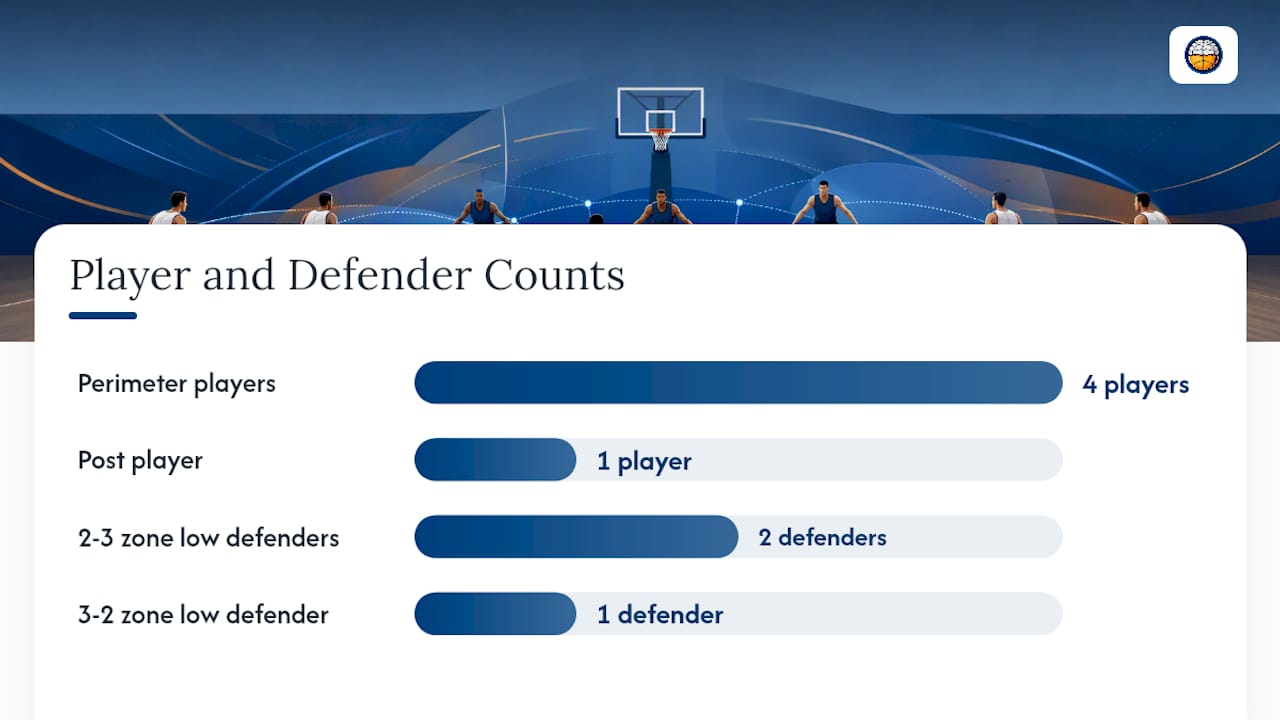
Against a 2-3 zone, the two low defenders have to choose between guarding the short corner and helping on the post. Against a 3-2, the single low defender is outnumbered before the ball even reverses. That’s the built-in advantage of this alignment.
Here’s the sequencing that makes the set repeatable rather than a one-time surprise:
- The point guard engages the top of the zone, forcing the top defender (or defenders, in a 3-2) to commit.
- A pass to the wing pulls a second defender out, opening the middle.
- The weak-side guard fills up to the top, replacing the passer and keeping the zone honest on both sides.
- The post player reads the low defenders. If they collapse toward the ball, he flashes to the high post. If they stay home, he works the short corner.
- If nothing opens, the offense reverses the ball again rather than forcing a pass into a set defender.
That last rule matters more than coaches usually admit. A scripted swing rule that forces at least one full ball reversal before allowing an inside pass keeps the offense from becoming predictable, and it’s often the difference between a zone that stays organized and one that starts scrambling by the third or fourth pass. Diagram this out on a whiteboard as six to eight repeatable actions rather than a single play, and your players will start recognizing the pattern instead of waiting for you to call it every time. For a deeper look at the spacing principles behind any four-out alignment, see how four-out offense structures build scoring chances from the perimeter in.
The Corners Variant: A Different Angle of Attack
Move both wings down to the corners and you get the Corners 4-out variant, a spacing tweak that changes the passing angles more than it changes the philosophy. Instead of wing-to-wing skip passes, the ball now travels top-to-corner, a sharper angle that most zones aren’t built to close quickly.
That angle change opens three specific reads:
- Short-corner catch and shoot. With the wing already in the corner, the post’s short-corner flash lines up directly with a shooter who’s spaced the corner rather than the wing.
- Baseline power move. A post player who catches on the move in the short corner, with a defender still recovering from the skip pass, has room to put the ball on the floor toward the rim.
- Post seal on entry. The corner spacing lets the post seal his defender lower and closer to the block, which turns a simple entry pass into a direct scoring look instead of a catch-and-decide.
Switch to Corners when your zone opponent is aggressively denying wing touches, or when you have shooters who are more comfortable in the corner than on the wing. It’s also the better fit if your post player is a strong finisher around the rim but not a reliable jump shooter from the high post. He’ll get more direct looks at the basket from the short corner than he would flashing high all night.
Three Plays You Can Install This Week
These three plays give you concrete calls to run once your players understand the base continuity. Each one attacks a slightly different weakness in the zone.
1. Quick Post Entry
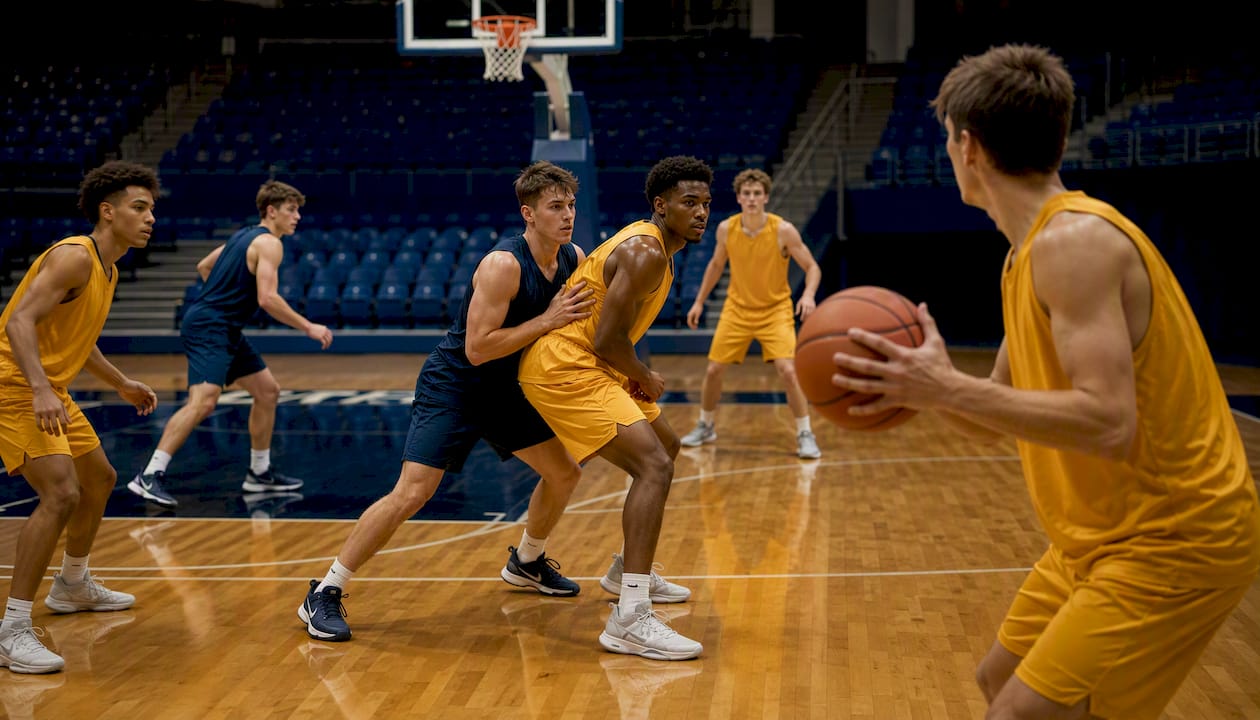
Set up in standard 4-out spacing. The point guard passes to the wing, and the post immediately seals his defender toward the ball-side low block. The first read is a direct post feed. If the low defender fronts, the post player counters by sliding to the short corner for the pass instead. Coaching cue: the post should never stand still waiting for the ball. He seals, then adjusts.
2. Wing Flare Screen and Drive
The point guard passes to the wing, then loops behind a flare screen set by the weak-side guard. The wing catches the pass off the loop with a live dribble and attacks the gap created by the flare action. Dribble penetration right after a quick swing beats a zone more often than an isolated drive, because the defenders haven’t finished their recovery assignments. Counter one: if the drive is cut off, kick to the corner for a catch-and-shoot. Counter two: if the defense collapses fully, dump to the post for a short-corner finish.
3. Skip to Corner
The top guard swings the ball to one wing, then immediately skips it across to the opposite corner before the zone can rotate. This is the highest-value pass in the whole system because it forces the farthest defender to sprint the longest distance. The corner player reads the closeout. Hard closeout means drive baseline; soft closeout means shoot.
Pro Tip: Teach a two-count rule on every catch. Players should look to the post or a shot within two seconds of catching the ball, or reverse it. Standing still with the ball is what lets a zone recover.
How to Read Entries and Ball Reversal Against Any Zone Front
Every possession should start with a top engage, whether you’re facing a 2-3 or a 3-2. Against a 3-2, that means forcing both top defenders to commit before you pass; against a 2-3, it means engaging the single top defender and the nearest wing before the ball moves.
From there, the read hierarchy looks like this:
- First read: does the zone bump down? If the low defenders shift toward the strong side to help on the wing, the high post is open for a flash and a mid-range look.
- Second read: does the zone hold its shape? If the low defenders stay home, work the short corner instead, since the post has better positioning there than fighting for high-post position against a set defender.
- Third read: is nothing open? Reverse the ball. Never force a pass into a defender who hasn’t been forced to move.
The “bump down” is the single most important cue you can teach a young point guard to recognize. It happens fast, usually within a second of the wing catching the ball, and it’s the signal that tells the post whether to flash or seal. Drill your point guard to call it out loud in practice (“down!” or “hold!”) until the recognition becomes automatic. Coaches who install zone offense strategies built around this single read report far fewer stagnant possessions than teams running the set purely off memorized passes.
Screens and Spacing That Actually Break a Zone
Screening against a zone works differently than screening against man defense, because you’re not trying to lose a defender, you’re trying to force two zone defenders to occupy the same space and leave a third area open.
Three screen types do most of the work:
- Pin screens by the post. The post steps up and pins a low defender, freeing either the short corner for a cutter or creating a direct post seal on the other side.
- Flare screens off dribble loops. As described in the Wing Flare play above, a guard looping off a flare screen creates a driving angle that a zone’s rotation rules don’t account for.
- Center screens on skip passes. A brief screen near the free-throw line as the ball skips across forces the top defenders to choose between covering the screener and covering the pass, and that hesitation is where the skip lane opens.
Spacing rules matter as much as the screens themselves. Keep perimeter players at least 15 feet apart at all times; any closer and you let one defender guard two players at once. Pin screens by the post and flare screens after dribble loops are consistently the two highest-value actions in this offense because they attack the exact spot where zone rotation rules break down.
Pro Tip: Chart your spacing on tape once a week. Coaches who actually measure gaps between players, instead of eyeballing it during a live scrimmage, catch spacing violations they’d otherwise miss entirely.
A Two-Practice Plan to Install the Offense
You don’t need a full week to get this into your team’s legs. A tight, three-phase progression across two practices gets most teams game-ready.
- Walkthrough the sequence (Day 1, 15 minutes). Run the base continuity at half speed, no defense. Repeat until every player can execute the top engage, weak-side fill, and post read without looking to you for direction.
- Live read drills (Day 1, 20 minutes). Add a token defense in the post and one wing. Run the high-post flash and finish drill, then the short-corner finishing drill, isolating each read before combining them.
- Skip-pass and pin-screen reps (Day 2, 15 minutes). Run a skip-pass shooting drill for your corner and wing players, then a pin-screen finishing drill for your post. Track makes out of ten attempts to measure progress.
- Controlled scrimmage (Day 2, 20 minutes). Put a full zone look on the floor and let the offense run itself. Stop only to correct spacing or a missed read, not to re-teach the whole sequence.
Track installation with a simple checklist: can the point guard call out the bump-down cue unprompted? Is the post flashing on time rather than a half-second late? Those two questions tell you more about readiness than any scrimmage score.
Where the Evidence Behind This System Comes From
A coach named Dejan has developed playbooks around this kind of practical, install-in-a-week system related to zone-offense resources. Hoop Mentality’s own zone offense research suggests scoring can improve against zone defenses when teams apply the recommended spacing and high-post entry reads consistently, though results depend heavily on personnel and practice reps. Pair this article with a structured playbook for faster results in your next practice.
Common Mistakes I See Coaches Make With This Set
Poor spacing is the most frequent issue. Players drift inside 12 feet of each other and hand the zone a free extra defender. The fix is a simple sideline cue: “Stretch!” Late high-post flashes come second. If your post is a half-beat slow, the defender recovers and the seam closes. The third mistake, weak-side abandonment, happens when the fill guard forgets to replace the passer, collapsing your spacing on the far side. At a timeout, two cues fix most of it: “Stretch” for spacing, “Fill” for weak-side responsibility. If execution keeps breaking down, simplify to just the quick post entry play until players rebuild confidence.
— Dejan
Ready-Made Playbooks to Speed Up Installation
You don’t have to build every diagram and drill from scratch. Hoop Mentality’s 1-2-2 Zone Offense Playbook with Video Tutorial walks through a related zone-attacking structure with video demonstration, so you can watch the reads in motion instead of just reading diagrams cold.
If your team is specifically facing a 2-3 zone this season, the Ultimate 2-3 Zone Offense Set Play gives you a ready-made continuity built for that exact front, which pairs naturally with the entries and reads covered above. And if you want to stress-test your own 4-out execution in practice, running your team against the Complete 1-3-1 Zone Defense Guide V2.0 gives your scout team a legitimate zone look to scrimmage against, sharper than a walk-through defense your players already know how to beat.
For your next practice, pick one diagram from the 1-2-2 playbook, run it for 15 repetitions at game speed, and chart makes versus misses. That single rep count tells you more about whether the set is ready for a game than a full scrimmage will. Download the playbook now and have it ready before your next practice plan is due.
Sources
FAQ
What Is the 4-Out 1-In Offense?
It’s a spacing structure with four players on the perimeter and one post player working the high post and short corner, designed to stretch a zone defense and create scoring seams that a packed formation can’t cover.
What Is the 4-Out 1-In Offense in Princeton Terms?
The Princeton offense uses backdoor cuts and constant motion within a similar four-perimeter, one-post framework, but the zone-attacking version described here relies on scripted reads like the bump-down cue rather than continuous man-to-man motion.
How Do I Know Whether to Flash High or Go to the Short Corner?
Watch the low defenders as the wing catches the ball. If they bump down toward the ball side, flash the post to the high post; if they hold their spot, work the short corner instead.
What’s the Biggest Mistake Teams Make Running This Set?
Poor spacing is the most common issue. Perimeter players drifting inside 12 to 15 feet of each other let one zone defender guard two players at once.
Which Hoop Mentality Resource Should I Start With?
The 1-2-2 Zone Offense Playbook with Video Tutorial is the fastest starting point, since it shows the reads in motion rather than static diagrams.