

TL;DR:
- Weakside defense involves active movement and precise rotations by defenders away from the ball to maintain team shape. Teaching situational responses like help rotations, skip passes, and advanced tactics enhances overall team defense. Consistent drills, communication, and repetition build confidence and make weakside concepts automatic.
Most players and coaches spend the majority of their defensive prep time on ball pressure and on-ball footwork. Weakside defense gets maybe five minutes of practice time, if that. That’s a mistake. What is weakside defense, exactly? It’s the coordinated positioning, movement, and rotation system used by the defenders on the opposite side from the ball. Get it right and your entire defense holds shape under pressure. Get it wrong and a single skip pass blows everything up.
Key Takeaways
| Point | Details |
|---|---|
| Weak side defined | The weak side is the half of the court away from the ball, where help defense originates. |
| Positioning is active | Weakside defenders must move constantly with ball movement, not wait in place. |
| Rotations must be sequential | When a defender helps, the rest of the team fills vacated spots in a set order. |
| Communication prevents breakdowns | Clear verbal cues and defined triggers stop open shooters from appearing after rotations. |
| Advanced tactics reduce burden | Weakside switching and bump coverage make rotations shorter and more manageable for all players. |
What is weakside defense and why it matters
Before getting into technique, let’s pin down the vocabulary. In basketball, the weak side is the half of the court that does not have the ball. If the ball is on the right wing, the left side of the floor is the weak side. The defenders stationed there are weakside defenders. Their job is not to guard the ball. Their job is to be ready for everything that happens because of where the ball is.
Weak side defense is the formal term used by coaches and analysts. Some call it “help-side defense” or “off-ball defense,” and all three phrases refer to the same concept: what your non-ball defenders are doing at any given moment. Understanding weakside defense means understanding that basketball defensive concepts are built on connected responsibilities, not individual matchups.
Here’s why this matters so much. Offenses are designed to force defenders to make choices. When your ball-side defender gets beat off the dribble, someone has to help. That someone almost always comes from the weak side. If that defender isn’t in the right spot, at the right angle, the drive turns into a layup or a kick-out three. The entire defensive structure depends on weakside defenders doing their job before they’re needed, not reacting after the fact.
Positioning basics: where weakside defenders stand
In man-to-man defense, a weakside defender should be positioned in what coaches call “help position.” That means one or two steps off their man, on the line between their man and the basket, in the defender’s peripheral vision of both the ball and the player they’re guarding. This is not a passive stance. The moment the ball moves, the defender moves.
- On-ball defender: Guards the player with the ball, applying pressure.
- One pass away (wing/elbow): Defender stays close, denying the pass or playing on the high side.
- Two passes away (weak side): Defender drops into help position, splitting vision between their man and the ball.
- In the corner (weak side): Defender sags significantly, ready to close out if the ball swings.
Pro Tip: Use a simple phrase like “see ball, see man” to remind weakside defenders to maintain a line-of-sight to both their assignment and the ball. If a defender can’t see both, they’re out of position.
In a 2-3 zone, the weakside principles shift. The weakside low defender moves toward the middle of the paint, a move coaches call the “bump to the middle,” when the ball reaches the wing. This is not optional. It blocks the high-value interior passing lane and keeps the zone connected. Treating this bump as optional allows passers to thread the ball into the post, which is the exact shot the 2-3 zone is designed to prevent.
Rotations and help defense mechanics
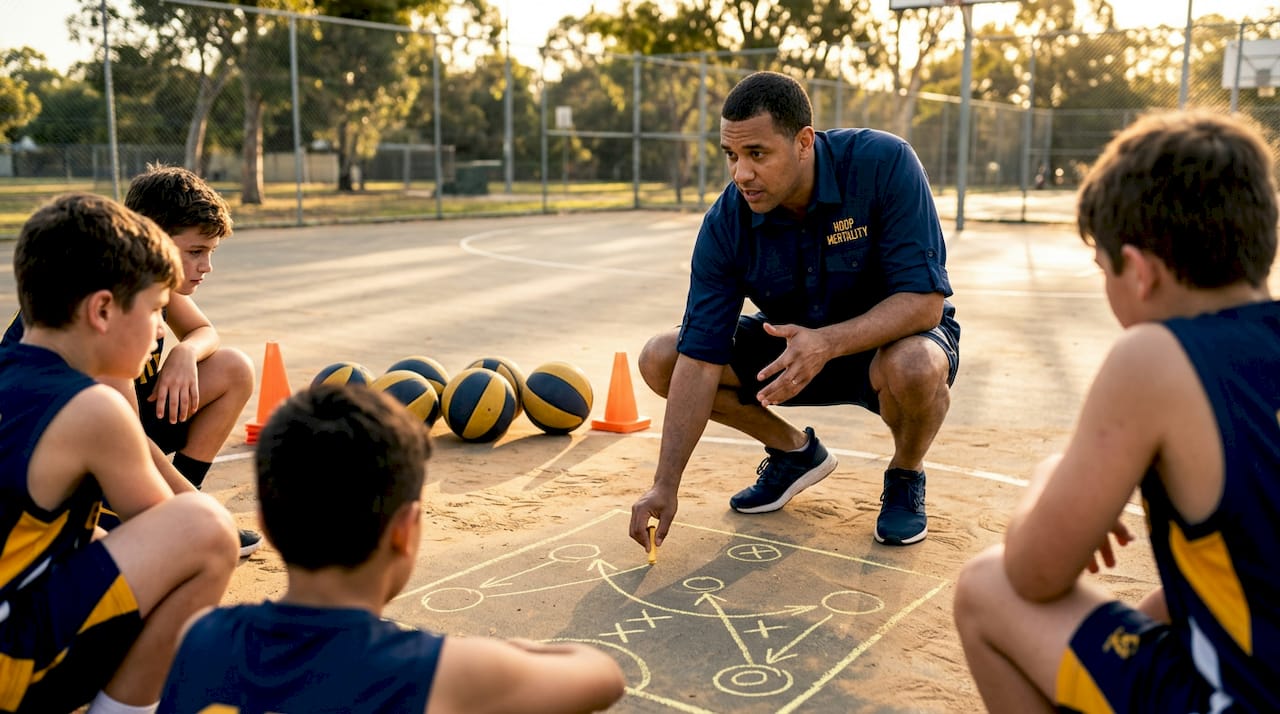
Weakside rotations are the most misunderstood part of team defense at every level. Players understand that they need to rotate. What they often miss is when and in what order.
Here is the standard rotation sequence when a ball-side defender gets beat off the dribble toward the paint:
- The nearest weakside defender steps up to stop the drive before the ball reaches the paint. This is the “helper.”
- The helper’s man is now open. A second weakside defender must rotate to cover that open player.
- That second defender’s man is now open. The original ball-handler’s defender, after being beaten, must sprint back to cover the third open player.
- Communication triggers the whole chain. The helper calls “help” so teammates know to rotate. Without the call, nobody moves on time.
Rotations include the weakside defender leaving their man to contest the drive or shot, while others cover the vacated assignments in sequence. The sequence is non-negotiable. If step two doesn’t happen, the helper creates an open corner three. If step three doesn’t happen, there’s a wide-open cutter.
Pro Tip: Run a 3-on-3 rotation drill in practice where the offense’s only job is to make the defense help. Score points for each rotation completed correctly, not just for stops. This shifts player focus to the process, not just the outcome.
One of the most common offensive counters to disciplined weakside rotations is the skip pass. Offenses will deliberately bait the help defender out, then throw a quick skip pass to the opposite corner. Timing and communication are critical to prevent defenders from being caught out of position when that pass travels. The corner defender must be reading the ball, not watching their man. A detailed defensive rotations guide breaks this sequencing down further for coaches who want a structured system.
Advanced weakside defensive tactics
Once your players have the basics down, you can start using weakside adjustments to solve specific offensive problems. Two of the most useful are the weakside switch and the pop-drop coverage response.
Weakside switching in pick-and-roll defense
In pick-and-roll situations, the traditional coverage asks the big man to drop back into the paint while the guard fights over the screen. When the offense runs a “pop” action (the screener pops out to the perimeter instead of rolling), the big is suddenly chasing a shooter 20 feet from the basket. That’s a losing sprint every time.
The weakside switch tactic assigns the popping big man to the weakside defender instead, while the original weakside defender rotates to pick up paint responsibilities. The big stays closer to the basket. The perimeter defender covers the pop. The result is shorter rotations for everyone.
Here’s how the two approaches compare:
| Situation | Traditional coverage | Weakside switch |
|---|---|---|
| Big pops to the perimeter | Big must sprint out to contest | Weakside guard rotates to the pop |
| Paint protection | Exposed during big’s sprint | Big stays near the basket |
| Rotation length | Long, often late | Short, manageable |
| Closeout quality | Rushed, off-balance | Controlled, contest-ready |
Weakside switching reduces the big man’s defensive burden and creates cleaner rotations that keep paint protection intact while covering perimeter threats. The tradeoff is that weakside defenders need to recognize the pop action early. That recognition comes from film study and repetition in practice.
Countering the 45 burn cut
Offenses that use baseline cuts and corner actions will often run what’s called the “45 burn cut” to exploit slow weakside defenders. A player cuts from the weak-side corner toward the elbow at a 45-degree angle, looking for a pass from the wing. If the weakside defender is ball-watching and fails to step up, that cutter gets the ball in scoring position. The counter is simple: the weakside defender reads the cutter’s hips, not the ball, and gets their body in the passing lane before the cut is complete.
No coverage in basketball defense is complete on its own. Weakside layers protect stressed moments like pop actions and closeout vulnerabilities. Each individual scheme needs weakside support to function.
How to teach weakside defense
Teaching this concept takes patience and structure. Here’s what works in practice:
- Start with the shell drill. Four defenders, four offensive players, no live dribble. Ball moves around the perimeter and defenders practice repositioning with every pass. Call out position names as the ball moves.
- Add live reads. Once defenders can move correctly without the ball, let the offense drive. Now the help rotation kicks in and you evaluate step one of the sequence.
- Use cue words. “Help” when a defender steps up. “Rotate” for the second defender. “Recover” for the original ball defender sprinting back. Consistent language builds automatic responses.
- Make the cost visible. When a rotation breaks down and leaves a shooter open, stop play immediately. Walk through the sequence. Show defenders exactly which step failed.
- Teach the help/rotation sequence explicitly, covering who rotates first, second, and third. Never assume players will figure it out during games.
Situational drills that simulate skip passes, baseline cuts, and pop actions are the fastest way to build weakside competence. Keep each drill short (four to six minutes), repetition-heavy, and tied to a specific rotation breakdown you’ve seen in your games.
Putting it all together
Weakside defense is not a secondary concern. It is the foundation that makes your primary on-ball pressure work.
“Your on-ball defense is only as good as your help defense. Players who guard the ball knowing their teammates are in position play harder, take more risks, and make better decisions. That confidence comes from weakside discipline.”
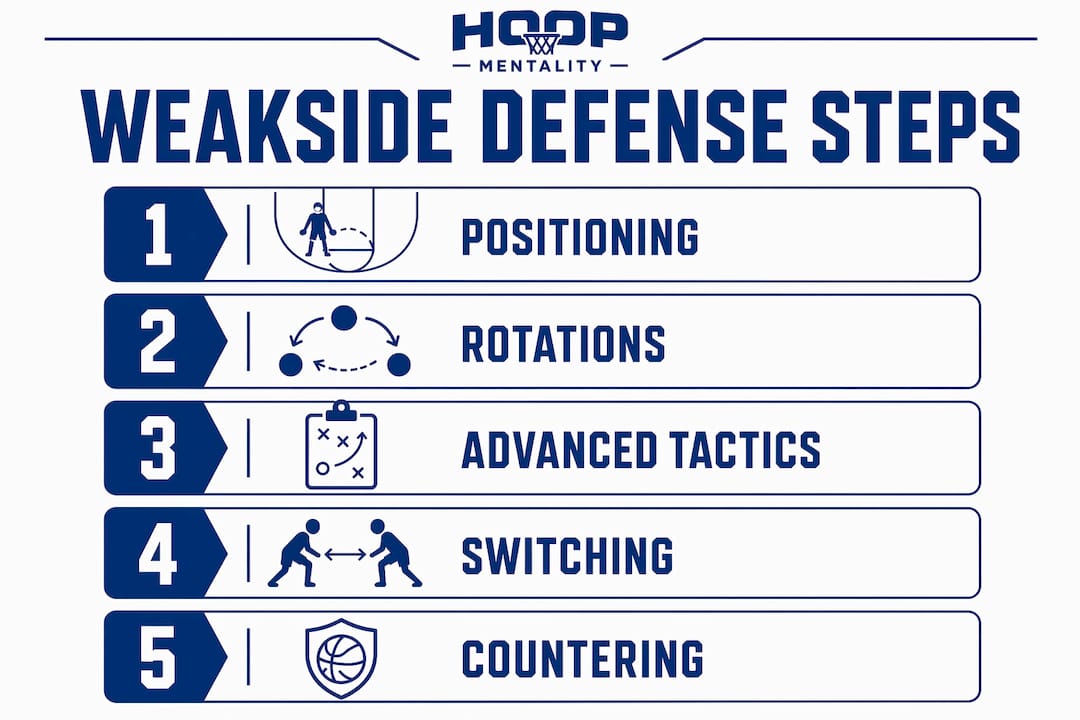
Every concept covered here connects. Positioning creates the base. Rotations provide the response. Advanced tactics solve specific offensive problems. Communication ties every piece together. If you want to apply basketball defense tips at the team level, start with what your weakside defenders are doing right now, before any help is needed.
My take on weakside defense
I’ve spent years watching teams fall apart defensively in the exact same way. The on-ball defender works hard, the ball handler makes one pass to the weak side, and suddenly there’s a wide open corner three. Nobody’s fault individually. Collective breakdown.
What I’ve learned is that players don’t fail at weakside defense because they’re lazy. They fail because nobody ever showed them the exact picture of where to stand relative to both the ball and their man. Once you draw that picture clearly and drill it with movement, improvement happens fast.
The misconception I hear most from players is that weakside defense is passive. “I’ll just wait here in case the ball comes to my side.” That thinking is wrong every time. Weakside defensive involvement is about dynamic movement and communication, not static positioning. The best defensive teams I’ve seen move like a unit. Everyone on the weak side shifts in response to every single pass.
My advice to coaches: spend at least 20 percent of your defensive practice time on weakside scenarios. Run the skip pass read. Run the pop rotation. Make these moments automatic. Your team’s defense will not just get better at stopping individual plays. It will start feeling connected, and that feeling is when defense becomes a real identity.
— Dejan
Build your defensive system with Hoopmentality

If you want to put weakside concepts into practice, Hoopmentality has tools designed for exactly that. The Big Man Dual Action Drill covers weakside pop roles and rotations, giving your big men the reps they need to read and respond correctly without the rushed sprint. For coaches building a full practice structure, the Basketball Practice Plan Template gives you a ready-made framework to integrate weakside shell drills, rotation sequences, and situational scenarios into your sessions. Both resources are built from real coaching experience and ready to use now.
FAQ
What is a weak side in basketball?
The weak side is the half of the court opposite the ball. Defenders on this side are responsible for help defense and rotating to cover open players when their teammates leave assignments to stop drives.
How does weakside defense work in a 2-3 zone?
In a 2-3 zone, the weakside low defender bumps toward the middle of the paint when the ball reaches the wing, cutting off interior passes and keeping the zone connected.
What is the most common mistake in weakside defense?
Leaving a shooter open after a help rotation is the most common breakdown. When the weakside defender steps up to help, a second defender must immediately cover the vacated assignment, or the offense gets an open three.
What is the weakside switch in pick-and-roll defense?
The weakside switch assigns the popping big man’s coverage to a perimeter weakside defender, keeping the big near the basket. This tactic prevents bigs from sprinting long distances and produces cleaner, shorter rotations.
How do you teach weakside defense to players?
Start with the shell drill to establish positioning habits, then add live drives to trigger rotations. Use consistent cue words like “help,” “rotate,” and “recover,” and stop play every time a breakdown occurs to walk through the correct sequence.