

TL;DR:
- Basketball tempo refers to the rhythm of a game, measured by possessions per 48 minutes, not the speed of players.
- Understanding and controlling tempo allows teams to optimize their playing style based on personnel and strategic goals.
- Both fast and slow tempos can lead to winning, depending on how well they align with a team’s strengths.
Basketball tempo is one of the most misunderstood concepts in the game. Most players hear “tempo” and assume it just means playing fast. It does not. Basketball tempo describes the rhythm and pace at which a game unfolds, specifically measured by the number of possessions each team generates per 48 minutes. Get your head around this concept and you will start to see every game differently, whether you are on the court, on the bench, or watching from the stands.
Table of Contents
- Key takeaways
- What is basketball tempo and how is it calculated?
- Why tempo matters strategically
- Fast vs. slow basketball tempo: what actually works?
- How to measure and control basketball tempo
- What to take away from this
- My take on tempo: the most underused advantage in basketball
- Build your tempo game with Hoopmentality
- FAQ
Key takeaways
| Point | Details |
|---|---|
| Tempo is possessions, not speed | Basketball tempo is measured by possessions per 48 minutes, not how fast players run. |
| Pace Factor has a formula | Possessions are estimated using field goal attempts, turnovers, free throws, and offensive rebounds. |
| Tempo shapes player roles | Guards thrive in fast tempos; big men tend to dominate in slower, half-court games. |
| No tempo is universally better | Championship teams have won at both fast and slow tempos depending on their roster. |
| Coaches can control tempo | Lineup choices, timeouts, and defensive pressure are all tools for managing game pace. |
What is basketball tempo and how is it calculated?
At its core, basketball tempo answers one question: how many possessions does a team use in a full game? Analysts and coaches use a metric called the Pace Factor to answer it. This number standardizes possessions to a 48-minute window, which makes it possible to compare teams across games with different foul situations or overtime periods.
The possession estimation formula works like this:
Possessions = FGA − ORB + TOV + (0.44 × FTA)
Here is what each variable means:
- FGA (Field Goal Attempts): Every shot taken counts as using a possession.
- ORB (Offensive Rebounds): These extend possessions, so they get subtracted.
- TOV (Turnovers): A turnover ends a possession without a shot, so it still counts.
- FTA (Free Throw Attempts): Not every free throw ends a possession, which is why the 0.44 coefficient accounts for “and-one” situations and technical fouls.
Once you calculate each team’s possessions, you average the two totals and normalize to 48 minutes. That gives you the game’s Pace Factor. The NBA league average pace in 2024-25 was approximately 99.4 possessions per 48 minutes, with most teams falling between 95 and 104.
| Tempo Range | Possessions per 48 min | Style label |
|---|---|---|
| Slow | Below 97 | Half-court, deliberate |
| Average | 97 to 101 | Balanced |
| Fast | Above 101 | Run-and-gun, transition |
Pro Tip: Track your team’s possession count in practice scrimmages. You do not need NBA analytics software. Count turnovers, shots, and free throw trips manually and you will get a reliable tempo picture within a few games.
Why tempo matters strategically
Understanding the importance of tempo in basketball goes well beyond knowing a number. Tempo directly affects scoring output, player roles, and how a team builds its identity.
Here is what the data shows. Teams averaged 115.6 points per game during the 2026 NBA regular season. In first-round playoff games, that number dropped to 106.8. The drop is not random. Playoff teams intentionally slow tempo to reduce possessions, which limits variance and puts a premium on half-court execution over transition basketball. Fewer possessions mean fewer opportunities for the opponent to catch up.
Tempo also dictates which players have the biggest impact on any given night:
- Guards who push pace and excel in transition scoring have more opportunities in fast-tempo environments.
- Centers and power forwards who operate in the post or set screens get more touches when the game slows down and every possession matters.
- Shooting guards and wings see their role shift depending on whether they are expected to finish in transition or operate in structured sets.
“High-tempo environments favor guards who excel in transition; slower tempos favor big men who thrive in half-court play.”
The strategic choice a coach makes about tempo is really a choice about which players to empower. This is why understanding game tempo in basketball is not just an analyst’s job. Players who grasp this can position themselves to perform when the game fits their strengths and adjust when it does not.
Defensive efficiency is also tied to tempo. A team that forces 18 turnovers in a slow game with 88 possessions has done something remarkable. That same turnover count in a 108-possession game carries less weight. Context matters, and tempo provides that context.
Fast vs. slow basketball tempo: what actually works?
The honest answer is that no tempo is inherently better than another. Success depends entirely on how well a team’s chosen pace aligns with its personnel and coaching system. Championship teams have won at both ends of the speed spectrum.
Fast-paced basketball is built on transition opportunities, quick decision-making, and offensive players who can score before defenses get set. The advantage is that it creates high-volume shot attempts and punishes teams that cannot keep up physically. The drawback is that it also generates more opponent possessions, which can backfire if your defense cannot handle the pace.
Slow-paced basketball prioritizes half-court execution, shot selection, and defensive structure. It reduces the number of possessions for both teams, which narrows the gap for less talented rosters trying to beat superior opponents. The downside is that it demands exceptional shooting efficiency because you get fewer attempts.
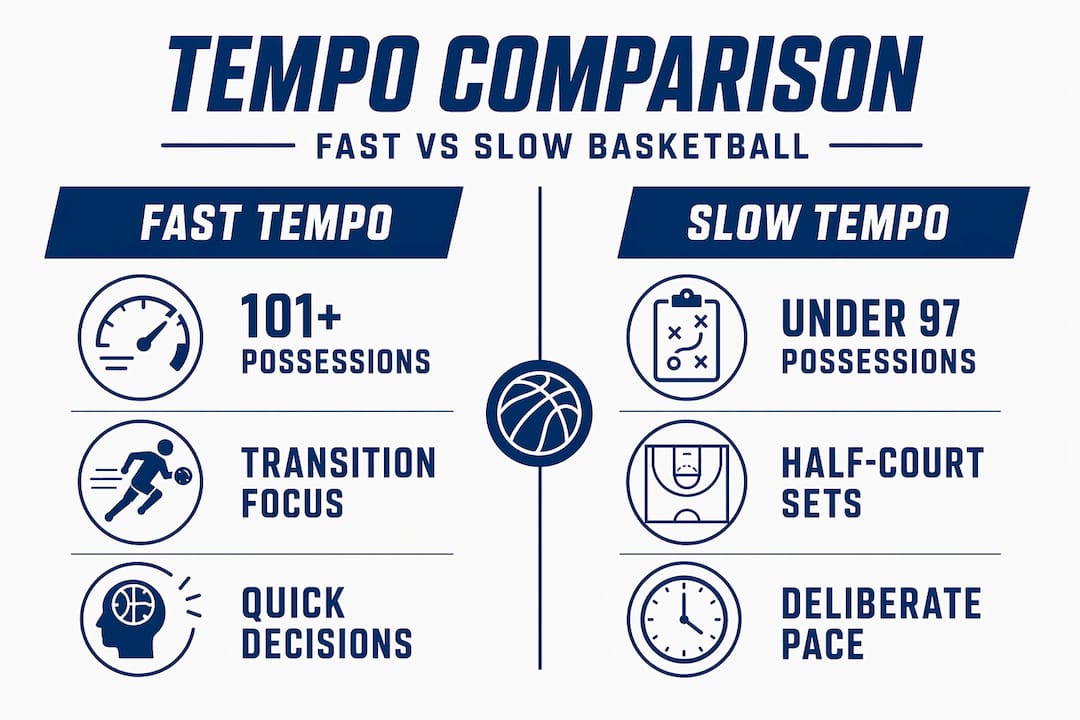
| Feature | Fast tempo | Slow tempo |
|---|---|---|
| Possessions per game | 101 or more | 97 or fewer |
| Key beneficiaries | Guards, wings in transition | Big men, half-court specialists |
| Scoring volume | Higher | Lower |
| Defensive demands | Transition defense, recovery | Half-court discipline, positioning |
| Best suited for | Athletic, deep rosters | Experienced, efficient rosters |
| Risk factor | More opponent possessions | Lower variance, fewer comebacks |
Pro Tip: If your team has better athletes than the opponent, push tempo early in the game. If you are the underdog, slow it down. More possessions help the more talented team; fewer possessions level the playing field.
Championship basketball history backs this up. Dominant defensive teams that grind games to 90-possession battles have won titles. So have run-and-gun offenses with elite guard play pushing past 105 possessions per game. The differentiator is alignment, not speed.
How to measure and control basketball tempo
Measuring and influencing tempo is a skill coaches and players can develop deliberately. Here is a practical breakdown of how to do it.
-
Calculate Pace Factor after every game. Use the formula: FGA minus ORB plus TOV plus 0.44 times FTA, averaged across both teams, and normalized to 48 minutes. This gives you a reliable number to track week over week.
-
Use On-Floor vs. Off-Floor pace data. Advanced analytics track which players accelerate or decelerate tempo when they are on the court. A coach who knows that a specific point guard raises team pace by 4 possessions per game can make smarter substitution decisions.
-
Control transition opportunities. The fastest way to increase tempo is to push the ball after made shots and defensive rebounds. The fastest way to slow it is to require players to set up in the half court before attacking. This is a coaching decision that players can reinforce through habit.
-
Use timeouts as tempo tools. Timeouts do not just stop the clock. They break an opponent’s momentum and reset rhythm. Learning how to use timeouts strategically to disrupt the other team’s preferred pace is a coaching skill that pays off in close games.
-
Develop lineup strategies around pace. If your opponent thrives at 103 possessions per game, deploy your most disciplined defenders who avoid fouling and commit fewer turnovers. This forces them below their preferred tempo and out of their offensive rhythm.
Mastering tempo shifts means being able to speed up or slow down deliberately during a game, not just react to what the opponent does. Coaches who teach their players to recognize tempo and adjust in real time give their teams a genuine competitive edge.
Pro Tip: Film review becomes far more useful when you tag possessions by tempo. Compare your team’s shooting efficiency in transition possessions versus half-court possessions. The gap will tell you exactly which tempo your roster should prioritize.
What to take away from this
Basketball tempo is not a stat reserved for analysts with spreadsheets. It is a game-shaping variable that every player and coach should understand.
- Tempo is measured in possessions per 48 minutes, not miles per hour.
- The Pace Factor formula captures shots, rebounds, turnovers, and free throws into one usable number.
- Fast and slow tempos both win games. The choice depends on your personnel.
- Players directly influence tempo through decisions like pushing in transition or calling for the half-court set.
- Coaches control tempo through lineup construction, defensive systems, and timeout usage.
The more clearly you understand these dynamics, the better you will read the game in real time. That awareness is what separates players who just compete from players who actually shape how a game is played.
My take on tempo: the most underused advantage in basketball
I have spent years watching teams obsess over shooting percentages, rebounding margins, and turnover ratios while completely ignoring the variable that frames all of them: tempo. Here is what I have come to believe after studying teams at every level. Most players and coaches treat tempo as a byproduct of the game. The best ones treat it as a weapon.
I have seen a physically outmatched team hold a faster, more talented opponent to 88 possessions and win by six points. The talent gap did not disappear. It just did not matter as much in 88 possessions as it would have in 108. That is not luck. That is a team that understood game management principles and executed a tempo plan with discipline.
My honest take: most players do not think about tempo until they are losing. That is exactly backwards. Build your tempo awareness in practice, understand which pace brings out your best play, and you will walk into games with a strategic layer that most opponents are not even thinking about. That edge compounds over a season.
— Dejan
Build your tempo game with Hoopmentality

Understanding tempo is the foundation. Applying it in practice is where improvement actually happens. Hoopmentality has the tools to help coaches and players put these concepts to work. The Big Man Dual Action Drill is built specifically for post players who need to sharpen their half-court game, which is exactly where slow-tempo teams generate their offensive advantage. For coaches who want to build tempo awareness across their full program, the Game Preparation Guide with Weekly Practice Plan lays out structured, tempo-conscious sessions that prepare your team for any opponent’s pace. Practical tools. Real results. Start exploring today.
FAQ
What is basketball tempo in simple terms?
Basketball tempo is the number of possessions a team uses per 48 minutes. It measures how fast or slow a game is being played, not just how quickly players run.
How do you measure basketball tempo?
Tempo is calculated using the Pace Factor formula: FGA minus offensive rebounds plus turnovers plus 0.44 times free throw attempts, averaged between both teams and normalized to 48 minutes.
Does a faster tempo lead to more points?
Generally yes. The 2026 NBA regular season averaged 115.6 points per game, while first-round playoff games with slower tempo dropped to 106.8 points per game.
Can players control basketball tempo?
Yes. Players influence tempo through decisions like pushing transition, calling for the half-court set, avoiding turnovers, and applying defensive pressure to dictate the game’s pace.
Is a fast tempo always better than a slow one?
No. Success depends on alignment between a team’s tempo and its player strengths. Championship teams have won at fast and slow tempos depending on their roster makeup and strategy.