

The assistant manager, better known in basketball as the assistant coach, runs practice planning, player development, and scouting so the head coach can focus on game strategy and team leadership. The assistant reports directly to the head coach, owns clearly defined pieces of the program day to day, and gets evaluated on measurable outputs like film turnaround and player improvement. The sections below give you the duties list, weekly workflow, and job description to make that scope official.
TL;DR:
- Clear role definitions with specific, measurable tasks improve communication and decision-making within coaching staff.
- Weekly routines should include practice plan drafts, scouting reports, film review, and administrative tasks to create consistency.
- Specializing assistant roles based on strengths, such as recruiting or analytics, enhances efficiency and decision clarity.
- Key performance indicators include timely report delivery, skill improvement, and recruitment outreach, with regular performance reviews.
- Using standardized templates for scouting and practice plans accelerates onboarding and ensures quality across all assistants.
Table of Contents
- Core Duties Every Assistant Coach Job Description Should Include
- What a Typical Week Looks Like for an Assistant Coach
- When to Create Specialist Assistant Roles
- Skills and Tools an Effective Assistant Coach Needs
- KPIs and Career Growth for Assistant Coaches
- A Copy-Ready Assistant Coach Job Description
- Onboarding a New Assistant: A 90-Day Plan
- What Coaches Consistently Get Wrong About the Assistant Role
- Get Your Staff Running on the Same System
- Sources
- FAQ
Core Duties Every Assistant Coach Job Description Should Include
A vague job description creates a vague assistant. Write the role around specific, checkable tasks instead of general phrases like “supports the head coach.”
Research on elite-level coaching staffs backs this up directly: programs that assign clear organizational roles with defined responsibilities communicate better and make faster in-game decisions than staffs where duties overlap or stay undefined.
Your assistant manager job description should cover:
- Practice planning: drill sequencing, period structure, and running scout-team possessions that mirror the next opponent.
- Player development: building individualized improvement plans with measurable targets, then running the skill sessions that hit them.
- Scouting and film: breaking down opponent tendencies, producing scout reports, and directing the scout team in practice.
- Game-day support: managing bench rotations, relaying timeout instructions, and flagging substitution windows to the head coach.
- Administrative tasks: scheduling, travel logistics, equipment inventory, and compliance communications with the league or association.
- Recruiting and analytics: when assigned, tracking prospects, maintaining a recruiting database, or building shot-charting and efficiency reports.
Assistant coaches handle film analysis, scouting, and travel logistics as a matter of course, not as extras bolted onto the job. Write those tasks into the job description from day one instead of discovering them three weeks into the season.
What a Typical Week Looks Like for an Assistant Coach
A season without a weekly rhythm turns into constant improvisation. Build the assistant’s week around fixed deliverables so nothing gets lost between practices.
- Monday to Wednesday: practice-plan drafts due to the head coach 24 hours ahead; individual skill sessions scheduled around team practice.
- Thursday: scouting report on the next opponent finalized, including tendencies, personnel notes, and suggested defensive coverages.
- Game-week peak: film review with players, a pre-game staff meeting to confirm bench roles and matchups, then a post-game breakdown within 24 hours.
- Off-days: administrative catch-up (travel, equipment, compliance) and recruiting outreach where that duty is assigned.
A rough time split for a full-time assistant runs close to 40% player development, 25% scouting and film, 20% administration, and 15% recruiting, though recruiting can dominate the calendar at programs where roster building is a year-round job. Adjust those percentages to your level. Youth and high school programs will lean harder into development and admin; college and semi-pro staffs shift weight toward scouting and recruiting.
When to Create Specialist Assistant Roles
Not every program needs three assistants with three titles. But once you have more than one assistant, splitting duties by strength beats splitting them evenly.
Common specialist titles worth considering:
- Recruiting lead: owns prospect tracking, evaluations, and family communication.
- Player-development coach: runs individual workout plans and tracks skill progress over the season.
- Video and analytics coordinator: handles film cutting, shot charting, and statistical reporting.
- Scouting specialist: builds opponent reports and manages scout-team practice reps.
Match the assignment to what the assistant already does well rather than forcing a generalist into a title that doesn’t fit their strengths. Naming specialist roles speeds up decision-making in games because everyone already knows who owns what.
Pro Tip: Write down who makes the final call on lineup suggestions, recruiting offers, and disciplinary issues before the season starts. Overlapping authority between an assistant and a head coach causes more staff friction than any workload issue.

Skills and Tools an Effective Assistant Coach Needs
Hiring the wrong assistant usually traces back to skipping a real skills check. Look for these traits during interviews, not just basketball résumé lines.
- Teaching and communication: can this person break down a concept for a 14-year-old and a college transfer with equal clarity?
- Film literacy: comfort reading tendencies from tape, not just watching highlights.
- Organizational discipline: meets deadlines on scouting reports and practice plans without reminders.
- Data comfort: basic ability to read shot charts, efficiency numbers, and matchup data if the role includes analytics.
Standardized templates for scouting reports and practice plans consistently shorten the learning curve for new hires, since the format is already built and the assistant just fills in the basketball. That’s a strong argument for equipping every new assistant with a set format from day one rather than letting them build one from scratch.
KPIs and Career Growth for Assistant Coaches
Evaluating an assistant on “vibes” is how good hires quit and bad hires stay. Set numbers you can actually check.
- Operational KPIs: scout reports delivered on time, practice-plan quality scores from the head coach, recruiting touchpoints logged per week.
- Player-development KPIs: measurable gains in shooting percentage, turnover rate, or other tracked skill benchmarks for assigned players.
- Review cadence: a short check-in monthly, a full written evaluation at midseason and season’s end.
Assistants with a demonstrable track record in recruiting or player development tend to move up faster and command stronger offers at the next level. That gives you a real reason to tie KPI performance directly to promotion conversations rather than treating raises as a loyalty reward.
A Copy-Ready Assistant Coach Job Description
Adapt this directly for a youth, high school, college, or semi-pro posting.
Role summary: Support the head coach in practice planning, player development, scouting, and game-day operations. Reports to the head coach.
Core responsibilities:
- Design and deliver individualized player development plans.
- Prepare weekly practice plans and lead assigned drill periods.
- Produce scouting reports and direct scout-team preparation.
- Support in-game bench management and substitution timing.
- Handle assigned administrative duties (travel, equipment, compliance).
Qualifications: prior playing or coaching experience, teaching ability, film literacy, and organizational reliability. Recruiting or analytics background preferred where those duties apply.
Sample weekly schedule: three practice sessions, one scouting report deadline, one individual workout block, one administrative catch-up window.
For youth programs, cut recruiting and lean on development. For college or semi-pro staffs, add recruiting metrics and heavier film obligations.
Onboarding a New Assistant: A 90-Day Plan
A new assistant without a structured ramp-up either freezes up or overreaches. Give them a clear path.
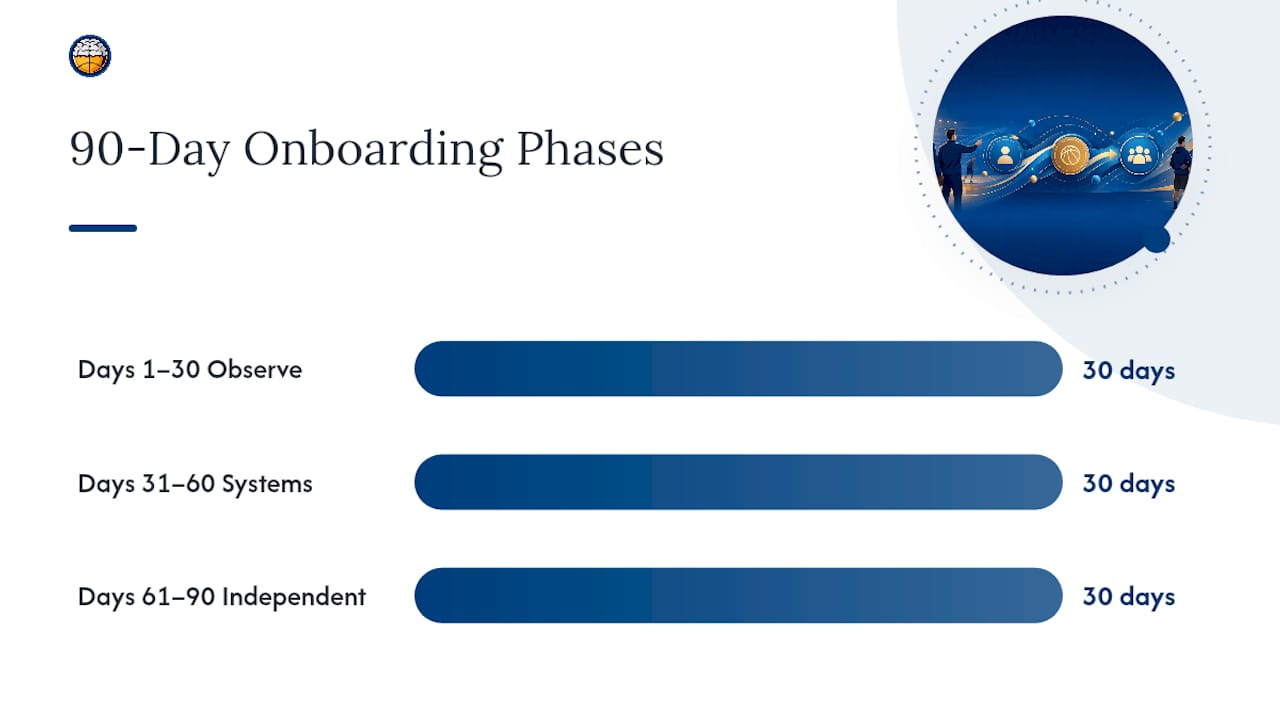
- Days 1 to 30: observation phase. Shadow practices, review last season’s scouting reports, learn team terminology and systems.
- Days 31 to 60: systems training. Run assigned drill periods under supervision, draft a scouting report for review before it goes live.
- Days 61 to 90: independent ownership. Run individual development sessions solo and submit scouting reports directly to the head coach.
Document each checkpoint with a simple written note, not just a verbal check-in. Editable scouting and practice-plan templates cut a lot of that ramp time because the new assistant learns the format once instead of guessing at it for a month.
Pro Tip: Pair every new assistant with a specific mentor on staff, even if it’s the head coach, for a 15-minute weekly check-in during the first 90 days. It catches small misunderstandings before they become season-long habits.
What Coaches Consistently Get Wrong About the Assistant Role
Most coaching staffs treat the assistant manager role as a favor to a friend or a reward for loyalty rather than a defined job with real deliverables. That’s backwards. The research on elite coaching staffs is consistent on this point: programs that assign specific organizational roles and hold people accountable to them outperform programs that leave duties fuzzy.
The other mistake I see constantly is head coaches who won’t let go of tasks they’ve assigned. You can’t hand someone scouting duties and then rewrite their reports every week. Pick the scope, write it down, and trust the assistant to own it. If the reports aren’t good enough, that’s a training conversation, not a reason to take the job back.
Templates help here more than most coaches admit. Hoop Mentality builds ours specifically so a new assistant can produce a usable scouting report or practice plan on day one instead of week four.
— Dejan
Get Your Staff Running on the Same System
Writing the job description is the easy part. Getting your assistant to actually deliver consistent scouting reports and practice plans week after week is where most staffs fall apart, usually because everyone is building formats from scratch instead of working from one shared system.
The Basketball Practice Plan Template gives your assistant a ready structure for drill sequencing and period timing the same day you hand it over. Pair it with the Editable Scouting Report Template so opponent breakdowns follow one format from your youngest assistant to your most experienced one. If you’re building a staff from the ground up, the Basketball Starter Pack For Coaches and the Basketball Template Bundle For Coaches bundle both documents with additional practice and scouting resources so you’re not assembling a system piece by piece. Browse the full collection at Hoop Mentality and get your assistant working from the same playbook this week.
Sources
- The Organizational Structure, Roles, and Responsibilities of an Elite-Level Basketball Coaching Staff
- Jobdescription
- What Does an Assistant Basketball Coach Do? - CLIMB
FAQ
What Is the Main Role of an Assistant Manager in Basketball?
The assistant manager, or assistant coach, handles practice planning, player development, and scouting while reporting to the head coach on strategy and final decisions.
What Skills Should I Look for When Hiring an Assistant Coach?
Prioritize teaching ability, film literacy, organizational reliability, and communication skills over basketball résumé length alone.
How Do I Evaluate an Assistant Coach’s Performance?
Track operational KPIs like on-time scouting reports and practice-plan quality, plus player-development KPIs like measurable skill improvement, reviewed monthly and at season milestones.
Should Every Program Have a Specialist Assistant Role?
Only once you have more than one assistant. Splitting duties by strength, such as recruiting lead or video coordinator, works better than assigning identical generalist duties to every assistant.
How Long Should Onboarding a New Assistant Take?
A structured 90-day plan moving from observation to supervised practice to independent report ownership works for most programs, and standardized templates from Hoop Mentality can shorten that ramp time further.