

Beat a half-court press break with three rules: secure the inbound, give the ball-handler three near outlets plus one long outlet, and follow the sideline/middle/reverse decision flow. Your best passer inbounds. Your primary ball-handler catches first. Your off-side post is the long outlet. That is the whole system.
- Secure the inbound. Use a V-cut or seal to get open. No dribble until the ball is in play.
- Create three near outlets plus one long. Sideline wing, middle guard, and a reverse option on the weak side. Long outlet is the off-side post or forward.
- Follow sideline/middle/reverse. Read in that order. Attack the first open lane. If all three are covered, reverse and reset.
Pro Tip: Attack when you have a numbers advantage or the defense is scrambling. Reset when the shot clock is above 15 seconds and the defense is set. Never force a pass under pressure with fewer than 5 seconds on the shot clock.
Key Takeaways
A reliable half-court press break requires three near outlets, one long outlet, and a slide-and-fill decision flow that players can execute without a timeout.
| Point | Details |
|---|---|
| Three-lane decision flow | Read sideline first, then middle, then reverse — in that order, every possession. |
| Long outlet is non-negotiable | The off-side post sprints on every inbound; one skip pass ends most presses. |
| Seal before every cut | No receiver should cut without first making shoulder contact with the defender. |
| Drill progression matters | Move from static reads to live pressure to game-speed scrimmage before adding a second formation. |
| Hoop Mentality resources | The Full-Court Press Break Offense V2.0 provides diagrams, role sheets, and drill progressions ready to run today. |
Table of Contents
- How do you read a half-court press before the inbound?
- The three-lane slide-and-fill template that beats any press
- How to attack a 3-1-1 half-court press
- How to attack a 2-2-1 half-court press
- How to attack a 3-2 half-court press
- How to attack a 1-3-1 half-court press
- Beating irregular traps: 2-1-2, 1-1-2-1, and 1-2-1-1
- How to build a press break in practice: drills and progressions
- Coaching cues, common mistakes, and what to measure
- How Dejan teaches half-court press breaks at every level
- Hoop Mentality has ready-to-run press break resources
- Sources
- FAQ
How do you read a half-court press before the inbound?
Pre-inbound scanning takes two seconds and saves five turnovers a game. Before the whistle, your inbounder and point guard need one shared read: is the defense showing an even front (2-2-1, 2-1-2) or an odd front (3-1-1, 1-3-1, 3-2)?

Even-front reads: Two defenders near the ball. Expect a middle gap. Set your ball-handler at the elbow and your long outlet on the weak-side block. A 2-1-2 alignment spreads the floor and protects leads late in games; use it when you need to control pace.
Odd-front reads: One top defender. Expect sideline traps. Bump your inbounder toward the corner and place a high-post receiver (your 4) at the free-throw line. Against odd fronts, a 1-3-1 press-break set creates short passing lanes and middle entries.
Role assignments (one line each):
- Inbounder: Best passer, not necessarily your point guard. Reads the trap first.
- Primary ball-handler: Catches the first pass. Must be able to attack or dish immediately.
- Long outlet: Off-side post. Sprints to the opposite wing or corner the moment the ball is inbounded.
- Wing outlets: Seal defenders with a shoulder, then release to the ball.
- Screener: Sets a screen for the inbounder if the defense denies the first pass.
Coach signals: Use a fist for “reset/reverse,” an open hand for “attack middle,” and two fingers for “long outlet go.” Call these at the timeout table so players recognize them mid-game without a huddle.
The three-lane slide-and-fill template that beats any press
The template in one sentence: catch on the sideline, look middle, reverse if both are covered, and let the long outlet trigger the fast break if the middle opens.
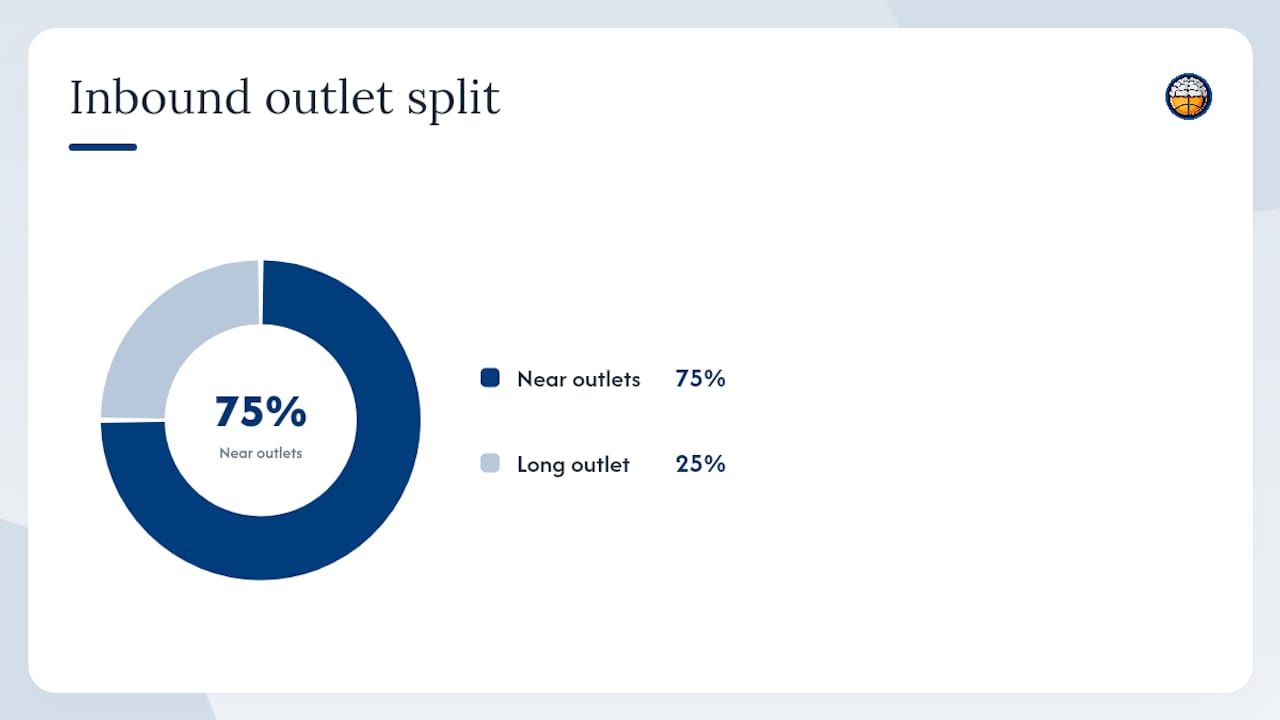
The WBCA press-break framework assigns three near outlets and one long outlet on every inbound, uses a slide-and-fill rotation, and designates the off-side post as the long outlet to create a fast break when the middle lane opens. That structure works against every half-court press shape.
Step-by-step sequence:
- Inbound read. Inbounder scans left-right. First look: sideline wing (nearest open receiver).
- First pass. Ball goes to sideline wing. Wing catches and immediately reads: is the middle open?
- Middle attack. If yes, wing drives or passes to the middle guard sliding into the lane.
- Reverse option. If middle is covered, ball swings to the weak-side wing or guard (the reverse outlet).
- Long outlet trigger. If the middle opens at any point, the off-side post sprints for the rim. One skip pass ends the press.
- Flow to half-court set. Once across half-court, transition into your standard half-court offense with spacing and screen actions already in place.
On every catch, the receiver checks three things:
- Is the middle open? (Attack.)
- Is the long outlet clear? (Skip pass.)
- Is the defense scrambling? (Drive the gap.)
Pro Tip: Put your quickest ball-handlers in the slide-and-fill lanes. Per CoachAd’s pressure-offense principles, fast handlers in those roles are best positioned to attack or flow directly into the half-court set without resetting.
How to attack a 3-1-1 half-court press
The 3-1-1 puts three defenders near the ball, leaving sideline seams and a wide midcourt window. The top three defenders can’t cover both wings and the middle simultaneously; that gap is your target.
Play 1: Sideline-favored entry
- Inbounder passes to the strong-side wing (1).
- Wing catches, faces the basket, and reads the middle guard (2) sliding up the lane.
- If the middle guard is open, immediate pass. Guard attacks the basket or pulls up at the elbow.
- Long outlet (4) has already sprinted to the weak-side corner.
Play 2: Middle/reverse combo
- Inbounder fakes to the sideline wing, then hits the middle guard (2) cutting baseline to the elbow.
- Middle guard catches, pivots, and looks long outlet first, then wing second.
- If both are covered, ball reverses to the weak-side wing (3) for a catch-and-attack.
Counters for common 3-1-1 reactions:
- Trap the inbound: Screener sets a back-screen for the inbounder. Inbounder releases after the screen and catches the return pass in space.
- Overplay the wing: Wing back-cuts hard to the basket. Inbounder lofts a pass over the top.
Drill idea: Run “3-1-1 Live Inbounds” — offense inbounds against a live 3-1-1 shell. Score only if the ball crosses half-court in three passes or fewer. Five reps, rotate.
How to attack a 2-2-1 half-court press
The 2-2-1 leaves a seam in the middle and a gap on the weak side. Two defenders guard the ball-side; two more sit in the midcourt zone. The middle is open earlier than most coaches expect.
The Hybrid 2-2-1 Zone Press Defense Guide from Hoop Mentality shows exactly how defenders are taught to rotate in this set, which tells you where the gaps appear.
Play 1: Seal and middle entry
- Wing (1) seals the near defender with a shoulder and catches the inbound.
- Middle guard (2) slides to the elbow the moment the ball is inbounded.
- Wing passes to the elbow. Middle guard reads: drive, pull up, or skip to the long outlet (4) in the corner.
Play 2: Skip pass and weak-side attack
- Inbounder hits the strong-side wing (1).
- Wing immediately looks to skip to the weak-side wing (3), who has sealed the back defender.
- Weak-side wing catches and attacks before the 2-2-1 can rotate.
Drill idea: “Skip Pass Pressure” — two defenders guard the strong side. Offense must complete a skip pass to the weak side within four seconds. Repeat until the skip pass is automatic.
How to attack a 3-2 half-court press
A 3-2 compresses the top of the floor with three defenders and drops two more in a zone behind them. The long outlet and corner passes are your primary weapons. The high post is the hub.
Play 1: High-post entry
- Inbounder hits the sideline wing (1).
- High-post receiver (4) flashes to the free-throw line, sealing the middle defender.
- Wing passes to the high post. High post reads: drive, pass to the corner (long outlet), or reverse to the weak-side wing.
Play 2: Corner skip
- Inbounder passes to the wing (1).
- Wing immediately skips to the corner (5), who has sealed the back-side defender.
- Corner catches and attacks the baseline or passes back to the high post for a pull-up.
Counters:
- Defense collapses on the high post: Wing cuts baseline behind the defense for a lob.
- Defense overplays the corner: High post dribbles to the elbow and shoots or passes to the cutting wing.
Drill idea: “3-2 Corner Attack” — offense runs Play 1 against a live 3-2 shell. Defenders rotate on every pass. Offense scores only on a corner catch or a high-post drive. Five reps per group.
How to attack a 1-3-1 half-court press
The 1-3-1 is wide at the baseline and vulnerable in the middle. One top defender, three across the midcourt, one baseline chaser. The middle entry and the baseline skip are both open if you set them up correctly.
Against a 1-3-1, bump the inbounder toward the corner and use a high-post receiver (4) to create short passes and middle entries. The Columbia press-break variant splits seams on the dribble when the middle entry is denied.
Play 1: Baseline-sideline combo
- Inbounder bumps to the corner. Wing (1) seals the near wing defender and catches.
- Wing reads the baseline: if the baseline chaser is late, wing drives baseline.
- If covered, wing passes to the high post (4) at the elbow for a middle attack.
Play 2: High-post entry and reverse
- Inbounder passes directly to the high post (4) flashing to the free-throw line.
- High post catches, pivots, and looks to the long outlet (5) sprinting the weak-side lane.
- If the long outlet is covered, reverse to the weak-side wing (3) for a catch-and-drive.
Drill idea: “1-3-1 Seal and Entry” — inbounder and high post work against a live 1-3-1 top and wing. High post must seal the middle defender and catch within three seconds. Rotate after five reps.
Beating irregular traps: 2-1-2, 1-1-2-1, and 1-2-1-1
Irregular or shifting trap shapes look different every possession. The reads change, but the rules do not.
General rules for any irregular trap:
- Seal the nearest defender before cutting. No seal, no catch.
- Threat dribble: one hard dribble toward the trap forces the defense to commit, then pass away.
- Long outlet is always active. The off-side post sprints on every inbound, no exceptions.
- Attack the gap between two defenders, not a single defender.
Quick play 1: “4-Up”
- All four perimeter players spread to the corners and wings.
- Ball-handler (1) dribbles until pressured, then passes to the open corner.
- Corner catches and immediately looks long outlet or reverses.
Quick play 2: Trailer dribble clear
- Inbounder passes to the wing (1). Wing dribbles hard toward the sideline.
- Trailer (4) cuts from the high post to the opposite elbow as the defense shifts.
- Wing passes back to the trailer for a catch-and-attack in open space.
Decision flowchart for players:
- Is the sideline open? Pass there.
- Is the middle open? Attack there.
- Is the defense scrambling? Drive the gap.
- Is everything covered? Reverse and reset. Never force.
Keeping corner outlets and a trailer active while the ball-handler dribbles until pressured creates multiple safe passing lanes against most half-court trap shapes.
How to build a press break in practice: drills and progressions
Three drill steps, run in order. Start without pressure, add it gradually, finish at game speed.
Step 1: Static inbounds and reads (no defense)
- Walk through the slide-and-fill template. Inbounder calls the option (sideline, middle, reverse) before passing.
- Coach cue: “Call it before you catch it.” Players verbalize the read before the ball arrives.
- Run five reps of each option. Rotate roles every set.
Step 2: Live pressure shells (half-speed defense)
- Add two defenders: one on the inbounder, one on the first receiver.
- Offense must complete the first pass and one more before the drill ends.
- Coach cue: “Seal first, then release.” No receiver cuts without a seal.
- Checkpoint: track inbound completion percentage. Target above 90% before moving to Step 3.
Step 3: Game-speed scrimmage with restrictions
- Full 5-on-5. Defense presses every inbound. Offense must cross half-court in five seconds or fewer.
- Restriction: no dribbling on the inbound pass (forces passing reads).
- Coach cue: “Long outlet, go.” The post sprints on every whistle, no exceptions.
- Track turnovers per session. Target fewer than three per ten possessions.
Suggested weekly progression (two to three sessions):
- Session 1: Steps 1 and 2 only. Install the template and one formation (start with 2-2-1).
- Session 2: Step 3 plus one formation-specific play (add 3-1-1 or 1-3-1 counters).
- Session 3: Full game-speed scrimmage with two formations. Review film after.
Video review: Film from the baseline, not the sideline. Tag every inbound possession. Review turnovers first, then successful breaks. Look for missed seals and late long-outlet sprints. The Transition DHO Drill For Guards adds a useful guard-specific layer for finishing the break with DHO actions once the press is beaten.
For more drill ideas that connect press breaks to fast-break finishing, the transition drills guide at Hoop Mentality covers the full progression.
Coaching cues, common mistakes, and what to measure
Short cues work. Players under pressure cannot process a sentence. Give them one word.
Repeatable cues (one or two words each):
- “Seal” — make contact before cutting
- “Long” — post sprints the weak side now
- “Sideline” — first look, strong-side wing
- “Middle” — attack the elbow gap
- “Reverse” — swing it weak side
- “Call it” — verbalize the read before catching
- “Threat” — one hard dribble to force the trap
- “Reset” — reverse and slow down, shot clock is fine
- “Go” — long outlet has a step, skip it now
- “Hold” — do not force, wait for the defense to commit
Common mistakes and corrections:
| Mistake | Why it happens | Correction cue |
|---|---|---|
| Catching without a seal | Receiver cuts too early, defender stays attached | “Seal first” |
| Skipping the long outlet | Post doesn’t sprint on the whistle | “Long, go” every inbound |
| Forcing the middle when covered | Ball-handler reads only one option | “Sideline, middle, reverse — in order” |
| Inbounder holds the ball too long | Panic under trap pressure | “Quick release, trust the outlet” |
| Dribbling into a trap | Ball-handler doesn’t pass before contact | “Pass before pressure” |
Weekly practice goals:
- Maintain a high inbound completion rate in drills.
- Aim to minimize turnovers during game-speed scrimmage drills.
- Encourage quick ball advancement across half-court on every possession.
How Dejan teaches half-court press breaks at every level
The biggest coaching mistake when installing a press break is teaching too many formations at once. Pick one template, one formation, and drill it until it is automatic. Add a second formation only when the first runs without a verbal reminder from the bench.
For youth players (grades 4–8), simplify to two options: sideline and reverse. Cut the long outlet sprint until players can complete the first pass reliably. The seal is the most important skill at this level. Spend half your press-break practice time on seals alone.
For high school players, add the middle option and the long outlet sprint in the same session. Introduce the threat dribble once the three-lane read is clean. Assign a captain to call the option at the inbound so the coach’s signal is a backup, not the primary cue.
For varsity and advanced players, the press break should double as a fast-break trigger. Design your long outlet and trailer to become primary attackers the moment the middle opens, as the WBCA press-break material recommends. Once the press is broken, flow directly into a set play. Terry Stotts’ “1 Up” half-court set uses flares, turnouts, and box-set misdirection to get guards open immediately after the break — a practical finishing option coaches can adapt at the varsity level.
Film every press-break possession. Review it with players the next day. Show one good rep and one mistake per session. Keep it short. Players remember what they see, not what they hear.
Hoop Mentality has ready-to-run press break resources
Coaches who want a complete, documented system can skip the whiteboard work. The Full-Court Press Break Offense V2.0 from Hoop Mentality includes play diagrams, step-by-step practice progressions, and video demonstration recommendations — everything covered in this article, packaged for immediate use.
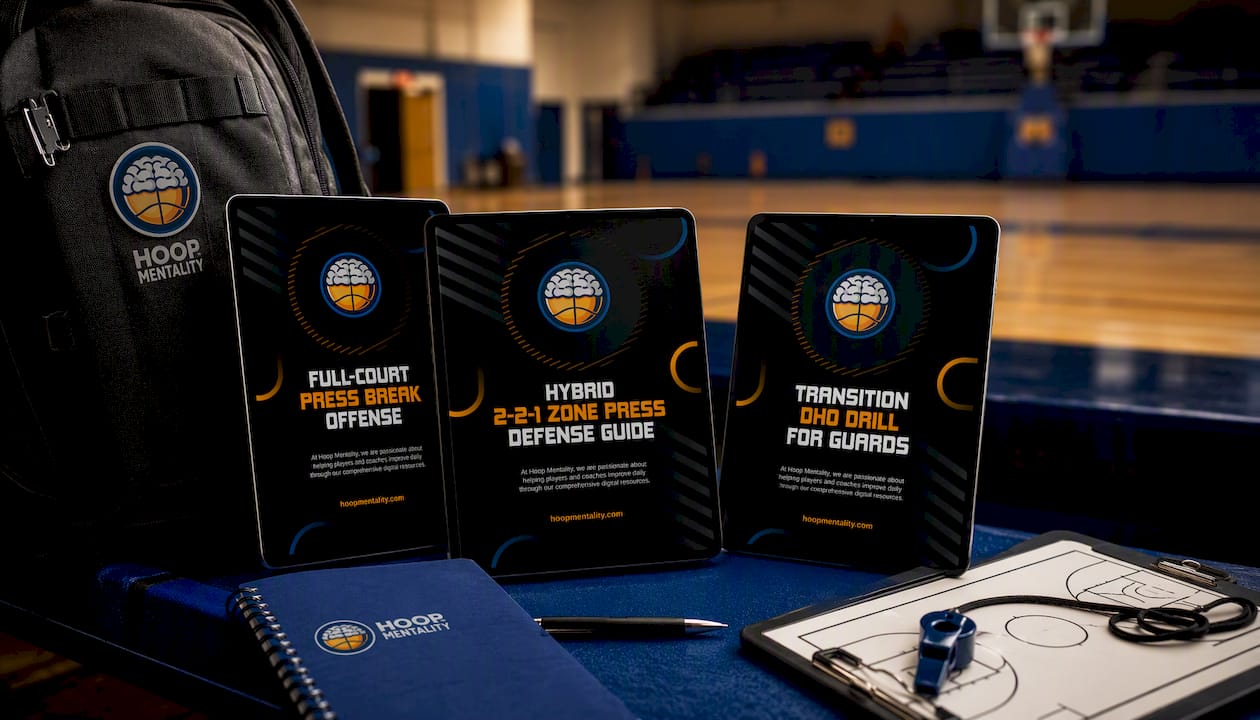
- Play diagrams: Every formation covered, with role assignments and decision trees printed and ready to hand to players.
- Practice progressions: The three-step drill sequence built in, with coaching checkpoints and weekly session plans.
- Clear role sheets: One page per position so every player knows their job before the whistle.
Coaches who also want to understand the defensive side can pair it with the Hybrid 2-2-1 Zone Press Defense Guide to see exactly how opponents are coached to trap. Visit Hoop Mentality to get both resources and run your first press-break practice this week.
Sources
Two sources stand out for printable diagrams and deeper sequence breakdowns. The WBCA Press Break Sets PDF is the most diagram-dense free resource available — print it and use it at your next coaching meeting. The CoachAd pressure-offense article covers the general principles behind slide-and-fill actions and is worth reading alongside the WBCA diagrams.
Additional resources used in this article:
- Press Break Sets.pdf - WBCA
- Proven methods for attacking full-court pressure | Winning Hoops (CoachAd)
- Press breaks - Halfcourt basics - Hoops Playbook
- Basketball offense special play: Half court press break - JES Basketball
- Half-court offense | sports | Britannica
- Terry Stotts: 1 Up Half Court Offense | The Official Website of The NBA Coaches Association
FAQ
How do you break a half-court press?
Secure the inbound with a sealed V-cut, then follow the sideline/middle/reverse decision flow. Keep a long outlet sprinting the weak side on every possession so one skip pass can end the press.
Who should inbound against a half-court press?
Your best passer, not necessarily your point guard. The inbounder needs to read the trap quickly and deliver an accurate pass under pressure — ball-handling skill matters less here than passing vision.
When should you reset instead of attacking the press?
Reset when the shot clock is above 15 seconds and the defense is fully set. Attack when you have a numbers advantage, a defender is scrambling, or the long outlet has a clear step to the basket.
Why don’t NBA teams use half-court presses more often?
NBA spacing and ball-handling make half-court traps easier to exploit. Guards at that level read pressure instantly, and one skip pass to a corner shooter ends the possession. The risk-reward rarely favors the defense.
What is the best press-break alignment against an even-front press?
A 2-1-2 alignment spreads the floor and creates a middle gap against even-front presses like the 2-2-1. It also protects leads late in games by controlling pace while still giving the ball-handler three clear outlet options.