

Every effective basketball defense comes from one of four families: man-to-man, zone, combination, or press. The single decision that determines whether any of them works is matching the scheme to your roster and locking in one force philosophy, middle or sideline, so every rule underneath it stays consistent. Get those two things right, and the rest of your season runs on pick-and-roll coverages, rotation rules, and drill repetition instead of guesswork.
TL;DR:
- Choosing the correct defense depends on matching the scheme to your roster’s size, speed, and communication skills for optimal effectiveness.
- Pick-and-roll coverage must be tailored to your personnel, with options like drop, switch, hedge, blitz, or ICE, each involving specific trade-offs.
- Effective help rotations require clear calls, disciplined communication, and quick, smooth movements to prevent open shots and exploit mismatches.
- Drills should progress from shell work to live scrimmages, focusing on rotation timing and communication to build trust and consistency under pressure.
- Installing new defensive schemes should be incremental, testing improvements through specific benchmarks like rotation speed and live-possession success.
Table of Contents
- What Are the Main Types of Basketball Defense?
- How Should Coaches Choose Pick-and-Roll Coverage?
- How Do Help Defense and Rotations Actually Work?
- How Do You Pick the Right Defense for Your Team?
- What Drills Build Reliable Team Defense?
- Where Hoop Mentality Fits Into Your Defensive Install
- A Coach’s Note on Installing Defense Without Losing Your Team
- Ready-to-Use Defensive Resources From Hoop Mentality
- Sources
- FAQ
What Are the Main Types of Basketball Defense?
Man-to-man, zone, combination, and press make up the four core defensive families in basketball, and each one solves a different roster problem.
Man-to-man assigns each defender a specific player and rewards teams with individual discipline and switching skill. A straight man alignment sticks tight on every cut. Sagging man drops off weaker shooters to load help around the paint. Deny man denies the ball entirely to a primary scorer, and switching man trades assignments on screens to avoid chasing through picks.
Zone defenses protect an area of the floor instead of a player. The 2-3 zone packs the paint and gives up the corners and top of the key. The 3-2 zone flips that trade, pressuring the perimeter while accepting more paint touches. The 1-3-1 zone gambles on ball pressure and passing-lane deflections but leaves the baseline and short corner exposed if the point defender gets beaten off the dribble.
Combination, or junk, defenses blend man and zone principles to hide a weakness or exploit a mismatch. A match-up zone plays zone spacing with man-to-man closeouts. A box-and-one locks a defender onto a single dominant scorer while the other four play a zone box around the paint.
Presses apply pressure before the offense sets up. A full-court press tries to force turnovers and rushed shots but drains bench depth fast. A half-court press, sometimes called a “1-2-1-1” trap or a matchup trap, conserves energy while still disrupting spacing.
- Man-to-man rewards individual defensive skill and switching IQ.
- Zone defenses protect specific areas at the cost of specific shots.
- Combination defenses hide one weakness by sacrificing flexibility elsewhere.
- Presses trade energy for forced mistakes and tempo control.
How Should Coaches Choose Pick-and-Roll Coverage?
Pick-and-roll defense is where most basketball defensive strategies actually get tested, because ball screens force an instant, live decision between five defenders. Five coverages dominate the modern game:
- Drop coverage: the big steps back toward the paint, conceding a mid-range look while protecting the rim.
- Switch everything: defenders trade assignments on the screen, ideal for rosters with interchangeable, athletic defenders.
- Hedge and recover: the screener’s defender jumps out to slow the ball-handler, then sprints back to the roller.
- Blitz or trap: two defenders trap the ball-handler immediately off the screen, forcing a quick, often rushed pass.
- ICE, or down coverage: the on-ball defender forces the ball-handler away from the screen entirely, toward the sideline.
Pro Tip: Every coverage has a hidden cost beyond the shot chart. Drop coverage is efficient in seconds and steps for the weak side, but it invites the short roll, the pass to the screener stopping just inside the free-throw line with a driving lane open. Build a specific “tag” rule for exactly who steps in to cut that off.
No coverage wins on every trade-off. Drop protects the rim but allows more mid-range and pull-up three-point attempts from a switchable guard. Switching limits open threes but exposes size mismatches on the block. Blitzing creates live-ball turnovers but leaves a four-on-three scramble if the pass beats the trap. The right call depends on your personnel: a mobile five who can hedge and recover buys you options a slower big does not, and a team full of a switch-everything wing rotation makes that scheme viable in ways a slower roster simply cannot replicate.
How Do Help Defense and Rotations Actually Work?
Pack-line and gap defenses share the same core idea: keep four defenders one step inside the three-point arc, ready to help the instant the ball gets deep. Pack-line schemes intentionally funnel dribble penetration toward pre-positioned help, which only works if every defender agrees on which direction that penetration should go.
That is the force decision. Force middle sends dribblers toward help defenders stacked in the paint. Force sideline, or baseline, pushes the ball toward the sideline where the boundary itself acts like an extra defender. Mixing the two within the same possession, one defender forcing middle while his teammate forces baseline, is how open threes happen. It is not a talent problem. It is a coordination problem.
Rotation rules need to be just as clear:
- Tag the roller the instant a ball screen forces help, so the short roll never gets a clean catch.
- Rotate one pass ahead, not to the ball, so the next closeout is already in motion.
- Scram switch big-to-big when a mismatch develops off a cut, before the smaller defender gets isolated on the block.
- Recover to shooters with a hand up and a controlled stop, not a full sprint that flies past the catch.
Standardizing short calls like “SWITCH,” “ICE,” “TAG,” and “SCRAM” matters as much as the scheme itself. Hesitation, not a bad system, is what actually creates open shots. Structured communication and rotation discipline separate teams that talk on defense from teams that just play it.
How Do You Pick the Right Defense for Your Team?
Start with a personnel audit before you touch a whiteboard. Size and length dictate whether zone or drop coverage is even viable. Foot speed determines whether switching everything holds up against quicker guards. Communication skill, more than raw athleticism, decides whether a pack-line scheme survives contact with a live game.
Scout your opponent with the same lens:
- Who is the primary scorer, and can your personnel guard them one-on-one?
- Does the offense run heavy ball-screen actions that will test your PnR coverage?
- What is their three-point volume and shooting profile from the corners versus above the break?
Aligning your scheme to your roster beats running three incompatible defenses at once. Pick one base defense your team can play at full speed under fatigue, and one change-up you use for eight to ten possessions per game to disrupt rhythm. If you plan to press, build clear substitution rules ahead of time. Full-court pressure only works if you have fresh legs ready to rotate in every two to three minutes.
What Drills Build Reliable Team Defense?
Tactics only matter once they survive contact in a live game. Build practice around a progression, not isolated drills.
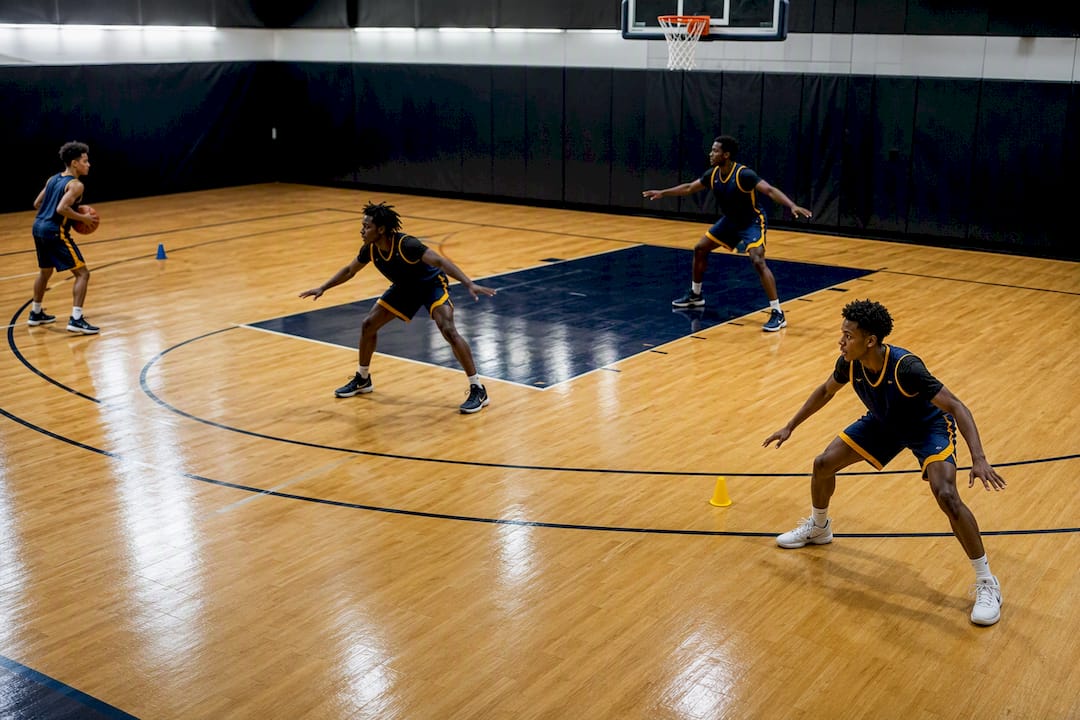
- Shell drill, four-on-four with no dribble at first, teaches spacing, ball-you-man positioning, and closeout technique. Add checkpoints: no dribble, one-dribble penetration, then full live action once rotations look clean.
- Pick-and-roll progression moves from 1v1 on-ball reps, to 2v2 show-and-recover work against a stationary screener, to live 3v3 possessions where the weak-side defender has to tag the roller under pressure.
- Press work starts with feed-based reps where the inbounder throws to a predictable spot, then adds live trapping zones, then finishes with a conditioned scrimmage that forces the press under real fatigue.
Pro Tip: Time your shell drill rotations. If a closeout takes longer than two seconds from the help position, that is your leak, not a scheme problem.
Progressing from controlled reps to live, conditioned scrimmages is what actually transfers a whiteboard scheme into a habit players trust under pressure. The shell drill remains the fastest way to install rotation habits before adding live ball screens.
Where Hoop Mentality Fits Into Your Defensive Install
Hoop Mentality builds playbooks, drill packs, and practice plans from real coaching experience, covering everything from base man-to-man principles to a full defensive schemes menu. Coaches installing a pack-line system, a 2-3 zone, or a pick-and-roll coverage plan can pair this article’s drill sequences directly with ready-to-run practice templates instead of building install plans from scratch.
A Coach’s Note on Installing Defense Without Losing Your Team
Install one base defense first. Add a single new wrinkle each week, never three at once, and measure progress with something concrete: rotation time, live-possession stops, closeout speed. Most breakdowns I see come from a staff running pack-line principles on Monday and ICE coverage on Wednesday without reconciling the force philosophy underneath both. Pick one, teach it relentlessly, and let the change-up wait its turn.
— Dejan
Ready-to-Use Defensive Resources From Hoop Mentality
If you want a faster path from this article to your practice plan, Hoop Mentality’s resources are built to skip the setup work. The Essential Defensive Bundle For Coaches packages base defensive installs, practice plans, and drill templates so you are not building a shell drill progression from a blank page.

For teams that live and die on ball screens, the Advanced Ball Screen Strategies For Coaches breaks down hedge, drop, and blitz coverages into specific drill sequences, including the tag and recovery reps this article walks through. And if your scouting reports keep running into hedge or show-and-recover defenses, Attacking The Hedge Ball Screen Defense gives you the offensive counters and scouting templates to prepare your team for exactly that look. Browse the full catalog at Hoop Mentality and start building your install plan around whichever coverage your roster is built to run.
Sources
- Drop vs. Switch vs. Hedge vs. Blitz: The Complete PnR Coverage Playbook
- Pack-Line Progeny: How Tony Bennett Used His Father’s System
- 4 Types of Defense in Basketball
- Tactical Skills in Basketball: Master the Game
FAQ
What Are the 5 D’s of Basketball Defense?
The 5 D’s commonly cited by coaches are deny, deflect, dictate, defend the post, and defensive rebound, principles that reinforce ball pressure, help positioning, and finishing possessions with a stop.
What Is the Best Defense Style in Basketball?
No single style wins for every roster. Man-to-man rewards individual skill and switching ability, zone protects specific areas of the floor, and the best choice always comes down to matching the scheme to your personnel and one consistent force philosophy.
How Can a Player Get Better Defensively?
Focus on footwork, hand positioning, and communication, the same fundamentals that separate structured, high-performing defensive teams from disorganized ones, then drill closeouts and rotations until recovery speed becomes automatic.
What’s the Difference Between Ice and Drop Coverage?
ICE forces the ball-handler away from the screen entirely, usually toward the sideline, while drop coverage lets the ball-handler use the screen but has the big retreat toward the rim to protect against a drive.
How Do I Install a New Defense Without Breaking My Team’s Habits?
Add one new tactic at a time on top of a stable base defense, and measure it with concrete practice benchmarks like rotation speed and live-possession stops rather than guessing whether it “looks right.”