

When a close game is on the line, one decision can turn a promising bench player into a game-changer for your team. Coaches know that building a deep roster is about more than focusing on starters. Developing bench talent demands a comprehensive skill assessment and thoughtful practice design. This guide shares clear steps for evaluating your team’s current strengths, creating individual growth plans, and implementing engaging routines to raise every player’s impact.
Table of Contents
- Step 1: Assess Current Bench Player Skills
- Step 2: Design Individual Development Plans
- Step 3: Implement Engaging Practice Routines
- Step 4: Integrate Bench Players in Game Scenarios
- Step 5: Monitor Progress and Adjust Strategies
Quick Summary
| Key Point | Explanation |
|---|---|
| 1. Assess Players’ Skills | Evaluate physical conditioning, technical skills, basketball IQ, and mental resilience to identify areas for improvement. |
| 2. Create Individual Plans | Develop personalized growth strategies that align players’ goals with team needs for holistic player development. |
| 3. Implement Engaging Practices | Design practice routines that enhance motivation and simulate game scenarios to prepare bench players effectively. |
| 4. Integrate Players Strategically | Use situational substitutions and specialized roles to build bench players’ confidence during games. |
| 5. Monitor and Adjust | Establish a system for continuous assessment and feedback to support players’ development and progress tracking. |
Step 1: Assess Current Bench Player Skills
Effective coaching of bench players starts with a comprehensive understanding of their current skill levels. By conducting a systematic evaluation, you can develop targeted strategies to enhance their performance and team contribution.
To assess your bench players effectively, focus on multiple performance dimensions. Core training impacts multiple athletic skills including strength, agility, and technical basketball abilities. Your assessment should cover several key areas:
- Physical Conditioning: Evaluate speed, strength, stamina, and overall fitness
- Technical Skills: Assess shooting accuracy, dribbling control, passing precision
- Basketball IQ: Observe decision-making, court awareness, and strategic understanding
- Mental Resilience: Check psychological readiness and response to coaching feedback
During evaluation, create game-like scenarios that reveal true player capabilities. Verbal encouragement during small-sided games can significantly enhance technical performance and focus, so integrate motivational feedback into your assessment process.
A player’s potential is not just about current skills, but their capacity to learn and improve.
Develop a standardized evaluation template that includes measurable metrics for each skill category. Rate players on a scale of 1-5 in areas like shooting percentage, defensive positioning, and communication. This structured approach provides clear insights into individual development needs.
The goal is not to criticize, but to identify specific areas where bench players can contribute more effectively to team success.
Pro tip: Create individual player development cards that track progress over time, allowing you to visualize skill improvement and adjust training strategies accordingly.
Step 2: Design Individual Development Plans
Developing personalized growth strategies for bench players requires a systematic and thoughtful approach that addresses their unique skills, potential, and team role. Effective individual development plans must balance technical skill improvement with holistic player growth.
Begin by creating a comprehensive player profile that includes:
- Technical Assessment: Current skill levels in shooting, dribbling, passing
- Physical Metrics: Strength, speed, agility, and conditioning status
- Mental Attributes: Basketball IQ, decision-making skills, psychological resilience
- Performance Goals: Short-term and long-term individual development objectives
Collaborative Goal Setting is critical. Meet with each bench player to discuss their aspirations and align personal goals with team needs. Coaching competency frameworks emphasize creating partnerships that respect player individuality.
Individual development is not about fixing weaknesses, but amplifying unique strengths.
Structure the development plan with specific, measurable milestones. Break down each goal into actionable steps, creating a clear roadmap for skill progression. This might include specialized training drills, targeted practice sessions, and incremental performance tracking.
Remember that development plans are dynamic documents. Regular review and adjustment ensure the plan remains relevant and motivating for the player.
Pro tip: Schedule quarterly review meetings to assess progress, celebrate improvements, and recalibrate development strategies based on the player’s evolving capabilities and team needs.
Step 3: Implement Engaging Practice Routines
Engaging practice routines are the cornerstone of developing bench players who can make meaningful contributions when called upon. Contemporary coaching pedagogies emphasize creating athlete-centered practice designs that foster skill development and psychological growth.
Design practice routines that incorporate multiple dimensions of player development:
- Skill-Specific Drills: Targeted exercises addressing individual player weaknesses
- Game-Realistic Scenarios: Simulations that mirror actual game conditions
- Competitive Challenges: Small-sided games that create high-engagement learning environments
- Rotational Learning: Structured activities that maximize participation for bench players
Nonlinear Practice Approach means moving beyond rigid, repetitive drills. Create dynamic training environments where bench players can develop decision-making skills and spontaneous basketball intelligence. This approach transforms practice from mechanical repetition to an adaptive learning experience.
Effective practice is about creating opportunities, not just running exercises.
Utilize a mix of structured and free-form training segments. Incorporate competitive elements that make every minute count, ensuring bench players remain motivated and feel valued. This might include scoring systems for drill performance, leadership opportunities, and real-time feedback mechanisms.
Remember that engagement is psychological. Your coaching style, communication, and ability to make players feel important directly impact their willingness to improve and contribute.
The following table contrasts linear and nonlinear practice approaches:
| Practice Type | Structure | Player Development Impact |
|---|---|---|
| Linear | Fixed, repetitive drills | Improves technical consistency |
| Nonlinear | Adaptive, variable drills | Enhances decision-making skills |
Pro tip: Design practice segments with clear, measurable objectives and immediate feedback loops to keep bench players continuously motivated and focused on personal improvement.
Step 4: Integrate Bench Players in Game Scenarios
Successfully integrating bench players requires strategic planning and intentional game management that transforms sideline waiting into meaningful development opportunities. Incorporating players in small-sided games can enhance their technical skills and psychological readiness for competitive moments.
Develop a comprehensive integration strategy that includes:
- Situational Substitution: Planned entry points based on player strengths
- Specialized Role Assignments: Specific defensive or offensive responsibilities
- Performance-Based Opportunities: Reward practice effort with meaningful game minutes
- Targeted Skill Deployment: Match bench players’ unique abilities to game needs
Game Scenario Preparation involves creating clear expectations and communication channels. Brief bench players on potential game situations where they might be called upon, ensuring they understand exactly how to contribute when their moment arrives.
Your bench is not just a waiting area, but a strategic performance zone.
Utilize structured bench player protocols that maintain team discipline while providing meaningful engagement. This means giving bench players active roles during games, such as detailed scouting responsibilities, real-time statistical tracking, or specific in-game communication duties.
Effective integration is about building confidence. Demonstrate to bench players that their preparation and potential impact are valued, regardless of their current playing time.
Pro tip: Create a “ready state” mentality by running specialized warm-up routines and mental preparation strategies that keep bench players consistently engaged and psychologically prepared for immediate game entry.
Step 5: Monitor Progress and Adjust Strategies
Developing an effective monitoring system for bench players requires continuous assessment and strategic adaptation. Reflective coaching practice allows coaches to create personalized development pathways that maximize player potential.
Establish a comprehensive tracking mechanism that evaluates multiple performance dimensions:
- Quantitative Metrics: Statistical performance indicators
- Qualitative Observations: Behavioral and skill progression notes
- Practice Performance: Consistent effort and improvement tracking
- Game Readiness: Mental and physical preparation assessments
Data-Driven Adjustment means moving beyond surface-level observations. Create a systematic evaluation framework that provides actionable insights into each bench player’s development trajectory.
Progress is not linear - it requires constant recalibration and nuanced understanding.
Implement regular check-in meetings where players receive transparent feedback about their current status, areas of improvement, and specific strategies for advancement. These conversations should be constructive, forward-looking dialogues that empower players to take ownership of their development.
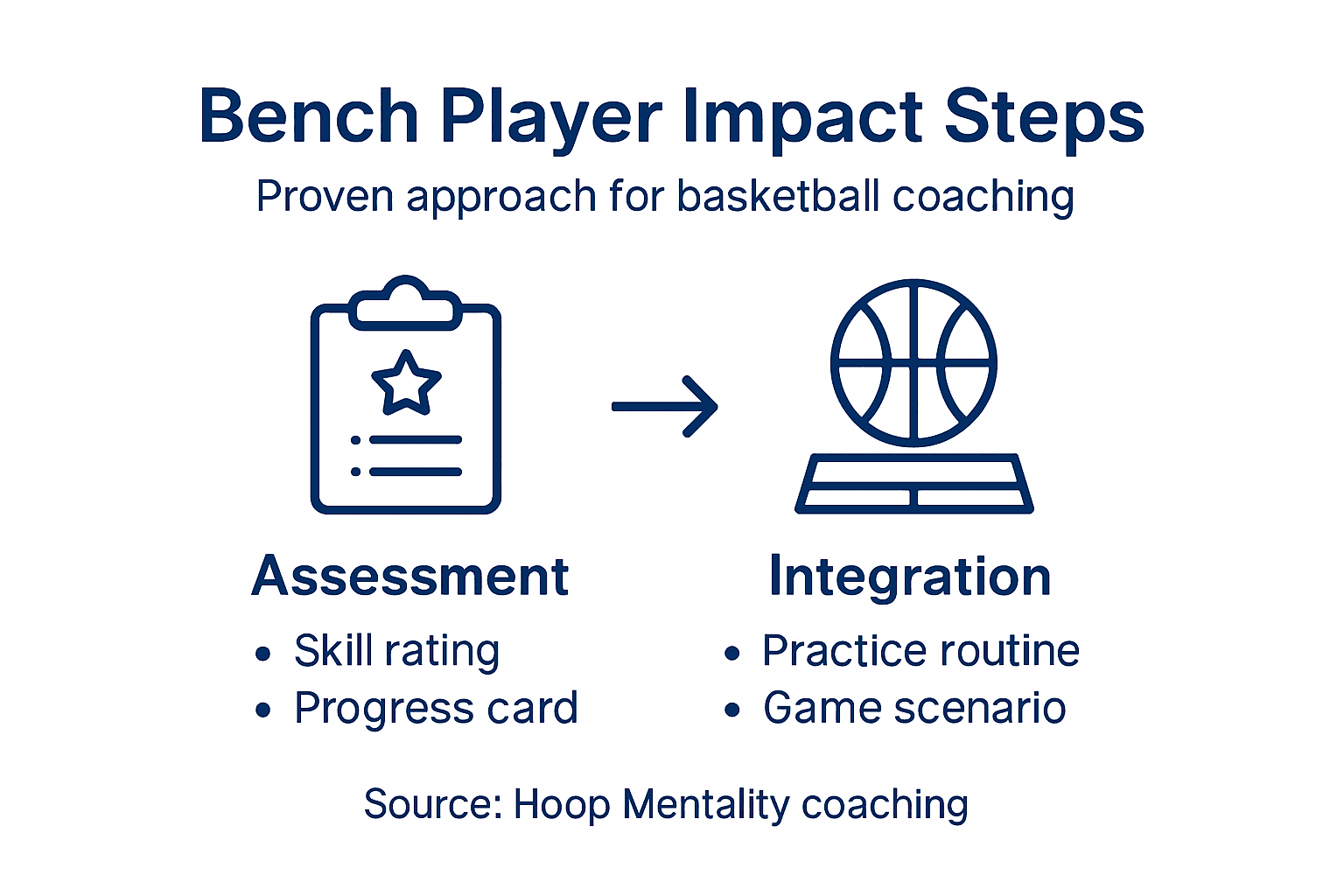
Remember that monitoring is not about criticism but about creating personalized pathways for growth. Your approach should communicate belief in each player’s potential while providing clear, achievable benchmarks.
Pro tip: Develop individualized tracking sheets that visualize player progress, making performance improvements tangible and motivating for bench players.
Here’s a summary of how each development step benefits bench players:
| Development Step | Primary Focus | Key Benefit for Bench Player |
|---|---|---|
| Assess Skills | Comprehensive evaluation | Identifies strengths and growth areas |
| Individual Plans | Personalized development | Aligns goals with team needs |
| Engaging Practice | Adaptive routines | Boosts motivation and game readiness |
| Game Integration | Strategic participation | Builds confidence and in-game impact |
| Ongoing Monitoring | Progress tracking | Supports continuous improvement |
Unlock Your Bench Players’ Full Potential with Proven Coaching Resources
Coaching bench players to deliver maximum impact takes more than intuition. The challenge lies in assessing their unique skills, crafting personalized development plans, and integrating them effectively during games. If you want to transform frustration into confident contributions and build a “ready state” mentality on your team, you need structured support designed for your specific coaching needs.
Discover how Hoop Mentality’s collection of Basketball Drills, Basketball Templates, and Basketball Playbooks can help you implement engaging practice routines, monitor progress, and integrate bench players strategically. These easy-to-use tools bring clarity to your coaching plan and empower you to develop all players confidently. Visit Hoop Mentality today to start building a deeper, more effective roster that elevates your entire team.
Frequently Asked Questions
How can I assess the skills of bench players effectively?
To assess the skills of bench players effectively, create a comprehensive evaluation that covers physical conditioning, technical skills, basketball IQ, and mental resilience. Use measurable metrics on a scale of 1-5 to track each area, and observe players in game-like scenarios to reveal true capabilities.
What should I include in an individual development plan for bench players?
An individual development plan for bench players should include a technical assessment of their current skills, physical metrics, mental attributes, and both short-term and long-term performance goals. Collaborate with each player to align their personal goals with team needs to ensure a personalized approach.
How can I design engaging practice routines for bench players?
To design engaging practice routines, incorporate skill-specific drills, game-realistic scenarios, competitive challenges, and rotational learning. Aim to create a dynamic training environment that encourages decision-making and keeps players motivated to improve.
What strategies can I use to integrate bench players into game scenarios?
Integrate bench players by planning situational substitutions, assigning specialized roles, and providing performance-based opportunities in games. Clearly communicate expectations for each player so they understand how to contribute when called upon, building their confidence.
How should I monitor the progress of bench players?
Monitor the progress of bench players by establishing a tracking system that evaluates both quantitative metrics and qualitative observations. Schedule regular check-in meetings to provide constructive feedback and adjust development strategies based on each player’s evolving capabilities.