

Every fast break or last-second possession demands more than raw athletic talent from basketball teams. Coaches across the United States, Canada, and beyond know that every victory or costly turnover often comes down to the split-second, high-pressure choices their players make on the court. Developing expert decision-making skills is what separates average teams from true competitors, and this article unpacks practical methods to help coaches train, analyze, and improve those crucial moments for lasting game-day success.
Table of Contents
- What Is Decision Making Basketball?
- Types of Decisions Coaches and Players Make
- Key Elements of Effective Decision Making
- Training Players for Better On-Court Choices
- Using Analytics and Film for Smarter Decisions
- Common Pitfalls and How to Avoid Them
Key Takeaways
| Point | Details |
|---|---|
| Decision Making is Multifaceted | Effective decision making in basketball combines individual and team strategies, requiring players to assess real-time conditions while coaches focus on broader tactics. |
| Emphasize Cognitive Training | Developing decision-making skills through video analysis and situational drills enhances players’ cognitive processing speed and adaptability under pressure. |
| Leverage Data and Analytics | Utilizing advanced analytics and film breakdown can help coaches make informed decisions, revealing insights that improve team performance and strategy. |
| Foster Psychological Resilience | Training players under pressure improves their decision-making effectiveness, reducing errors stemming from stress and cognitive inflexibility. |
What Is Decision Making Basketball?
Decision Making Basketball represents a sophisticated cognitive framework where athletes strategically process information and execute actions during gameplay. At its core, this concept involves players rapidly assessing complex game scenarios and making split-second choices that can determine match outcomes. Expert decision-making skills distinguish professional basketball players from novices, highlighting the intricate mental processes underlying successful performance.
The fundamental mechanics of Decision Making Basketball involve continuous perceptual scanning, anticipation, and tactical reasoning. Players must simultaneously monitor multiple game elements - teammate positions, opponent movements, court spacing, time remaining, and score differential. This dynamic process requires players to integrate visual information, assess probabilities, and execute precise motor responses within microseconds. Basketball athletes develop these skills through extensive practice, progressively training their cognitive capabilities to recognize patterns and predict potential game developments.
Unique to this approach is the recognition that decision making is not merely about individual skill but collective team intelligence. Successful teams cultivate a shared mental model where players synchronize their decision-making processes, creating fluid, adaptive gameplay strategies. Complex cognitive processes enable players to transform isolated actions into coordinated team movements, transforming basketball from a simple physical contest into an intricate chess-like engagement of strategic thinking.
Pro tip: Develop decision-making skills by systematically reviewing game footage and analyzing your cognitive processing during critical gameplay moments.
Types of Decisions Coaches and Players Make
In basketball, decision making encompasses a complex spectrum of strategic choices that span multiple levels of engagement. Basketball tactical decisions fundamentally break down into offensive and defensive choices that players and coaches must execute with precision and speed. At the player level, these decisions include critical moment-to-moment actions like determining whether to shoot, pass, or drive towards the basket, each choice contingent on real-time court dynamics and defensive positioning.
Coaches engage in a different tier of decision making that involves broader strategic considerations. These include pre-game and in-game decisions such as selecting optimal player lineups, designing specific offensive and defensive schemes, managing player rotations, and making strategic adjustments based on the opponent’s gameplay. Referees and coaching decisions represent a nuanced interaction of strategic thinking, where each choice can potentially alter the game’s trajectory.
Players’ decisions are particularly time-sensitive and require instantaneous cognitive processing. These include split-second choices like identifying open teammates, recognizing defensive gaps, anticipating opponent movements, and executing precise motor responses. The quality of these decisions often distinguishes elite players, as they can read the court, predict potential outcomes, and make intelligent choices under intense competitive pressure.
Here’s a summary of key decision-making differences among players and coaches in basketball:
| Decision Maker | Primary Focus | Main Challenge | Impact on Game |
|---|---|---|---|
| Players | In-game tactical choices | Reacting under time pressure | Immediate possession |
| Coaches | Broader game strategies | Adjusting to evolving scenarios | Overall team outcome |
Pro tip: Develop a systematic decision-making framework by regularly practicing scenario-based drills that simulate complex game situations and challenge players’ cognitive processing speed.
Key Elements of Effective Decision Making
Decision making in basketball represents a sophisticated cognitive process that goes far beyond simple physical reactions. Cognitive processing capabilities emerge as the critical foundation for transforming player performance, involving complex mental strategies that enable athletes to navigate rapidly changing game environments. These cognitive skills allow players to anticipate movements, assess multiple variables simultaneously, and execute precise actions under intense competitive pressure.
The core elements of effective decision making include multiple interconnected cognitive capabilities. Visual perception stands out as a fundamental skill, with expert players demonstrating an extraordinary ability to track multiple moving objects, recognize defensive patterns, and identify split-second opportunities. Multiple-object tracking skills distinguish elite athletes, enabling them to process court dynamics with remarkable speed and accuracy. Players must develop selective visual attention, focusing on critical game cues while filtering out irrelevant information.

Successful decision making also requires psychological adaptability and strategic thinking. This involves maintaining emotional composure, understanding team dynamics, and making calculated risk assessments. Players must balance intuitive responses with analytical reasoning, quickly evaluating potential outcomes of their actions. The ability to delay decisions, create advantageous scenarios, and maintain situational awareness separates exceptional players from average performers. Mental flexibility allows athletes to adjust strategies instantaneously based on evolving game conditions, transforming reactive play into proactive strategic engagement.
Pro tip: Develop your decision-making skills by systematically recording and analyzing game footage, focusing on your cognitive processing and identifying patterns in your strategic choices.
Training Players for Better On-Court Choices
Developing exceptional decision-making skills requires a structured and comprehensive training approach that goes beyond traditional skill drills. Video-based training programs have emerged as a critical method for enhancing players’ perceptual-cognitive abilities, allowing athletes to recognize and respond to complex game scenarios with increased accuracy and speed. These programs systematically break down game situations, providing players with opportunities to analyze and improve their decision-making processes in a controlled environment.
Effective training emphasizes situational simulation and realistic game-like conditions. On-court decision-making drills are designed to replicate the intense spatial and temporal constraints players encounter during actual gameplay. Coaches must create scenarios that challenge players’ cognitive processing, forcing them to make rapid decisions while simultaneously managing physical execution. This approach helps transform theoretical understanding into intuitive, automatic responses that can be seamlessly implemented during high-pressure moments.
The most successful training methodologies incorporate a multi-dimensional approach that targets both mental and physical aspects of decision making. This includes developing visual tracking skills, improving spatial awareness, enhancing pattern recognition, and building emotional resilience. Players learn to process multiple game variables simultaneously, anticipate opponent movements, and make split-second choices that optimize team performance. Coaches play a crucial role in designing progressive training modules that gradually increase complexity, ensuring players continuously expand their cognitive capabilities.
Pro tip: Create a decision-making training log to track individual player progress, documenting specific scenarios, response times, and strategic choices to identify areas for targeted improvement.
Using Analytics and Film for Smarter Decisions
Modern basketball coaching has been revolutionized by advanced technological tools that transform raw data into actionable strategic insights. Advanced predictive analytics enable coaches to move beyond traditional observation, providing deep understanding of team and player performance through comprehensive data analysis. These sophisticated systems break down complex game dynamics into measurable metrics, revealing patterns and tendencies that would remain invisible through conventional scouting methods.
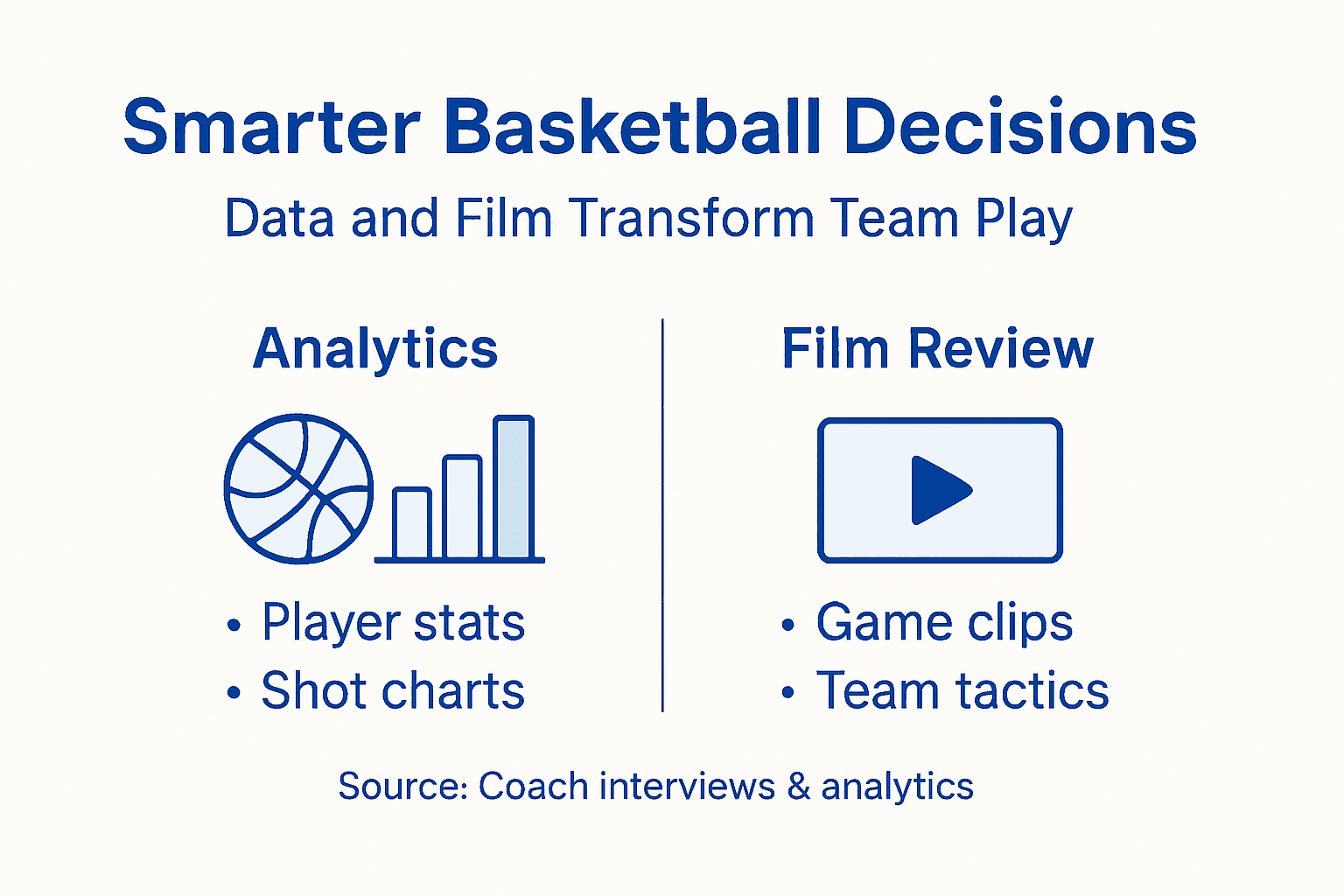
Film analysis represents another critical dimension of data-driven decision making. By meticulously reviewing game footage, coaches can dissect player movements, identify strategic vulnerabilities, and develop targeted improvement strategies. Decision Support Systems powered by machine learning algorithms augment this process, offering predictive models that help coaches anticipate opponent strategies and optimize team performance. These systems integrate multiple data points, including player physiological metrics, historical performance data, and real-time game statistics.
The true power of analytics lies in its ability to overcome human cognitive biases. Traditional coaching often relies on intuition and personal experience, which can be subjective and limited. By contrast, data-driven approaches provide objective, quantifiable insights that challenge preconceived notions and reveal hidden performance opportunities. Coaches can now make more informed decisions about player rotations, strategic adjustments, and individual skill development by leveraging comprehensive data analysis that goes far beyond surface-level observations.
Pro tip: Develop a systematic approach to analytics by creating standardized data collection protocols and investing time in understanding the specific metrics most relevant to your team’s performance.
Common Pitfalls and How to Avoid Them
Decision-making challenges are inherent in basketball, with players and coaches frequently encountering cognitive obstacles that can compromise team performance. Cognitive decision-making limitations emerge primarily from overreliance on intuition, failure to adapt quickly, and mental rigidity under competitive pressure. Understanding these pitfalls is the first step toward developing more robust strategic approaches that transcend individual biases and reactive thinking.
Time pressure represents a significant cognitive challenge that can dramatically reduce decision-making effectiveness. Stress management techniques become critical in helping players maintain focus and accuracy during high-intensity moments. Less experienced athletes are particularly vulnerable to performance degradation when confronted with complex, rapidly changing game scenarios. By implementing targeted training that simulates high-stress conditions, teams can systematically build psychological resilience and improve split-second decision-making capabilities.
Another common pitfall involves cognitive inflexibility, where players and coaches become locked into predetermined strategies without recognizing emerging game dynamics. This rigidity can manifest through predictable play patterns, resistance to adjusting tactics, and an inability to read opponent responses effectively. Successful teams cultivate a culture of adaptability, encouraging players to remain mentally agile, continuously reassess situational contexts, and make fluid, intelligent choices that exploit emerging opportunities. By developing a growth mindset that values learning and strategic flexibility, basketball teams can transform potential weaknesses into competitive advantages.
Below are common decision-making pitfalls in basketball and strategies to avoid them:
| Pitfall | Core Issue | Strategy to Overcome |
|---|---|---|
| Overreliance on Intuition | Misses objective analysis | Use data-driven reviews |
| Mental Rigidity | Fails to adapt to changes | Encourage flexible thinking |
| Stress-Induced Errors | Decreased cognitive control | Train under pressure conditions |
Pro tip: Create weekly review sessions that systematically analyze game footage, focusing on decision-making moments to identify patterns, learn from mistakes, and develop more nuanced strategic responses.
Elevate Your Team’s Decision Making with Proven Tools
Mastering decision making in basketball requires more than talent it demands structured training that sharpens cognitive skills under pressure. If you want to transform team play by improving real-time tactical responses and strategic thinking our expertly crafted Basketball Drills - Hoop Mentality provide targeted exercises designed to develop the exact cognitive and situational awareness highlighted in this article.

Don’t let your players struggle with split-second choices or mental rigidity any longer. Unlock their potential now by exploring our comprehensive Basketball Workouts - Hoop Mentality and organize your coaching with our ready-to-use Basketball Templates - Hoop Mentality. Visit Hoop Mentality today and start building the decision-making skills that win games and elevate your entire team’s performance.
Frequently Asked Questions
What is Decision Making Basketball?
Decision Making Basketball refers to the sophisticated cognitive processes athletes use to assess game scenarios and make strategic decisions during play. It emphasizes the importance of rapid information processing and effective decision-making skills, distinguishing elite players from novices.
How do coaches influence decision making during a basketball game?
Coaches influence decision making by designing offensive and defensive strategies, managing player rotations, and making real-time adjustments based on the game’s flow. Their decisions are crucial for shaping team dynamics and game outcomes.
What are common pitfalls in basketball decision making?
Common pitfalls include overreliance on intuition, mental rigidity, and stress-induced errors. Players might struggle to adapt to changing game conditions, leading to poor decisions. Developing flexibility and managing stress are key to overcoming these challenges.
How can players improve their decision-making skills?
Players can enhance their decision-making skills through systematic practice, including video analysis of game footage, simulation drills, and training under pressure. This helps them improve cognitive processing speed and situational awareness, enabling better on-court choices.