



Balancing offense and defense challenges even experienced coaches, especially when striving for team-wide consistency on the court. The push and pull between creating scoring opportunities and shutting down opponents demands more than instinct. When coaches emphasize comprehensive skill development rooted in strength, agility, and communication, players respond with adaptability and precision. This guide clarifies core concepts that will help you design practice plans where offensive and defensive strategies elevate each other, shaping athletes ready for complex competitive environments.
Table of Contents
- Offense Vs Defense: Core Concepts Explained
- Key Offensive Systems And Their Purposes
- Defensive Strategies And Player Responsibilities
- Balancing Offense And Defense In Practice
- Common Mistakes And Optimization Tactics
Key Takeaways
| Point | Details |
|---|---|
| Holistic Skill Development | Players must master both offensive and defensive skills to optimize performance and adaptability on the court. |
| Balanced Practice Approach | Incorporate both offensive and defensive drills in training to enhance overall team versatility and responsiveness. |
| Understanding Systems | Familiarity with various offensive systems allows teams to exploit defensive weaknesses while creating dynamic gameplay. |
| Error Recognition and Correction | Coaches should focus on identifying common technical and psychological mistakes to improve team performance and resilience. |
Offense vs Defense: Core Concepts Explained
Basketball is fundamentally a strategic dance between offensive and defensive play, where each team seeks to control the court’s momentum through calculated movements and skills. Offensive and defensive strategies represent two interconnected yet distinctly different approaches to achieving victory, requiring players to develop comprehensive athletic capabilities.
At its core, basketball demands players master both offensive and defensive skills, which are deeply intertwined. Core physical training impacts athletic performance across both sides of the court, enabling players to execute complex maneuvers with precision and efficiency. The most successful teams recognize that excellence isn’t about specializing in just offense or defense, but creating a holistic approach to the game.
Key distinctions between offensive and defensive play include:
-
Offensive Objectives:
- Score points through strategic shooting
- Create scoring opportunities
- Maintain ball possession
- Break through defensive formations
-
Defensive Objectives:
- Prevent opponent scoring
- Intercept passes
- Force turnovers
- Protect the team’s basket
Successful basketball performance requires players to seamlessly transition between offensive and defensive roles, demonstrating adaptability and comprehensive skill development. Coaches must train athletes to understand both perspectives, creating versatile players capable of reading the court’s dynamic landscape.
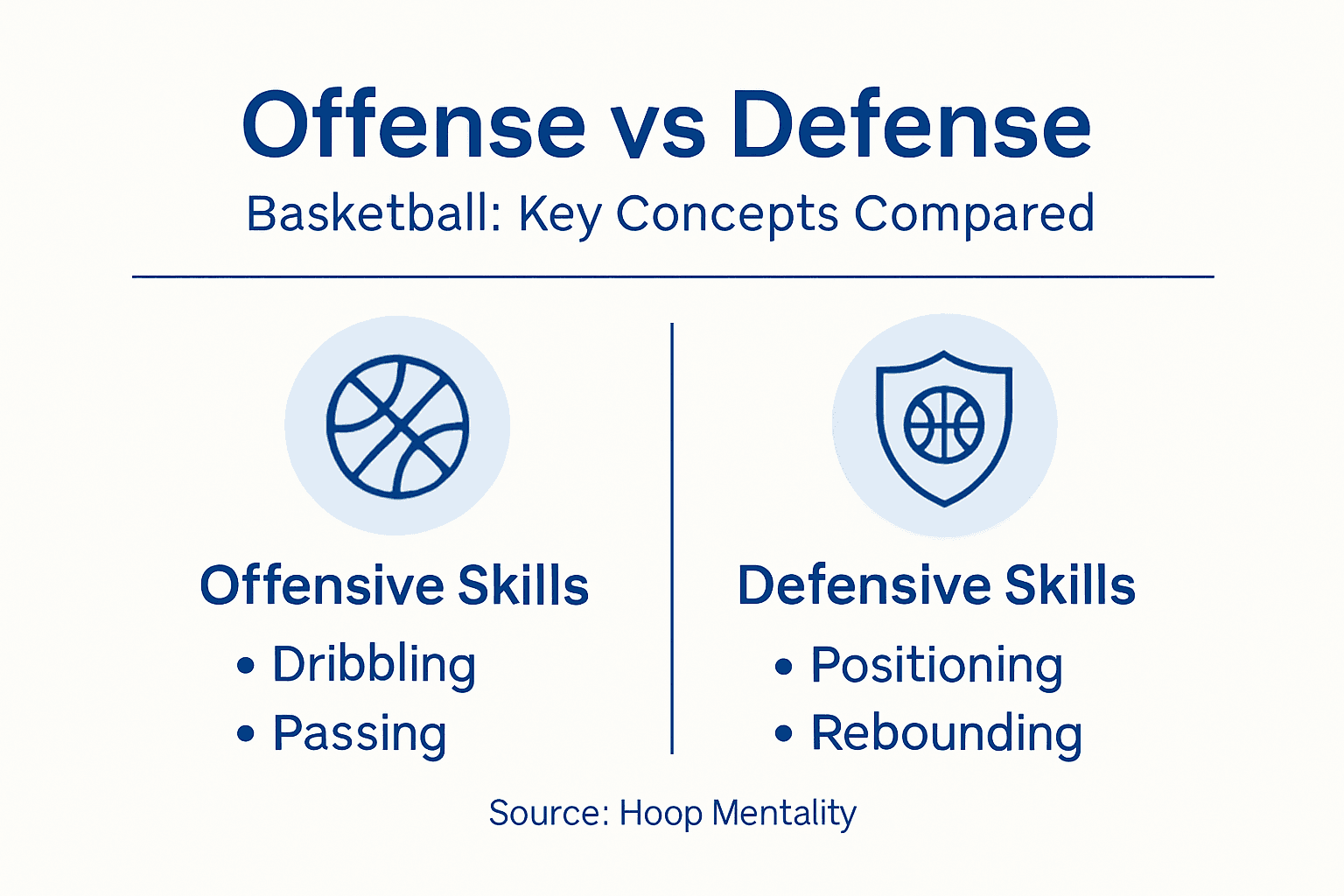
Here’s how offensive and defensive basketball approaches differ in focus and result:
| Aspect | Offense Perspective | Defense Perspective |
|---|---|---|
| Main Objective | Create scoring chances | Limit opponent’s attempts |
| Key Skill Emphasis | Ball movement and shooting | Positioning and anticipation |
| Desired Outcome | Points on scoreboard | Forced turnovers, stops |
| Player Mindset | Aggressive and creative | Reactive and disciplined |
Pro tip: Practice defensive and offensive drills in equal measure to develop a truly well-rounded basketball skill set.
Key Offensive Systems and Their Purposes
Basketball offense represents a complex strategic approach where teams design systematic plays to create scoring opportunities. Basketball offensive concepts provide coaches with multiple strategies to break through defensive formations and maximize team scoring potential.
The primary offensive systems in basketball include several key approaches that teams can deploy based on their strengths and player capabilities:
-
Man-to-Man Offense:
- Focuses on individual player matchups
- Emphasizes player movement and spacing
- Allows for complex screening strategies
- Enables quick decision-making
-
Continuity Offenses:
- Includes Flex, Swing, and Chin systems
- Creates repeatable passing and movement patterns
- Maintains constant offensive pressure
- Reduces predictability for defensive teams
-
Motion Offense:
- Promotes free-flowing player movement
- Requires high basketball IQ
- Adaptable to different defensive setups
- Emphasizes read-and-react gameplay
Each offensive system has unique advantages, and successful coaches understand how to integrate multiple approaches to exploit defensive weaknesses. The key is not just selecting a system, but teaching players to execute it with precision and adapt quickly to changing game dynamics.
Effective offensive systems transform individual talents into a cohesive team strategy, turning potential into points.
Understanding these systems allows teams to create dynamic, unpredictable offensive plays that keep opponents guessing and create multiple scoring opportunities.
Pro tip: Practice multiple offensive systems to develop team versatility and prevent defensive teams from anticipating your strategy.
Defensive Strategies and Player Responsibilities
Defensive success in basketball hinges on a complex interplay of individual skills and collective team strategies. Defensive variables critical to team performance reveal that effective defense is more than just blocking shots or preventing scoring - it’s about creating systematic pressure and disrupting opponent gameplay.
The primary defensive strategies require players to understand and execute multiple key responsibilities:
-
Individual Defensive Responsibilities:
- Maintain tight defensive positioning
- Communicate constantly with teammates
- Read offensive player movements
- Anticipate potential passing and scoring lanes
-
Team Defensive Techniques:
- Execute coordinated defensive switches
- Implement trap and zone defense strategies
- Support teammates during defensive rotations
- Create defensive pressure points
-
Defensive Performance Metrics:
- Track defensive rebounds
- Count steals and blocked shots
- Measure defensive engagement time
- Analyze opponent scoring limitations
Successful defense transforms individual defensive actions into a cohesive team strategy that disrupts opponent momentum.
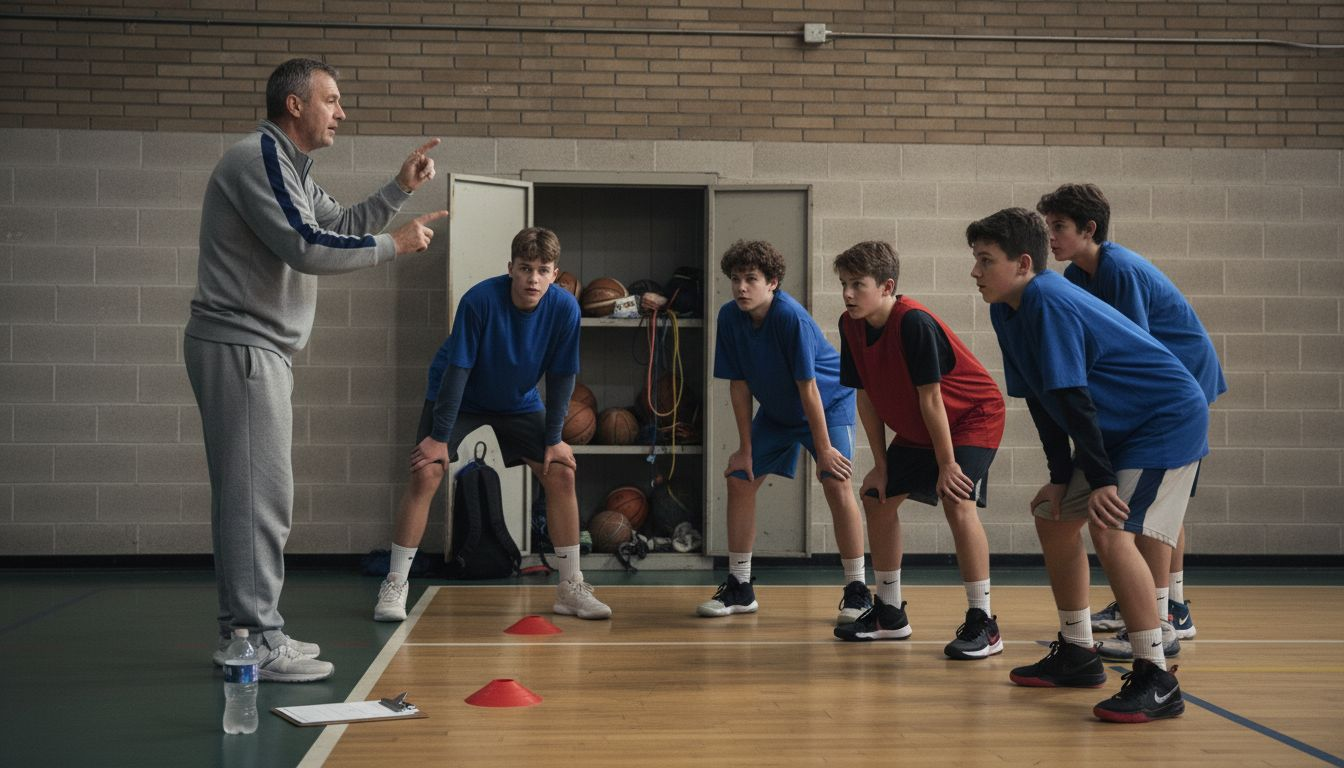
Defensive basketball strategies emphasize the importance of advanced communication and precise positioning. Players must develop a collective understanding that goes beyond individual skills, creating a unified defensive approach that anticipates and neutralizes offensive threats.
Pro tip: Practice defensive scenarios that simulate game-like pressure to improve team communication and adaptive defensive skills.
Balancing Offense and Defense in Practice
Balancing offense and defense requires a holistic approach to basketball training that develops comprehensive player skills and team dynamics. Essential basketball offense techniques demonstrate that players must cultivate abilities that seamlessly transition between attacking and defending strategies.
Successful practice sessions must incorporate structured approaches that develop both offensive and defensive capabilities:
-
Integrated Training Components:
- Alternate offensive and defensive drills
- Create scenario-based practice situations
- Develop cross-positional skill sets
- Emphasize adaptable player roles
-
Practice Structure Techniques:
- Design full-court transition exercises
- Implement competitive practice scenarios
- Use small-sided game situations
- Rotate player defensive and offensive responsibilities
-
Skill Development Strategies:
- Teach reading opponent movements
- Develop quick decision-making skills
- Practice communication during gameplay
- Build physical and mental resilience
Effective basketball training transforms individual skills into a cohesive team strategy that seamlessly transitions between offense and defense.
Coaches must recognize that true basketball excellence emerges from players who understand both offensive creativity and defensive discipline. This approach requires constant adaptation, strategic thinking, and a willingness to challenge players beyond their comfort zones.
Pro tip: Design practice sessions that deliberately blur the lines between offensive and defensive training to create more versatile, adaptive players.
Common Mistakes and Optimization Tactics
Basketball performance is dramatically impacted by systematic errors that can undermine both offensive and defensive effectiveness. Common basketball mistakes reveal critical areas where players and coaches can significantly improve team performance through targeted skill development and strategic awareness.
The most prevalent mistakes across offensive and defensive play include:
-
Offensive Technical Errors:
- Poor shooting mechanics
- Weak ball handling
- Predictable movement patterns
- Ineffective spacing between players
-
Defensive Technical Errors:
- Incorrect defensive stance
- Slow reaction times
- Inadequate communication
- Inconsistent positioning
-
Psychological Performance Limitations:
- Mental fatigue during gameplay
- Performance anxiety
- Lack of strategic adaptability
- Reduced decision-making speed
Recognizing and addressing mistakes is the first step toward transforming individual limitations into collective team strength.
Successful optimization requires a holistic approach that combines technical skill refinement, mental conditioning, and deliberate practice. Coaches must create training environments that systematically identify and correct mistakes while building player confidence and adaptive capabilities.
The table below highlights how common basketball mistakes impact game flow and offers brief solutions:
| Mistake Type | Typical Result | Quick Optimization Tactic |
|---|---|---|
| Technical | Lost possessions | Focused skill drills |
| Communication | Missed rotations | Dedicated verbal cue practice |
| Psychological | Poor decision-making | Stress simulation in training |
Pro tip: Record and analyze game footage to identify individual and team performance patterns that reveal hidden mistakes and opportunities for improvement.
Master Both Offense and Defense to Build Championship Teams
Are you struggling to balance offensive creativity with defensive discipline in your basketball program The article highlights the challenge of developing players who can seamlessly transition between aggressive offense and strategic defense while maintaining team cohesion. If you want to overcome common pitfalls like poor communication, inconsistent positioning, and predictable plays it is essential to adopt structured, proven coaching methods that develop versatile athletes and smart decision makers.
At Hoop Mentality we provide a wide range of professional resources to help you implement winning systems on both ends of the floor Our Basketball Playbooks - Hoop Mentality are meticulously designed to clarify offensive and defensive strategies so your team can execute with confidence and precision
 Explore our Basketball Drills - Hoop Mentality collection for drills that build skills like positioning anticipation and communication Our Basketball Guides – Hoop Mentality offer expert advice on balancing offense and defense in practice to elevate your coaching effectiveness Act now to bring clarity structure and measurable improvement to your team by visiting https://hoopmentality.com and start shaping your winning basketball culture today
Frequently Asked Questions
What are the main objectives of offensive play in basketball?
The main objectives of offensive play in basketball include scoring points through strategic shooting, creating scoring opportunities, maintaining ball possession, and breaking through defensive formations.
How do defensive strategies impact overall team performance in basketball?
Defensive strategies impact overall team performance by preventing opponent scoring, forcing turnovers, and creating systematic pressure, which disrupts the opponent’s gameplay and maintains control of the game.
What are some key components of effective offensive training for basketball players?
Key components of effective offensive training include practicing ball movement and shooting techniques, developing high basketball IQ for decision-making, and executing coordinated plays that adapt to various defensive setups.
Why is it important for basketball players to balance both offensive and defensive skills?
Balancing both offensive and defensive skills is crucial for basketball players because it allows them to seamlessly transition between roles during a game, enhances team dynamics, and creates versatile players who can read and react to the court’s changing strategies.
Recommended
- Why Run Offensive Sets: Building Structure and Success – Hoop Mentality
- 7 Essential Basketball Defense Tips for Coaches – Hoop Mentality
- 10 Essential Basketball Offense Techniques Every Player Should Master – Hoop Mentality
- How to Teach Your Players to Play Good Defense in Basketball – Hoop Mentality
- Leadership Development for Youth: Skills for Future Success - team I