



Every American youth basketball coach has watched promising possessions stall when players cluster together and the offense grinds to a halt. Effective team spacing is not just a buzzword but the key to unlocking scoring opportunities and keeping defenses on their heels. With research-backed concepts like precise geometric dispersion driving modern offensive success, this guide gives you practical approaches to develop smarter spacing, sharper player movement, and improved shot quality at every practice and game.
Table of Contents
- Defining Basketball Spacing Fundamentals
- Types of Spacing in Team Offenses
- How Spacing Impacts Offensive Success
- Implementing Spacing With Drills and Practice
- Common Spacing Mistakes to Avoid
Key Takeaways
| Point | Details |
|---|---|
| Effective Spacing | Player positioning and lane creation are vital for maximizing offensive opportunities and disrupting defenses. |
| Dynamic Adaptation | Teams must transition between spacing configurations based on defensive responses to maintain unpredictability. |
| Common Mistakes | Avoid clustering and static positioning to reduce defensive pressure and create more scoring chances. |
| Practice Techniques | Implement drills that enhance spatial awareness and court communication among players for better offensive execution. |
Defining Basketball Spacing Fundamentals
Basketball spacing represents the strategic positioning of players on the court to create optimal offensive opportunities and maximize team efficiency. Graph-theoretic spatial analysis reveals that effective spacing involves precise geometric dispersion among team members.
At its core, basketball spacing involves three critical elements:
- Player Positioning: Ensuring athletes are distributed strategically across offensive zones
- Lane Creation: Generating clear driving paths for ball handlers
- Passing Lanes: Establishing open channels for ball movement
The fundamental goal of spacing is disrupting defensive structures by spreading players across different court areas. This approach forces defenders to make challenging positioning decisions, creating potential scoring opportunities.
Successful basketball spacing requires players to maintain appropriate distances from each other, typically 15-18 feet apart. These strategic intervals prevent defensive congestion while enabling quick ball transfers and potential scoring actions.
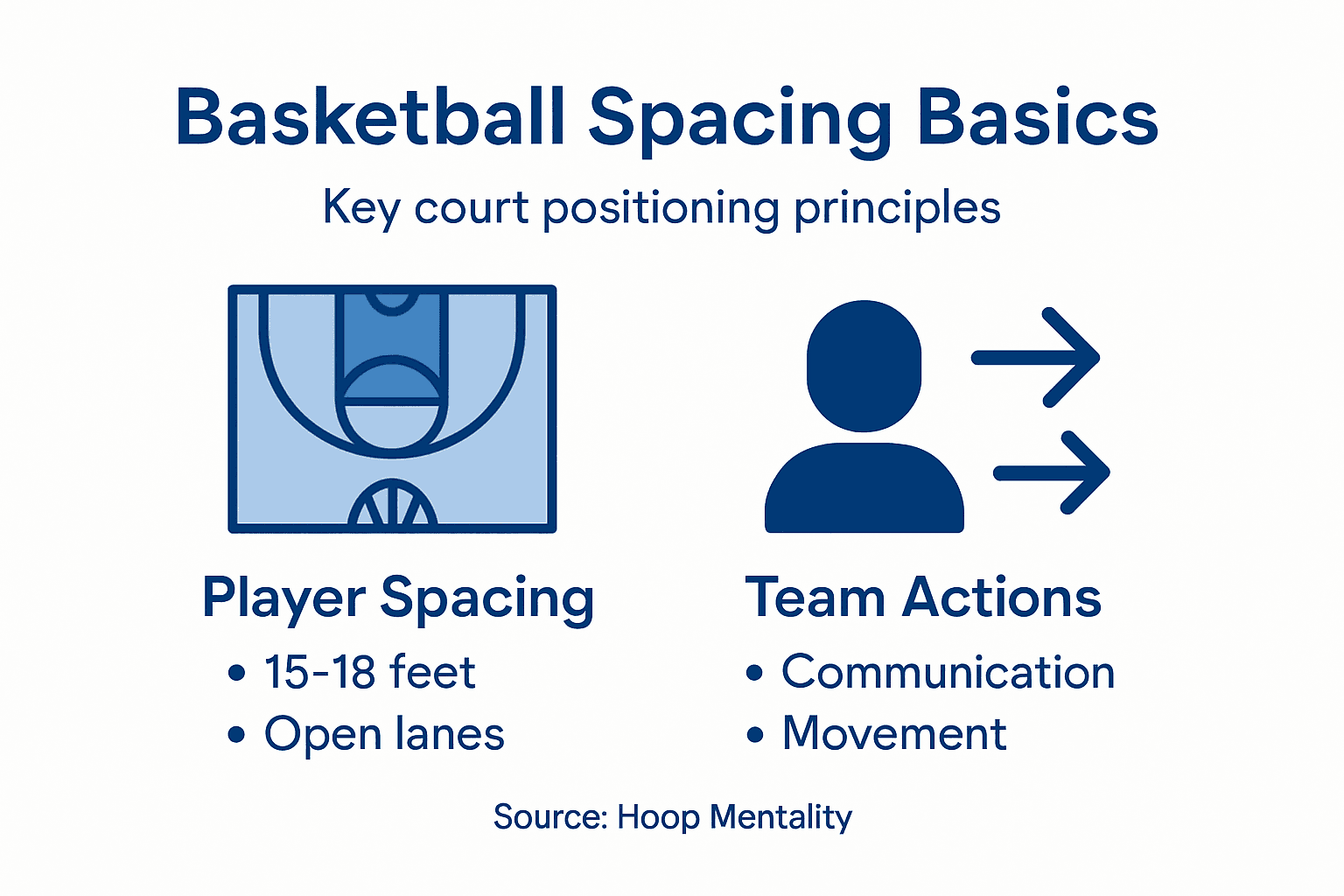
Pro tip: Practice spacing drills that emphasize player movement and positioning without basketball to develop muscle memory and court awareness.
Types of Spacing in Team Offenses
Team offenses utilize multiple spacing strategies to create competitive advantages on the basketball court. FIBA 3x3 World Tour research reveals distinct spacing configurations that can dramatically impact offensive performance.
Based on comprehensive analysis, basketball teams typically employ five primary spacing configurations:
- Pusher Spacing: Aggressive positioning that creates immediate driving lanes
- Shoulder Spacing: Balanced player distribution across offensive zones
- Corner Spacing: Strategic placement of players in corner areas to stretch defensive formations
- High Post Spacing: Utilizing center or power forward near free-throw line to create passing opportunities
- Spread Offense Spacing: Maximizing court width to create multiple scoring options
Each spacing type offers unique advantages depending on team composition, player skills, and defensive challenges. The Shoulder Spacing, for instance, provides a balanced approach that allows flexible ball movement and creates multiple scoring possibilities.
Here’s a quick comparison of basketball spacing types and their distinctive offensive advantages:
| Spacing Type | Main Benefit | Best Used When |
|---|---|---|
| Pusher Spacing | Opens direct driving lanes | Fast breaks or isolations |
| Shoulder Spacing | Enables balanced ball movement | Flexible set offenses |
| Corner Spacing | Stretches defense horizontally | Against zone defenses |
| High Post Spacing | Creates mid-range options | Facing shot-blockers |
| Spread Offense Spacing | Maximizes scoring possibilities | Late-game situations |
Successful teams adapt their spacing dynamically, transitioning between configurations based on defensive responses. This fluid approach prevents opponents from anticipating offensive strategies and maintains tactical unpredictability.
Pro tip: Practice transitioning between different spacing configurations during scrimmages to develop team adaptability and spatial awareness.
How Spacing Impacts Offensive Success
Offensive success in basketball fundamentally depends on strategic player positioning and court manipulation. Why Run Offensive Sets demonstrates that effective spacing creates multiple scoring opportunities by disrupting defensive structures.
Spacing directly influences offensive performance through several critical mechanisms:
- Defensive Pressure Reduction: Creating wider player distribution forces defenders to cover more ground
- Passing Lane Expansion: Wider spacing creates more open channels for ball movement
- Driving Lane Creation: Strategic positioning generates clear paths to the basket
- Shot Opportunity Multiplication: More space means more potential shooting angles
- Quick Decision Making: Reduced defensive congestion accelerates offensive reactions
The mathematical precision of spacing can transform an average offense into a scoring powerhouse. When players maintain optimal distances—typically 15-18 feet apart—they stretch defensive formations, creating vulnerabilities that skilled teams can systematically exploit.
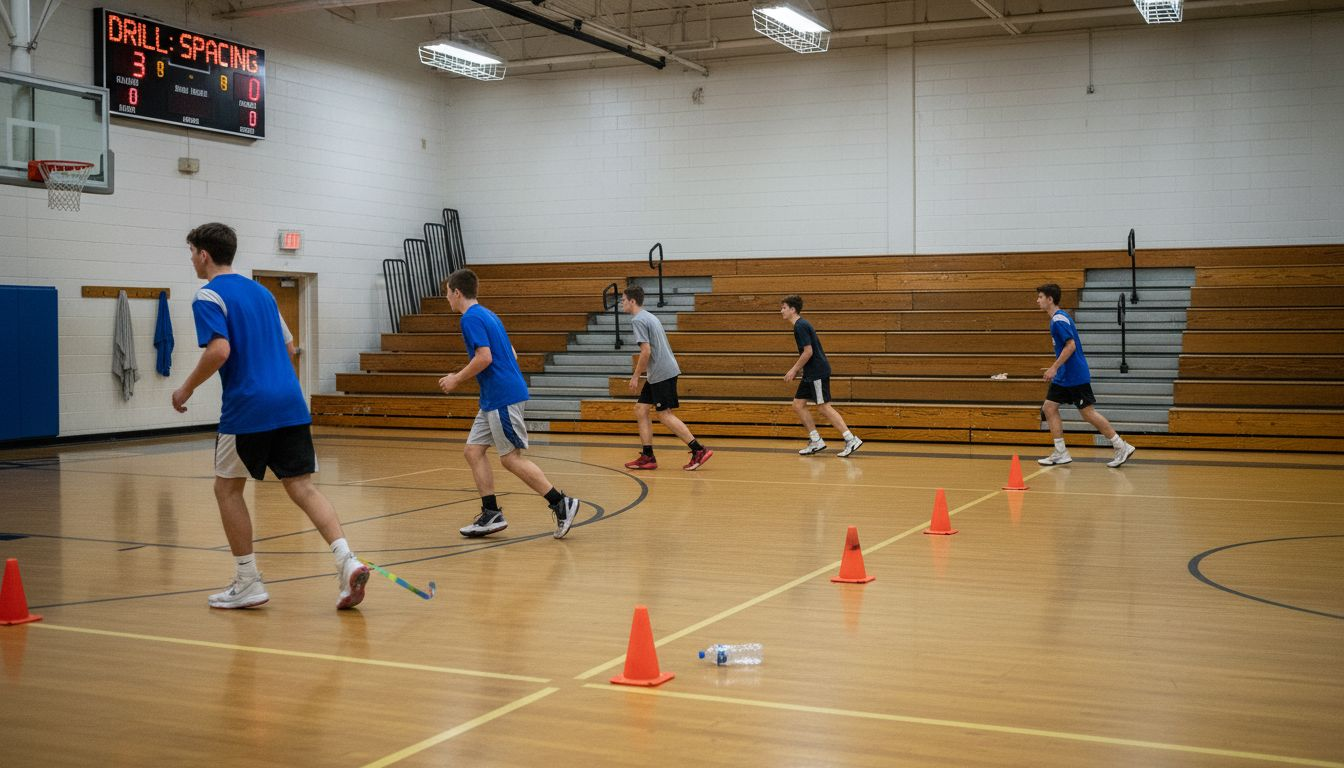
Successful teams understand that spacing is not static but a dynamic, constantly evolving strategy. Players must communicate, move purposefully, and adapt their positioning based on defensive responses, ball location, and teammate movements.
Pro tip: Develop team spacing awareness through blindfolded positioning drills that enhance players’ spatial intuition and court communication.
Implementing Spacing With Drills and Practice
Developing effective basketball spacing requires deliberate, structured practice approaches that train players to think and move strategically. Basketball Practice Structure emphasizes the importance of intentional drill design for skill development.
Coaches can implement spacing skills through several targeted practice techniques:
- Cone Positioning Drills: Use cones to mark ideal player locations and practice maintaining spatial relationships
- No-Dribble Scrimmages: Force players to move and communicate without ball handling
- Defensive Recognition Exercises: Train players to read and react to defensive formations
- Passing Lane Simulation: Create scenarios that emphasize creating and maintaining open passing channels
- Movement Without Ball Drills: Focus on off-ball positioning and continuous motion
Successful spacing training goes beyond physical positioning. Players must develop a collective court awareness that allows intuitive understanding of teammate locations and potential movement patterns. This requires mental mapping and continuous communication during practice scenarios.
Consistent repetition transforms spacing from a theoretical concept into muscle memory. Coaches should design progressively complex drills that challenge players to adapt their positioning dynamically, simulating game-like conditions with increasing difficulty.
Pro tip: Record practice spacing drills and review video with players to enhance spatial understanding and highlight unconscious positioning habits.
Common Spacing Mistakes to Avoid
Bad spacing can completely derail an offensive strategy, turning potential scoring opportunities into turnovers and defensive breakdowns. Complete Guide to Spacing highlights the critical nature of avoiding common positioning errors.
Coaches and players should be vigilant about these fundamental spacing mistakes:
- Clustering: Allowing multiple players to occupy the same court zone
- Static Positioning: Remaining stationary instead of maintaining constant movement
- Ignoring Defensive Pressure: Failing to adjust spacing based on defensive formations
- Predictable Patterns: Repeating the same movement sequences that become easy to anticipate
- Overcrowding the Paint: Blocking driving lanes by concentrating too many players near the basket
Effective spacing requires dynamic intelligence. Players must develop a sixth sense for court geography, constantly reading and responding to defensive alignments while maintaining optimal distances from teammates.
Here’s a summary of common basketball spacing mistakes and their game impact:
| Mistake | On-Court Result | How to Prevent |
|---|---|---|
| Clustering | Turnovers, lost scoring chances | Emphasize court awareness |
| Static Positioning | Predictable attacks | Continuous off-ball movement |
| Overcrowding the Paint | Blocked driving lanes | Maintain 15-18 ft spacing |
| Ignoring Pressure | Missed open opportunities | Read and adjust positions |
| Predictable Patterns | Easy defensive anticipation | Vary offensive sets |
Mental awareness is as crucial as physical positioning. Successful teams treat spacing like a fluid chess match, where each movement creates a chain reaction of strategic repositioning that keeps defenders constantly off-balance.
Pro tip: Practice peripheral vision drills that train players to simultaneously track ball movement and maintain awareness of teammate locations.
Elevate Your Team’s Spacing and Offensive Flow Today
Mastering basketball spacing is essential for creating open lanes and efficient ball movement. Challenges like clustering, static positioning, and tight defensive pressure can stall your team’s offense. This article highlights the importance of maintaining proper player distances and dynamic positioning to keep defenses off-balance and unlock scoring opportunities.
At Hoop Mentality, you can overcome these common spacing hurdles with resources designed to sharpen your team’s court awareness and movement. Explore our targeted Basketball Drills to build muscle memory and enhance off-ball motion. Use our proven Basketball Workouts to develop players’ endurance and decision-making under pressure. All tools come from real coaching experience and are crafted to help coaches bring clarity and structure to every practice and game plan.

Take control of your team’s offensive success by implementing effective spacing strategies now. Visit Hoop Mentality and start using practical, easy-to-follow resources that save you time and elevate your team’s performance.
Frequently Asked Questions
What is basketball spacing?
Basketball spacing refers to the strategic positioning of players on the court to create optimal offensive opportunities and maximize team efficiency. It involves maintaining appropriate distances between players to prevent defensive congestion and facilitate quick ball movement.
Why is spacing important in basketball offense?
Spacing is crucial in basketball offense as it creates driving lanes, expands passing opportunities, and reduces defensive pressure. Proper spacing allows for better shot opportunities and accelerates decision-making, enhancing overall team performance.
What are some common mistakes to avoid when spacing on the court?
Common spacing mistakes include clustering players in the same area, maintaining static positioning, ignoring defensive pressure, and overcrowding the paint. These errors can lead to turnovers and missed scoring chances.
How can coaches effectively implement spacing in practice?
Coaches can implement effective spacing through targeted drills such as cone positioning, no-dribble scrimmages, and passing lane simulations. These drills help players understand their positioning and improve court awareness, adapting to various defensive situations.